Abraham is one of the most important figures in the Bible and is often remembered as a great example of faith, trust, and obedience. His story appears mainly in the Book of Genesis, where readers learn how God called him to leave his homeland and travel to an unfamiliar place. Abraham followed this command even though he did not know exactly where the journey would lead.
Originally named Abram, he lived in Ur and later settled in Haran with members of his family. God promised that Abram would become the father of a great nation, receive a land for his descendants, and bring blessings to many people. These promises became central to his life, although their fulfillment sometimes seemed impossible. Abram and his wife, Sarai, were already elderly and had no children.
God later changed their names to Abraham and Sarah. The name Abraham reflected his future role as the father of many nations. After years of waiting, Sarah gave birth to their son Isaac. His birth demonstrated the importance of patience and showed that, according to the biblical account, God remained faithful to His promise.
Abraham’s life included moments of courage, generosity, doubt, and difficult decision-making. He rescued his nephew Lot after a conflict, welcomed unexpected visitors with hospitality, and pleaded for the people of Sodom. However, he also made mistakes when fear influenced his actions. These details make his story easier to understand because Abraham is presented as a real person who continued learning throughout his journey.
One of the most dramatic events in Abraham’s life occurred when God tested his faith by asking him to offer Isaac as a sacrifice. Abraham prepared to obey, but God stopped him and provided a ram instead. This story has inspired centuries of discussion about faith, obedience, trust, and divine provision.
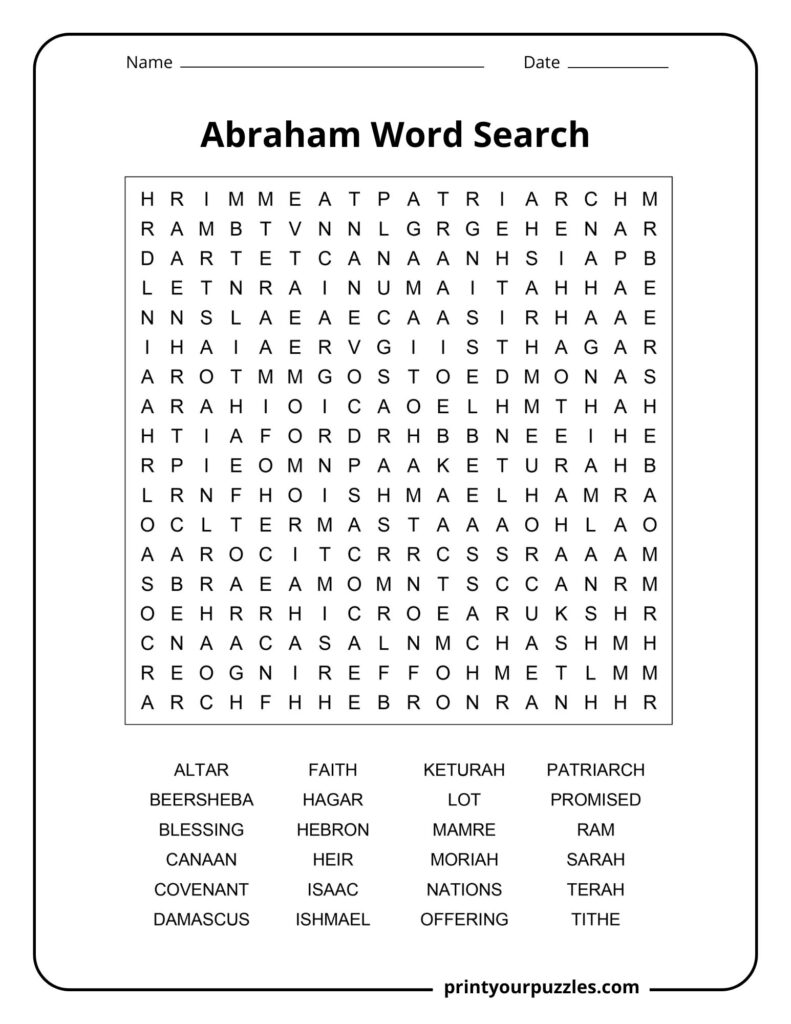
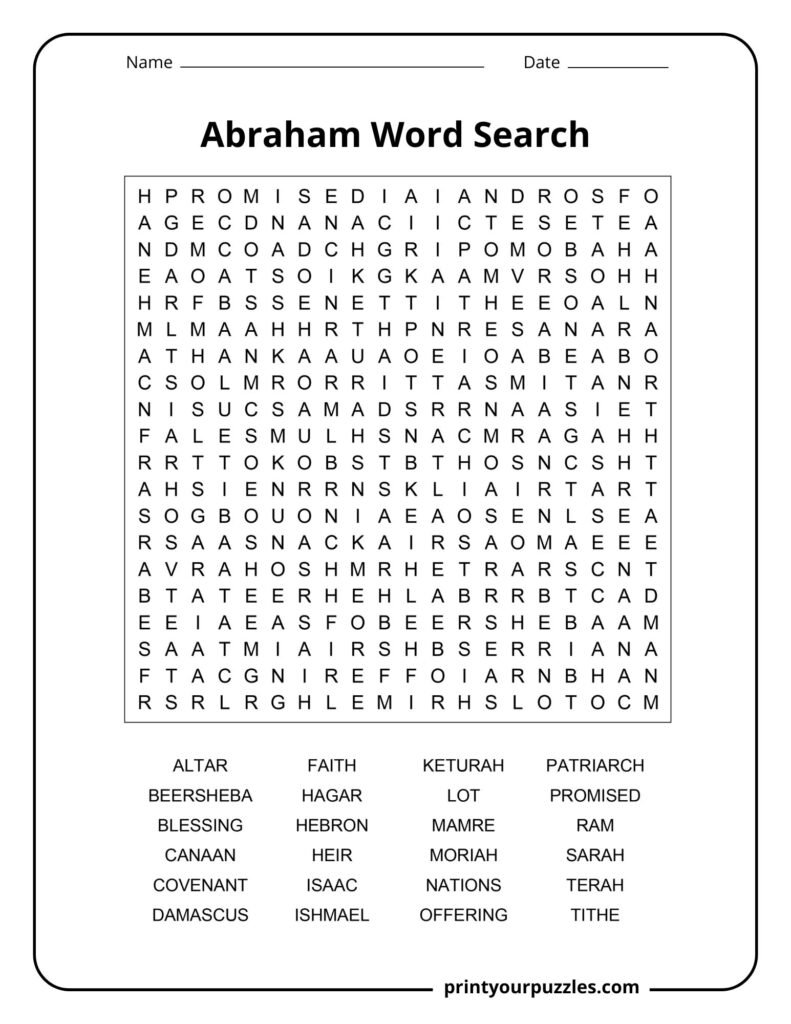
Abraham is respected in Judaism, Christianity, and Islam, making him a significant figure in the history of several major religions. An Abraham word search can introduce readers to important names, places, events, and ideas connected with his remarkable life. As you complete the puzzle, you can review the journey of a man whose faith influenced generations and whose story continues to be studied around the world.
Related Word Searches:
Isaac | Jacob | Genesis | Old Testament
ALTAR, BEERSHEBA, BLESSING, CANAAN, COVENANT, DAMASCUS, FAITH, HAGAR, HEBRON, HEIR, ISAAC, ISHMAEL, KETURAH, LOT, MAMRE, MORIAH, NATIONS, OFFERING, PATRIARCH, PROMISED, RAM, SARAH, TERAH, TITHE
ALTAR – A raised structure or flat surface used for making offerings and sacrifices to God. Abraham built altars at several locations in Canaan to worship and honor the Lord.
BEERSHEBA – A city in the southern region of Canaan where Abraham made a covenant with Abimelech. He planted a tamarisk tree there and called upon the name of the Lord.
BLESSING – A divine gift of favor, protection, and prosperity granted by God. Abraham received an extraordinary blessing, promising that all nations of the earth would be blessed through his descendants.
CANAAN – The land God promised to Abraham and his descendants as an eternal inheritance. Abraham traveled there from Haran, and it later became the homeland of the Israelite people.
COVENANT – A solemn, binding agreement between God and Abraham. God promised land, countless descendants, and a special relationship, sealing it with a formal ceremony involving sacrificial animals and a burning torch.
DAMASCUS – An ancient city mentioned in connection with Abraham’s servant Eliezer, who came from there. Abraham passed through the region during his journeys and had military encounters near its territory.
FAITH – Complete trust and confident belief in God without requiring visible proof. Abraham’s faith was legendary — he obeyed God’s commands unconditionally, and it was counted as righteousness before the Lord.
HAGAR – An Egyptian slave woman belonging to Sarah, Abraham’s wife. When Sarah remained childless, she gave Hagar to Abraham as a secondary wife, and Hagar became the mother of Ishmael.
HEBRON – A significant city in Canaan where Abraham settled and lived for many years. He purchased the cave of Machpelah nearby as a burial site for Sarah and later himself.
HEIR – A person who inherits property, title, or legacy. Abraham desperately longed for a legitimate heir until God miraculously fulfilled his promise through the birth of Isaac in his old age.
ISAAC – The son miraculously born to Abraham and Sarah in their extreme old age. His name means “laughter,” and he became the chosen heir through whom God’s covenant promises would continue.
ISHMAEL – Abraham’s firstborn son, born to the Egyptian servant Hagar. Though not the child of the covenant promise, God still blessed Ishmael, promising he would father twelve princes and a great nation.
KETURAH – A woman Abraham married after Sarah’s death. She bore him six sons — Zimran, Jokshan, Medan, Midian, Ishbak, and Shuah — expanding Abraham’s family and legacy in his later years.
LOT – Abraham’s nephew who traveled with him from Haran to Canaan. The two eventually separated due to conflict between their herdsmen, and Lot chose the fertile plains near the cities of Sodom and Gomorrah.
MAMRE – An ancient place near Hebron associated closely with Abraham’s life in Canaan. It was here, beneath the great trees of Mamre, that three mysterious visitors announced that Sarah would bear a son.
MORIAH – The mountain region where God commanded Abraham to sacrifice his son Isaac. At the critical moment, God provided a ram as a substitute, demonstrating both Abraham’s obedience and God’s faithful provision.
NATIONS – Multiple peoples and kingdoms across the earth. God promised Abraham he would become the father of many nations, a promise fulfilled spiritually through Judaism, Christianity, and Islam tracing ancestry to him.
OFFERING – A gift or sacrifice presented to God as an act of worship or devotion. Abraham made many offerings throughout his life, most notably when he prepared to offer his own son Isaac on the altar.
PATRIARCH – The founding father and leader of a family, tribe, or religious tradition. Abraham is revered as the supreme patriarch of the Hebrew people and the foundational ancestor of three major world religions.
PROMISED – Something declared and guaranteed by God with absolute certainty. The Promised Land was God’s guaranteed gift to Abraham and his descendants, a central theme throughout the entire Hebrew scriptural narrative.
RAM – A male sheep caught by its horns in a thicket on Mount Moriah. God provided this animal as a last-moment substitute sacrifice, sparing Isaac’s life and revealing himself as Jehovah-Jireh, the Provider.
SARAH – Abraham’s beloved wife and the mother of Isaac. Originally named Sarai, God changed her name to Sarah, meaning “princess,” and she miraculously conceived Isaac at the remarkable age of ninety years.
TERAH – Abraham’s father, who initiated the family’s migration from the city of Ur toward the land of Canaan. The journey stopped in Haran, where Terah settled and eventually died at two hundred and five years old.
TITHE – One tenth of one’s income or goods given as an offering. Abraham gave a tithe of all his war spoils to Melchizedek, the mysterious priest-king of Salem, in a historically significant act of worship.
ALTAR, BEERSHEBA, BLESSING, CANAAN, COVENANT, DAMASCUS, FAITH, HAGAR, HEBRON, HEIR, ISAAC, ISHMAEL, KETURAH, LOT, MAMRE, MORIAH, NATIONS, OFFERING, PATRIARCH, PROMISED, RAM, SARAH, TERAH, TITHE