
This 2026 World Cup word search brings one of the most anticipated sporting events in history directly to your fingertips. The FIFA World Cup 2026 will be hosted across three North American nations — the United States, Canada, and Mexico — making it the first tournament ever held simultaneously across three different countries. Scheduled to run from June 11 to July 19, 2026, the competition will feature an expanded field of 48 national teams competing across 104 matches, a significant leap from the traditional 32-team, 64-match format that fans have known for decades.
The tournament exists to celebrate the beautiful game, uniting nations and cultures through the universal language of soccer. Sixteen American cities, three Canadian cities, and three Mexican cities will welcome players, coaches, and millions of passionate supporters from around the world. The prestigious final will be held at MetLife Stadium in New Jersey, a venue capable of hosting over eighty thousand spectators.
This 2026 World Cup word search printable is designed for soccer fans of all ages, combining entertainment with education. Hidden within the grid are 24 carefully selected keywords that capture the spirit, rules, and excitement of the World Cup. Every word comes with a full definition, helping players expand their soccer vocabulary while enjoying the puzzle.
To make this word search printable even more enriching, we have included a FAQ section addressing the most common questions about the tournament, plus a fascinating Did You Know? section full of surprising facts — including the remarkable detail that Mexico will become the first nation ever to host the World Cup three times.
This 2026 World Cup word search is the perfect activity for classrooms, soccer clubs, family game nights, or anyone eager to celebrate the greatest sporting spectacle on earth.
We invite you to try solving our Stars of the 2026 World Cup word search, featuring 24 extraordinary players to discover. From Messi and Ronaldo to Haaland, Mbappé, and Lautaro.
This word search was created before the start of the 2026 World Cup, which Spain won by defeating Argentina in the final.
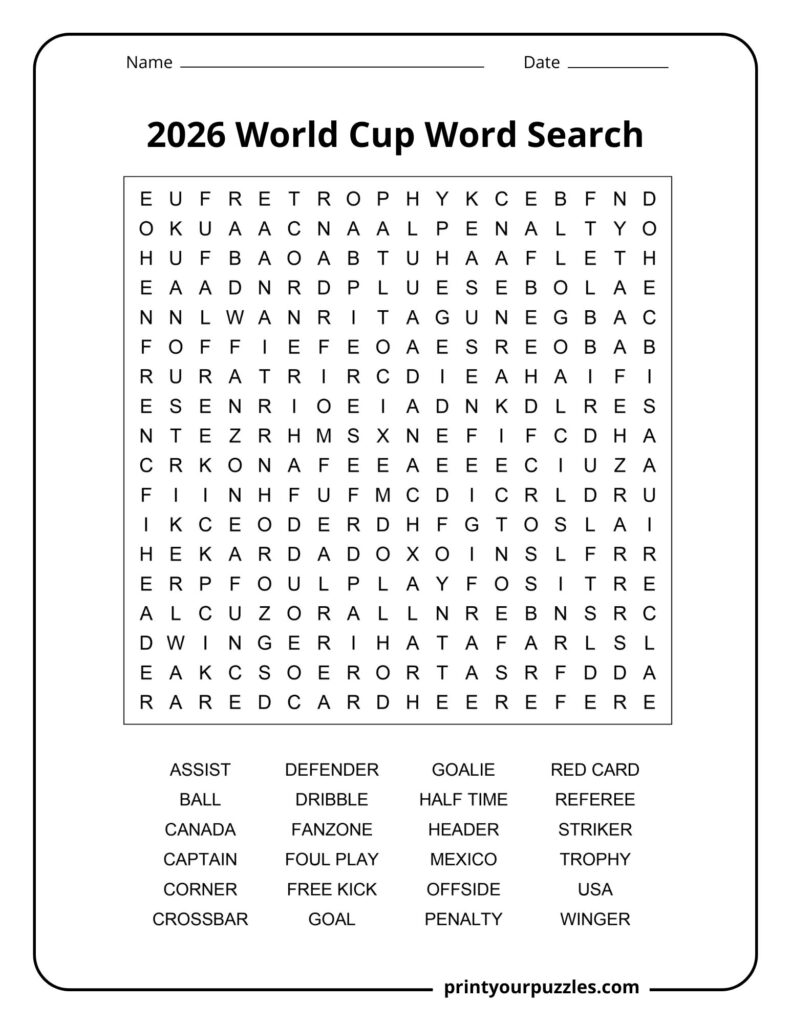
ASSIST, BALL, CANADA, CAPTAIN, CORNER, CROSSBAR, DEFENDER, DRIBBLE, FANZONE, FOUL PLAY, FREE KICK, GOAL, GOALIE, HALF TIME, HEADER, MEXICO, OFFSIDE, PENALTY, RED CARD, REFEREE, STRIKER, TROPHY, USA, WINGER
ASSIST – A pass or action by a player that directly leads to a teammate scoring a goal during a match. Statistics track assists as a key measure of a player’s creative contribution.
BALL – The spherical object used in soccer, kicked or headed by players to score goals throughout the game. Official World Cup balls are specially designed and tested for each tournament.
CANADA – North American country co-hosting the 2026 World Cup alongside the USA and Mexico for the first time. Canadian soccer has grown enormously in recent years.
CAPTAIN – The designated team leader who wears the armband, communicates with the referee, and motivates teammates during matches. Only the captain may formally address the referee during disputes.
CORNER – A set piece awarded when the ball crosses the goal line last touched by a defending player. Corners are dangerous scoring opportunities, especially for tall teams.
CROSSBAR – The horizontal bar connecting the two goalposts at the top of the goal frame, eight feet high. Shots striking the crossbar and staying out are agonizing near-misses.
DEFENDER – A player positioned to protect their team’s goal, blocking opposing attackers and clearing the ball from danger. Modern defenders are also expected to contribute to attacking play.
DRIBBLE – The skill of moving the ball forward using short, controlled touches while maintaining possession past opposing defenders. Great dribblers like Messi have redefined what is possible in soccer.
FANZONE – A designated public area where supporters gather to watch matches on screens, celebrate, and enjoy the tournament atmosphere. The 2026 World Cup fanzones will span three different countries simultaneously.
FOUL PLAY – Illegal or unsporting actions by a player that violate the rules and result in a free kick. Repeated foul play can lead to yellow or red cards.
FREE KICK – A restart awarded to a team after the opponent commits a foul, taken from the spot of infringement. Specialists can curve free kicks powerfully around defensive walls.
GOAL – The moment the ball fully crosses the opposing team’s goal line, counting as one point on the scoreboard. Goal-line technology ensures no valid goal is ever wrongly disallowed.
GOALIE – The goalkeeper, the only player allowed to use their hands within the penalty area to stop shots. A brilliant goalie can single-handedly carry a team to victory.
HALF TIME – The fifteen-minute break between the two forty-five-minute periods of a standard regulation soccer match. Coaches deliver crucial tactical instructions to players in the dressing room.
HEADER – A technique where a player uses their forehead to direct, pass, or shoot the ball during play. Perfectly timed headers from corners have decided many World Cup matches.
MEXICO – North American nation and co-host of the 2026 FIFA World Cup, having also hosted in 1970 and 1986. Mexico will become the first country to host three FIFA World Cups.
OFFSIDE – A rule violation when an attacking player is closer to the opponent’s goal line than the last defender. VAR technology now reviews tight offside calls with remarkable precision.
PENALTY – A direct free kick taken from the penalty spot, awarded when a foul occurs inside the penalty area. Penalty shootouts remain the most nerve-wracking way to decide knockout matches.
RED CARD – A disciplinary sanction shown by the referee that results in the immediate expulsion of a player from the match. The penalized team must continue the game with ten players.
REFEREE – The official responsible for enforcing the rules, making decisions, and maintaining fair play throughout the entire match. World Cup referees undergo rigorous international training and strict selection processes.
STRIKER – An attacking player positioned closest to the opponent’s goal, primarily responsible for scoring goals during the match. The top scorer receives the prestigious Golden Boot award at tournaments.
TROPHY – The FIFA World Cup golden trophy awarded to the winning nation, one of sport’s most prestigious prizes. The current trophy design has been used since the 1974 West Germany tournament.
USA – The United States of America, primary host nation of the 2026 FIFA World Cup, staging the most matches. Sixteen American cities will host games across the entire tournament.
WINGER – An attacking player operating along the flanks who delivers crosses and creates scoring opportunities for teammates. Explosive pace and precise crossing ability are essential qualities for world-class wingers.
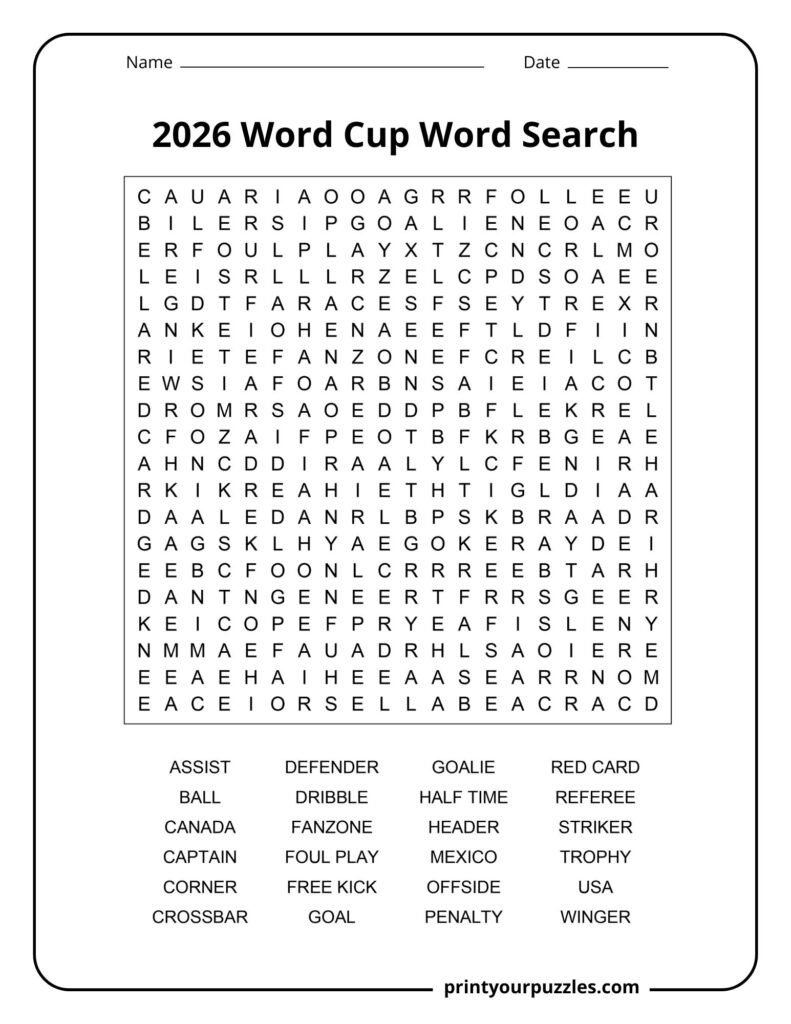
ASSIST, BALL, CANADA, CAPTAIN, CORNER, CROSSBAR, DEFENDER, DRIBBLE, FANZONE, FOUL PLAY, FREE KICK, GOAL, GOALIE, HALF TIME, HEADER, MEXICO, OFFSIDE, PENALTY, RED CARD, REFEREE, STRIKER, TROPHY, USA, WINGER
The 2026 World Cup will be co-hosted by three North American nations: the United States, Canada, and Mexico, spanning sixteen American, three Canadian, and three Mexican cities.
For the first time in history, 48 national teams will compete, expanded from the previous 32-team format, giving more nations a chance to participate globally.
The tournament is scheduled to run from June 11 to July 19, 2026, making it one of the longest World Cup tournaments ever held.
The MetLife Stadium in East Rutherford, New Jersey, near New York City, will host the prestigious 2026 World Cup Final, with a capacity exceeding eighty thousand spectators.
The expanded format introduces a group stage of twelve groups of four teams, with the top two and eight best third-placed teams advancing to a new round of thirty-two.
Three recommended books about the history of the World Cup:
. The Official History of the FIFA World Cup by FIFA Museum. Now in its third edition, this authoritative account covers every aspect of football’s flagship competition, complete with captivating photography and rare memorabilia from the FIFA Museum, including the full story of Qatar 2022. It is the only FIFA-endorsed chronicle of every tournament since 1930, making it the most complete and trustworthy reference for understanding how the World Cup shaped global football culture.
. World Cup! History, Politics, and Art of the Beautiful Game by Vernon Press. A highly engaging anthology offering an interdisciplinary and global perspective on the FIFA World Cup, spanning from the inaugural 1930 tournament in Uruguay to the politically charged 1978 edition in Argentina and the controversial Qatar 2022. It goes beyond goals and trophies, revealing how World Cups reflect politics, culture, and identity — essential reading for anyone who wants to understand football’s deeper impact on the world.
. The FIFA World Cup: A History of the Planet’s Biggest Sporting Event by Clemente A. Lisi. Veteran soccer reporter Lisi chronicles the tournament from 1930 to today, offering vivid accounts of individual games, biographical sketches of greats like Pelé, Maradona, and Messi, plus objective coverage of off-field controversies such as the FIFA corruption case.
No previous World Cup has spanned three nations at once, making this tournament uniquely historic in FIFA’s nearly century-long history of organizing the competition.
The expansion from 32 to 48 teams dramatically increases the number of games played, giving fans significantly more soccer action to enjoy throughout the tournament.
Having previously hosted in 1970 and 1986, Mexico’s 2026 participation as co-host gives it an unmatched and historic hosting record among all FIFA member nations.
With 48 competing nations and growing global soccer popularity, broadcast projections suggest viewership could shatter all previous records, potentially reaching over six billion worldwide viewers.
Though Canada co-hosted the 1994 qualifying rounds, the 2026 tournament marks the country’s true debut as an official FIFA World Cup host nation.