Pelé is remembered as one of the greatest and most influential footballers in the history of the sport. Born Edson Arantes do Nascimento in Três Corações, Brazil, in 1940, he grew up in a modest family and learned to play football from an early age. His extraordinary technique, movement, finishing, and understanding of the game soon made him stand out, and as a teenager he joined Santos, the club that would define most of his career.
Pelé became a first-team star remarkably quickly. With Santos, he won numerous Brazilian and international trophies and helped turn the club into one of the most famous teams in world football. His goalscoring ability was exceptional, but he was much more than a traditional striker. Pelé could create chances, dribble past defenders, head the ball powerfully, combine with teammates, and score with either foot.
His international career made him a global icon. Pelé was only 17 when he played for Brazil at the 1958 FIFA World Cup in Sweden. He scored six goals during the tournament, including a hat-trick in the semifinal and two goals in the final, helping Brazil win its first World Cup. He was also part of the Brazilian teams that won the tournament in 1962 and 1970, making him the only player in history to win three men’s World Cups.
The 1970 tournament in Mexico became one of the defining moments of his career. Playing in a brilliant Brazil team, Pelé combined individual skill with intelligent passing and teamwork. Brazil defeated Italy in the final, and the team is still widely remembered as one of the finest ever assembled.
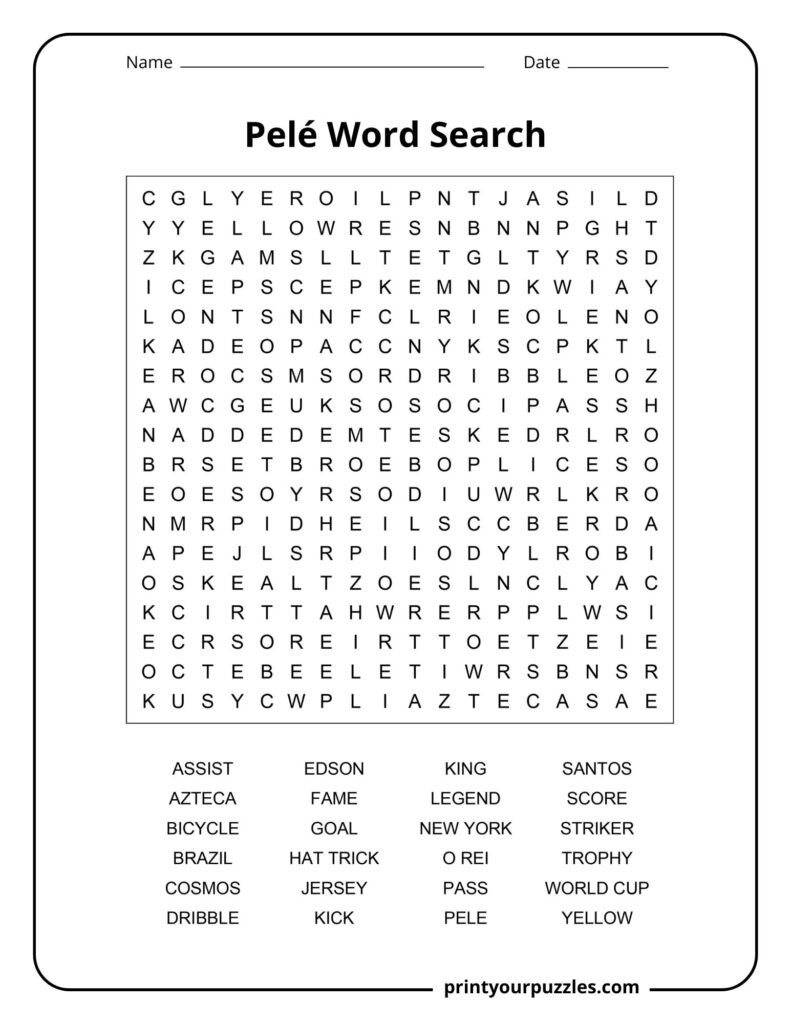
Later in his career, Pelé moved to the New York Cosmos, helping to raise the profile of football in the United States. A printable Pele word search puzzle can connect readers with Brazil, Santos, World Cups, famous stadiums, teammates, skills, trophies, and other important parts of his remarkable story.
Pelé died in 2022, but his influence remains enormous. Alongside other legendary figures such as Diego Armando Maradona, he is frequently included in debates about the greatest footballer of all time. Beyond his records and titles, Pelé helped make football a truly global spectacle. His creativity, athleticism, joy of play, and international success turned him into a symbol of the sport and ensured that his name would remain part of football history for generations.
ASSIST, AZTECA, BICYCLE, BRAZIL, COSMOS, DRIBBLE, EDSON, FAME, GOAL, HAT TRICK, JERSEY, KICK, KING, LEGEND, NEW YORK, O REI, PASS, PELE, SANTOS, SCORE, STRIKER, TROPHY, WORLD CUP, YELLOW
ASSIST – A pass or action by a player that directly leads to a teammate scoring a goal, officially credited as a statistical contribution in soccer matches.
AZTECA – The iconic stadium located in Mexico City where Pelé played his final World Cup match in 1970, lifting his third and most celebrated FIFA World Cup trophy.
BICYCLE – The spectacular acrobatic kick where a player strikes the ball overhead while airborne, which became one of Pelé’s most iconic and visually breathtaking personal signatures.
BRAZIL – South American country and Pelé’s homeland, renowned worldwide for its passionate soccer culture, samba style of play, and record five FIFA World Cup titles.
COSMOS – The New York Cosmos was the American professional soccer club where Pelé played from 1975 to 1977, helping to popularize the sport across the United States.
DRIBBLE – The skill of moving the ball forward while maintaining close control using the feet, allowing a player to advance past opposing defenders during a match.
EDSON – Pelé’s real birth name, Edson Arantes do Nascimento, given in honor of Thomas Edison, the famous American inventor, by his father Dondinho, also a footballer.
FAME – The worldwide recognition and celebrity status Pelé achieved throughout his extraordinary career, becoming one of the most recognized and celebrated athletes in all of human history.
GOAL – The fundamental scoring unit in soccer, achieved when the ball completely crosses the opponent’s goal line, with Pelé scoring over a thousand throughout his legendary career.
HAT TRICK – When a single player scores three goals in one match, a remarkable individual achievement that Pelé accomplished numerous times throughout his extraordinary professional playing career.
JERSEY – The numbered shirt worn by soccer players during matches, representing their team and identity on the field, with Pelé famously wearing the iconic number ten.
KICK – The fundamental action in soccer of striking the ball with the foot, a skill Pelé mastered with extraordinary precision, power, and creativity throughout his entire career.
KING – A title of supreme authority and excellence, widely used to describe Pelé’s unmatched dominance and influence over the sport of soccer throughout his legendary career.
LEGEND – A person whose extraordinary achievements and lasting impact transcend their era, with Pelé universally regarded as the greatest soccer legend the world has ever witnessed.
NEW YORK – The American city where Pelé played for the Cosmos, helping transform soccer into a mainstream sport in the United States during the mid-nineteen seventies era.
O REI – Portuguese phrase meaning “The King,” the most iconic and celebrated nickname given to Pelé, reflecting his absolute supremacy and unrivaled greatness in world soccer history.
PASS – The deliberate transfer of the ball from one teammate to another, a fundamental soccer skill that Pelé executed with remarkable vision, timing, and pinpoint accuracy.
PELE – The globally recognized nickname of Edson Arantes do Nascimento, the Brazilian soccer genius widely considered the greatest player in the history of the beautiful game.
SANTOS – The Brazilian soccer club based in São Paulo state where Pelé spent the majority of his legendary career, winning numerous national and international titles together.
SCORE – To successfully put the ball into the opponent’s net, counting as a goal, something Pelé did over one thousand times across his entire extraordinary professional career.
STRIKER – A forward-positioned player whose primary role is scoring goals, the position Pelé mastered with unparalleled instinct, athleticism, creativity, and finishing ability throughout his career.
TROPHY – A physical award presented to winners of competitions and tournaments, with Pelé lifting countless trophies throughout his career including three FIFA World Cup winners medals.
WORLD CUP – FIFA’s premier international soccer tournament held every four years, which Pelé won three times with Brazil in 1958, 1962, and 1970, an unmatched achievement.
YELLOW – The iconic color of the Brazilian national team jersey, proudly worn by Pelé throughout his international career, becoming a globally recognized symbol of soccer excellence.
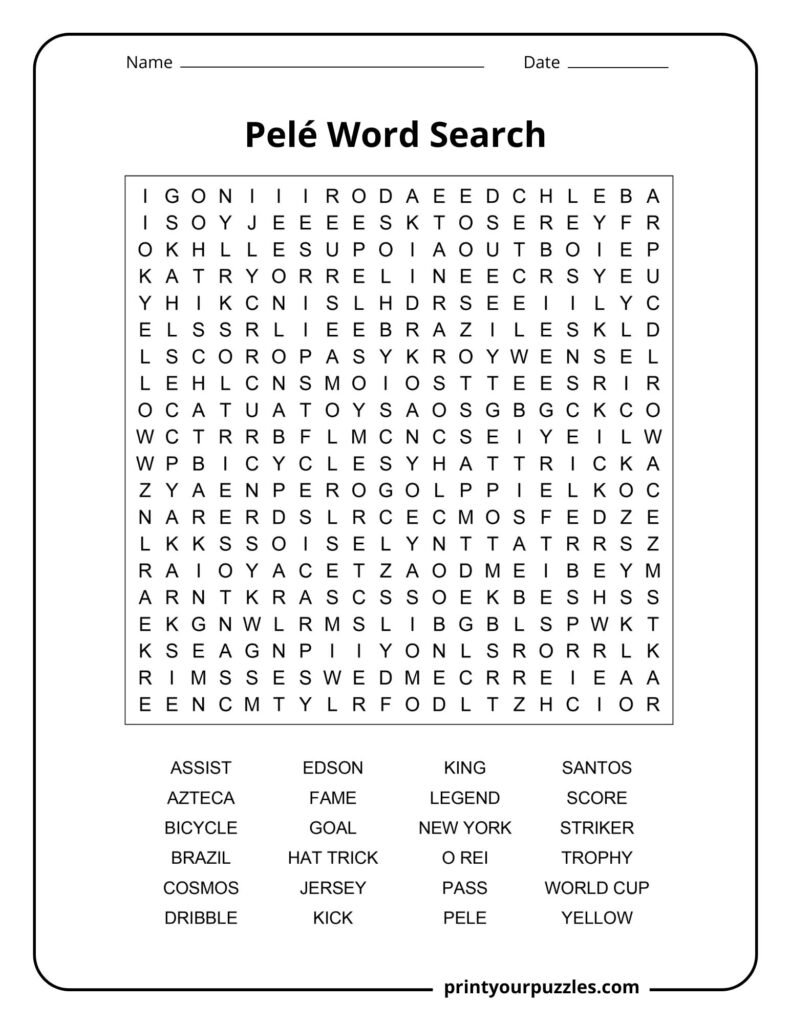
ASSIST, AZTECA, BICYCLE, BRAZIL, COSMOS, DRIBBLE, EDSON, FAME, GOAL, HAT TRICK, JERSEY, KICK, KING, LEGEND, NEW YORK, O REI, PASS, PELE, SANTOS, SCORE, STRIKER, TROPHY, WORLD CUP, YELLOW