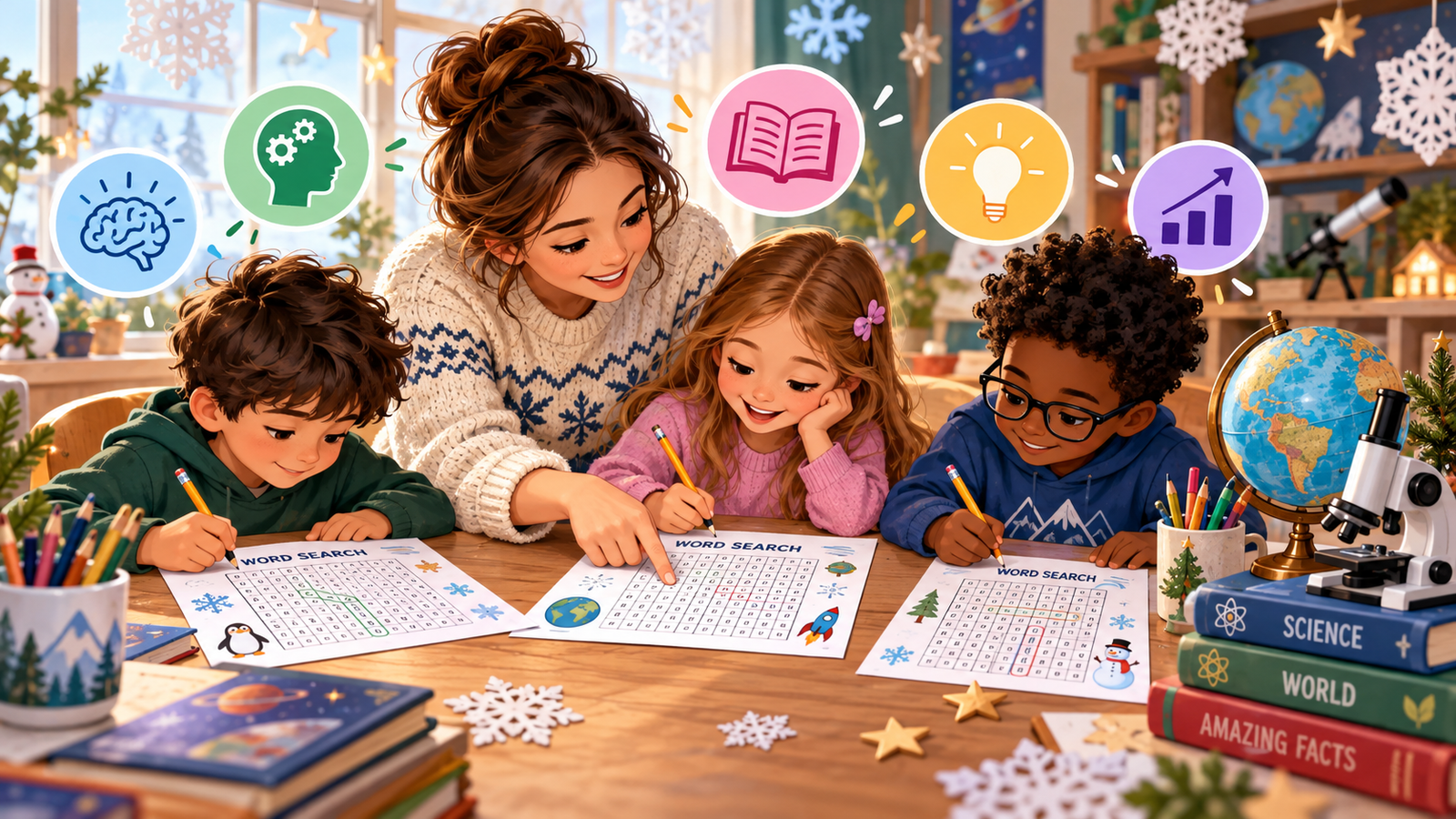
Children learn in many different ways, and some of their most valuable learning experiences happen when they are having fun. Brain games, word searches, crosswords, memory activities, and other puzzles offer opportunities to practice important thinking skills while enjoying an engaging challenge. These activities can complement classroom lessons and encourage children to approach learning with curiosity and confidence.
Brain games and word puzzles for combine entertainment with opportunities to practice concentration, language, visual recognition, and problem-solving. When children search for hidden words, recognize patterns, remember instructions, or experiment with possible answers, they use mental processes that also play important roles in everyday learning.
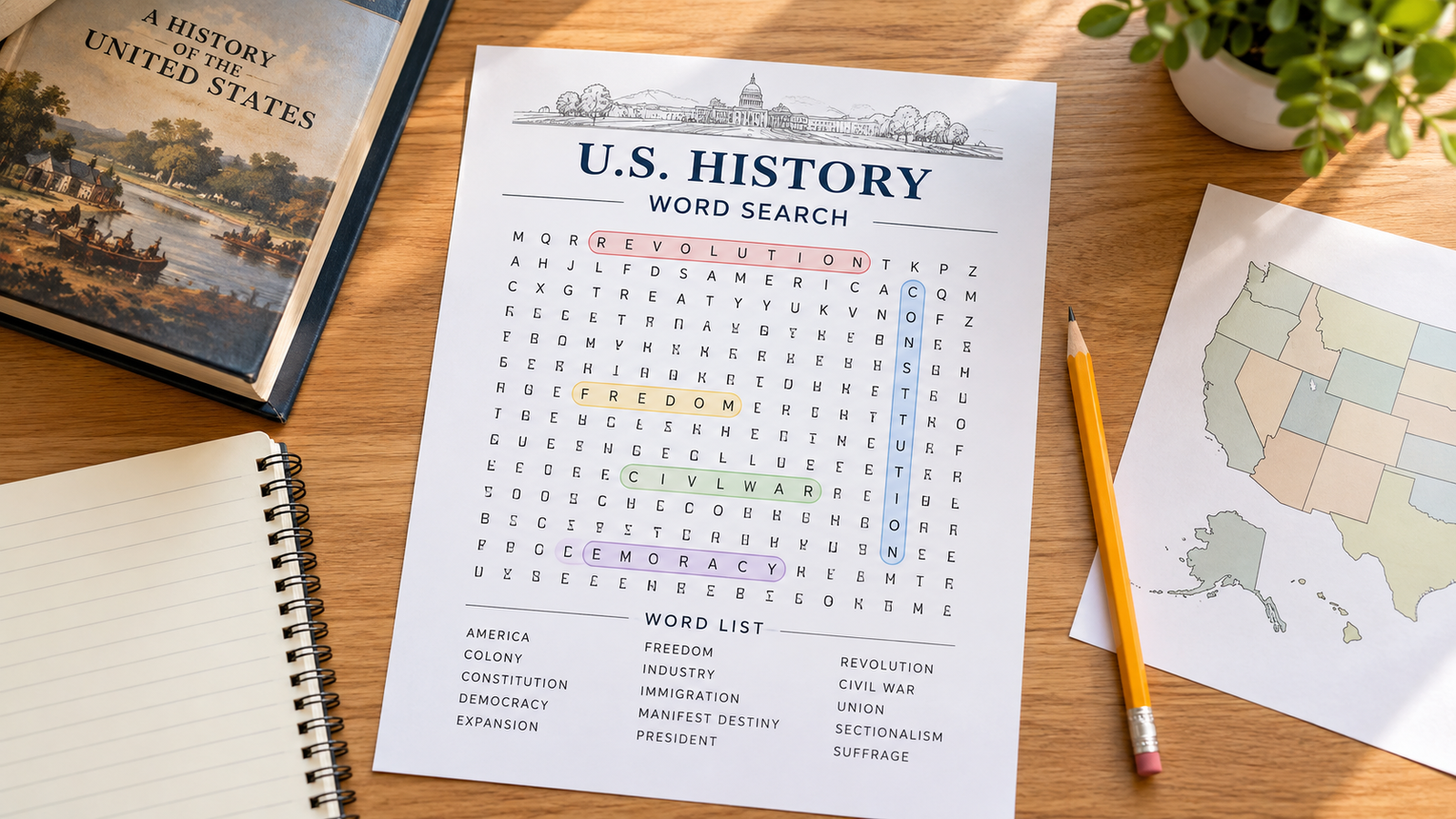
Printable word searches are especially convenient because they require few materials, can be adapted to different ages, and work well at home or in school. Educational themes make them even more useful by introducing vocabulary connected to subjects children are studying.
Understanding how puzzles support cognitive development can help parents and teachers make these simple activities a meaningful part of children’s learning experiences.
1. Understanding Cognitive Development in Children
Cognitive development refers to the growth of mental abilities that help children understand information, acquire knowledge, solve problems, and interact with the world.
These abilities include memory, attention, language comprehension, reasoning, and executive functions. Executive functions are mental processes involved in planning, organizing information, controlling impulses, and adjusting behavior when circumstances change.
During childhood, these skills develop through a combination of biological maturation, education, social interaction, and everyday experiences.
Puzzles provide opportunities to practice several cognitive processes simultaneously. For example, a child completing a word search must remember the target word, examine rows and columns, recognize letter combinations, and decide where to search next.
However, practicing puzzles does not automatically produce broad improvements in intelligence or academic achievement. Their greatest educational value often comes from combining enjoyable mental activity with relevant knowledge, discussion, and appropriately challenging tasks.
2. Improving Attention and Concentration
Concentration is important for reading, listening, following classroom instructions, and completing assignments.
Word searches encourage children to focus on a specific objective while ignoring unrelated letters. Finding a hidden word requires careful visual scanning, attention to spelling, and persistence when the answer is not immediately visible.
This process provides practice in sustaining attention during a defined activity.
Teachers can introduce puzzles as short classroom warm-ups, independent activities, or quiet transitions between lessons. Parents can also offer them during relaxed moments at home.
A child who initially searches for only a few minutes may gradually become more comfortable completing longer activities.
The goal should not be to force concentration for extended periods, but to make focused attention enjoyable and achievable.
3. Practicing Memory and Information Recognition
Memory plays an important role in learning vocabulary, remembering instructions, and connecting new knowledge with previous experiences.
Different puzzles engage memory in different ways. Matching games require children to remember locations, while crosswords encourage them to retrieve words and facts.
Word searches involve holding a target word in mind while looking for its letters across a grid. Children may also recognize familiar vocabulary from previous lessons.
For example, after learning about planets, a student might encounter Mars, Saturn, Orbit, and Comet in a science puzzle.
Recognizing those terms can provide another opportunity to revisit classroom knowledge.
Teachers can strengthen this connection by asking children to explain selected words after completing the activity.
Finding Saturn becomes more meaningful when the student can also identify it as a planet famous for its prominent rings.
4. Expanding Vocabulary and Language Skills
Vocabulary development is essential for reading comprehension, writing, and communication.
Word puzzles introduce children to unfamiliar terms while reinforcing the spelling and appearance of words they already know.
Repeated exposure can make words more recognizable, particularly when puzzles are connected to lessons, books, or classroom discussions.
For example, science-related activities might include vocabulary such as Habitat, Energy, Atom, Gravity, and Ecosystem.
Children encounter these terms visually while searching the grid. Reading their definitions afterward helps connect spelling with meaning.
At Print Your Puzzles, families and educators can explore Science Word Searches covering subjects such as biology, astronomy, chemistry, and the natural world.
A useful teaching strategy is to choose five unfamiliar puzzle words, discuss their meanings, and invite students to write a sentence using each one.
This turns an enjoyable word-finding activity into a broader language-learning exercise.
5. Encouraging Problem-Solving and Flexible Thinking
Problem-solving involves identifying a challenge, considering possible approaches, and evaluating results.
Different brain games offer different types of problem-solving practice. Logic puzzles encourage deduction, number puzzles involve mathematical reasoning, and word searches require systematic visual strategies.
A child might begin searching randomly before discovering that checking the first letter of each word is more efficient.
Other strategies include examining diagonals, looking for unusual letter combinations, or searching backward.
These adjustments encourage children to think about how they approach a task.
Parents and teachers can support this process by asking questions such as, “What strategy helped you find that word?” or “What could you try differently next time?”
The objective is not simply to finish the puzzle. It is also to help children recognize that difficult tasks can often be approached in more than one way.
6. Supporting Visual Recognition and Spatial Awareness
Word searches require children to distinguish individual letters from a crowded arrangement of similar symbols.
They also involve recognizing sequences in different directions, including horizontally, vertically, diagonally, and sometimes backward.
These tasks engage visual discrimination and spatial attention.
For younger learners, identifying letter patterns provides useful practice with the visual features of written language.
Older children may enjoy larger grids with overlapping words and less obvious arrangements.
Visual scanning is also involved in activities such as interpreting diagrams, reading charts, and locating information on a page.
Although completing word searches does not guarantee improvements in these other activities, it offers an accessible way to practice careful observation and organized searching.
Students can experiment with moving across a grid systematically rather than examining the same areas repeatedly.
7. Developing Persistence and Confidence
Learning often involves making mistakes, encountering unfamiliar information, and continuing despite difficulties.
Puzzles create manageable opportunities to experience these challenges.
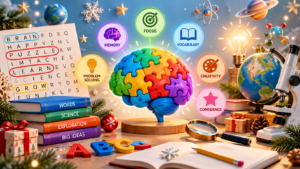
A child searching for a difficult word may initially feel frustrated. Finding it after trying a different strategy can produce a satisfying sense of accomplishment.
Completing a puzzle also provides a clear, visible result.
These experiences can help children associate effort with progress, especially when adults recognize the strategies used rather than praising speed alone.
Difficulty should always match the child’s abilities. Puzzles that are too easy may become uninteresting, while excessively difficult activities can discourage participation.
Offering different challenge levels allows children to experience success while gradually attempting more demanding tasks.
This balance is particularly helpful in classrooms where students have different reading abilities and learning needs.
8. Making Science Learning More Engaging
Science introduces children to specialized vocabulary that can sometimes feel complicated.
Words such as Photosynthesis, Magnetism, Molecule, and Gravity become easier to discuss when children encounter them repeatedly in meaningful contexts.
Science word searches can reinforce terminology after a lesson, introduce a new subject, or support revision before an assessment.
For example, a lesson about the solar system could begin with a puzzle containing the names of planets and astronomical objects.
Students could then investigate interesting facts about selected terms.
The Science Word Searches collection at Print Your Puzzles provides printable activities with definitions and additional educational information.
Teachers can find further topics across the second page of Science puzzles and explore the additional Science category page.
These resources work best when combined with experiments, illustrations, reading, and discussion.
A puzzle introduces or reinforces scientific language, while complementary activities help children understand the concepts behind it.
9. Using Holiday Puzzles to Explore Culture and Traditions
Holiday-themed puzzles provide opportunities to connect language learning with history, culture, geography, and family traditions.
Children often enjoy activities related to familiar celebrations because they recognize the objects, foods, symbols, and customs involved.
A Christmas word search might introduce vocabulary associated with decorations, traditions, and seasonal celebrations.
A Thanksgiving puzzle could lead to conversations about gratitude, family customs, and the historical background of the holiday.
Other celebrations offer opportunities to explore different communities and cultural traditions.
The Holiday Word Searches collection includes printable puzzles covering celebrations and special occasions throughout the year.
Educators can also browse more Holiday puzzles featuring additional observances, or discover seasonal and celebration-themed activities.
These resources can support classroom discussions that respectfully recognize the diversity of children’s experiences.
Teachers might invite students to compare traditions, explore historical origins, or describe celebrations important to their families.
In this way, a simple word search can become the starting point for meaningful cultural learning.
10. Encouraging Screen-Free Learning
Digital educational games can provide valuable experiences, but printable puzzles offer a practical alternative when families and teachers want activities that do not require electronic devices.
A printed word search needs only paper and a pencil.
Children can complete puzzles at the kitchen table, in a classroom, during travel, or while spending quiet time with family members.
Printed activities also allow children to underline words, circle unfamiliar vocabulary, and write notes directly on the page.
They can work independently or collaborate with classmates and siblings.
Screen-free activities are not automatically more educational than digital ones. The quality of the learning experience matters more than the format.
However, printable puzzles offer convenience, flexibility, and opportunities for focused participation without notifications or other digital interruptions.
11. Choosing Age-Appropriate Puzzles
Selecting the right challenge level is essential for making puzzle activities enjoyable.
Younger children may benefit from smaller grids, familiar vocabulary, and words arranged in straightforward directions.
As children develop stronger reading and visual-search skills, they can attempt more complex puzzles involving longer vocabulary and diagonal or backward words.
Older elementary students may enjoy educational subjects connected to science, history, or geography.
At Print Your Puzzles, each topic includes medium and hard versions using the same vocabulary, allowing learners to choose different levels of challenge.
The medium version uses an 18-by-18 grid, while the hard version uses a 20-by-20 grid with more diagonal placements and overlapping words.
Adults should consider a child’s reading level, interests, and familiarity with the subject rather than relying exclusively on age.
Providing encouragement and allowing children to choose between difficulty levels can make participation more rewarding.
12. Practical Ways to Include Puzzles in Daily Learning
Word puzzles are most effective as educational tools when they serve a clear purpose.
Teachers might use them to introduce vocabulary before beginning a science unit or to reinforce important concepts after a lesson.
Parents can include puzzles in weekend activities, family learning sessions, or holiday preparations.
A simple routine might involve completing one puzzle, selecting three interesting words, and discussing their meanings.
Students can also create their own word searches using vocabulary from a favorite subject.
Designing a puzzle requires choosing relevant words, checking spelling, organizing information, and thinking about the experience of the person who will solve it.
For group activities, children might complete a puzzle together and explain how they located difficult words.
These extensions encourage communication and deeper engagement without turning every activity into a formal assignment.
13. What Research Says About Brain Games
Research into cognitive training suggests that some structured games and activities can improve performance on the specific skills they practice.
Certain studies have reported improvements in attention, working memory, and executive functions among children participating in targeted training programs.
However, researchers distinguish between improvement on practiced tasks and broader benefits that transfer to unrelated academic or everyday activities.
Evidence for these wider benefits remains mixed, and results depend on the type of activity, the children involved, and the design of the training.
Ordinary printable word searches should therefore not be presented as scientifically proven methods for increasing intelligence, preventing cognitive problems, or improving school grades.
Their educational value is more straightforward: they provide engaging practice with vocabulary, observation, attention, and task completion.
When connected to meaningful subject matter and supported by discussion, puzzles become useful components of a varied learning environment.
Conclusion: Learning Through Enjoyable Challenges
Brain games and word puzzles offer children opportunities to practice important cognitive skills while enjoying activities that feel more like play than traditional schoolwork.
Word searches encourage focused observation, vocabulary recognition, persistence, and the exploration of different strategies. Themed puzzles can also reinforce knowledge from science, history, holidays, and other educational subjects.
Their benefits are strongest when adults select suitable challenges, explain unfamiliar vocabulary, and connect puzzle activities with broader learning experiences.
At Print Your Puzzles, our free printable word searches provide accessible resources for teachers, homeschool families, and parents looking for educational activities.
Whether children are discovering scientific concepts or exploring holiday traditions, every puzzle offers another opportunity to learn, think, and enjoy the process of discovery.