Introduction to the 12 Days of Christmas Word Search
The 12 Days of Christmas is a festive tradition that combines religious history, cultural customs, and one of the most recognizable Christmas songs in the English-speaking world. Although many people associate the twelve days with the countdown to Christmas, they traditionally begin on December 25, Christmas Day, and continue through January 5, the evening before Epiphany.
In Christian tradition, this festive period celebrates the birth of Jesus Christ and leads to Epiphany on January 6, which is commonly associated in Western Christianity with the visit of the Three Wise Men. Throughout history, these twelve days have been marked by religious services, family gatherings, feasts, music, and other seasonal celebrations.
The tradition is particularly famous thanks to the English Christmas carol “The Twelve Days of Christmas.” First published in England in 1780, the song describes a series of increasingly extravagant gifts received from a true love. Each verse introduces a new gift while repeating those mentioned on the previous days, creating a memorable cumulative song.
The gifts range from a partridge in a pear tree and two turtle doves to golden rings, swimming swans, dancing ladies, and drummers. If every repeated gift is counted throughout the song, the recipient receives an impressive total of 364 gifts. This playful numerical pattern makes the carol especially interesting from both a musical and mathematical perspective.
Over the centuries, different countries have developed their own customs associated with the twelve days. In some places, the celebrations include special meals, gift exchanges, traditional decorations, and community events. Twelfth Night, celebrated toward the end of the festive period, has historically been an occasion for parties, music, and entertainment.
Completing a 12 Days of Christmas word search is an enjoyable way to discover the vocabulary, symbols, history, and traditions connected with this festive celebration. From the famous gifts featured in the carol to traditional religious and cultural customs, each hidden word offers an opportunity to learn something new while enjoying a relaxing Christmas activity.
Whether you are a student, a teacher looking for an educational holiday resource, or someone who simply enjoys festive puzzles, exploring the Twelve Days of Christmas provides a wonderful opportunity to combine entertainment with learning. It also offers a deeper appreciation of a centuries-old tradition that continues to bring joy to people around the world.
Ho, ho, ho! The holiday fun doesn’t stop here! Explore our Christmas Word Searches collection, featuring 18 festive puzzles filled with Christmas magic, traditions, and cheer!
Related Word Searches:
Christmas Day | Christmas Nativity | Christmas Traditions | Advent Calendar | Christmas Around the World | Ebenezer Scrooge
Medium Difficulty Word Search
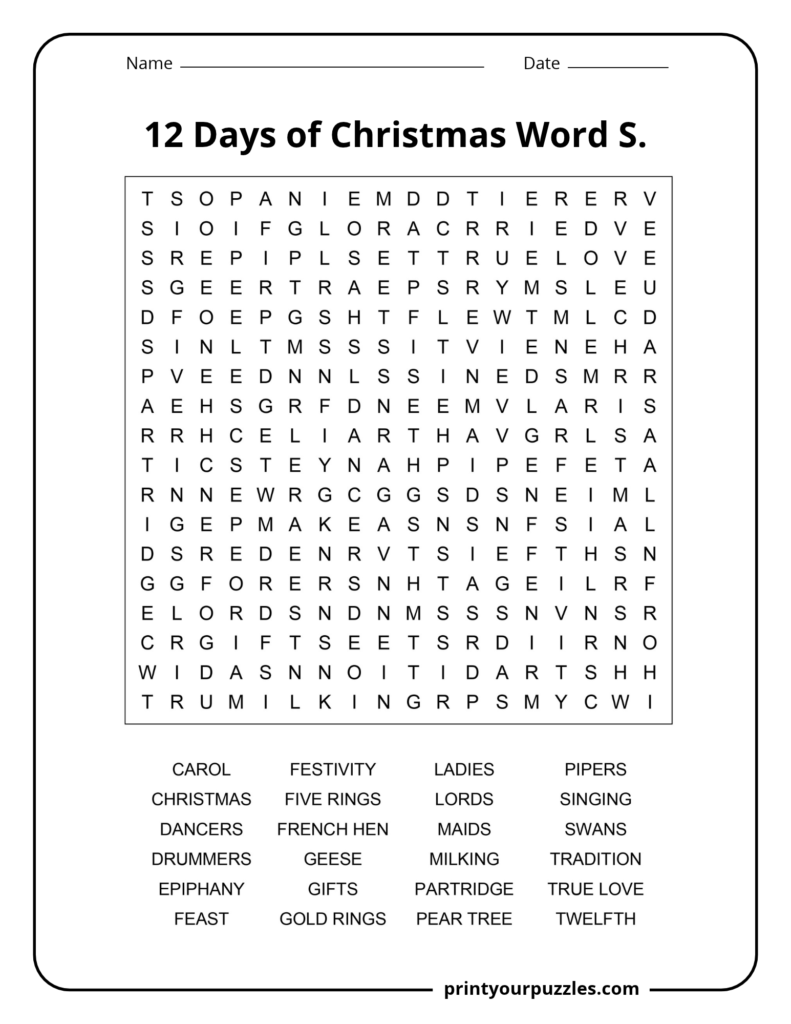
Words to Find:
CAROL, CHRISTMAS, DANCERS, DRUMMERS, EPIPHANY, FEAST, FESTIVITY, FIVE RINGS, FRENCH HEN, GEESE, GIFTS, GOLD RINGS, LADIES, LORDS, MAIDS, MILKING, PARTRIDGE, PEAR TREE, PIPERS, SINGING, SWANS, TRADITION, TRUE LOVE, TWELFTH
All Words Defined
CAROL – A traditional festive song associated with Christmas celebrations, often expressing religious devotion, seasonal joy, or storytelling, such as the famous song The Twelve Days of Christmas.
CHRISTMAS – An annual celebration on December 25 commemorating the birth of Jesus Christ and marking the traditional beginning of the festive period known as the Twelve Days of Christmas.
DANCERS – Performers who express rhythm and movement through dance, represented in the traditional Christmas carol by nine ladies dancing as one of the increasingly extravagant gifts.
DRUMMERS – Musicians who play percussion instruments, appearing on the twelfth and final day of the famous Christmas carol as twelve drummers performing a lively musical celebration.
EPIPHANY – A Christian feast celebrated on January 6 that traditionally commemorates the visit of the Three Wise Men to Jesus and follows the Twelve Days of Christmas.
FEAST – A large celebratory meal shared with family, friends, or community members, reflecting the historical traditions of hospitality and enjoyment during the twelve days of Christmas celebrations.
FESTIVITY – A joyful celebration involving entertainment, music, food, decorations, and social gatherings, capturing the cheerful atmosphere traditionally associated with Christmas and its extended twelve-day seasonal celebration.
FIVE RINGS – The gift introduced on the fifth day of the Christmas carol, consisting of five golden rings and forming one of the song’s most recognizable musical passages.
FRENCH HEN – A domesticated female chicken associated with the third day of the traditional Christmas carol, in which the recipient receives three French hens from their true love.
GEESE – Large waterbirds traditionally featured in the Christmas carol as six geese laying eggs, representing the gift introduced on the sixth day of the festive song.
GIFTS – Presents exchanged as expressions of affection, generosity, or celebration, forming the central theme of the Christmas carol through twelve progressively elaborate and unusual daily offerings.
GOLD RINGS – Precious circular ornaments featured in the fifth verse of the traditional Christmas carol, representing one of its most memorable gifts and frequently emphasized during musical performances.
LADIES – Female figures appearing in the traditional Christmas carol as nine ladies dancing, contributing movement, entertainment, and a sense of celebration to the song’s imaginative collection of gifts.
LORDS – Men traditionally associated with noble rank or social status, appearing in the Christmas carol as ten lords leaping during the tenth day of gift giving.
MAIDS – Women traditionally employed in domestic or agricultural work, represented in the Christmas carol by eight maids milking as the gift introduced on the eighth day.
MILKING – The process of collecting milk from domesticated animals, particularly cows, featured in the Christmas carol through the eight maids performing this traditional agricultural activity together.
PARTRIDGE – A medium-sized game bird featured as the first gift in the famous Christmas carol, traditionally described as sitting in a pear tree and repeated throughout every verse.
PEAR TREE – A fruit-bearing tree that produces pears, famously featured in the opening gift of the Christmas carol as the place where the partridge is described as resting.
PIPERS – Musicians who play wind instruments such as pipes, appearing in the traditional Christmas carol as eleven pipers piping during the eleventh day of the festive celebration.
SINGING – The activity of producing musical sounds with the voice, forming an essential part of Christmas celebrations and helping preserve traditional carols across generations and cultures.
SWANS – Elegant aquatic birds with long necks, featured in the traditional Christmas carol as seven swans swimming, representing the seventh gift received during the twelve-day sequence.
TRADITION – A custom, belief, or practice passed down through generations, such as celebrating the Twelve Days of Christmas through religious observances, festive meals, music, and family gatherings.
TRUE LOVE – The affectionate expression used in the Christmas carol to describe the person who generously presents increasingly elaborate gifts to the recipient throughout the twelve festive days.
TWELFTH – An ordinal number identifying the final day of the Twelve Days of Christmas, associated with the last verse of the carol and traditional Twelfth Night celebrations.
Hard Difficulty Word Search
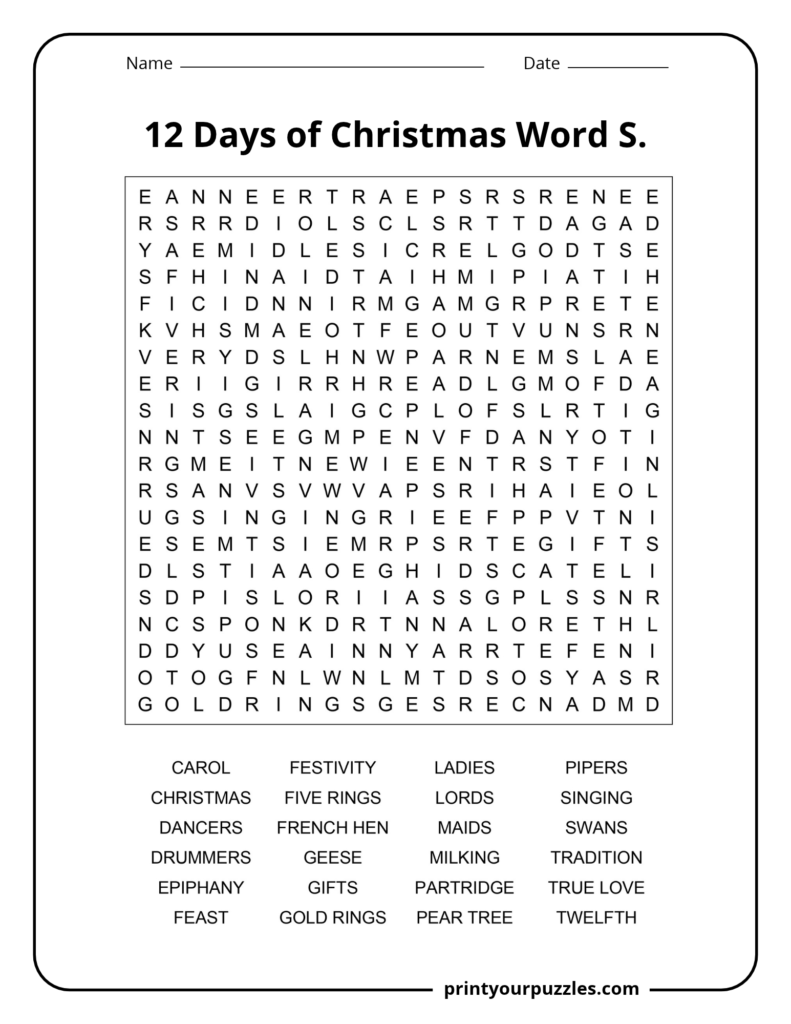
Words to Find:
CAROL, CHRISTMAS, DANCERS, DRUMMERS, EPIPHANY, FEAST, FESTIVITY, FIVE RINGS, FRENCH HEN, GEESE, GIFTS, GOLD RINGS, LADIES, LORDS, MAIDS, MILKING, PARTRIDGE, PEAR TREE, PIPERS, SINGING, SWANS, TRADITION, TRUE LOVE, TWELFTH
5 Key FAQs About the 12 Days of Christmas
5 Curious "Did You Know?" Facts About the 12 Days of Christmas