
Explore New York’s capital city with this engaging Albany word search that brings history, culture, and landmarks to life! This puzzle features 24 carefully selected words that capture the essence of one of America’s oldest cities, from its Dutch colonial roots to its modern role as the Empire State’s governmental center.
What makes this Albany word search printable special is its educational value—every single word included in the puzzle comes with a detailed 20-30 word definition. You’ll learn about iconic landmarks like the Corning Tower and Empire State Plaza, historical figures such as Philip Schuyler, cultural celebrations like the Tulip Festival, and geographical features including the Hudson River and Erie Canal. This word search printable serves double duty as both an entertaining puzzle and an informative guide to Albany’s most significant elements.
Perfect for students studying New York State history, visitors planning a trip to the capital region, or puzzle enthusiasts who enjoy learning while they play, this activity offers an interactive way to discover what makes Albany unique. Challenge yourself to find all 24 words while expanding your knowledge of this historic Hudson River city!
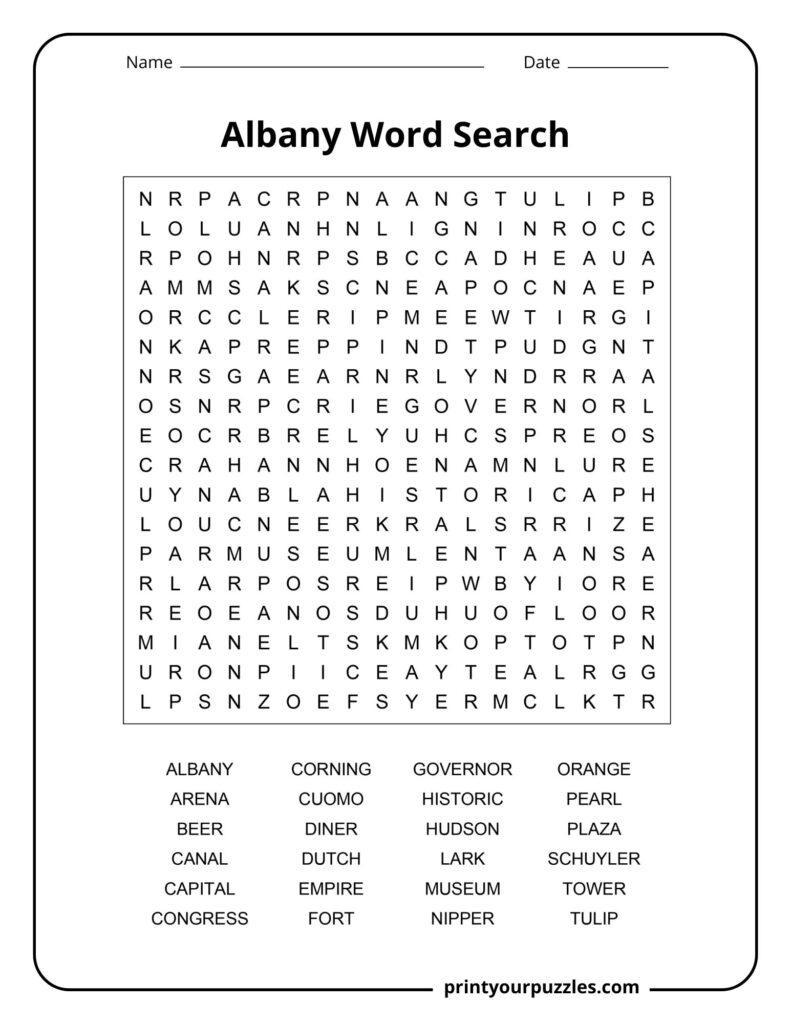
ALBANY, ARENA, BEER, CANAL, CAPITAL, CONGRESS, CORNING, CUOMO, DINER, DUTCH, EMPIRE, FORT, GOVERNOR, HISTORIC, HUDSON, LARK, MUSEUM, NIPPER, ORANGE, PEARL, PLAZA, SCHUYLER, TOWER, TULIP
ALBANY – New York’s capital city since 1797, located on the Hudson River. One of America’s oldest continuously chartered cities, founded by Dutch settlers in 1614.
ARENA – The MVP Arena, downtown’s premier entertainment venue hosting concerts, sporting events, and the Siena College basketball team. Seats over 15,000 spectators for major events.
BEER – Albany boasts a thriving craft beer scene with numerous breweries. The city’s brewing tradition dates back centuries, reflecting its Dutch and German immigrant heritage.
CANAL – The Erie Canal terminus connected Albany to the Great Lakes in 1825, transforming the city into a major commercial hub and transportation gateway.
CAPITAL – Albany serves as New York State’s capital, housing the Governor’s office, State Legislature, and numerous government agencies in the Capitol building and Empire State Plaza.
CONGRESS – The Albany Congress of 1754 brought colonial delegates together, where Benjamin Franklin proposed his Albany Plan of Union, foreshadowing American unity and cooperation.
CORNING – The Corning Tower stands as Albany’s tallest building at 589 feet, part of Empire State Plaza. Its observation deck offers spectacular views of the region.
CUOMO – Andrew Cuomo served as New York’s governor from 2011-2021, following his father Mario Cuomo who also governed from Albany for three terms.
DINER – Albany’s diner culture thrives with classic establishments serving comfort food. These neighborhood gathering spots reflect the city’s working-class roots and community spirit throughout history.
DUTCH – Dutch settlers established Fort Nassau in 1614, creating New Netherland’s northern trading post. Albany’s Dutch heritage remains visible in architecture, street names, and cultural traditions.
EMPIRE – The Empire State Plaza, completed in 1978, is Governor Nelson Rockefeller’s dramatic modernist government complex featuring reflecting pools, museums, and performing arts venues.
FORT – Fort Orange was established by Dutch traders in 1624, becoming the area’s first permanent European settlement and the foundation of modern Albany’s development.
GOVERNOR – The New York State Executive Mansion on Eagle Street has housed governors since 1875. It serves as the official residence for the state’s chief executive.
HISTORIC – Albany’s historic districts preserve centuries of architecture, from Dutch Colonial to Victorian styles. The city played crucial roles in colonial, revolutionary, and industrial American history.
HUDSON – The Hudson River defines Albany’s eastern border, providing historical transportation routes and modern recreation. The river shaped Albany’s development as a major port city.
LARK – Lark Street is Albany’s bohemian neighborhood featuring eclectic restaurants, bars, cafes, and shops. This vibrant corridor hosts festivals and attracts diverse crowds seeking alternative culture.
MUSEUM – The New York State Museum in Empire State Plaza showcases natural history, cultural heritage, and art collections. It’s one of the nation’s oldest and largest state museums.
NIPPER – The iconic Nipper statue atop the former RCA building depicts the Victor Records dog. This four-ton fiberglass landmark has overlooked Broadway since 1954.
ORANGE – Fort Orange honored the Dutch House of Orange-
Nassau. The color and name remain significant in Albany’s identity, appearing in sports teams and historical references.
PEARL – Pearl Street runs through downtown Albany as a major commercial corridor. Named for the mother-of-pearl shells found along the Hudson, it features historic buildings.
PLAZA – Empire State Plaza’s 98-acre complex houses government offices, museums, and performing arts venues. The modernist marvel features dramatic architecture and significant public art collections.
SCHUYLER – Philip Schuyler was a Revolutionary War general, U.S. Senator, and prominent Albany resident. The Schuyler Mansion State Historic Site preserves his elegant Georgian home.
TOWER – Corning Tower dominates Albany’s skyline as the tallest building between New York City and Montreal. Completed in 1973, it anchors the Empire State Plaza.
TULIP – The annual Tulip Festival celebrates Albany’s Dutch heritage each May in Washington Park. Thousands of tulips bloom, honoring the city’s cultural roots with festivities.
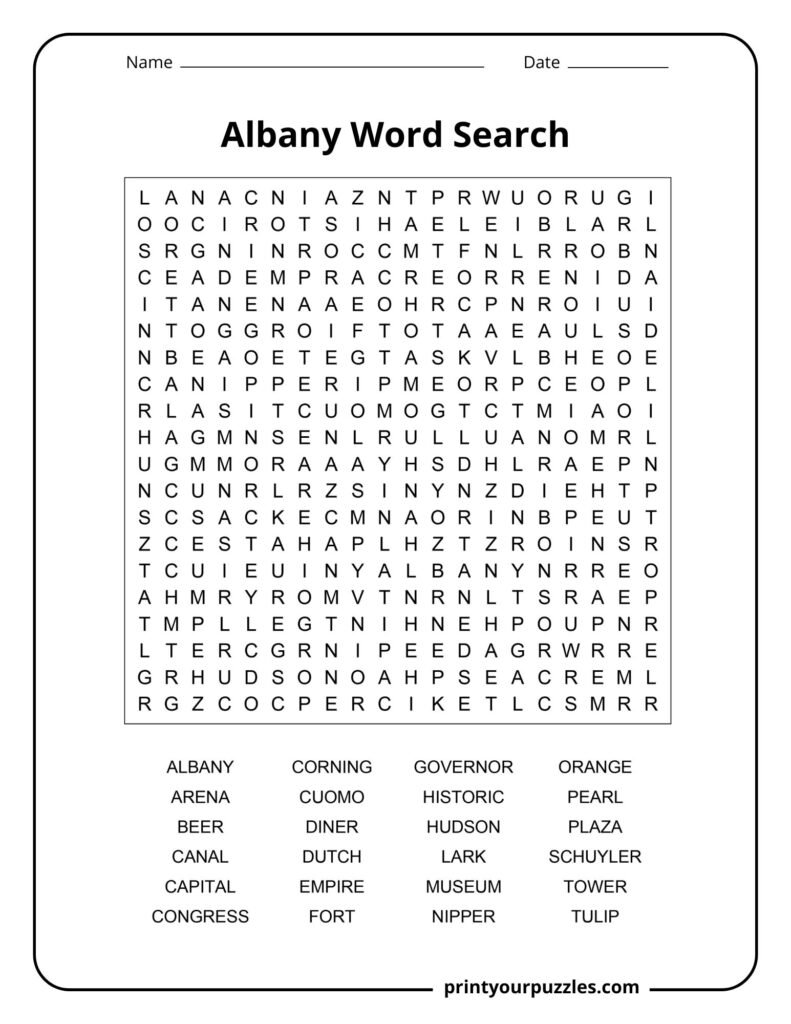
ALBANY, ARENA, BEER, CANAL, CAPITAL, CONGRESS, CORNING, CUOMO, DINER, DUTCH, EMPIRE, FORT, GOVERNOR, HISTORIC, HUDSON, LARK, MUSEUM, NIPPER, ORANGE, PEARL, PLAZA, SCHUYLER, TOWER, TULIP
Albany became New York’s permanent capital in 1797. The city was chosen for its central location along the Hudson River and its importance as a commercial hub.
Albany is one of America’s oldest cities, founded in 1614. It hosted the Albany Congress in 1754 and served as a strategic location during the Revolutionary War era.
Albany is renowned for being New York’s capital, its Dutch colonial heritage, the Erie Canal terminus, Empire State Plaza’s modernist architecture, and the annual Tulip Festival celebration.
Albany sits on the Hudson River’s west bank, approximately 150 miles north of New York City. It’s positioned in the Capital District region of eastern New York State.
Must-see attractions include the New York State Capitol building, Empire State Plaza, New York State Museum, historic neighborhoods, Washington Park, and the USS Slater destroyer escort ship.
For official city information, government updates, and public services, visit the City of Albany website. If you are planning a trip, check out the official tourism portal, Discover Albany.
George Crum, a chef at Moon’s Lake House in Saratoga Springs (near Albany), reportedly created potato chips in 1853 after a customer complained about thick-cut fries.
Nipper, the RCA Victor Records mascot, sits atop a former warehouse on Broadway. This massive fiberglass terrier has been an Albany landmark since 1954, visible citywide.
The Dutch established a permanent settlement here in 1614, making Albany one of the nation’s oldest continuously inhabited European settlements, predating many major American cities.
Governor Nelson Rockefeller’s ambitious 1960s project created this massive government complex. Adjusted for inflation, it remains one of the most expensive construction projects in state history.
Creator Greg Daniels attended Harvard but was inspired by mundane office culture. However, Albany native Kate Flannery played Meredith Palmer throughout the series’ nine-season run.
Purus ut praesent facilisi dictumst sollicitudin cubilia ridiculus.