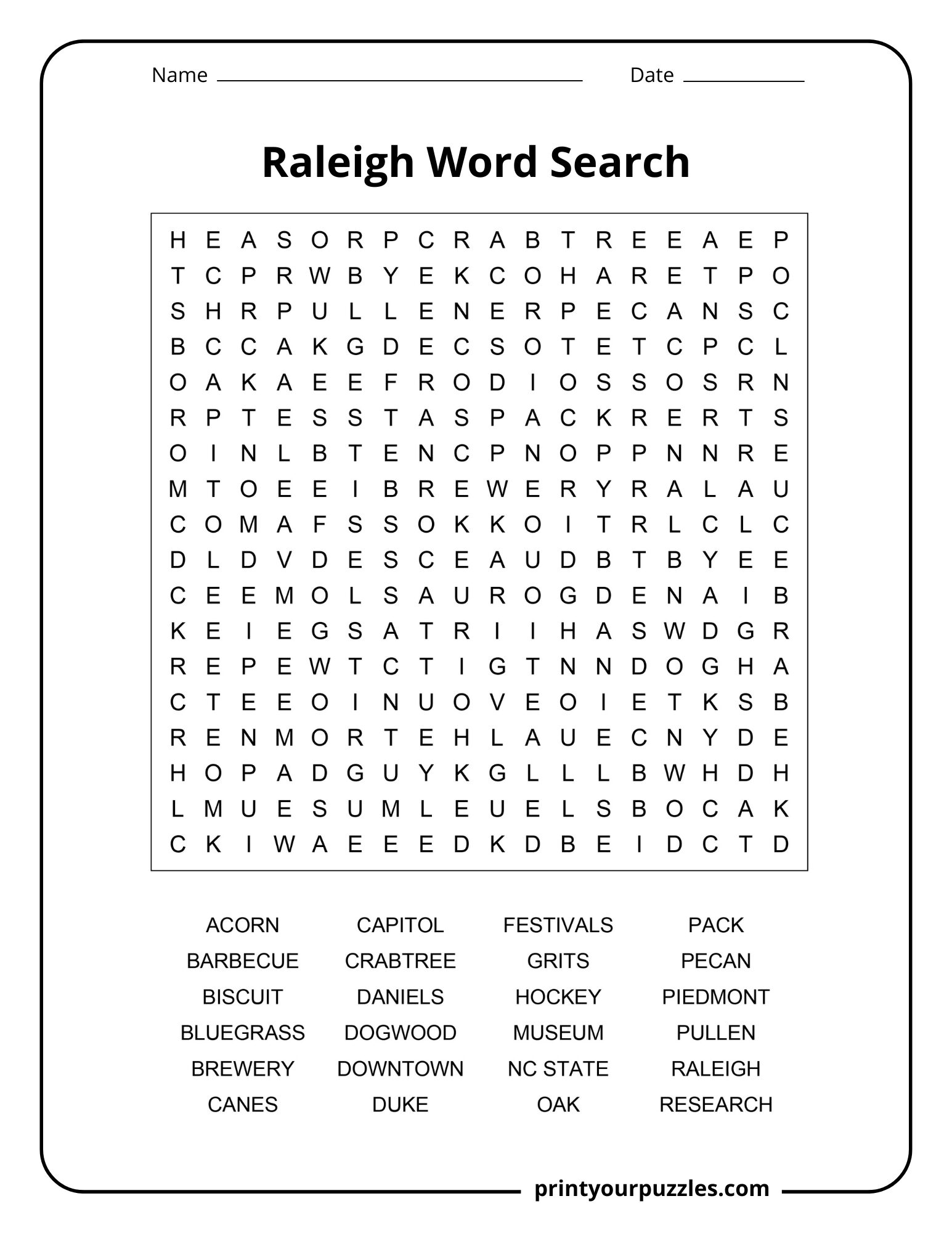

Atom word search puzzles provide an engaging and educational way to explore the fundamental concepts of chemistry and physics while enjoying a classic brain-teasing activity. This interactive learning tool combines entertainment with scientific vocabulary, making it perfect for students, teachers, and science enthusiasts of all ages who want to deepen their understanding of atomic structure and related principles.
Our atom word search printable features 24 carefully selected terms that cover essential atomic concepts, from basic particles like protons and electrons to complex ideas such as isotopes and quantum mechanics. What makes this word search printable especially valuable is that every word included in the puzzle comes with a clear, concise definition of 20-30 words, ensuring that learners not only find the terms but also understand their meanings and significance in atomic science.
This comprehensive approach transforms a simple puzzle into a complete learning experience. As you locate each hidden word arranged in various directions throughout the grid, you can refer to the accompanying definitions to reinforce your knowledge and build a solid foundation in atomic theory. Whether used in classrooms, at home, or for independent study, this resource makes learning about atoms both accessible and enjoyable.
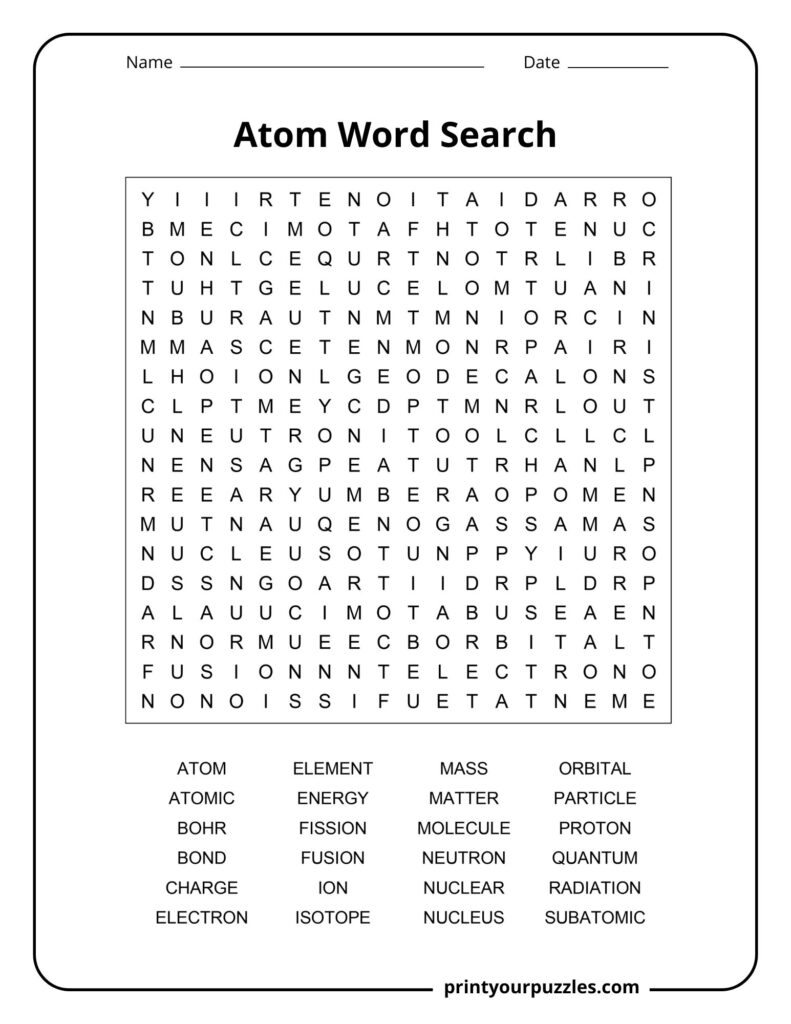
ATOM, ATOMIC, BOHR, BOND, CHARGE, ELECTRON, ELEMENT, ENERGY, FISSION, FUSION, ION, ISOTOPE, MASS, MATTER, MOLECULE, NEUTRON, NUCLEAR, NUCLEUS, ORBITAL, PARTICLE, PROTON, QUANTUM, RADIATION, SUBATOMIC
ATOM – The smallest unit of matter that retains the properties of an element, consisting of a nucleus surrounded by electrons in orbital shells.
ATOMIC – Relating to atoms or the energy released from splitting or combining atomic nuclei; pertaining to the fundamental building blocks of matter.
BOHR – Niels Bohr, Danish physicist who developed the Bohr model of the atom, showing electrons orbit the nucleus in specific energy levels or shells.
BOND – A chemical connection between atoms formed by sharing or transferring electrons, creating molecules and compounds through attractive forces holding atoms together.
CHARGE – An electrical property of matter that can be positive or negative, caused by an excess or deficiency of electrons in an atom or particle.
ELECTRON – A negatively charged subatomic particle that orbits the nucleus of an atom, responsible for chemical bonding and electrical conductivity in materials.
ELEMENT – A pure substance consisting of only one type of atom, characterized by its unique number of protons, and cannot be broken down chemically.
ENERGY – The capacity to do work or cause change, existing in various forms including kinetic, potential, thermal, and released during atomic reactions.
FISSION – Nuclear reaction where a heavy atomic nucleus splits into smaller fragments, releasing massive amounts of energy used in nuclear power and weapons.
FUSION – Nuclear process where light atomic nuclei combine to form heavier nuclei, releasing tremendous energy, powering stars and experimental reactors on Earth.
ION – An atom or molecule with a net electrical charge due to the loss or gain of one or more electrons during chemical reactions.
ISOTOPE – Variant forms of the same element having identical proton numbers but different neutron counts, resulting in different atomic masses and stability.
MASS – The amount of matter in an object, measured in units like grams or kilograms, representing the object’s resistance to acceleration or movement.
MATTER – Anything that has mass and occupies space, composed of atoms and molecules, existing in solid, liquid, gas, and plasma states.
MOLECULE – A group of two or more atoms bonded together chemically, representing the smallest unit of a chemical compound maintaining its properties.
NEUTRON – An electrically neutral subatomic particle found in the atomic nucleus, with mass similar to protons, determining isotopes and contributing to atomic stability.
NUCLEAR – Relating to the nucleus of an atom or the energy produced from splitting or fusing atomic nuclei in reactions and power generation.
NUCLEUS – The dense central core of an atom containing protons and neutrons, holding most of the atom’s mass and maintaining a positive charge.
ORBITAL – A region of space around an atom’s nucleus where electrons are most likely to be found, having specific shapes and energy levels.
PARTICLE – A tiny piece of matter, including subatomic particles like protons, neutrons, and electrons, or any small discrete unit of physical substance.
PROTON – A positively charged subatomic particle located in the atomic nucleus, determining the element’s identity through its atomic number and chemical properties.
QUANTUM – The smallest discrete unit of energy or matter, fundamental to quantum mechanics describing atomic and subatomic behavior at microscopic scales.
RADIATION – Energy transmitted as electromagnetic waves or moving subatomic particles, emitted from radioactive materials or nuclear reactions, potentially harmful in large doses.
SUBATOMIC – Referring to particles smaller than an atom, including protons, neutrons, electrons, and other fundamental particles comprising atomic structure and behavior.
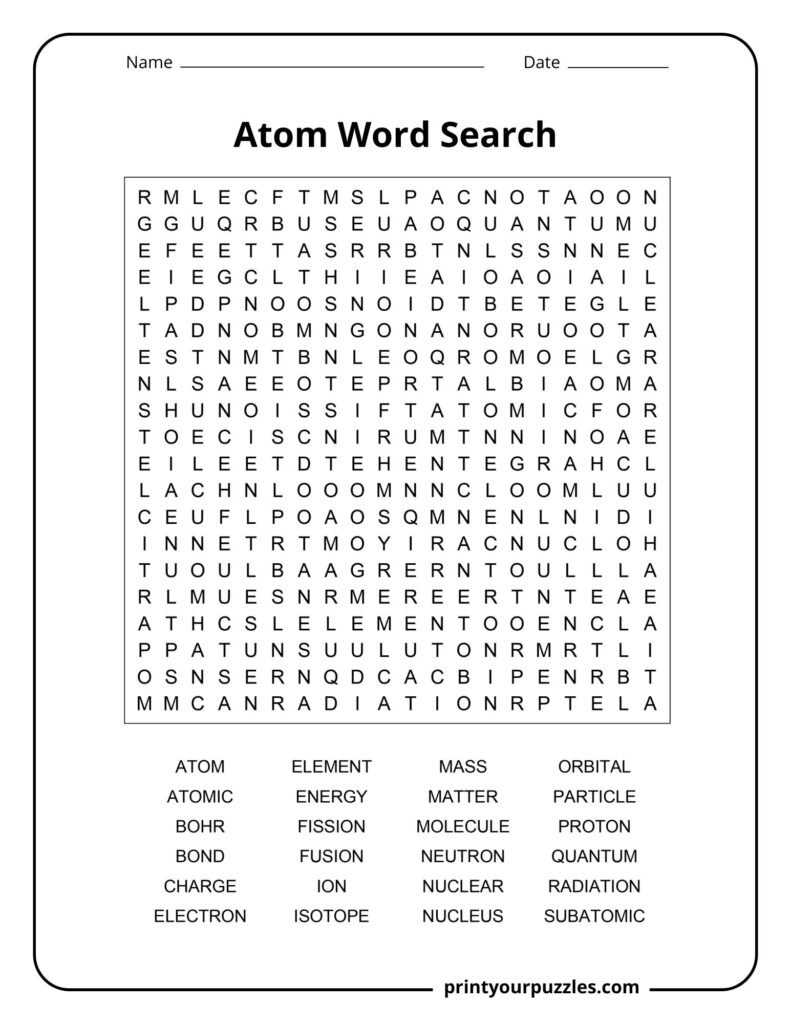
ATOM, ATOMIC, BOHR, BOND, CHARGE, ELECTRON, ELEMENT, ENERGY, FISSION, FUSION, ION, ISOTOPE, MASS, MATTER, MOLECULE, NEUTRON, NUCLEAR, NUCLEUS, ORBITAL, PARTICLE, PROTON, QUANTUM, RADIATION, SUBATOMIC
An atom is the smallest unit of matter that retains an element’s properties, consisting of a nucleus containing protons and neutrons, surrounded by orbiting electrons.
Atoms are incredibly tiny, measuring approximately 0.1 to 0.5 nanometers in diameter. Millions of atoms could fit across the width of a single human hair.
The three main subatomic particles are protons (positive charge), neutrons (no charge), and electrons (negative charge). Protons and neutrons form the nucleus, while electrons orbit outside.
Atoms cannot be created or destroyed in ordinary chemical reactions; they can only be rearranged. However, nuclear reactions can transform atoms into different elements.
The nucleus occupies a tiny fraction of an atom’s volume while electrons orbit at relatively large distances, making atoms approximately 99.9% empty space overall.
The atoms in your body have been recycled through Earth’s ecosystems for billions of years, meaning you literally contain atoms once belonging to historical figures.
Most atoms in your body were formed in ancient stars that exploded as supernovas billions of years ago, making you truly made of stardust.
When objects appear to touch, electromagnetic forces between atoms repel each other, creating an incredibly small gap. You’ve never truly touched anything in your life.
That’s 1,000,000,000,000,000,000 atoms in just one tiny grain, demonstrating the incomprehensibly small size of individual atoms and their astronomical abundance everywhere.
If an atom were enlarged to the size of a football stadium, its nucleus would be smaller than a marble at the center field.
Purus ut praesent facilisi dictumst sollicitudin cubilia ridiculus.