
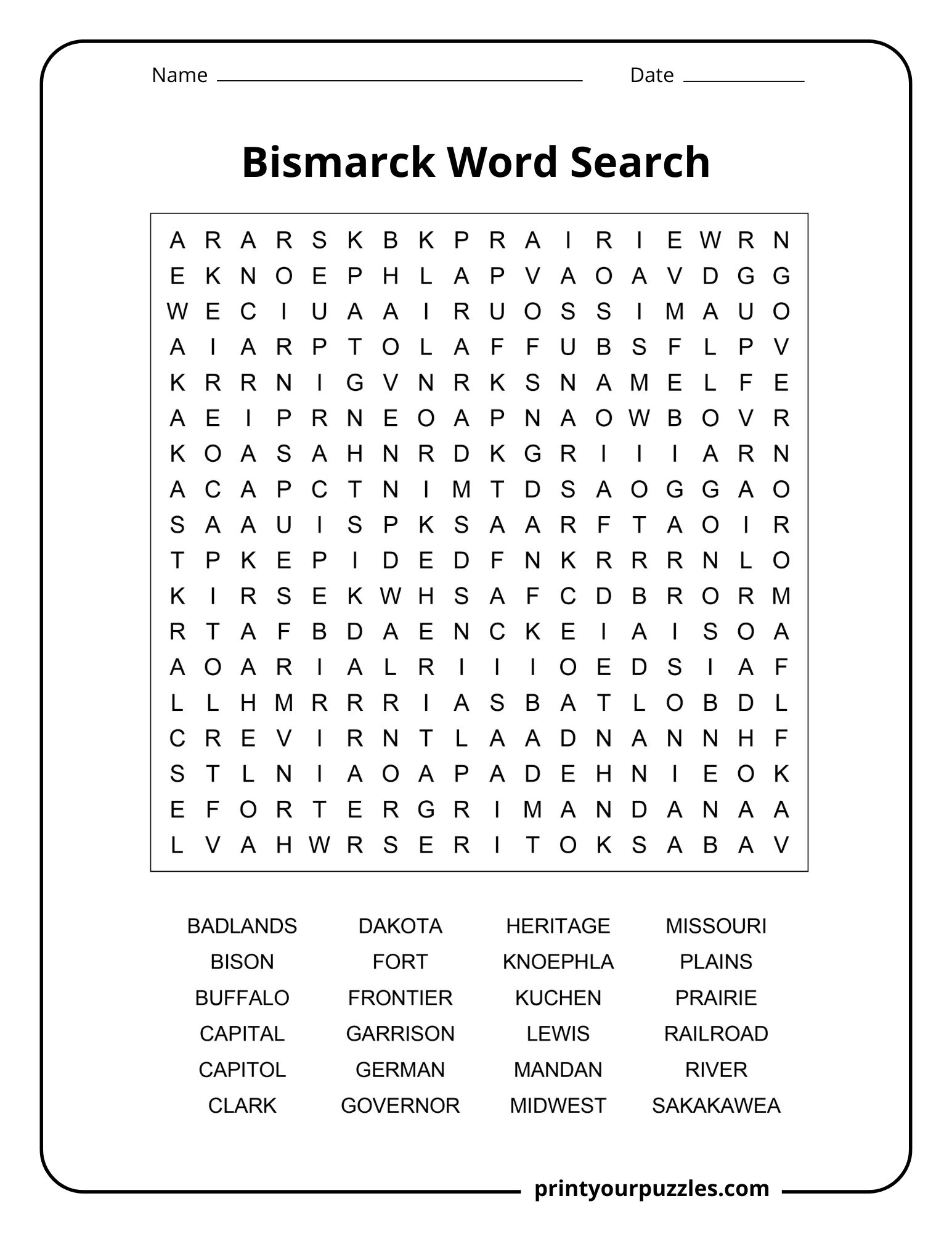
This Bismarck word search offers an engaging way to explore North Dakota’s capital city through an entertaining puzzle featuring 24 carefully selected words. Each term represents significant aspects of Bismarck’s identity, from its rich history and cultural heritage to its natural landscapes and beloved local traditions.
What makes this Bismarck word search printable particularly valuable is that every word comes with a detailed definition of 20-30 words, transforming a simple puzzle into an educational experience. You’ll learn about historical figures like Lewis and Clark, discover traditional German-Russian foods such as knoephla soup and kuchen, explore natural features including the Missouri River and prairie landscapes, and understand important landmarks like the unique Art Deco capitol building.
This word search printable is perfect for classrooms, homeschooling lessons, family activities, or anyone interested in learning about Bismarck while enjoying a fun challenge. The comprehensive definitions ensure that solvers don’t just find words—they gain meaningful knowledge about what makes this Midwestern capital special. Whether you’re a student, teacher, tourist, or puzzle enthusiast, this activity combines entertainment with education, celebrating Bismarck’s distinctive character and fascinating heritage through every word you discover.
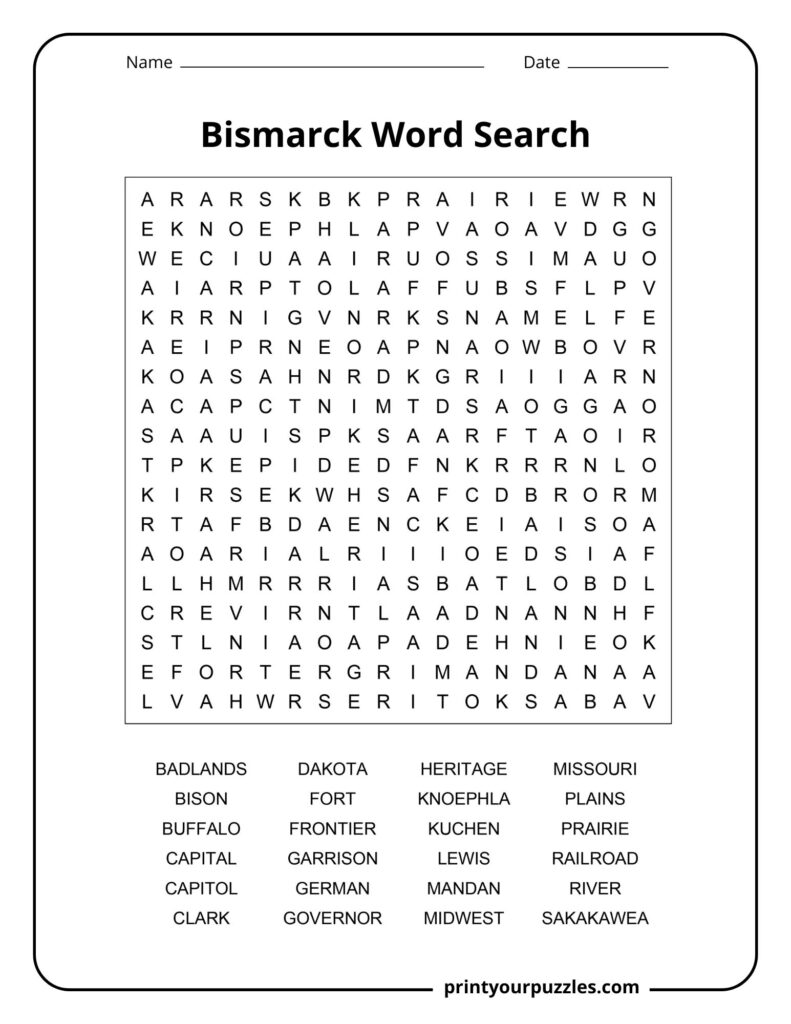
BADLANDS, BISON, BUFFALO, CAPITAL, CAPITOL, CLARK, DAKOTA, FORT, FRONTIER, GARRISON, GERMAN, GOVERNOR, HERITAGE, KNOEPHLA, KUCHEN, LEWIS, MANDAN, MIDWEST, MISSOURI, PLAINS, PRAIRIE, RAILROAD, RIVER, SAKAKAWEA
BADLANDS – Dramatic eroded rock formations found in western North Dakota featuring colorful layered sediment, steep canyons, and unique geological landscapes created over millions of years by erosion.
BISON – Massive prairie mammals that once roamed North Dakota in vast herds, now protected in parks and reserves, symbolizing the state’s wildlife heritage and frontier history.
BUFFALO – Another name for American bison, these iconic animals represent the Great Plains ecosystem and are central to Native American culture and North Dakota’s natural heritage.
CAPITAL – Bismarck serves as North Dakota’s seat of government since 1889, housing state administration, legislative sessions, and serving as the political center of the state.
CAPITOL – The impressive Art Deco skyscraper government building completed in 1934, serving as North Dakota’s statehouse and a distinctive landmark on Bismarck’s skyline at nineteen stories.
CLARK – William Clark, co-leader of the Lewis and Clark Expedition that explored the region in 1804-1806, mapping the Missouri River and documenting the area’s resources and peoples.
DAKOTA – Refers to both North Dakota state and the Dakota Sioux Native American tribes who originally inhabited the region before European settlement and statehood in 1889.
FORT – Fort Abraham Lincoln State Park near Bismarck preserves
military history including Custer’s headquarters and reconstructed Mandan earthlodge village, showcasing frontier military and indigenous life.
FRONTIER – Bismarck’s identity as a former western frontier town, established during westward expansion, reflecting pioneer heritage, railroad development, and settlement of the Great Plains region.
GARRISON – Garrison Dam on the Missouri River creates Lake Sakakawea, providing flood control, hydroelectric power, and recreation, significantly impacting the region’s development and economy since 1953.
GERMAN – German-Russian immigrants settled heavily in the
Bismarck area, bringing distinctive cultural traditions, food, architecture, and agricultural practices that still influence the region’s character today.
GOVERNOR – The state’s chief executive resides and works in Bismarck, overseeing North Dakota government operations, signing legislation, and representing the state in the capitol building.
HERITAGE – Bismarck’s rich cultural legacy includes Native American history, frontier settlement, railroad expansion, German-Russian immigration, and agricultural development shaping the community’s identity and traditions.
KNOEPHLA – Traditional German-Russian dumpling soup featuring tender potato dumplings in creamy broth, a beloved comfort food specific to North Dakota reflecting the region’s immigrant heritage.
KUCHEN – Traditional German fruit-filled pastry cake with custard topping, brought by German-Russian immigrants, now North Dakota’s official state dessert, commonly served at gatherings and celebrations.
LEWIS – Meriwether Lewis, expedition leader who explored the Missouri River region with William Clark, camping near present-day Bismarck and documenting encounters with Mandan villages in 1804.
MANDAN – Both a neighboring city across the Missouri River and the Mandan tribe, indigenous people who lived in earthlodge villages and traded extensively along the river.
MIDWEST – Geographic and cultural region encompassing Bismarck, characterized by agriculture, prairie landscapes, friendly communities, moderate politics, and traditional American values in the nation’s heartland.
MISSOURI – The mighty Missouri River flows through Bismarck, providing water resources, transportation history, recreation, and serving as a defining geographic feature of the city’s location.
PLAINS – The Great Plains region encompasses Bismarck with vast grasslands, agricultural lands, big sky views, and flat to gently rolling terrain defining the landscape and lifestyle.
PRAIRIE – Native grassland ecosystem surrounding Bismarck featuring wildflowers, grasses, and wildlife, representing the natural landscape before agricultural development transformed much of the region into farmland.
RAILROAD – The Northern Pacific Railroad’s arrival in 1873 established Bismarck as a major transportation hub, spurring growth, commerce, and the city’s selection as territorial then state capital.
RIVER – The Missouri River provides Bismarck with recreation, historical significance as Lewis and Clark’s route, water supply, and natural beauty, flowing through the heart of the region.
SAKAKAWEA – Massive reservoir created by Garrison Dam, named for Sacagawea, the Shoshone guide who aided Lewis and Clark, offering extensive recreation, fishing, and tourism opportunities near Bismarck.
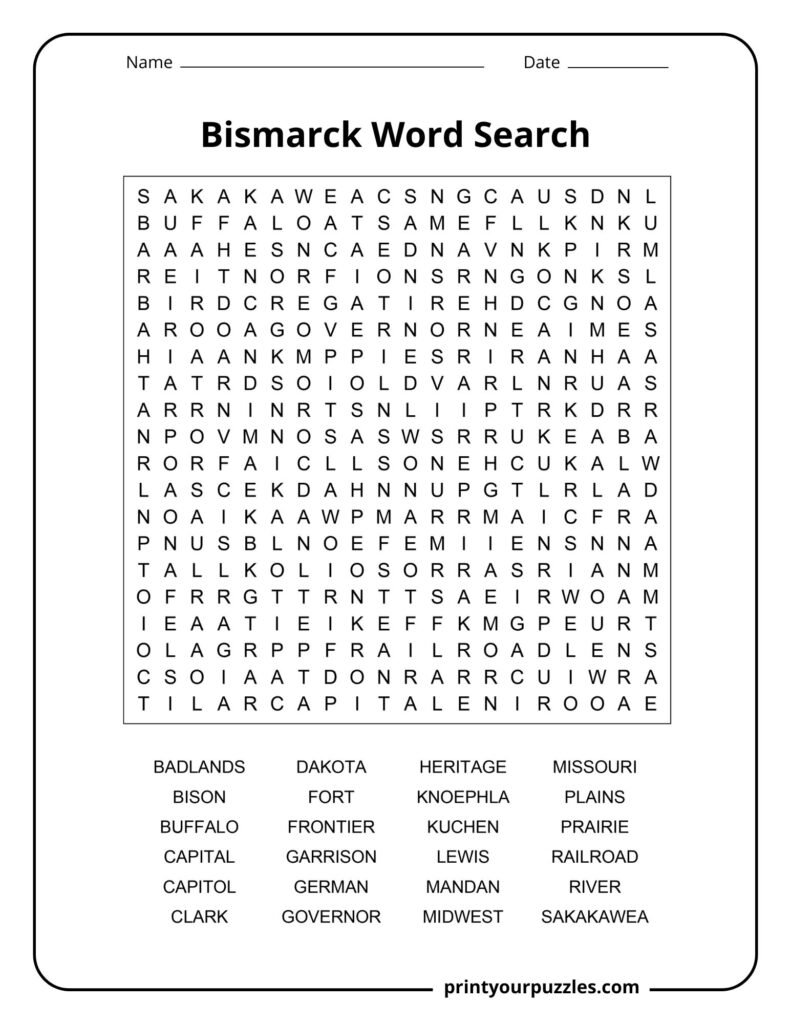
BADLANDS, BISON, BUFFALO, CAPITAL, CAPITOL, CLARK, DAKOTA, FORT, FRONTIER, GARRISON, GERMAN, GOVERNOR, HERITAGE, KNOEPHLA, KUCHEN, LEWIS, MANDAN, MIDWEST, MISSOURI, PLAINS, PRAIRIE, RAILROAD, RIVER, SAKAKAWEA
Bismarck became the territorial capital in 1883 due to its central location and railroad connections, then became the state capital when North Dakota achieved statehood in 1889.
Bismarck is famous for its distinctive Art Deco capitol building, Lewis and Clark history, German-Russian heritage, Missouri River location, and role as North Dakota’s governmental center since 1889.
Top attractions include the North Dakota State Capitol, Fort Abraham Lincoln State Park, North Dakota Heritage Center & State Museum, Missouri River trails, and the Dakota Zoo for family-friendly entertainment.
Bismarck experiences a continental climate with cold, snowy winters averaging below freezing, warm summers reaching the 80s, moderate rainfall, and dramatic seasonal temperature variations typical of Great Plains weather.
Try knoephla soup, a creamy German-Russian dumpling soup, kuchen, the official state dessert, fleischkuekle (fried meat pockets), and locally-raised bison burgers reflecting the region’s culinary heritage and immigrant traditions.
For official city information, government updates, and public services, visit the City of Bismark website. If you are planning a trip, check out the official tourism portal, Visit Bismark.
The city was renamed Bismarck in 1873 to honor German Chancellor Otto von Bismarck, hoping to attract German investment and immigrant settlers to the Northern Pacific Railroad region.
Built during the Great Depression in 1934, the nineteen-story Art Deco skyscraper design was chosen for practicality and cost-efficiency, creating North Dakota’s most distinctive architectural landmark.
The explorers camped near present-day Bismarck during winter 1804-1805, staying five months among the Mandan villages, where they met Sacagawea who joined their westward journey.
The city has recorded temperatures ranging from minus 45 degrees Fahrenheit to 114 degrees Fahrenheit, creating a remarkable 159-degree temperature range throughout its recorded climate history.
The city’s central location between the Atlantic and Pacific coasts, and Canada and Mexico, places it near the continental midpoint, symbolizing its heartland identity and strategic position.
Purus ut praesent facilisi dictumst sollicitudin cubilia ridiculus.