

Word search puzzles, those familiar grids of letters hiding words in various directions, have become a beloved pastime for millions of people worldwide. Yet despite their ubiquity in newspapers, puzzle books, and classrooms, these simple but engaging puzzles have a surprisingly short and well-documented history—one that involves multiple inventors across different continents and some intriguing historical disputes.
Ancient Precursors: Word Puzzles in Antiquity
While the modern word search is a recent invention, the concept of arranging letters in grids has ancient roots. The direct precursor of grid-based word puzzles is the word square, a special kind of acrostic puzzle in which the same words can be read across and down.
The ancient Romans loved word puzzles, and the first known word square, the so-called Sator Square, was found in the ruins of Pompeii. This five-by-five, five-word Latin palindrome reads: SATOR AREPO TENET OPERA ROTAS (“the farmer Arepo works a plow”). The Sator Square became the “Kilroy Was Here” of the Roman Empire, appearing in locations from Rome to Corinium (in modern England) to Dura-Europos (in modern Syria).
However, these ancient word squares differ fundamentally from modern word searches. Word squares require palindromic arrangements where words read identically across and down, while word searches hide words scattered throughout a grid in multiple directions. The modern word search puzzle as we know it would not emerge until nearly two thousand years later.
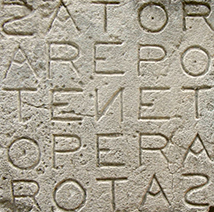
Image of Stator Square from Wikipedia (https://en.wikipedia.org/wiki/Sator_Square)
The Birth of the Word Search: Norman E. Gibat’s Creation
The modern English word search puzzle was officially invented by Norman E. Gibat on March 1, 1968, when he published the first puzzle in the Selenby Digest, a small want-ad publication distributed in Norman, Oklahoma. Gibat (1929-2012), who was working in the printing business at the time, created the puzzle format to engage readers of his publication and distinguish it from competitors.
His first puzzle featured a 20×20 grid containing 34 Oklahoma towns and cities that could be found horizontally, vertically, and diagonally—both forwards and backwards. The second puzzle shifted to a local theme featuring Norman street names. Gibat’s goal was simple: create an entertaining game that people could play while waiting in line at the supermarket or in any waiting room.
Competing Claims: The Spanish Connection
However, the origins of word search puzzles are not without historical debate. Pedro Ocón de Oro, born in Madrid in 1932, was a renowned Spanish puzzle creator who invented over 125 types of puzzles and published more than 600,000 individual puzzles during his career. Among his most famous creations was the “Sopa de Letras” (Soup of Letters), which he developed sometime during the 1960s.
Historians have been unable to pinpoint the exact date when Ocón de Oro created his Sopa de Letras puzzles, although they agree it occurred during the 1960s. His puzzles were published in numerous Spanish and Latin American newspapers, and he later launched his own magazine titled “Sopa de letras” in 1976. This lack of certainty about the precise date has led most historians to credit Gibat as the official inventor, though it is generally accepted that Gibat may have been inspired by the Spanish version.
The American Mystery: James Patrick Carr
Adding another layer to the puzzle’s origin story, there is evidence suggesting that James Patrick Carr of Villa Grove, Illinois, may have created a similar puzzle before 1968. Carr was a media director and faculty member at Villa Grove schools for 44 years, and his Educational Puzzle Series of 89 puzzles included “Slant-R-Straight,” “Phase Out,” and “Name Seek.”
According to some sources, Carr titled his puzzles “Slate R Straight” and sent them to a copyright/patent company, only to have the idea allegedly stolen. Evidence of his puzzles appears in Villa Grove High School sporting event brochures predating Gibat’s 1968 publication. However, this claim remains disputed and less documented than either Gibat’s or Ocón de Oro’s contributions.
Rise to Popularity and Educational Applications
The puzzle’s breakthrough into mainstream popularity came remarkably quickly. Teachers in Norman loved the puzzles so much that they requested reprints to use in their classrooms, recognizing their educational value for teaching spelling, vocabulary, and pattern recognition. One teacher sent the puzzles to various friends and teachers across the United States, and this grassroots distribution helped transform word searches into a national phenomenon.
The Selenby Digest was short-lived and closed its doors in 1970, but the word search puzzle Gibat created was destined to live much longer. As neither Norman E. Gibat nor Ocón de Oro patented their creations, word search puzzles quickly became syndicated, appearing in numerous publications throughout the world.
By the 1970s, word search puzzles had become a fixture in American popular culture. The format’s adaptability meant it could be themed around virtually any topic—from holidays and seasons to historical events, scientific terms, or pop culture references. This flexibility contributed significantly to its sustained popularity across different age groups and interests.
The Golden Age: 1970s Through 1980s
During the late 1970s and throughout the 1980s, dedicated word search puzzle books began flooding the market. Publishers recognized the format’s broad appeal and low production costs compared to crosswords, which required skilled constructors to create quality clues and symmetrical grids. A word search could be generated relatively easily, especially as computer programs began to automate much of the construction process.
The digital revolution of the 1990s and 2000s brought word searches into the electronic age. Computer games and early websites featured digital versions of the puzzles, and eventually, smartphone apps would make word searches available anywhere, anytime. These digital versions often added new twists to the classic format, including timed challenges, competitive multiplayer modes, and elaborate graphics.
Variations and Evolution of the Format
Interestingly, while Norman Gibat created the modern word search puzzle, he never profited significantly from his invention, as he did not patent the puzzle format. As it spread rapidly through newspapers and publications, others commercialized and popularized the concept. Gibat remained relatively unknown for his contribution to puzzle history, though in later years, puzzle enthusiasts and historians have worked to ensure his role as the inventor is properly recognized.
Variations of the basic word search have emerged over the decades. Some puzzles hide words only along straight lines, while others allow words to bend or snake through the grid. Advanced versions might feature words that share letters, words hidden backward, or grids shaped like objects related to the puzzle’s theme. Cryptic word searches might not even provide a word list, challenging solvers to discover hidden themes or messages within the grid.
The educational applications of word searches have evolved as well. Teachers use them not just for vocabulary building but also for teaching foreign languages, reinforcing historical facts, introducing scientific terminology, and even as calming activities for students with anxiety or attention challenges. The puzzles provide a low-stakes, confidence-building activity that offers clear success markers when words are found.
Global Spread and International Names
While word search puzzles originated exclusively in the United States and Spain during the 1960s, they rapidly spread across the globe through syndication. No evidence exists of independent invention in other countries such as the United Kingdom, France, Germany, or Japan. Instead, the puzzle format was adopted and adapted by publications worldwide, leading to various regional names for the same game.
The puzzle became known by different names depending on the region and language:
. In English-speaking countries, the puzzle acquired multiple names including Word Search, Word Find, Word Seek, Word Sleuth, and Mystery Word—though “Word Search” and “Word Find” eventually became the most common designations.
. In Spanish-speaking countries, the puzzle retained Pedro Ocón de Oro’s original name “Sopa de Letras” (Soup of Letters), which remains the standard term throughout Spain and Latin America.
. In Portugal, the Spanish name was adopted as “Sopa de Letras.”
. In Brazil, the puzzle became known as “Caça Palavras” (Word Hunt), reflecting the Portuguese language’s distinct naming convention.
This rapid global adoption, facilitated by the fact that neither Gibat nor Ocón de Oro patented their creation, transformed the word search from a regional curiosity into an international phenomenon within just a few years of its invention.
Today, word search puzzles remain immensely popular worldwide. They appear in newspapers alongside crosswords and sudoku, fill entire sections of bookstores, and generate millions of downloads as mobile apps. Their enduring appeal lies in their accessibility—unlike crosswords that can frustrate with obscure references or sudoku that requires logical reasoning, word searches offer a relaxing, meditative experience that almost anyone can enjoy regardless of age, education level, or cultural background.
From the ancient Roman word squares to the disputed origins in the 1960s, and on to today’s elaborate themed puzzles and digital variations, word searches have earned their place as one of the most enduring and beloved puzzle formats ever created. They serve as both entertainment and education, providing mental stimulation without intimidation, and their straightforward pleasure shows no signs of fading in our increasingly complex world.
Word Searches in Spain: The Legacy of Pedro Ocón de Oro
In Spain, the word search tradition has been significantly influenced by Pedro Ocón de Oro, a renowned Spanish puzzle creator and publisher who played a crucial role in popularizing word searches and other educational puzzles throughout the Spanish-speaking world. At just 16 years old in 1947, Ocón de Oro won a crossword contest in the Madrid newspaper, launching a career that would span over four decades.
Ocón de Oro became synonymous with quality puzzle magazines and activity books, publishing his creations in numerous Spanish and Latin American newspapers. Blogger He directed four of his own publications: Pasatiempos de Oro (1958), Crucigramas Oconoro (1968), Sopa de letras (1976), and Juegoramas. His approach to word searches emphasized educational value, often incorporating themes related to Spanish culture, history, geography, and vocabulary.
Through his publications, Ocón de Oro introduced generations of Spanish children and adults to word searches, establishing the puzzle format as a staple in Spanish schools and homes. His legacy continues to influence how educational puzzles are designed and distributed in Spain and Latin America, demonstrating that the word search format transcends cultural and linguistic boundaries while adapting to serve the specific educational needs of different communities.
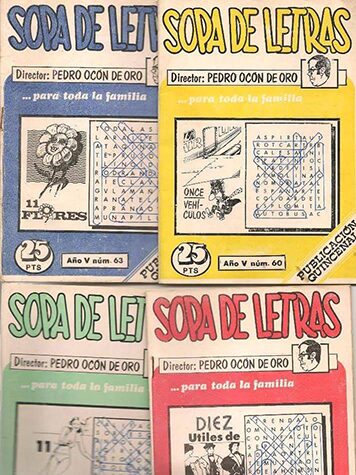
Copies of the magazine Sopa de Letras published by Ocón de Oro in the 1970s in Spain. Image from Twitter: @YofuiaEGB
The Modern Educational Word Search: Print Your Puzzles
For those seeking an enhanced educational puzzle experience, Print Your Puzzles offers an innovative approach to traditional word searches. What makes this platform truly groundbreaking is its addition of detailed definitions for each of the 24 carefully selected keywords—an absolutely new feature in the world of word search puzzles. This new approach transforms the simple act of finding words into a meaningful learning experience, sparking curiosity and building knowledge with every puzzle solved. Unlike traditional word searches that only challenge pattern recognition, Print Your Puzzles ensures that solvers not only find the words but truly understand their meaning and context.
The platform is designed with education at its core. Beyond the innovative keyword definitions, it includes two valuable supplementary sections: a FAQ section with five frequently asked questions that address common queries about the topic, and a “Did You Know?” section featuring five fascinating facts that provide additional context and interesting trivia. This comprehensive format transforms the simple word search into a rich educational tool, encouraging learners to explore deeper, ask questions, and discover connections they might never have considered.
By integrating vocabulary learning, comprehension, and discovery into a single puzzle format, Print Your Puzzles represents the next evolution in educational puzzle design. It’s perfect for students who want to learn more about any topic, teachers seeking engaging classroom resources, and lifelong learners who believe that every moment of entertainment can also be a moment of growth. This thoughtful combination of puzzle-solving and education makes learning not just effective, but genuinely enjoyable—proving that curiosity and knowledge can go hand in hand with fun.
Bibliography:
Article: The Fascinating History of Word Search Puzzles from Practicalgrowth
Article: Word puzzle innovator has Oklahoma roots from Oklahoman