
Chemical reaction word search puzzles offer an engaging way to learn and reinforce key chemistry concepts while having fun. This educational activity challenges students and chemistry enthusiasts to locate 24 important terms related to chemical reactions hidden within a grid of letters. Each word represents a fundamental concept in chemistry, from basic elements like acids and bases to complex processes like oxidation and synthesis.
What makes this Chemical reaction word search printable particularly valuable is its educational depth. Every term included in the puzzle has been carefully selected to represent essential vocabulary that students encounter when studying chemical reactions. To enhance the learning experience, all 24 words featured in this word search printable are accompanied by clear, concise definitions ranging from 20 to 30 words each. This means learners can not only find the terms but also understand their meanings and significance in chemistry.
Whether you’re a teacher looking for classroom activities, a student reviewing for exams, or simply someone interested in chemistry, this word search combines entertainment with education, making it an effective tool for vocabulary building and concept reinforcement.
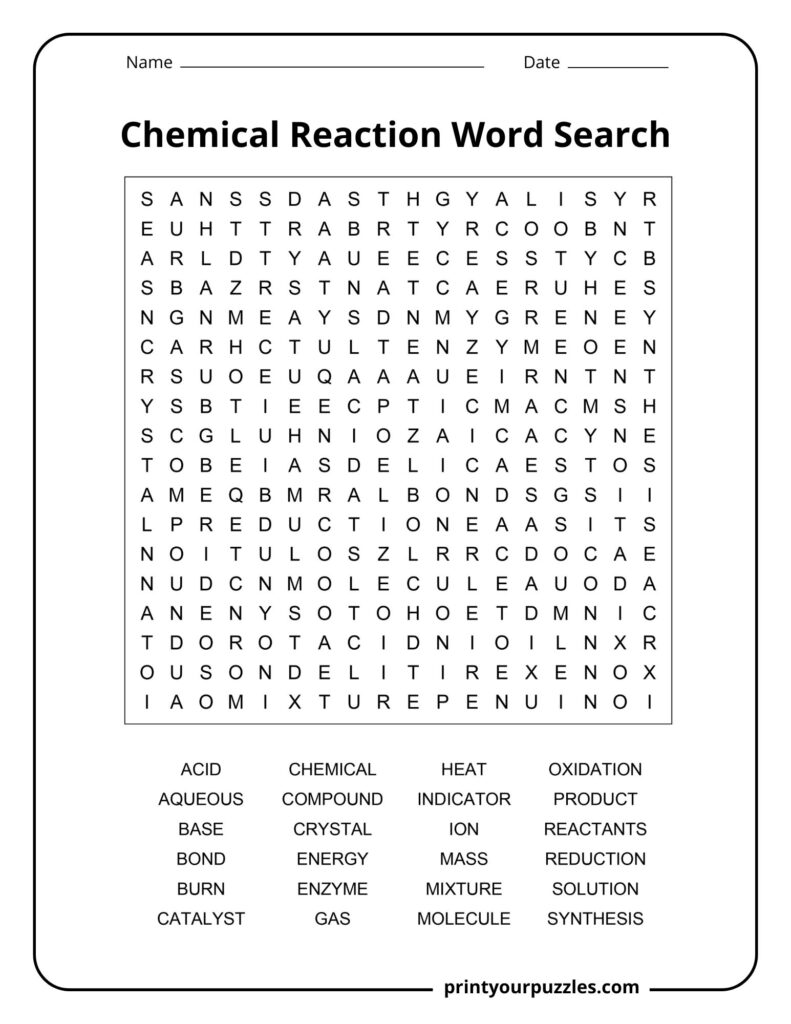
ACID, AQUEOUS, BASE, BOND, BURN, CATALYST, CHEMICAL, COMPOUND, CRYSTAL, ENERGY, ENZYME, GAS, HEAT, INDICATOR, ION, MASS, MIXTURE, MOLECULE, OXIDATION, PRODUCT, REACTANTS, REDUCTION, SOLUTION, SYNTHESIS
ACID – A substance that donates hydrogen ions in solution, tastes sour, turns litmus paper red, and has a pH value less than seven on the pH scale.
AQUEOUS – A solution in which water acts as the solvent, dissolving other substances. Commonly abbreviated as “aq” in chemical equations to indicate water-based solutions.
BASE – A substance that accepts hydrogen ions or donates hydroxide ions in solution, feels slippery, turns litmus paper blue, and has a pH greater than seven.
BOND – The attractive force holding atoms together in molecules or compounds, formed by sharing or transferring electrons between atoms, creating stable chemical structures.
BURN – A combustion reaction where a substance rapidly combines with oxygen, releasing heat and light energy, often producing flames and converting materials into new products.
CATALYST – A substance that speeds up a chemical reaction by lowering the activation energy required, without being permanently consumed or chemically changed in the process itself.
CHEMICAL – A substance with distinct molecular composition and properties, or relating to the interactions, transformations, and properties of matter at the atomic and molecular level.
COMPOUND – A pure substance formed when two or more different elements chemically combine in fixed proportions, creating new properties different from the original elements.
CRYSTAL – A solid material whose atoms or molecules are arranged in a highly ordered, repeating three-dimensional pattern, forming distinct geometric shapes with flat surfaces.
ENERGY – The capacity to do work or produce change in matter, released or absorbed during chemical reactions, existing in forms like heat, light, or electrical energy.
ENZYME – A biological catalyst, typically a protein, that accelerates specific biochemical reactions in living organisms by lowering activation energy without being consumed in the process.
GAS – A state of matter with no fixed shape or volume, where molecules move freely and spread to fill their container, often produced or consumed in reactions.
HEAT – Thermal energy transferred between substances due to temperature differences, often released in exothermic reactions or absorbed in endothermic reactions during chemical changes.
INDICATOR – A substance that changes color in response to chemical conditions like pH levels, used to detect acids, bases, or the endpoint of chemical reactions visually.
ION – An atom or molecule that has gained or lost one or more electrons, resulting in a net positive or negative electrical charge.
MASS – The amount of matter in a substance, measured in grams or kilograms, which remains constant during chemical reactions according to the law of conservation of mass.
MIXTURE – A combination of two or more substances physically blended together without chemical bonding, where each component retains its individual properties and can be separated.
MOLECULE – The smallest unit of a chemical compound consisting of two or more atoms bonded together, which retains the chemical properties of that substance.
OXIDATION – A chemical process where a substance loses
electrons, often involving combination with oxygen or increase in oxidation state, commonly occurring in combustion and rusting reactions.
PRODUCT – The new substance or substances formed as a result of a chemical reaction, appearing on the right side of a chemical equation after the arrow.
REACTANTS – The starting substances that undergo chemical change in a reaction, appearing on the left side of a chemical equation before the arrow, consumed to form products.
REDUCTION – A chemical process where a substance gains electrons, decreasing its oxidation state, often occurring simultaneously with oxidation in redox reactions involving electron transfer.
SOLUTION – A homogeneous mixture where one substance (solute) is dissolved uniformly in another substance (solvent), forming a single phase with consistent properties throughout.
SYNTHESIS – A chemical reaction where two or more simple substances combine to form a more complex compound, also called a combination reaction in chemistry.
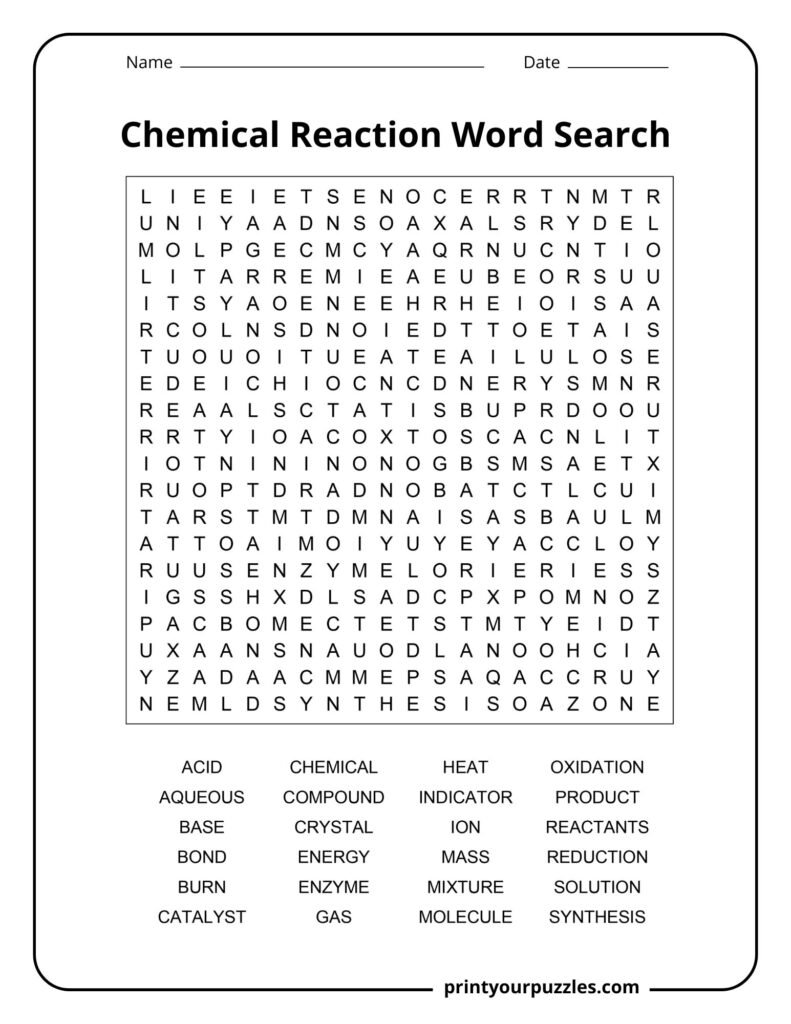
ACID, AQUEOUS, BASE, BOND, BURN, CATALYST, CHEMICAL, COMPOUND, CRYSTAL, ENERGY, ENZYME, GAS, HEAT, INDICATOR, ION, MASS, MIXTURE, MOLECULE, OXIDATION, PRODUCT, REACTANTS, REDUCTION, SOLUTION, SYNTHESIS
A chemical reaction is a process where substances called reactants transform into different substances called products through breaking and forming chemical bonds, creating new molecular structures.
Signs include color change, temperature change, gas production (bubbles), precipitate formation (solid appearing), light emission, or odor change, indicating new substances have formed.
Physical changes alter appearance without changing molecular composition (like melting ice), while chemical changes create entirely new substances with different properties through molecular rearrangement.
The main types include synthesis (combination), decomposition, single replacement, double replacement, and combustion reactions, each following distinct patterns of how atoms rearrange and combine.
Some reactions are reversible and can proceed in both directions, while others are irreversible. Reversibility depends on reaction conditions, energy requirements, and the stability of products formed.
When iron combines with oxygen and water, it forms iron oxide (rust) through oxidation. This slow chemical reaction gradually weakens metal structures over time.
Your body uses enzymes to break down food through chemical reactions, converting proteins, carbohydrates, and fats into smaller molecules your cells can absorb and use.
Different metal compounds produce specific colors when burned: strontium makes red, copper creates blue, and barium produces green through combustion reactions at high temperatures.
Batteries convert chemical energy into electrical energy through oxidation-reduction reactions, where electrons transfer between chemicals to create the electric current powering your devices.
Plants use sunlight to convert carbon dioxide and water into glucose and oxygen, producing the oxygen we breathe and food energy for nearly all life.
Purus ut praesent facilisi dictumst sollicitudin cubilia ridiculus.