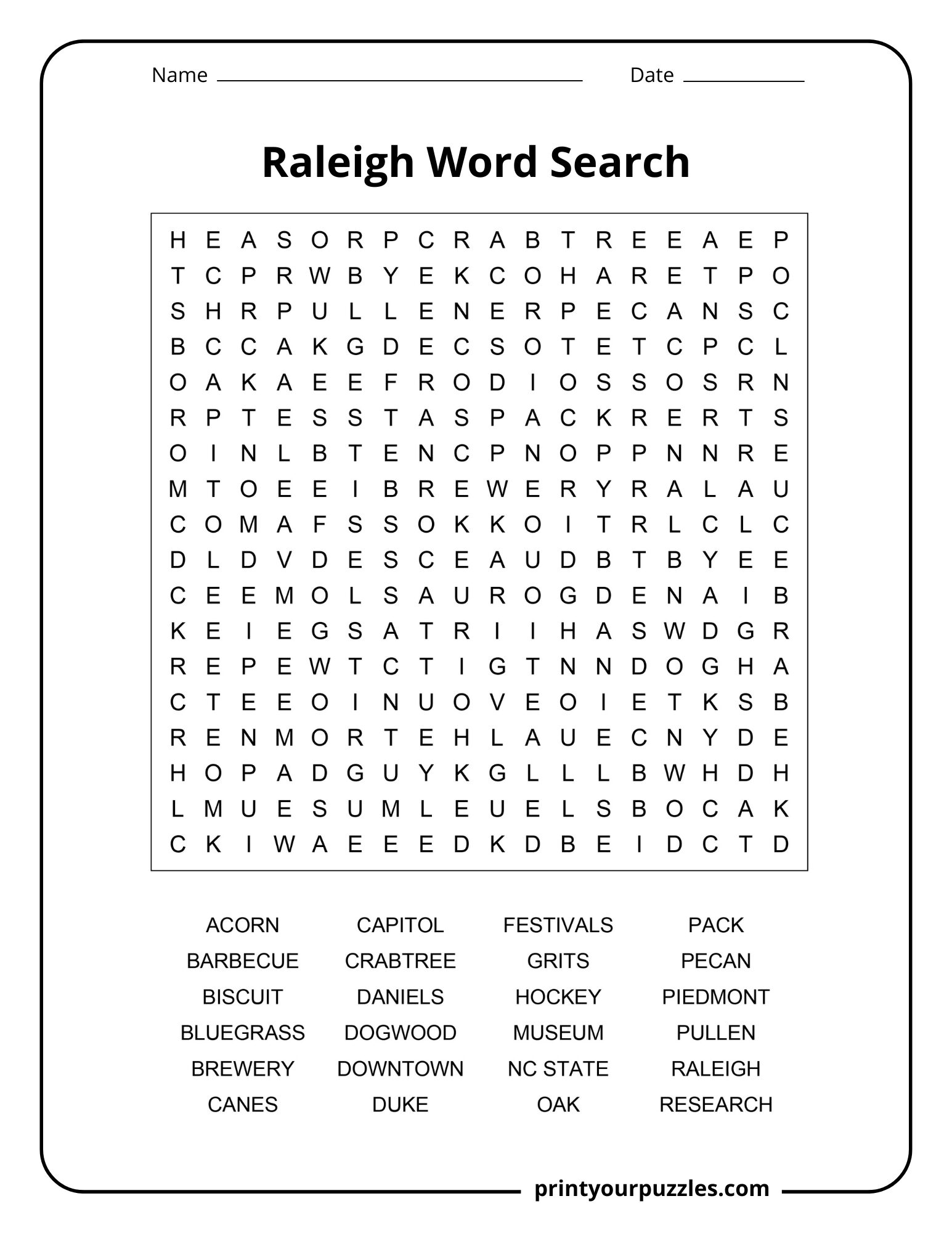

Chemistry word search puzzles offer an engaging and educational way to explore the fundamental concepts of chemistry while having fun. This Chemistry word search printable features 24 carefully selected terms that cover essential topics in the field, from basic building blocks like atoms and molecules to important processes such as oxidation and reactions. Each word has been limited to nine letters or fewer, making them perfect for puzzle enthusiasts of all ages and skill levels.
What makes this word search printable particularly valuable is that all 24 keywords are thoroughly defined with clear, concise explanations ranging from 20 to 30 words each. This means learners can not only find and identify chemistry terminology but also understand what each term means, reinforcing their knowledge as they solve the puzzle. The alphabetically organized word list includes fundamental concepts like acids, bases, ions, and elements, along with laboratory equipment terms such as apparatus and condenser.
Whether you’re a student studying for an exam, a teacher looking for classroom activities, or simply someone interested in chemistry, this puzzle provides an enjoyable method to familiarize yourself with essential chemical terminology while testing your observation skills.
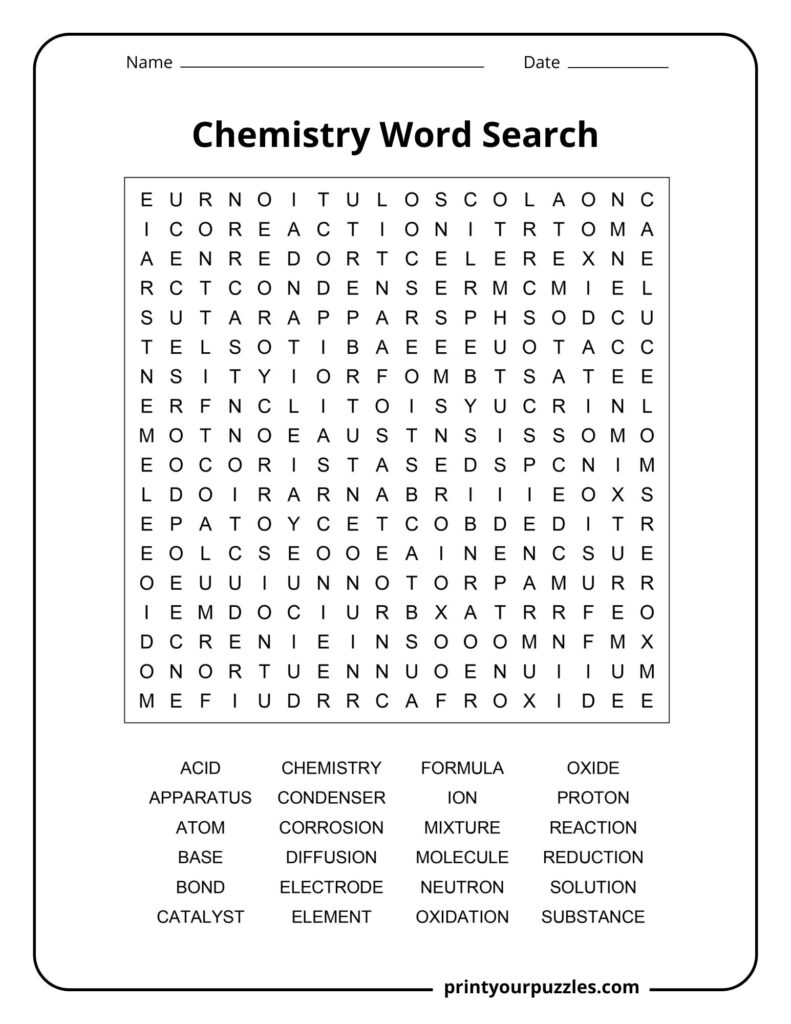
ACID, APPARATUS, ATOM, BASE, BOND, CATALYST, CHEMISTRY, CONDENSER, CORROSION, DIFFUSION, ELECTRODE, ELEMENT, FORMULA, ION, MIXTURE, MOLECULE, NEUTRON, OXIDATION, OXIDE, PROTON, REACTION, REDUCTION, SOLUTION, SUBSTANCE
ACID – A substance that donates hydrogen ions in solution, has a pH below 7, tastes sour, and turns blue litmus paper red when tested.
APPARATUS – Laboratory equipment and tools used to conduct chemical experiments, including glassware, heating devices, measuring instruments, and other specialized scientific instruments for research and analysis.
ATOM – The smallest unit of matter that retains the properties of an element, consisting of a nucleus containing protons and neutrons, surrounded by electrons.
BASE – A substance that accepts hydrogen ions in solution, has a pH above 7, tastes bitter, feels slippery, and turns red litmus paper blue.
BOND – The attractive force that holds atoms together in molecules or compounds, formed by sharing or transferring electrons between atoms to achieve chemical stability.
CATALYST – A substance that increases the rate of a chemical reaction without being consumed in the process, lowering the activation energy required for reactions.
CHEMISTRY – The scientific study of matter, its properties, composition, structure, and the changes it undergoes during chemical reactions and interactions with energy and other substances.
CONDENSER – Laboratory glassware used to cool vapors back into liquid form during distillation, typically consisting of a tube surrounded by a cooling water jacket.
CORROSION – The gradual destruction or deterioration of materials, especially metals, through chemical reactions with their environment, such as oxidation or exposure to acids and moisture.
DIFFUSION – The spontaneous movement of particles from areas of high concentration to low concentration until evenly distributed, occurring in gases, liquids, and solutions without stirring.
ELECTRODE – A conductor through which electric current enters or leaves an electrolyte, battery, or other electrical device, serving as either an anode or cathode.
ELEMENT – A pure substance consisting of only one type of atom that cannot be broken down into simpler substances by chemical means, organized in the periodic table.
FORMULA – A symbolic representation using chemical symbols and numbers to show the types and quantities of atoms present in a molecule or compound of a substance.
ION – An atom or molecule that has gained or lost one or more electrons, resulting in a net electrical charge, either positive or negative.
MIXTURE – A combination of two or more substances that are physically blended but not chemically bonded, retaining their individual properties and can be separated physically.
MOLECULE – The smallest particle of a compound that retains its chemical properties, formed when two or more atoms bond together through covalent or ionic bonds.
NEUTRON – A subatomic particle with no electrical charge found in the nucleus of atoms, having approximately the same mass as a proton, contributing to atomic mass.
OXIDATION – A chemical reaction where a substance loses electrons, increases its oxidation state, or combines with oxygen, often occurring during combustion, rusting, and metabolic processes.
OXIDE – A chemical compound formed when oxygen combines with another element, such as a metal or nonmetal, playing a fundamental role in processes like rusting, combustion, and respiration.
PROTON – A positively charged subatomic particle found in the nucleus of atoms, determining the element’s identity through its atomic number and contributing to atomic mass.
REACTION – A chemical process where substances, called reactants, are transformed into different substances, called products, through breaking and forming chemical bonds between atoms and molecules.
REDUCTION – A chemical reaction where a substance gains electrons, decreases its oxidation state, or loses oxygen, always occurring simultaneously with oxidation in redox reactions.
SOLUTION – A homogeneous mixture where one substance, the solute, is completely dissolved in another substance, the solvent, forming a single phase with uniform composition throughout.
SUBSTANCE – A form of matter with uniform and definite composition, having specific physical and chemical properties, classified as either an element or a chemical compound.
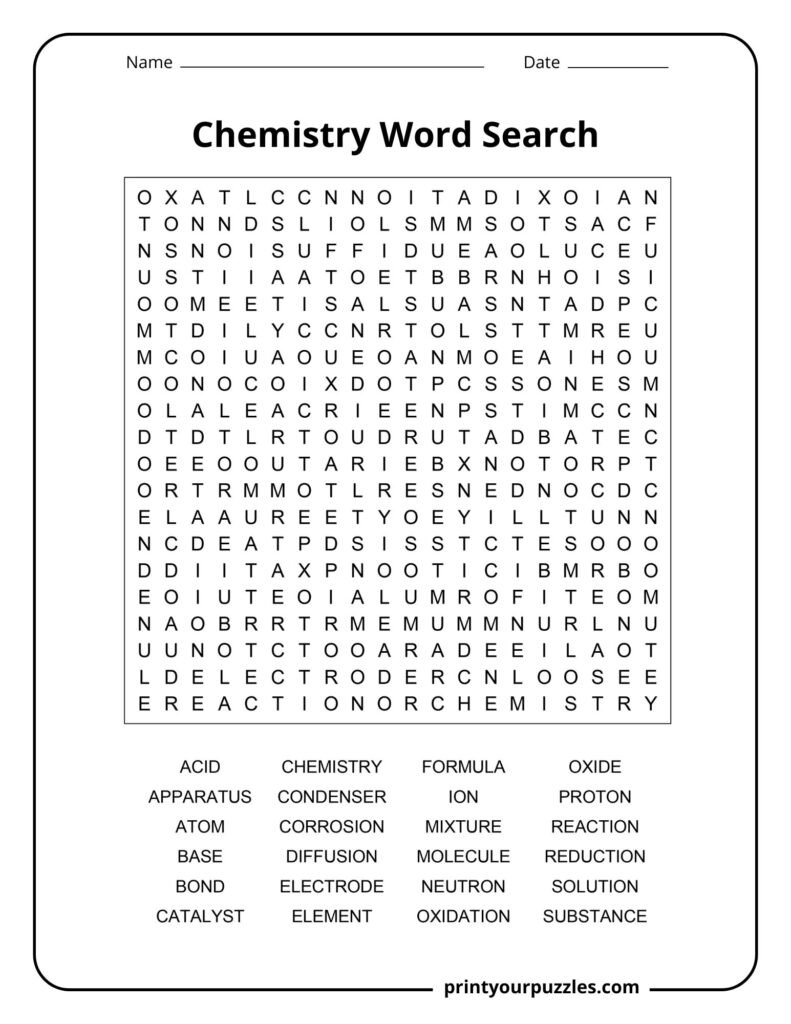
ACID, APPARATUS, ATOM, BASE, BOND, CATALYST, CHEMISTRY, CONDENSER, CORROSION, DIFFUSION, ELECTRODE, ELEMENT, FORMULA, ION, MIXTURE, MOLECULE, NEUTRON, OXIDATION, OXIDE, PROTON, REACTION, REDUCTION, SOLUTION, SUBSTANCE
Chemistry is the scientific study of matter, its properties, composition, structure, and the changes it undergoes through chemical reactions and interactions with energy.
Chemistry is essential for understanding our world, developing medicines, creating new materials, solving environmental problems, improving food production, and advancing technology in countless industries.
The five main branches are organic chemistry, inorganic chemistry, analytical chemistry, physical chemistry, and biochemistry, each focusing on different aspects of chemical science.
Chemists research and develop new substances, analyze materials, test products for quality and safety, create pharmaceuticals, develop sustainable solutions, and teach chemistry concepts.
Chemistry is everywhere: cooking food, cleaning products, cosmetics, medications, fuel for vehicles, batteries, plastics, textiles, water purification, and countless other daily applications.
At a specific pressure called the triple point, water can exist as solid, liquid, and gas all at once, demonstrating the fascinating relationship between temperature and pressure.
Mercury and bromine are the only elements that exist in liquid form at standard room temperature, making them unique among the 118 elements on the periodic table.
Both are pure carbon, but their atoms arrange differently. Diamond’s structure makes it the hardest natural material, while graphite is soft enough to write with.
Known as the Mpemba effect, hot water sometimes freezes more quickly than cold water under certain conditions, though scientists still debate exactly why this occurs.
Glass is technically a supercooled liquid or amorphous solid rather than a true solid, as its molecules aren’t arranged in a regular crystalline structure like typical solids.
Purus ut praesent facilisi dictumst sollicitudin cubilia ridiculus.