
Ecology word search puzzles offer an engaging and educational way to explore environmental science concepts while having fun. This comprehensive activity combines entertainment with learning, making it perfect for students, teachers, and nature enthusiasts of all ages.
Our Ecology word search printable features twenty-four carefully selected terms, each representing fundamental concepts in environmental science. From basic elements like carbon and energy to complex systems like ecosystems and food webs, these words encompass the essential vocabulary needed to understand our natural world. The puzzle includes biomes such as deserts, forests, and grasslands, alongside important ecological processes like composting and conservation.
What makes this word search printable particularly valuable is that every term comes with a detailed definition of 20-30 words, ensuring learners don’t just find the words but truly understand their meanings. This dual approach reinforces vocabulary retention while building ecological literacy. Whether used in classrooms, homeschool settings, or for personal enrichment, this resource transforms a simple puzzle into a meaningful educational experience that deepens appreciation for Earth’s interconnected systems and the importance of environmental stewardship.
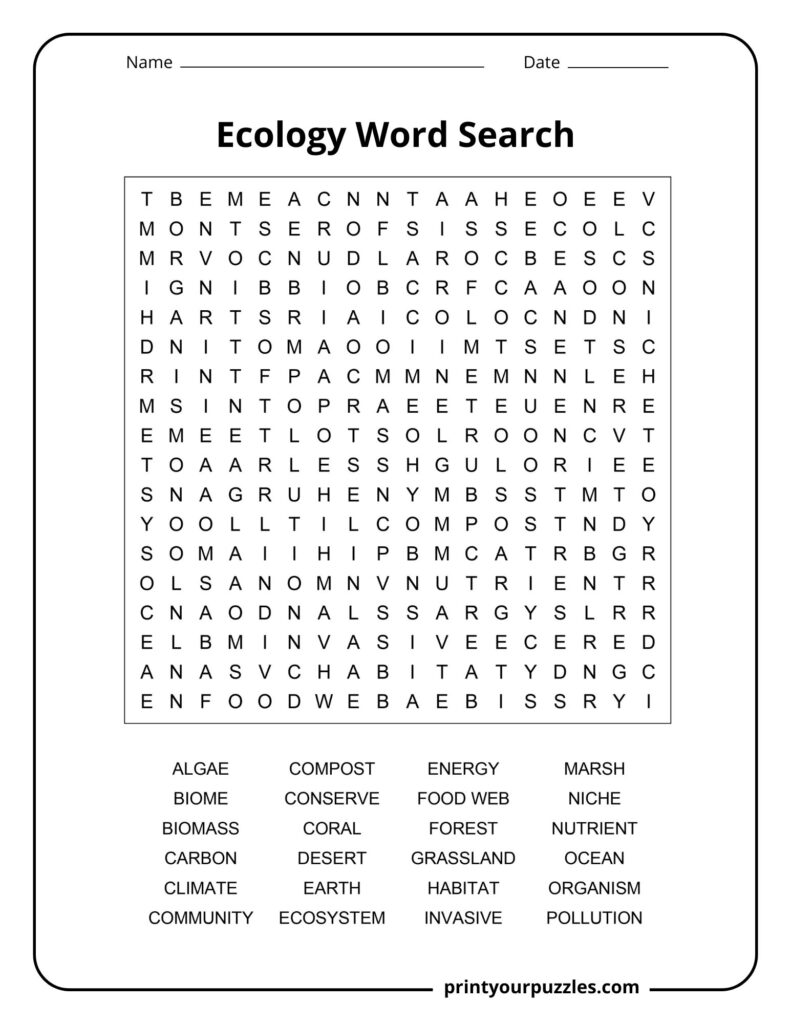
ALGAE, BIOME, BIOMASS, CARBON, CLIMATE, COMMUNITY, COMPOST, CONSERV, CORAL, DESERT, EARTH, ECOSYSTEM, ENERGY, FOOD WEB, FOREST, GRASSLAND, HABITAT, INVASIVE, MARSH, NICHE, NUTRIENT, OCEAN, ORGANISM, POLLUTION
ALGAE – Simple aquatic organisms that perform photosynthesis, ranging from microscopic phytoplankton to large seaweeds. They form the foundation of many aquatic food chains and produce significant oxygen.
BIOME – A large geographical region characterized by specific climate conditions, plants, and animals. Examples include tundra, rainforest, desert, and grassland ecosystems distributed across continents with similar environmental conditions.
BIOMASS – The total mass of living organisms in a specific area or ecosystem. It includes all plants, animals, and microorganisms, often measured to assess ecosystem productivity and energy availability.
CARBON – A fundamental chemical element essential for all life forms. It cycles through ecosystems via photosynthesis, respiration, decomposition, and combustion, playing a critical role in climate regulation.
CLIMATE – Long-term patterns of temperature, precipitation, humidity, and wind in a particular region. Climate influences which species can survive and determines the characteristics of different biomes worldwide.
COMMUNITY – All populations of different species living and interacting together in a specific area. Communities include predators, prey, competitors, and symbiotic relationships that create complex ecological networks and dependencies.
COMPOST – Decomposed organic matter used to enrich soil and improve plant growth. Created by breaking down kitchen scraps, yard waste, and other biodegradable materials through natural microbial activity.
CONSERVE – To protect and preserve natural resources, ecosystems, and biodiversity from degradation or destruction. Conservation efforts aim to maintain ecological balance and ensure sustainable use for future generations.
CORAL – Marine invertebrate animals that form large colonial structures called reefs. Corals provide critical habitat for countless marine species and protect coastlines from erosion and storm damage.
DESERT – An extremely dry biome receiving minimal annual rainfall, typically less than ten inches. Deserts support specially adapted plants and animals that survive extreme temperatures and water scarcity.
EARTH – Our planet, the only known world supporting life. Earth’s interconnected systems include atmosphere, hydrosphere, lithosphere, and biosphere, all working together to sustain diverse ecosystems and organisms.
ECOSYSTEM – A biological community of interacting organisms and their physical environment functioning as an integrated unit. Ecosystems involve energy flow, nutrient cycling, and complex relationships among living and nonliving components.
ENERGY – The capacity to do work, flowing through ecosystems from sunlight to producers, then consumers and decomposers. Energy transfer between trophic levels drives all ecological processes and life functions.
FOOD WEB – A complex network showing interconnected feeding relationships in an ecosystem. Unlike simple food chains, webs reveal how multiple species interact as predators, prey, and competitors simultaneously.
FOREST – A large area dominated by trees and understory vegetation. Forests provide habitat for countless species, regulate climate, produce oxygen, store carbon, and prevent soil erosion while supporting biodiversity.
GRASSLAND – A biome dominated by grasses rather than trees, found in temperate and tropical regions. Grasslands support grazing animals, maintain soil health, and include prairies, steppes, and savannas worldwide.
HABITAT – The natural environment where a particular species lives, providing necessary food, water, shelter, and space. Each organism requires specific habitat conditions to survive, reproduce, and thrive successfully.
INVASIVE – Non-native species that spread aggressively, causing ecological or economic harm. Invasive organisms outcompete native species, disrupt ecosystems, and reduce biodiversity by altering established natural community structures.
MARSH – A wetland ecosystem characterized by herbaceous plants growing in waterlogged soil. Marshes filter pollutants, prevent flooding, provide wildlife habitat, and support diverse plant and animal communities.
NICHE – The specific role and position a species occupies in its ecosystem, including its habitat, diet, behavior, and interactions. Each organism’s niche minimizes competition through specialization.
NUTRIENT – Chemical substances essential for organism growth and survival, including nitrogen, phosphorus, and potassium. Nutrients cycle through ecosystems via decomposition, absorption, and release, supporting all life forms continuously.
OCEAN – Vast saltwater bodies covering approximately seventy percent of Earth’s surface. Oceans regulate climate, produce oxygen, support incredible biodiversity, and provide essential resources for millions of species including humans.
ORGANISM – Any individual living thing, from microscopic bacteria to massive whales. Organisms grow, reproduce, respond to stimuli, maintain homeostasis, and require energy to survive in their respective environments.
POLLUTION – Harmful substances or energy introduced into the environment, causing damage to ecosystems and organisms. Pollution includes air, water, soil, noise, and light contamination from human activities.
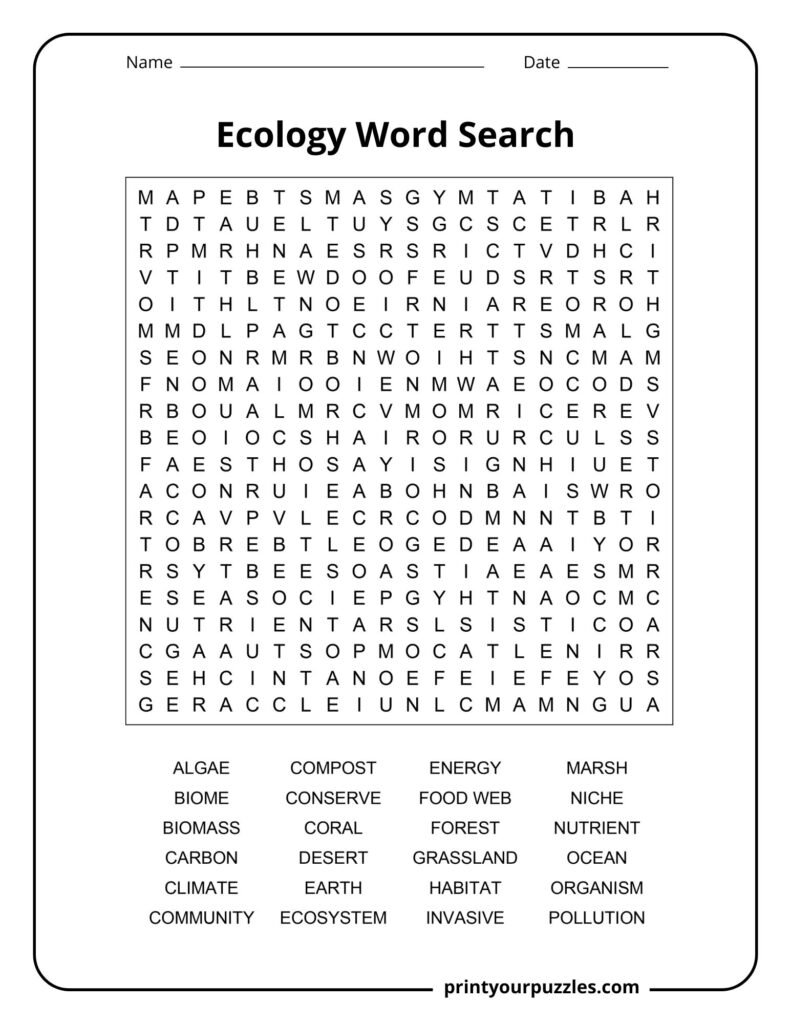
ALGAE, BIOME, BIOMASS, CARBON, CLIMATE, COMMUNITY, COMPOST, CONSERV, CORAL, DESERT, EARTH, ECOSYSTEM, ENERGY, FOOD WEB, FOREST, GRASSLAND, HABITAT, INVASIVE, MARSH, NICHE, NUTRIENT, OCEAN, ORGANISM, POLLUTION
Ecology is the scientific study of interactions between organisms and their environment. It examines relationships among living things and how they affect ecosystems, energy flow, nutrient cycles, and biodiversity patterns.
Ecology helps us understand environmental problems, conserve biodiversity, and manage natural resources sustainably. This knowledge is essential for addressing climate change, habitat loss, pollution, and maintaining healthy ecosystems for future generations.
A habitat is the physical place where an organism lives, while a niche is its specific role in the ecosystem, including feeding habits, behaviors, and interactions with other species.
Energy flows from the sun to producers through photosynthesis, then to consumers and decomposers. Each transfer loses approximately ninety percent of energy as heat, creating pyramid-shaped trophic level structures in ecosystems.
Major threats include habitat destruction, climate change, pollution, invasive species, and overexploitation of resources. These human-caused pressures reduce biodiversity, disrupt ecological balance, and threaten ecosystem services we depend upon daily.
One oak tree can support over 2,000 different species including insects, birds, mammals, fungi, and lichens, creating an entire miniature ecosystem within its branches and roots.
Mycorrhizal fungi form vast underground networks called “wood wide webs,” connecting tree roots and allowing forests to share nutrients, water, and even warning signals about pest attacks.
Despite rainforests’ reputation, marine phytoplankton and algae actually produce 50-80% of our planet’s oxygen through photosynthesis, making oceans truly the lungs of Earth.
When attacked by herbivores, certain plants release chemical signals into the air, warning neighboring plants to activate their defensive compounds before being eaten themselves, creating plant communication networks.
Without bacteria and fungi breaking down dead matter, nutrients would remain locked in corpses and waste. Decomposers make life possible by continuously recycling essential elements through ecosystems.
Purus ut praesent facilisi dictumst sollicitudin cubilia ridiculus.