
Gucci is one of the best-known names in luxury fashion, with a history that began in Florence, Italy, in 1921. Its founder, Guccio Gucci, had previously worked in environments connected with wealthy travelers and luxury luggage, experiences that helped shape his interest in fine leather goods and sophisticated travel accessories. When he opened his own shop, he focused on craftsmanship, quality materials, and products that appealed to customers who valued both practicality and elegance.
The business grew steadily as Gucci produced luggage, handbags, saddlery-inspired accessories, and other leather goods. Florence’s strong tradition of craftsmanship gave the company a natural foundation, while equestrian influences became especially important to its visual style. Horsebit details, leather straps, and riding-inspired shapes eventually became some of the brand’s most recognizable design elements.
Gucci expanded as Guccio’s sons became involved in the company, helping open new stores and take the brand beyond Florence. Rome and Milan became important locations, and international expansion followed. By the mid-twentieth century, Gucci products were attracting celebrities, aristocrats, and wealthy travelers, which helped strengthen the company’s image as a symbol of Italian luxury.
Several distinctive designs also emerged during this period. The bamboo-handled bag became famous for its unusual construction, while the green-and-red stripe, double-G logo, horsebit loafer, and patterned canvas helped create a visual identity that customers could recognize immediately.
A printable Gucci word search can connect many of these elements through terms related to Florence, leather, bamboo, horsebits, handbags, loafers, logos, fashion, and craftsmanship. These words reflect how the brand grew from a specialist leather-goods business into something much broader.
Over time, Gucci expanded into clothing, shoes, fragrances, jewelry, watches, and eyewear, while different creative directors repeatedly reinterpreted its heritage. The company’s history includes both periods of rapid success and difficult family and business disputes, but its ability to reinvent itself helped it remain influential. From a Florentine workshop to an international fashion house, Gucci’s growth shows how craftsmanship, recognizable symbols, celebrity appeal, and changing creative direction can turn a local business into a global luxury brand.
Related Word Searches:
Chanel | Louis Vuitton | Sephora | Levi’s
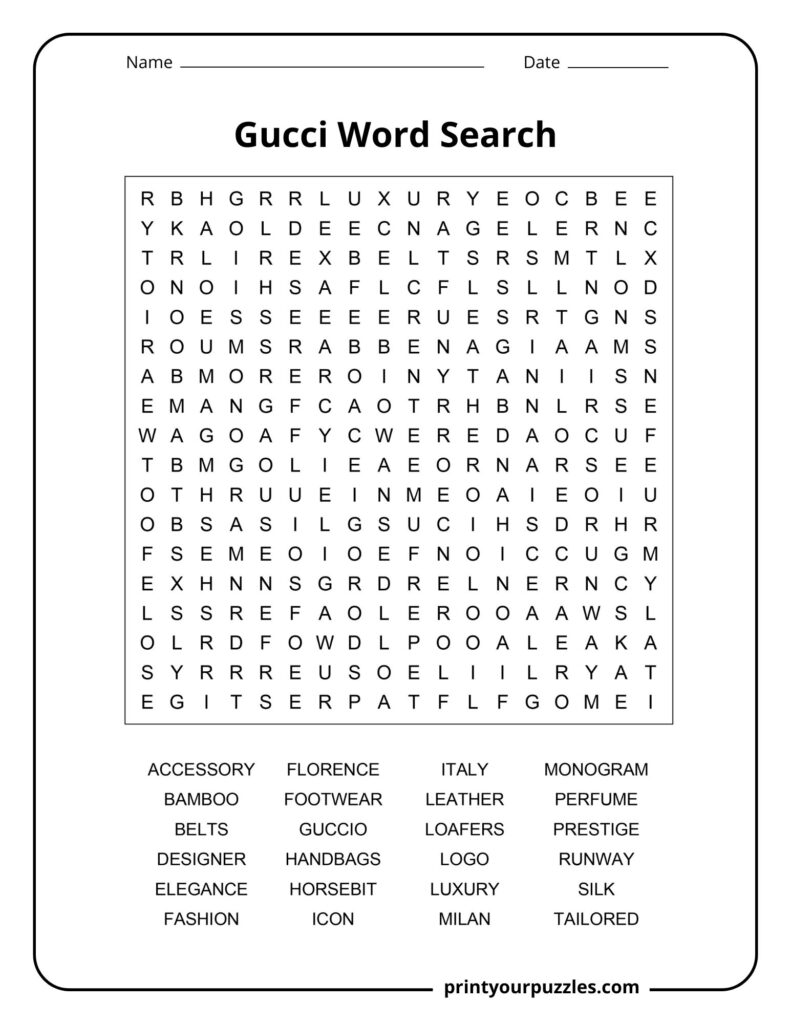
ACCESSORY, BAMBOO, BELTS, DESIGNER, ELEGANCE, FASHION, FLORENCE, FOOTWEAR, GUCCIO, HANDBAGS, HORSEBIT, ICON, ITALY, LEATHER, LOAFERS, LOGO, LUXURY, MILAN, MONOGRAM, PERFUME, PRESTIGE, RUNWAY, SILK, TAILORED
ACCESSORY – A complementary item such as a belt, scarf, or bag that enhances an outfit. Gucci accessories are crafted with exceptional quality, combining fine materials and iconic design codes to elevate any look.
BAMBOO – A natural material used by Gucci since 1947 to craft distinctive bag handles. Introduced due to postwar leather shortages, the bamboo handle became one of the brand’s most enduring and recognisable signatures.
BELTS – A Gucci staple featuring the iconic double-G buckle. Crafted from fine leather, Gucci belts became a global status symbol, widely recognised as one of the brand’s best-selling and most imitated luxury accessories.
DESIGNER – A creative professional who shapes a brand’s aesthetic vision. Gucci has been guided by celebrated designers including Tom Ford, Frida Giannini, and Alessandro Michele, each bringing a transformative and distinctive creative direction.
ELEGANCE – A defining quality of Gucci’s identity, reflecting refined taste, sophisticated craftsmanship, and timeless style. Gucci elegance blends Italian tradition with bold modernity, creating pieces that feel both elevated and deeply desirable.
FASHION – The art and industry of clothing design and trends. Gucci has been a dominant force in global fashion since the 1920s, consistently setting trends through innovative collections that balance heritage with contemporary cultural relevance.
FLORENCE – The Tuscan city where Guccio Gucci founded his first leather goods shop in 1921. Florence remains the spiritual home of the brand, deeply connected to Italy’s artisan traditions and the origins of Gucci’s craftsmanship.
FOOTWEAR – Shoes and boots designed under the Gucci name, ranging from the iconic horsebit loafer to bold runway styles. Gucci footwear is celebrated for its artisanal quality, distinctive details, and strong cultural resonance.
GUCCIO – The founder of the Gucci brand, born in Florence in 1881. Inspired by fine luggage he observed while working in London, Guccio Gucci opened a leather goods shop that would grow into one of the world’s most iconic luxury houses.
HANDBAGS – Among Gucci’s most celebrated creations, including the Bamboo, Jackie, and Dionysus styles. Gucci handbags combine skilled Italian craftsmanship with bold design, making them prized collectibles and enduring symbols of luxury.
HORSEBIT – A metal hardware detail inspired by equestrian bridles, first introduced by Gucci in 1953. The horsebit motif became a defining symbol of the brand, most famously featured on the classic loafer that bears its name.
ICON – A person, object, or symbol of lasting cultural significance. Gucci itself is considered a global fashion icon, and many of its products — from the loafer to the GG monogram — have achieved iconic status in their own right.
ITALY – The country that gave birth to Gucci and remains central to its identity. Italian craftsmanship, culture, and aesthetic sensibility are deeply embedded in every Gucci creation, reflecting a proud heritage of artisanal excellence.
LEATHER – The primary material behind Gucci’s origins. Guccio Gucci began with fine leather goods, and leather remains central to the brand’s identity, used in handbags, shoes, belts, and small accessories of exceptional quality.
LOAFERS – Slip-on shoes that became legendary through Gucci’s 1953 horsebit design. The Gucci loafer transcended footwear to become a cultural symbol, worn by icons from royalty to Hollywood stars across multiple generations.
LOGO – The interlocking double-G emblem created in honour of founder Guccio Gucci. One of the most recognised logos in the world, it appears across bags, clothing, and accessories as a bold declaration of luxury heritage.
LUXURY – The core positioning of the Gucci brand, defined by exclusivity, superior craftsmanship, and prestige. Gucci luxury encompasses not only fine materials but also a rich heritage, cultural influence, and a strong aspirational identity.
MILAN – Italy’s fashion capital and home to Gucci’s creative and commercial operations. Milan hosts the brand’s runway shows during Fashion Week, cementing Gucci’s position at the very heart of the global luxury fashion industry.
MONOGRAM – The repeating GG pattern that has become one of Gucci’s most recognisable visual codes. Introduced in the 1960s, the monogram canvas is used across bags, luggage, and accessories, representing the brand’s heritage and prestige.
PERFUME – Gucci’s fragrance line, which has been an important part of the brand since the 1970s. From the classic Gucci No. 1 to modern releases, Gucci perfumes extend the brand’s luxury identity into the world of scent.
PRESTIGE – The high regard and admiration that Gucci commands worldwide. Built over a century through quality, innovation, and cultural relevance, Gucci’s prestige places it among the most respected and desirable luxury brands in history.
RUNWAY – The elevated catwalk where Gucci unveils its seasonal collections. Gucci runway shows, held in Milan and beyond, are celebrated worldwide as major fashion events that set global trends.
SILK – A luxurious natural fabric used by Gucci in scarves, blouses, and accessories. Gucci silk pieces are known for their vibrant prints and exceptional quality, reflecting the brand’s commitment to fine materials and Italian artisanship.
TAILORED – Clothing precisely cut and constructed to achieve a refined, polished fit. Gucci’s tailored pieces blend Italian sartorial tradition with bold, contemporary styling, reflecting the brand’s ability to honour craft while pushing creative boundaries.
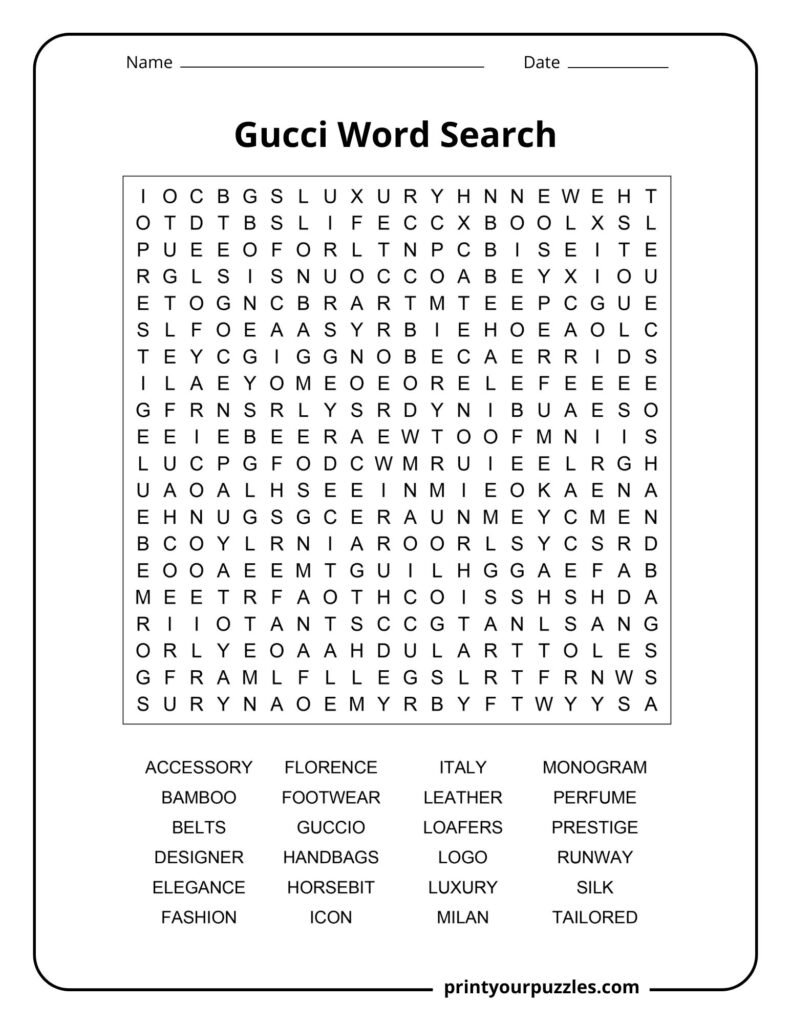
ACCESSORY, BAMBOO, BELTS, DESIGNER, ELEGANCE, FASHION, FLORENCE, FOOTWEAR, GUCCIO, HANDBAGS, HORSEBIT, ICON, ITALY, LEATHER, LOAFERS, LOGO, LUXURY, MILAN, MONOGRAM, PERFUME, PRESTIGE, RUNWAY, SILK, TAILORED
Guccio Gucci founded the brand in Florence, Italy, in 1921, opening a small leather goods and luggage shop inspired by the fine baggage he admired while working in London.
Gucci gained recognition for its exceptional leather craftsmanship, equestrian-inspired designs, and iconic details like the horsebit and the green-red-green stripe, which became enduring symbols of Italian luxury.
Through expansion into international markets during the 1950s and 1960s, celebrity clientele, and bold product icons like the bamboo bag and GG monogram, Gucci grew into a worldwide luxury powerhouse.
Tom Ford revitalised the brand in the 1990s with bold sensuality, while Alessandro Michele redefined it after 2015 with maximalist romanticism, making both among Gucci’s most transformative creative leaders.
Gucci is owned by Kering, the French luxury group, which acquired the brand in 1999. Under Kering, Gucci has grown into one of the world’s highest-revenue luxury fashion houses.
The House of Gucci: A Sensational Story of Murder, Madness, Glamour, and Greed by Sara Gay Forden. Forden masterfully weaves fifteen years of Milan reporting into a gripping, Shakespearean saga — tracing Gucci’s rise from a Florentine luggage shop to global luxury icon, ambition, murder and all.
Due to postwar leather shortages in 1947, Gucci used bamboo — heated and shaped by hand — to create bag handles, accidentally producing one of fashion history’s most recognised designs.
While working as a lift operator at the Savoy Hotel in London, Guccio observed wealthy guests’ fine luggage, inspiring him to return to Florence and create his own leather goods brand.
Originally called the Fifties Constance, the bag was renamed the Jackie after Jacqueline Kennedy was repeatedly photographed carrying it, turning it into an instant global luxury icon in the 1960s.
Gucci’s signature webbing stripe was inspired by the girth strap used on saddles. Introduced in the 1950s, it remains one of the most imitated and protected trademarks in luxury fashion.
Throughout the 1980s, bitter internal disputes among the Gucci family led to financial crisis and loss of control. The family was eventually bought out, paving the way for the brand’s remarkable revival.