
This Little Rock word search offers an engaging way to explore Arkansas’s capital city through 24 carefully selected words that capture its rich history, culture, and significance. From the courageous Little Rock Nine and civil rights pioneer Daisy Bates to iconic landmarks like the State Capitol and Arkansas River, each term represents an essential element of this remarkable Southern city.
This Little Rock word search printable features words related to historic events, notable people, delicious Southern cuisine, and important places that define Little Rock’s identity. You’ll discover terms like Barbecue, Catfish, Blues, Integrate, and Riverboat—each telling part of the city’s compelling story. The puzzle includes words ranging from four to nine letters, providing an enjoyable challenge for students, teachers, residents, and puzzle enthusiasts alike.
What makes this word search printable especially valuable is that every single word is accompanied by a detailed 20-30 word definition, helping solvers understand the significance of each term they find. As you locate words hidden horizontally, vertically, and diagonally throughout the grid, you’ll gain deeper appreciation for Little Rock’s contributions to American civil rights history, its vibrant cultural heritage, and its enduring Southern charm.
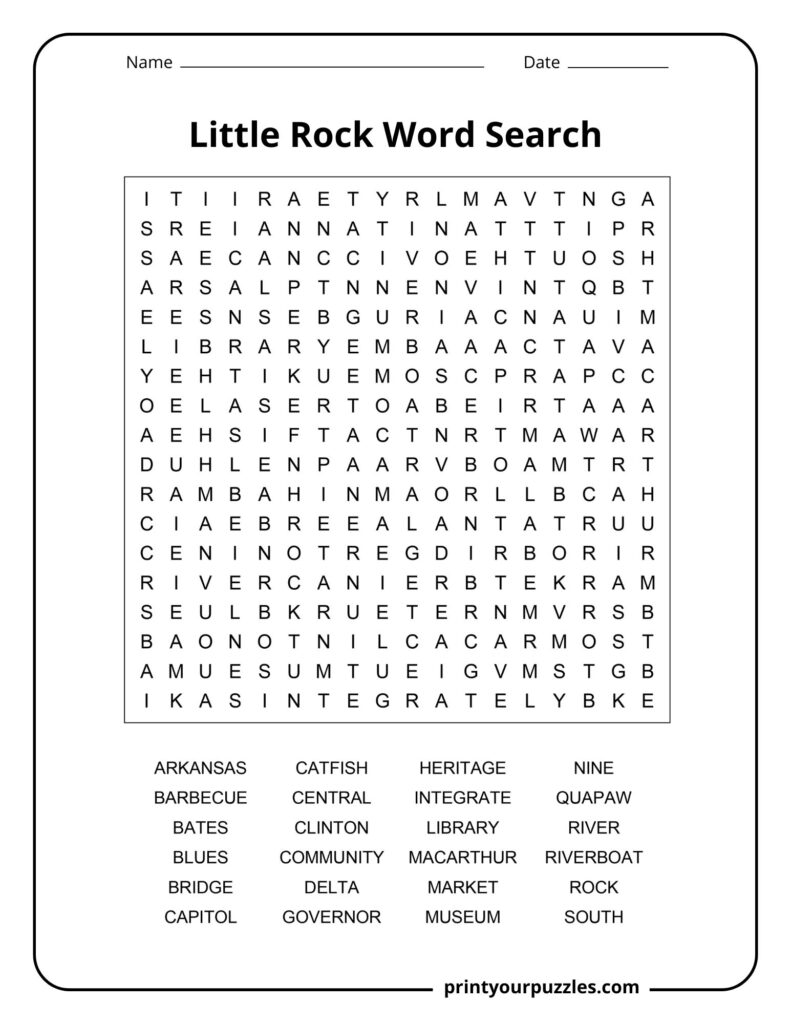
ARKANSAS, BARBECUE, BATES, BLUES, BRIDGE, CAPITOL, CATFISH, CENTRAL, CLINTON, COMMUNITY, DELTA, GOVERNOR, HERITAGE, INTEGRATE, LIBRARY, MACARTHUR, MARKET, MUSEUM, NINE QUAPAW, RIVER, RIVERBOAT, ROCK, SOUTH
ARKANSAS – The Natural State, where Little Rock serves as the capital city and largest metropolitan area, representing the state’s political, economic, and cultural center since 1821.
BARBECUE – Southern-style slow-cooked meat tradition deeply rooted in Little Rock’s culinary culture, featuring smoky pork ribs, pulled pork, and tangy sauces served at numerous local establishments.
BATES – Daisy Bates, courageous civil rights activist and journalist who mentored the Little Rock Nine and fought tirelessly for school desegregation during the 1957 Central High crisis.
BLUES – Musical genre with deep roots in Arkansas Delta culture, influencing Little Rock’s vibrant music scene through clubs, festivals, and the state’s rich African American heritage.
BRIDGE – The Broadway Bridge and other spans crossing the Arkansas River, connecting Little Rock to North Little Rock and symbolizing the city’s infrastructure and connectivity.
CAPITOL – The majestic Arkansas State Capitol building, completed in 1915, featuring neoclassical architecture and serving as the seat of state government in downtown Little Rock.
CATFISH – Southern culinary staple, typically fried and served with hushpuppies and coleslaw, representing Arkansas’s fishing culture and comfort food traditions throughout the Little Rock area.
CENTRAL – Central High School, site of the pivotal 1957 desegregation crisis where nine African American students bravely integrated the school, now a National Historic Site.
CLINTON – Bill Clinton, 42nd U.S. President, served as Arkansas Governor in Little Rock before his presidency. His presidential library opened along the Arkansas River in 2004.
COMMUNITY – Little Rock’s diverse population working together through challenges and growth, fostering civic engagement, cultural diversity, and neighborhood pride across the metropolitan area’s various districts.
DELTA – The Arkansas Delta region’s cultural influence on Little Rock, bringing agricultural heritage, blues music, and distinct Southern traditions to the state’s capital city.
GOVERNOR – The Arkansas Governor’s Mansion located in Little Rock’s historic Quapaw Quarter, home to the state’s chief executive and symbol of political leadership.
HERITAGE – Little Rock’s rich historical legacy encompassing Native American roots, Civil War history, civil rights struggles, and diverse cultural traditions preserved through museums and historic sites.
INTEGRATE – The historic 1957 act of desegregating Central High School, when federal troops enforced equality, making Little Rock synonymous with the civil rights movement’s pivotal moments.
LIBRARY – The Clinton Presidential Library, opened in 2004 along the Arkansas River, housing presidential archives and serving as a major cultural attraction and research center.
MACARTHUR – General Douglas MacArthur, born at Little Rock’s Arsenal in 1880, became one of America’s most decorated military leaders during World Wars and Korea.
MARKET – River Market District, a vibrant downtown area
featuring farmers markets, restaurants, shops, and entertainment venues along the scenic Arkansas River waterfront and pavilion.
MUSEUM – Little Rock houses numerous museums including the MacArthur Museum of Arkansas Military History, Arkansas Arts Center, and Museum of Discovery, enriching cultural education.
NINE – The Little Rock Nine, courageous African American students—Melba, Minnijean, Elizabeth, Ernest, Terrence, Carlotta, Jefferson, Gloria, and Thelma—who integrated Central High School in 1957.
QUAPAW – Indigenous tribe originally inhabiting the Arkansas region before European settlement, whose name graces Little Rock’s historic Quapaw Quarter neighborhood preserving Victorian-era architecture.
RIVER – The Arkansas River flows through Little Rock, providing scenic beauty, recreational opportunities, and historically serving as a vital transportation route for commerce and development.
RIVERBOAT – Historic paddle-wheel vessels once common on the Arkansas River, representing 19th-century transportation and commerce, now celebrated through tourism and river cruises.
ROCK – The small rock formation on the Arkansas River’s bank that gave the city its name, distinguishing it from the “big rock” upstream location.
SOUTH – Little Rock embodies Southern culture, hospitality, cuisine, and traditions while serving as Arkansas’s gateway city blending Old South charm with modern urban development.
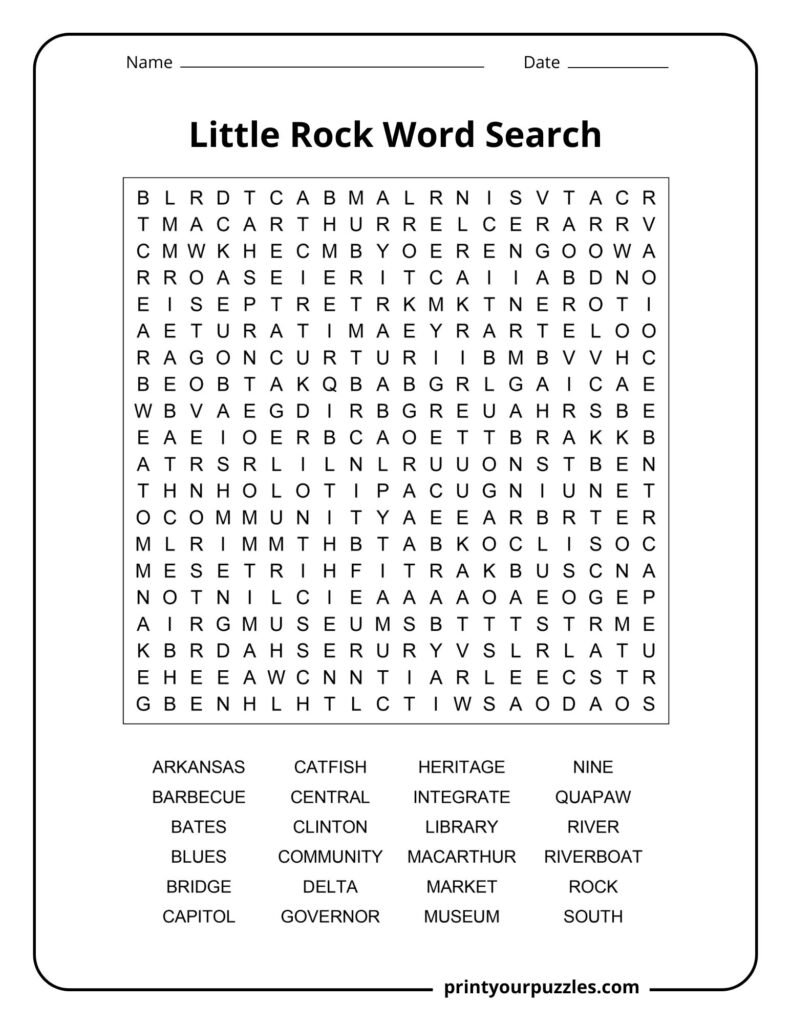
ARKANSAS, BARBECUE, BATES, BLUES, BRIDGE, CAPITOL, CATFISH, CENTRAL, CLINTON, COMMUNITY, DELTA, GOVERNOR, HERITAGE, INTEGRATE, LIBRARY, MACARTHUR, MARKET, MUSEUM, NINE QUAPAW, RIVER, RIVERBOAT, ROCK, SOUTH
Little Rock is most famous for the 1957 Central High School desegregation crisis, when nine African American students integrated the school under federal protection, becoming a pivotal civil rights moment.
The city was named after a small rock formation on the Arkansas River’s south bank, which served as a landmark distinguishing it from a larger rock formation upstream.
Top attractions include the Clinton Presidential Library, Little Rock Central High School National Historic Site, River Market District, Arkansas State Capitol, and the MacArthur Museum of Arkansas Military History.
Little Rock’s cuisine features Southern comfort food including slow-smoked barbecue, fried catfish with hushpuppies, cheese dip (invented in Arkansas), and Delta-inspired soul food reflecting regional traditions.
Little Rock has approximately 202,000 residents in the city and 750,000 in the metro area. The climate is humid subtropical with hot summers, mild winters, and year-round rainfall.
For official city information, government updates, and public services, visit the City of Little Rock website. If you are planning a trip, check out the official tourism portal, Visit Little Rock.
Mexico Chiquito restaurant in North Little Rock created the famous cheese dip in 1935, making Arkansas the birthplace of this beloved Tex-Mex appetizer now served nationwide.
Five-star General Douglas MacArthur was born at Little Rock Arsenal in 1880. The building now houses the MacArthur Museum of Arkansas Military History commemorating his legacy.
The small rock formation that gave the city its name remains visible on the Arkansas River’s bank in Riverfront Park, marked with a bronze plaque for visitors.
The Big Dam Bridge stretches 4,226 feet across Murray Lock and Dam, offering spectacular views and connecting over 15 miles of trails for cyclists and walkers.
Though they met in New Haven, the Clintons built their political careers in Little Rock, where Bill served as Arkansas Governor before becoming President, cementing the city’s political significance.
Purus ut praesent facilisi dictumst sollicitudin cubilia ridiculus.