
North Carolina stretches from the Atlantic Ocean to the highest mountains in the eastern United States, giving it one of the most varied landscapes in the Southeast. Raleigh is the capital, while Charlotte is the largest city and a major center for banking, business, sports, and transportation. Known as The Tar Heel State, North Carolina combines coastal history, mountain beauty, growing cities, strong universities, and a deep sense of regional pride.
The state’s geography changes dramatically from east to west. Along the coast, the Outer Banks form a chain of barrier islands known for beaches, lighthouses, wild horses, shipwreck history, and ocean winds. Farther inland, the Piedmont region includes rolling hills, farms, towns, and major cities such as Raleigh, Durham, Greensboro, and Charlotte. In the west, the Blue Ridge Mountains and Great Smoky Mountains offer forests, waterfalls, scenic drives, and hiking trails. These natural contrasts make a North Carolina word search especially rich in places, animals, landmarks, and landscapes.
History has left a strong mark on North Carolina. Indigenous peoples lived across the region long before European settlement, and the state later became one of the original thirteen colonies. North Carolina played important roles in the American Revolution, the Civil War, and the Civil Rights Movement. It is also famously connected to aviation: in 1903, the Wright brothers made their first successful powered flight at Kitty Hawk, giving the state its proud “First in Flight” identity.
Modern North Carolina has a diverse economy. Banking, technology, healthcare, education, agriculture, manufacturing, tourism, and research all play major roles. The Research Triangle, formed by Raleigh, Durham, and Chapel Hill, is known for universities, science, medicine, and innovation. Agriculture remains important too, especially tobacco, sweet potatoes, poultry, hogs, Christmas trees, and soybeans.
Food and sports add even more local character. North Carolina is famous for barbecue, with eastern vinegar-based styles and Lexington-style pork barbecue both inspiring strong opinions. Sweet tea, hush puppies, biscuits, seafood, and Cheerwine also belong to the state’s food traditions. College basketball is a major passion, especially around Duke, North Carolina, and NC State. As you complete this free printable North Carolina word search, look for words that reveal a state shaped by mountains, coastlines, invention, history, food, and Southern energy.
Explore more of the Southeast States with our South Carolina word search, Virginia word search, Tennessee word search, and the full US States Word Searches collection.
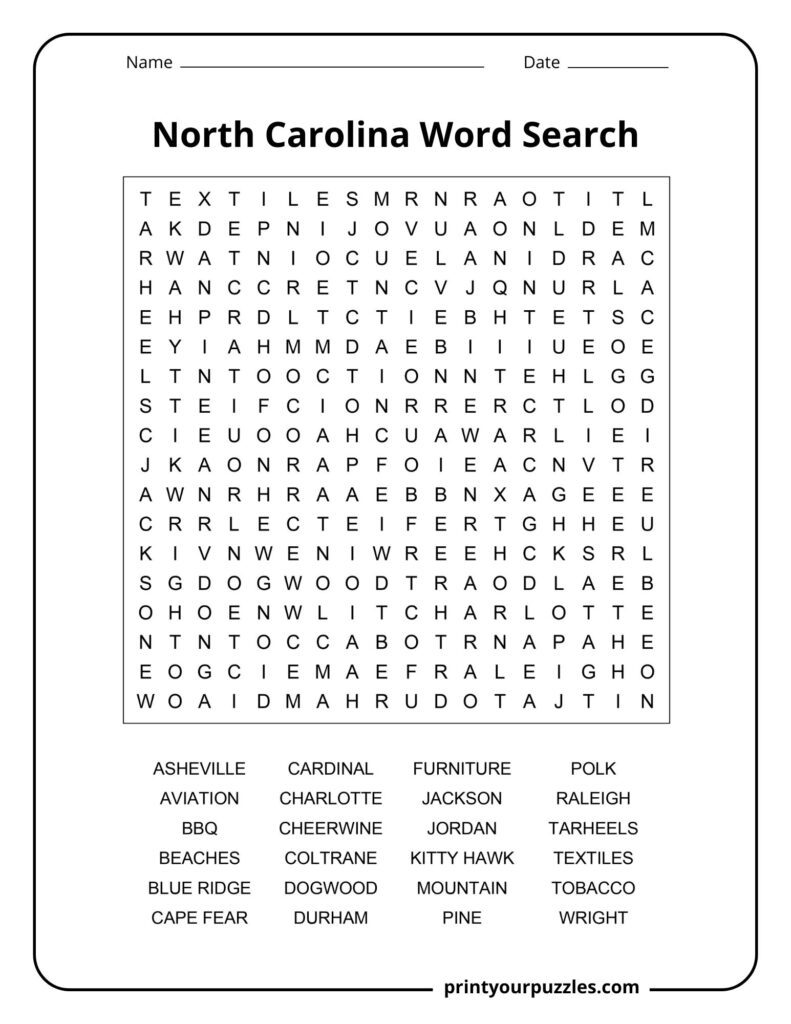
ASHEVILLE, AVIATION, BBQ, BEACHES, BLUE RIDGE, CAPE FEAR, CARDINAL, CHARLOTTE, CHEERWINE, COLTRANE, DOGWOOD, DURHAM, FURNITURE, JACKSON, JORDAN, KITTY HAWK, MOUNTAIN, PINE, POLK, RALEIGH, TARHEELS, TEXTILES, TOBACCO, WRIGHT
ASHEVILLE – Vibrant mountain city in western North Carolina, known for its arts scene, craft breweries, historic Biltmore Estate, and gateway to the Blue Ridge Mountains.
AVIATION – North Carolina claims “First in Flight” as the Wright Brothers achieved powered flight at Kitty Hawk in 1903, making aviation history fundamental to state identity.
BBQ – North Carolina barbecue is legendary, featuring two distinct styles: Eastern (whole hog with vinegar sauce) and Lexington (pork shoulder with tomato-vinegar sauce). Deeply rooted tradition.
BEACHES – The Outer Banks and Crystal Coast offer pristine Atlantic beaches, lighthouses, wild horses, fishing, and coastal tourism drawing millions of visitors annually to North Carolina.
BLUE RIDGE – The Blue Ridge Mountains form North Carolina’s western border, offering spectacular scenery, hiking trails, the Blue Ridge Parkway, and year-round outdoor recreation opportunities.
CAPE FEAR – Historic river and cape near Wilmington, featured in literature and film. The Cape Fear region includes beaches, historic sites, and significant Civil War history.
CARDINAL – The Northern Cardinal, with its brilliant red plumage, was designated North Carolina’s state bird in 1943. Males are bright red; females brownish-red.
CHARLOTTE – North Carolina’s largest city and major financial center, home to Bank of America headquarters, NASCAR Hall of Fame, and the Charlotte Hornets basketball team.
CHEERWINE – Iconic burgundy-colored cherry-flavored soft drink created in Salisbury, North Carolina in 1917. A beloved regional beverage with distinctive sweet cherry taste and caffeine.
COLTRANE – John Coltrane, legendary jazz saxophonist born in Hamlet, North Carolina in 1926. Revolutionary musician who transformed modern jazz with innovative compositions and improvisations.
DOGWOOD – The flowering dogwood became North Carolina’s state flower in 1941. Its white or pink spring blooms blanket forests, symbolizing beauty and renewal.
DURHAM – City in the Research Triangle, home to Duke University, renowned medical facilities, tobacco history, and a thriving tech and pharmaceutical industry hub.
FURNITURE – High Point is the “Furniture Capital of the World,” hosting massive international furniture markets twice yearly. North Carolina dominated American furniture manufacturing for generations.
JACKSON – Andrew Jackson, seventh U.S. President, was born in the Carolina border region in 1767. Known as “Old Hickory,” he was a populist leader.
JORDAN – Michael Jordan, basketball legend, played college basketball at UNC-Chapel Hill and later owned the Charlotte Hornets. Greatest basketball player many consider ever.
KITTY HAWK – Site where Orville and Wilbur Wright achieved the first sustained, powered, heavier-than-air flight on December 17, 1903, forever changing human transportation history.
MOUNTAIN – The Appalachian Mountains dominate western North Carolina, providing stunning vistas, outdoor recreation, distinct mountain culture, and elevation reaching over 6,000 feet at Mount Mitchell.
PINE – Loblolly and longleaf pines are abundant throughout North Carolina. The state is historically called the “Tar Heel
State” partly due to pine tar production.
POLK – James K. Polk, eleventh U.S. President, was born in Mecklenburg County, North Carolina in 1795. He served one term, expanding U.S. territory significantly.
RALEIGH – North Carolina’s capital city since 1792, named after Sir Walter Raleigh. Part of Research Triangle with strong government, education, and technology sectors.
TARHEELS – North Carolina’s nickname and UNC-Chapel Hill’s athletic teams. Term possibly originated from state’s tar, pitch, and turpentine production from abundant pine forests.
TEXTILES – Historically, textile mills dominated North Carolina’s economy, particularly in the Piedmont region. Though declined, textile manufacturing shaped communities and industrial development statewide.
TOBACCO – For over a century, tobacco was North Carolina’s dominant cash crop. Durham’s tobacco industry created fortunes and Duke University. Agriculture remains significant today.
WRIGHT – Orville and Wilbur Wright, Ohio bicycle mechanics who chose North Carolina’s Outer Banks for their aviation experiments due to steady winds and isolation.
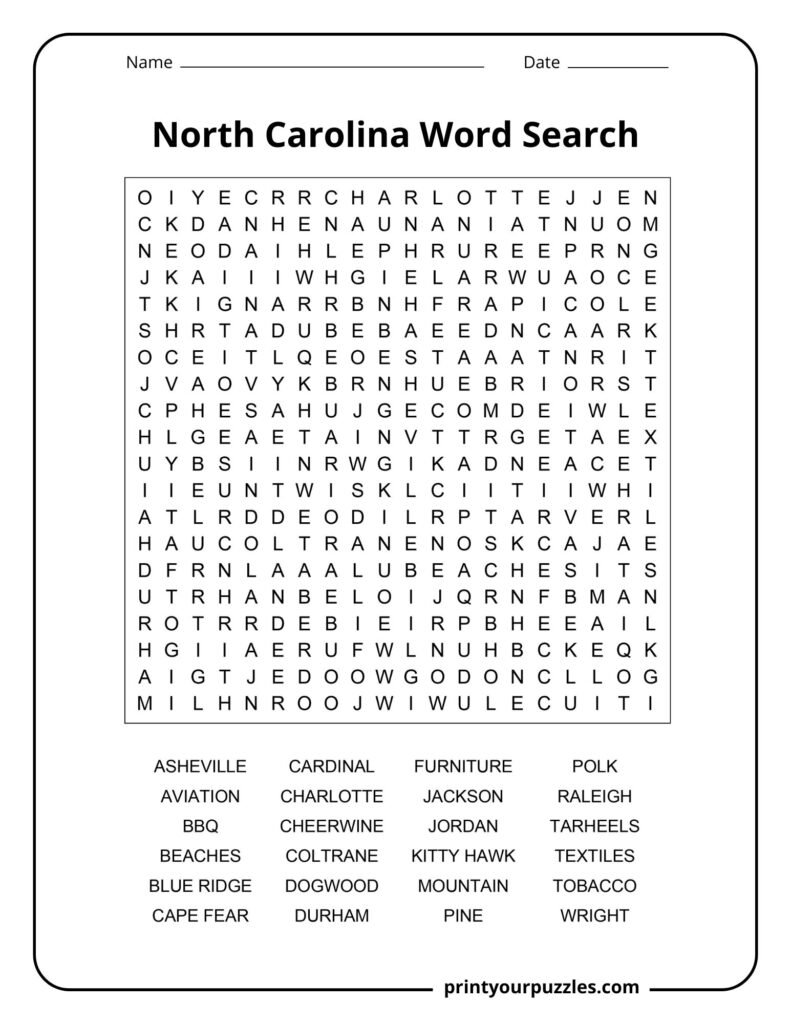
ASHEVILLE, AVIATION, BBQ, BEACHES, BLUE RIDGE, CAPE FEAR, CARDINAL, CHARLOTTE, CHEERWINE, COLTRANE, DOGWOOD, DURHAM, FURNITURE, JACKSON, JORDAN, KITTY HAWK, MOUNTAIN, PINE, POLK, RALEIGH, TARHEELS, TEXTILES, TOBACCO, WRIGHT
North Carolina is famous for being “First in Flight,” beautiful beaches, the Blue Ridge Mountains, barbecue, college basketball, furniture manufacturing, Research Triangle technology hub, and rich tobacco history.
The nickname “Tar Heel State” likely originated from North Carolina’s historic production of tar, pitch, and turpentine from its abundant pine forests during colonial times and beyond.
Charlotte is the largest city and financial center. Raleigh is the capital. Other major cities include Durham, Greensboro, Winston-Salem, Fayetteville, and the coastal city of Wilmington.
North Carolina features diverse climate zones: humid subtropical in coastal and Piedmont regions with hot summers and mild winters; cooler mountain climate in the west with four distinct seasons.
Top attractions include the Blue Ridge Parkway, Outer Banks beaches, Biltmore Estate, Great Smoky Mountains National Park, Wright Brothers National Memorial, NASCAR Hall of Fame, and numerous historic sites.
For official state records and government services, visit the North Carolina State Portal. If you are planning a trip, check out Visit NC.
The Outer Banks are home to wild Spanish Mustangs that have roamed free for over 400 years, descendants of horses from shipwrecked Spanish explorers, protected as living history.
Pharmacist Caleb Bradham created Pepsi-Cola in New Bern, North Carolina in 1893, originally calling it “Brad’s Drink” before renaming it Pepsi-Cola in 1898 for marketing purposes.
The University of North Carolina at Chapel Hill, chartered in 1789 and opened in 1795, is the nation’s first public university to admit students and award degrees.
At 6,684 feet, Mount Mitchell in North Carolina is the highest mountain east of the Mississippi River, offering spectacular views and unique high-elevation spruce-fir forests.
North Carolina produces approximately 60% of the nation’s sweet potato supply, making it America’s undisputed sweet potato capital with ideal sandy soil and climate conditions.