
This Phoenix word search offers an entertaining and educational journey through Arizona’s vibrant capital city. Perfect for all ages, this puzzle challenges you to discover 24 carefully selected words that capture the essence of Phoenix—from its iconic saguaro cacti and scorching desert heat to legendary political figures and beloved sports teams.
What makes this Phoenix word search printable special is its comprehensive approach. You won’t just find geographical locations; you’ll encounter words representing the region’s culture, wildlife, architecture, food, and history. Each term has been thoughtfully chosen to showcase what truly defines this Southwestern metropolis, from the dramatic monsoon season to traditional adobe buildings and the surrounding Valley cities.
Additionally, all words featured in this puzzle are thoroughly defined with detailed 20-30 word descriptions, helping you learn fascinating facts about each term as you search. This makes the word search printable an excellent educational resource for teachers, students, travelers, or anyone wanting to deepen their knowledge of Phoenix.
Whether you’re planning a visit, studying Arizona geography, or simply enjoying a relaxing puzzle activity, this word search provides an engaging way to explore everything that makes Phoenix an unforgettable desert destination.
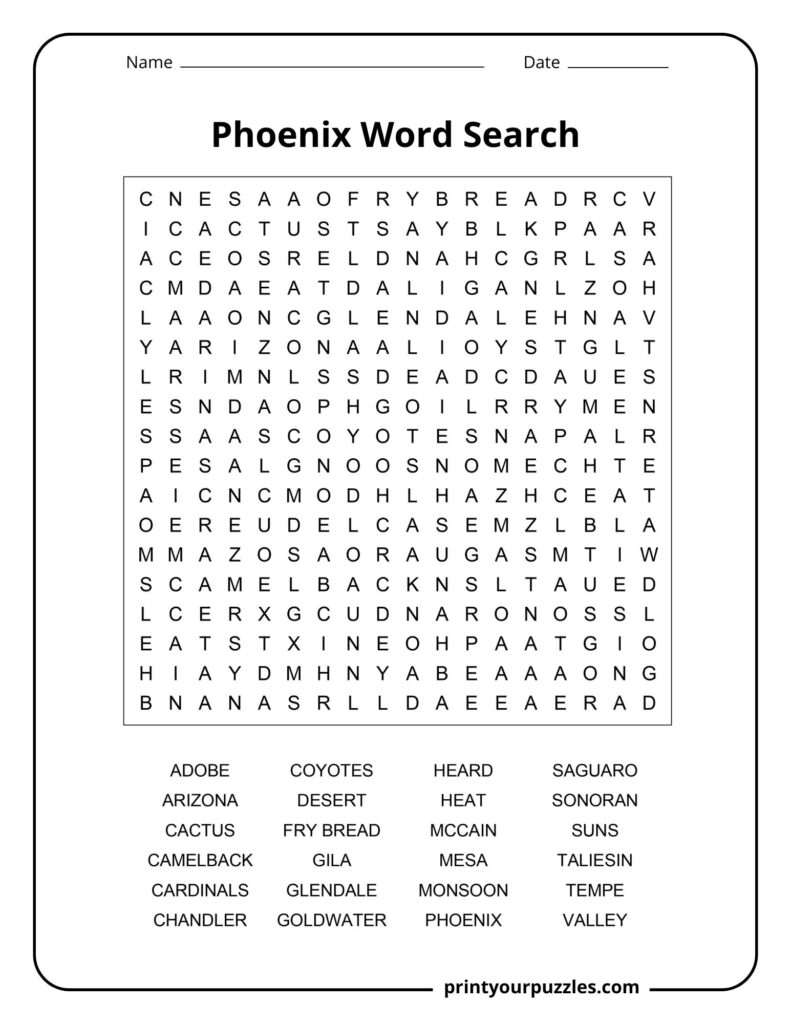
ADOBE, ARIZONA, CACTUS, CAMELBACK, CARDINALS, CHANDLER, COYOTES, DESERT, FRY BREAD, GILA, GLENDALE, GOLDWATER, HEARD, HEAT, MCCAIN, MESA, MONSOON, PHOENIX, SAGUARO, SONORAN, SUNS, TALIESIN, TEMPE, VALLEY
ADOBE – Traditional Southwestern building material made from sun-dried clay bricks, creating thick walls that keep buildings cool. Defines Phoenix’s historic architectural style and desert heritage.
ARIZONA – The 48th U.S. state, admitted in 1912. Known for the Grand Canyon, desert landscapes, and Phoenix as its capital and largest city.
CACTUS – Succulent desert plants with spines that thrive in Phoenix’s arid climate. Iconic symbols of the Southwest, storing water to survive extreme heat and drought.
CAMELBACK – Distinctive mountain landmark in Phoenix shaped like a kneeling camel. Popular hiking destination offering panoramic city views from its 2,704-foot summit and challenging trails.
CARDINALS – Phoenix’s NFL football team, originally from Chicago. Play at State Farm Stadium in Glendale, representing Arizona in the National Football League since 1988.
CHANDLER – Fast-growing suburban city southeast of Phoenix. Known for technology companies, Intel’s major manufacturing presence, and transformation from agricultural community to tech hub.
COYOTES – Phoenix’s NHL hockey team, playing desert ice hockey. Based in the Valley since 1996, representing Arizona’s unexpected but passionate hockey culture in the desert.
DESERT – Phoenix sits in the Sonoran Desert, characterized by extreme heat, minimal rainfall, unique flora and fauna, and stunning landscapes defining the region’s ecosystem and lifestyle.
FRY BREAD – Native American flatbread, deep-fried and served sweet or savory. Important cultural food in Phoenix’s indigenous communities, often topped with beans, meat, or honey.
GILA – River flowing through Arizona and important Gila monster lizard native to region. Both represent Phoenix’s natural heritage and connection to desert wildlife and waterways.
GLENDALE – Northwest Valley city, home to State Farm Stadium and Desert Diamond Arena. Major sports and entertainment destination within the Greater Phoenix metropolitan area.
GOLDWATER – Barry Goldwater, influential Arizona senator and 1964 presidential candidate. Conservative icon who shaped Phoenix politics and represented Arizona for decades in
Washington.
HEARD – The Heard Museum in Phoenix, world-renowned institution dedicated to Native American art, culture, and history. Essential destination showcasing indigenous Southwest heritage and contemporary works.
HEAT – Phoenix’s defining characteristic with summer temperatures exceeding 110°F. Intense, dry heat shapes lifestyle, architecture, and culture, making Phoenix one of America’s hottest cities.
MCCAIN – John McCain, Arizona senator, war hero, and 2008 presidential candidate. Longtime Phoenix resident who represented Arizona in Congress and shaped American politics for decades.
MESA – Third-largest city in Arizona, east of Phoenix. Suburban community known for Mormon heritage, spring training baseball, and as a major residential and commercial center.
MONSOON – Summer weather pattern bringing dramatic thunderstorms, dust storms, and heavy rain to Phoenix. Occurs July through September, providing relief from intense heat and spectacular displays.
PHOENIX – Arizona’s capital and fifth-largest U.S. city. Named after the mythical bird symbolizing rebirth, reflecting the city rising from ancient Hohokam ruins in the Salt River Valley.
SAGUARO – Iconic giant cactus with upward arms, reaching 40 feet tall. Symbol of the Sonoran Desert and Arizona, these majestic plants live over 150 years throughout Phoenix.
SONORAN – The Sonoran Desert surrounding Phoenix, most biologically diverse desert in North America. Features unique plants like saguaros and extreme summer heat with mild, pleasant winters.
SUNS – Phoenix’s NBA basketball team since 1968. One of the city’s most beloved franchises, playing downtown at Footprint Center with passionate fanbase and championship aspirations.
TALIESIN – Frank Lloyd Wright’s winter home and architecture school in Scottsdale. Taliesin West showcases desert modernism and Wright’s innovative designs harmonizing with the dramatic Arizona landscape.
TEMPE – Central Valley city home to Arizona State University. Vibrant college town with Mill Avenue entertainment district, Town Lake, and thriving cultural scene between Phoenix and Mesa.
VALLEY – Common nickname for the Greater Phoenix metropolitan area. Encompasses Phoenix and surrounding cities in the Salt River Valley, home to over 4.8 million residents.
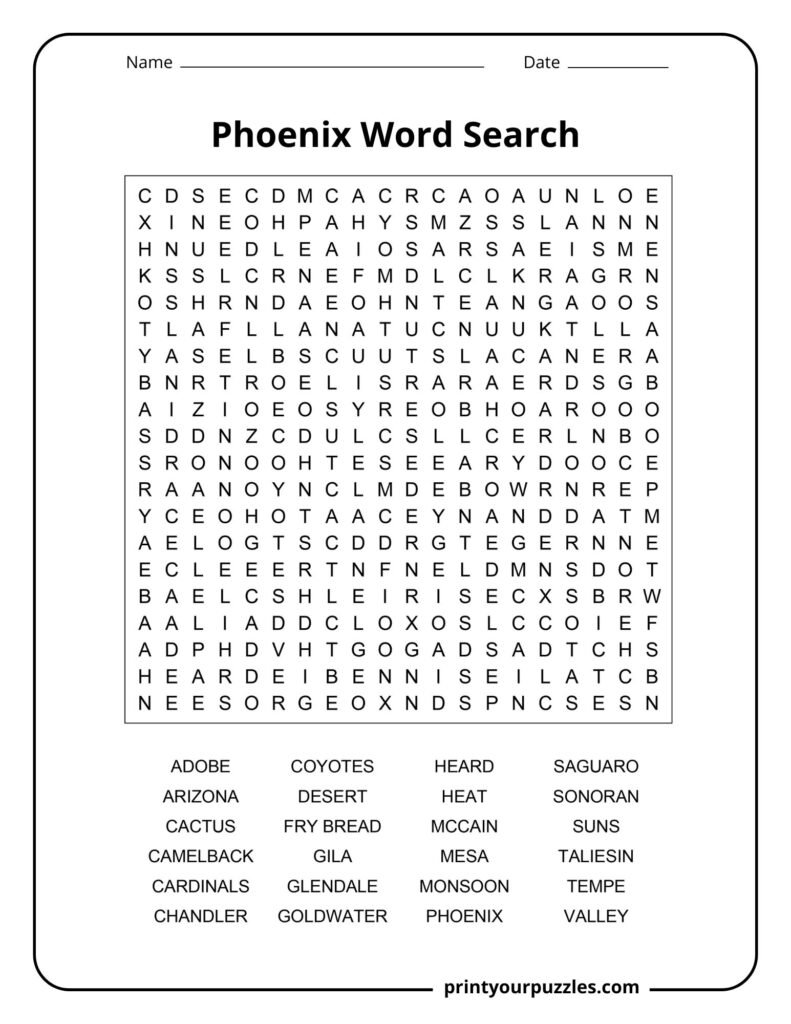
ADOBE, ARIZONA, CACTUS, CAMELBACK, CARDINALS, CHANDLER, COYOTES, DESERT, FRY BREAD, GILA, GLENDALE, GOLDWATER, HEARD, HEAT, MCCAIN, MESA, MONSOON, PHOENIX, SAGUARO, SONORAN, SUNS, TALIESIN, TEMPE, VALLEY
Phoenix is known for year-round sunshine, extreme summer heat, Sonoran Desert landscapes, professional sports teams, golf courses, Native American culture, and being America’s fifth-largest city and Arizona’s capital.
Phoenix summers are extremely hot, with temperatures regularly exceeding 110°F from June through August. The city averages over 110 days annually above 100°F, making it one of America’s hottest major cities.
The ideal time to visit Phoenix is October through April, when temperatures range from 60-85°F. Winter offers perfect weather for outdoor activities, hiking, and exploring without the intense summer heat.
Top attractions include the Heard Museum, Desert Botanical Garden, Camelback Mountain, Taliesin West, Papago Park, Phoenix Art Museum, South Mountain Park, and professional sports venues hosting Cardinals, Suns, and Diamondbacks games.
Phoenix was named after the mythical bird that rises from ashes, symbolizing the modern city emerging from ancient Hohokam civilization ruins. The name represents rebirth and the city’s establishment in 1868.
For official city information, government updates, and public services, visit the City of Phoenix website. If you are planning a trip, check out the official tourism portal, Visit Phoenix.
Phoenix enjoys approximately 299 sunny days per year, making it one of the sunniest cities on Earth. This abundant sunshine attracts sun-seekers and supports the city’s thriving solar energy industry.
Phoenix covers 518 square miles, making it geographically larger than the entire state of Rhode Island. It’s the largest state capital by land area in the continental United States.
South Mountain Park and Preserve spans 16,283 acres, making it one of the largest municipal parks in America. It offers over 50 miles of hiking trails with spectacular desert and city views.
Millions of years ago, the Phoenix area lay beneath a prehistoric sea. Fossils of ancient marine creatures have been discovered throughout the Valley, revealing the region’s dramatic geological transformation.
Arizona doesn’t observe Daylight Saving Time, keeping Mountain Standard Time year-round. This means Phoenix shares time zones with California in summer and Colorado in winter, confusing many visitors.

Purus ut praesent facilisi dictumst sollicitudin cubilia ridiculus.