
This engaging Saint Paul word search offers an entertaining way to explore Minnesota’s charming capital city through 24 carefully selected words that capture its unique spirit and heritage. Perfect for students, residents, visitors, or anyone curious about this historic Mississippi River city, the puzzle features landmarks, cultural icons, notable residents, and traditions that define Saint Paul’s distinctive character.
What makes this Saint Paul word search printable special is that every single word included in the puzzle comes with a detailed definition of 20-30 words, helping you learn fascinating facts about each term as you search. From the magnificent State Capitol and Cathedral to famous residents like James J. Hill and Charles Schulz, from the beloved Winter Carnival to the vibrant Hmong community, each word tells part of Saint Paul’s remarkable story.
This word search printable works wonderfully for classroom activities, family entertainment, or individual challenges. Whether you’re testing your knowledge of Minnesota’s capital or discovering new information about this beautiful city, you’ll enjoy both the puzzle-solving experience and the educational journey through Saint Paul’s history, culture, and landmarks. All words are clearly defined to enhance your learning experience!
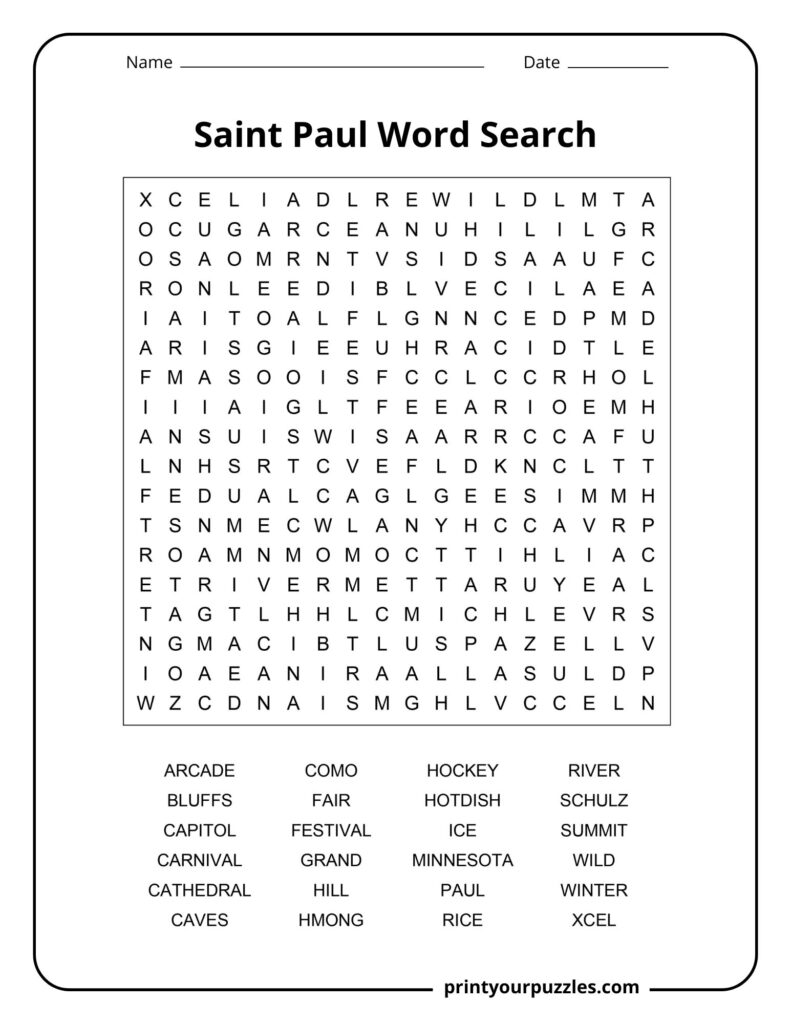
ARCADE, BLUFFS, CAPITOL, CARNIVAL, CATHEDRAL, CAVES, COMO, FAIR, FESTIVAL, GRAND, HILL, HMONG, HOCKEY, HOTDISH, ICE, MINNESOTA, PAUL, RICE, RIVER, SCHULZ, SUMMIT, WILD, WINTER, XCEL
ARCADE – A popular street in Saint Paul known for its vintage charm and local businesses, representing the city’s historic neighborhoods and community-focused commercial districts.
BLUFFS – Dramatic limestone cliffs along the Mississippi River that define Saint Paul’s landscape, offering scenic views and creating the city’s distinctive hilly topography and natural beauty.
CAPITOL – Minnesota’s State Capitol building in Saint Paul, designed by Cass Gilbert with its iconic white marble dome, serving as the center of state government since 1905.
CARNIVAL – The Saint Paul Winter Carnival, America’s oldest and largest winter festival, celebrating Minnesota’s snowy season since 1886 with ice palaces, parades, and winter activities.
CATHEDRAL – The Cathedral of Saint Paul, a stunning copper-domed Renaissance church completed in 1915, dominating the city’s skyline and serving as the archdiocese’s spiritual center.
CAVES – The Wabasha Street Caves, historic sandstone caverns carved in the 1840s, once used for mushroom growing, gangster speakeasies, and now hosting tours and events.
COMO – Como Park, a beloved urban oasis featuring a free zoo, conservatory, amusement park, and beautiful gardens, offering recreation and nature to Saint Paul residents since 1873.
FAIR – The Minnesota State Fair held annually in Saint Paul, attracting millions with agricultural exhibits, creative foods on sticks, concerts, and celebrating Minnesota’s heritage each summer.
FESTIVAL – Saint Paul hosts numerous festivals year-round including Irish, Italian, Greek, and Hmong celebrations, reflecting the city’s rich multicultural diversity and community spirit throughout seasons.
GRAND – Grand Avenue, Saint Paul’s premier shopping and dining street lined with Victorian homes, boutiques, restaurants, and bookstores, embodying the city’s walkable neighborhood character and charm.
HILL – James J. Hill, the legendary railroad magnate known as the “Empire Builder,” whose mansion and legacy shaped Saint Paul’s development as a major transportation hub.
HMONG – Saint Paul has the largest urban Hmong population in America, with this Southeast Asian community contributing vibrant culture, markets, restaurants, and festivals to city life.
HOCKEY – Minnesota’s passion sport deeply rooted in Saint Paul’s culture, from youth leagues to high school tournaments to professional games, defining winter recreation and identity.
HOTDISH – Minnesota’s beloved casserole comfort food, typically combining meat, vegetables, cream soup, and tater tots, representing the state’s hearty Midwestern cuisine and potluck culture traditions.
ICE – Central to Saint Paul’s identity through ice palaces at Winter Carnival, frozen Mississippi River activities, hockey rinks, and skating, embracing rather than avoiding cold winters.
MINNESOTA – The state for which Saint Paul serves as capital, with the city housing government offices, representing Minnesota’s values of community, education, and progressive governance.
PAUL – Named after the Apostle Paul, reflecting the city’s religious heritage and the Catholic chapel built near the settlement that inspired the city’s name in 1841.
RICE – Rice Park, a charming downtown square surrounded by landmark buildings including the Landmark Center, Ordway Theater, and Saint Paul Hotel, hosting events and gatherings year-round.
RIVER – The Mississippi River, flowing through Saint Paul’s heart, historically enabling trade and transportation, now offering recreation, defining geography, and connecting neighborhoods along its scenic banks.
SCHULZ – Charles Schulz, creator of Peanuts comic strip, grew up in Saint Paul, with the city honoring him through bronze Peanuts sculptures downtown and a museum.
SUMMIT – Summit Avenue, a magnificent four-mile boulevard featuring the longest stretch of intact Victorian mansions in America, including F. Scott Fitzgerald’s residence and the Governor’s Mansion.
WILD – Minnesota Wild, Saint Paul’s NHL hockey team playing at Xcel Energy Center, bringing professional sports excitement and community pride to the capital city since 2000.
WINTER – Saint Paul embraces winter rather than hibernating, celebrating cold months through Winter Carnival, outdoor activities, ice skating, and creating a unique culture around snowy seasons.
XCEL – Xcel Energy Center, Saint Paul’s premier sports and entertainment arena, home to the Minnesota Wild hockey team and hosting concerts, events, and high school hockey tournaments.
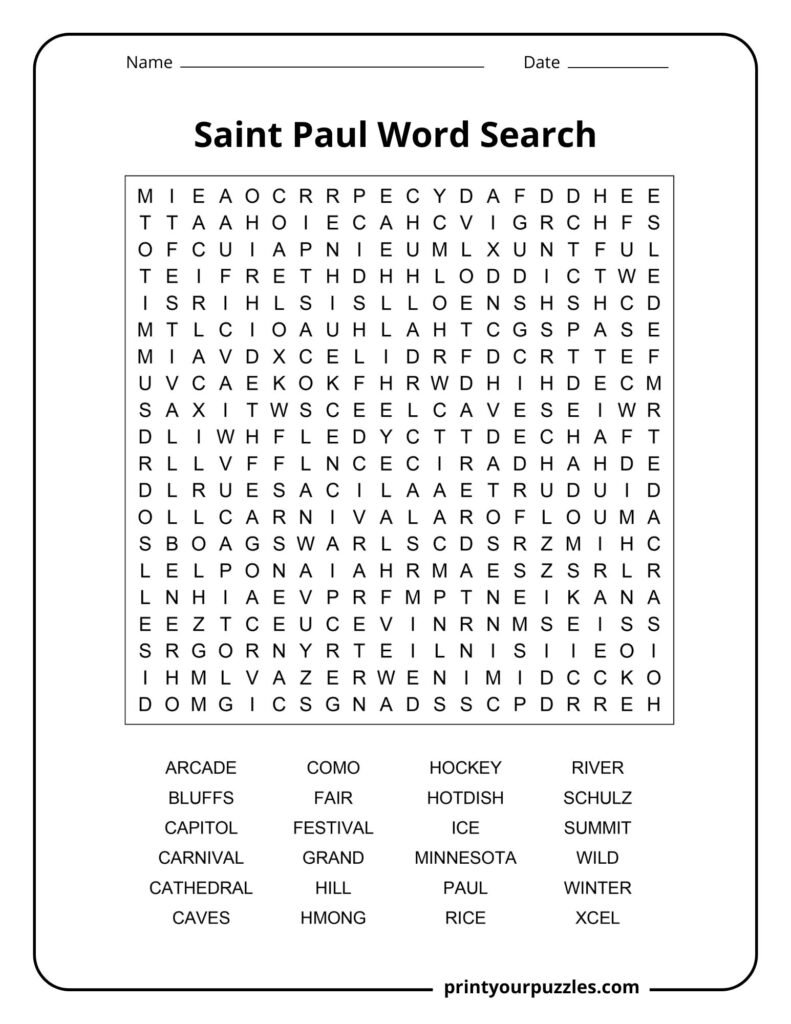
ARCADE, BLUFFS, CAPITOL, CARNIVAL, CATHEDRAL, CAVES, COMO, FAIR, FESTIVAL, GRAND, HILL, HMONG, HOCKEY, HOTDISH, ICE, MINNESOTA, PAUL, RICE, RIVER, SCHULZ, SUMMIT, WILD, WINTER, XCEL
Saint Paul is known for its stunning State Capitol, historic Victorian architecture along Summit Avenue, the Winter Carnival, diverse Hmong community, and beautiful Mississippi River bluffs defining the landscape.
Saint Paul became capital in 1849 before Minnesota’s statehood due to its earlier settlement and strategic location. The magnificent State Capitol was completed in 1905, cementing its status.
Saint Paul is older, more historic, and characterized by preserved Victorian neighborhoods and government buildings. Minneapolis is larger, more modern, with contemporary skyscrapers and a faster-paced business atmosphere.
Visit the State Capitol, explore Como Park Zoo and Conservatory, walk Summit Avenue’s mansions, tour the Cathedral, enjoy Grand Avenue shopping, and experience the legendary Winter Carnival festivities.
The Saint Paul Winter Carnival typically runs for ten days in late January through early February, celebrating winter since 1886 with ice palaces, parades, ice sculptures, and activities.
For official city information, government updates, and public services, visit the City of Saint Paul website. If you are planning a trip, check out the official tourism portal, Visit Saint Paul.
The famous author of “The Great Gatsby” was born in Saint Paul in 1896 and lived at 599 Summit Avenue, where he finished his first novel “This Side of Paradise.”
During Prohibition, the Wabasha Street Caves served as a speakeasy and hideout for notorious gangsters like John Dillinger and Ma Barker, who found refuge in Saint Paul’s underground.
The Peanuts creator grew up in Saint Paul, and characters were inspired by his childhood here. Downtown features bronze statues of Charlie Brown, Snoopy, and friends honoring him.
Over 30,000 Hmong Americans call Saint Paul home, making it the world’s largest Hmong community outside of Asia, contributing vibrant culture, markets, and traditions to the city.
When a New York reporter called Saint Paul “another Siberia, unfit for human habitation,” locals created the Winter Carnival in 1886 to prove they celebrated winter, not feared it!
Purus ut praesent facilisi dictumst sollicitudin cubilia ridiculus.