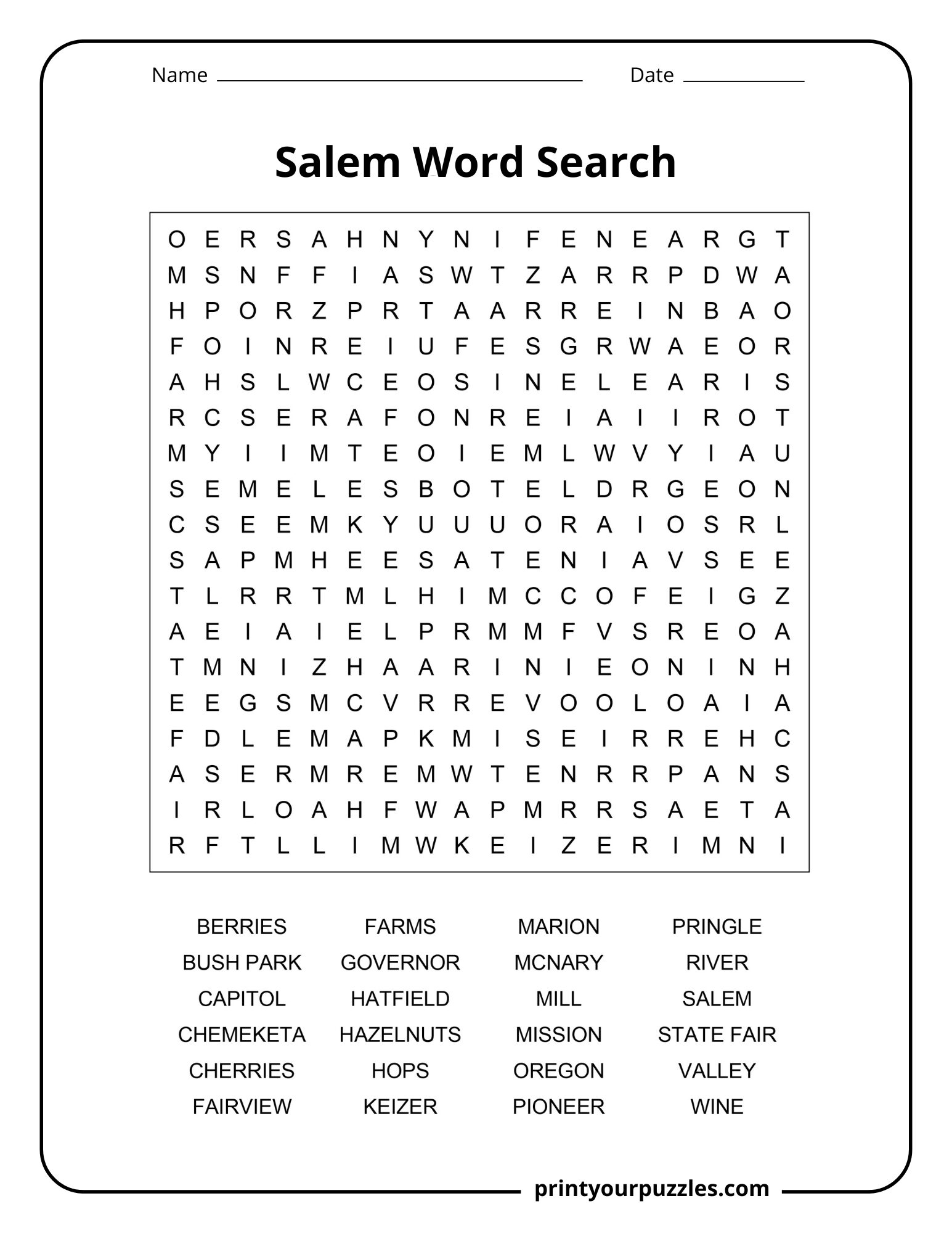

This Salem word search offers an engaging way to explore Oregon’s capital city through 24 carefully selected terms that capture Salem’s unique character and heritage. Each word represents an important aspect of this historic Willamette Valley community—from influential political figures and iconic landmarks to agricultural products and cultural institutions that define the region.
What makes this Salem word search printable special is that every term comes with a detailed 20-30 word definition, transforming your puzzle experience into an educational journey. You’ll learn about Senator Mark Hatfield’s legacy, discover why Oregon produces 99% of America’s hazelnuts, explore the significance of Bush Park, and understand the Kalapuya origins of the name Chemeketa. This word search printable serves as both entertainment and a comprehensive introduction to Salem’s multifaceted identity.
Whether you’re a local resident, student studying Oregon history, or puzzle enthusiast seeking a themed challenge, this collection provides context and meaning behind each search term. The puzzle format accommodates all ages and skill levels, making it perfect for classrooms, family activities, or personal enjoyment while learning about Oregon’s governmental and agricultural heartland.
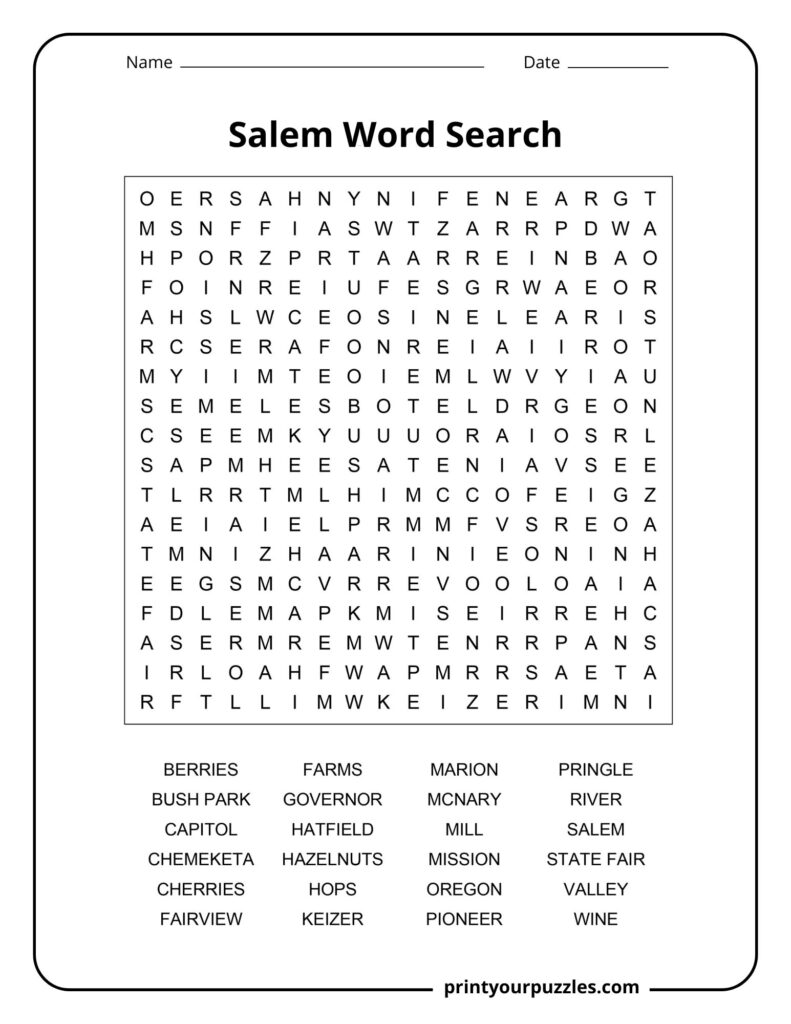
BERRIES, BUSH PARK, CAPITOL, CHEMEKETA, CHERRIES, FAIRVIEW, FARMS, GOVERNOR, HATFIELD, HAZELNUTS, HOPS, KEIZER, MARION, MCNARY, MILL, MISSION, OREGON, PIONEER, PRINGLE, RIVER, SALEM, STATE FAIR, VALLEY, WINE
BERRIES – Salem’s Willamette Valley climate produces abundant strawberries, blueberries, blackberries, and raspberries. Berry farming is a significant agricultural industry contributing to the region’s economy and culinary identity.
BUSH PARK – Named after newspaper publisher Asahel Bush, this 90-acre urban park features rose gardens, walking trails, and historic Deepwood Estate, serving as Salem’s premier recreational space.
CAPITOL – Oregon’s State Capitol building, completed in 1938, features art deco architecture and the iconic gold-plated Oregon Pioneer statue atop its dome, serving as the state government’s headquarters.
CHEMEKETA – Chemeketa Community College, established in 1969, serves over 30,000 students annually. The name derives from a Kalapuya word meaning “place of rest” or “meeting place.”
CHERRIES – The Willamette Valley’s climate makes Salem ideal for cherry cultivation. Sweet and tart cherry orchards flourish here, contributing significantly to Oregon’s reputation as a top cherry-producing state.
FAIRVIEW – A historic Salem neighborhood and training school campus, Fairview represents the city’s complex institutional history and ongoing discussions about disability rights and historical acknowledgment in Oregon.
FARMS – Agriculture defines Salem’s economy and landscape. Surrounding farmland produces grass seed, hazelnuts, berries, wine grapes, and vegetables, making Marion County Oregon’s top agricultural producer by value.
GOVERNOR – As Oregon’s capital, Salem houses the governor’s office and mansion. The governor administers state executive functions, signs legislation, and represents Oregon’s approximately 4.2 million residents.
HATFIELD – Mark Hatfield served as Oregon’s governor and U.S. Senator for decades. This moderate Republican championed environmental protection, education funding, and opposed the Vietnam War despite party pressure.
HAZELNUTS – Oregon grows 99% of America’s hazelnuts, with the Willamette Valley as the epicenter. Salem sits amid thousands of hazelnut acres, making this crop central to regional agriculture.
HOPS – The Willamette Valley produces significant hop crops for craft brewing. Salem’s agricultural heritage includes hop farming, supporting Oregon’s renowned craft beer industry with locally-grown brewing ingredients.
KEIZER – Salem’s northern neighbor city, incorporated in 1982, forms part of the Salem metropolitan area. With approximately 40,000 residents, Keizer provides suburban housing and retail development.
MARION – Marion County, named after Revolutionary War General Francis Marion, encompasses Salem as its county seat. The county covers 1,194 square miles and includes prime agricultural land.
MCNARY – Charles McNary served as U.S. Senator from Oregon for nearly three decades and was Republican vice-presidential nominee in 1940. McNary championed Northwest agricultural and hydroelectric development.
MILL – Salem’s Thomas Kay Woolen Mill, operational from 1889 to 1962, processed wool for blankets and clothing. The restored historic building now houses a textile museum celebrating industrial heritage.
MISSION – Jason Lee established a Methodist mission in 1840, founding Salem and bringing American settlement to the Willamette Valley. This mission directly led to Salem becoming Oregon’s capital city.
OREGON – Salem has served as Oregon’s capital since 1851. The city administers state government for Oregon’s diverse regions, from Pacific coastline to high desert, representing over four million residents.
PIONEER – The Oregon Pioneer statue, gold-plated and standing atop the Capitol, symbolizes westward expansion and state history. Salem emerged from pioneer settlement along the historic Oregon Trail route.
PRINGLE – Pringle Creek and Pringle Park honor Virgil Pringle, an
1846 Oregon Trail pioneer. The Pringle family helped establish Salem’s early agricultural economy and community development through mid-1800s settlement.
RIVER – The Willamette River flows through Salem, providing transportation, irrigation, recreation, and natural beauty. Riverfront Park and Minto-Brown Island Park offer extensive riverside trails and wildlife habitat.
SALEM – Oregon’s capital and third-largest city, Salem has approximately 175,000 residents. Named possibly for “peace” or Jerusalem, Salem anchors the Mid-Willamette Valley’s government, agriculture, and education sectors.
STATE FAIR – The Oregon State Fair, held annually at Salem’s fairgrounds since 1862, showcases agriculture, entertainment, and Oregon culture. This 12-day event attracts nearly one million visitors each August-September.
VALLEY – The Willamette Valley’s fertile soil and mild climate make it Oregon’s agricultural heartland. Salem sits centrally in this 150-mile valley, supporting diverse crops and wine production.
WINE – Salem lies within the Willamette Valley wine region, internationally acclaimed for Pinot Noir. Surrounding vineyards and wineries make wine tourism and viticulture important to Salem’s economy and identity.
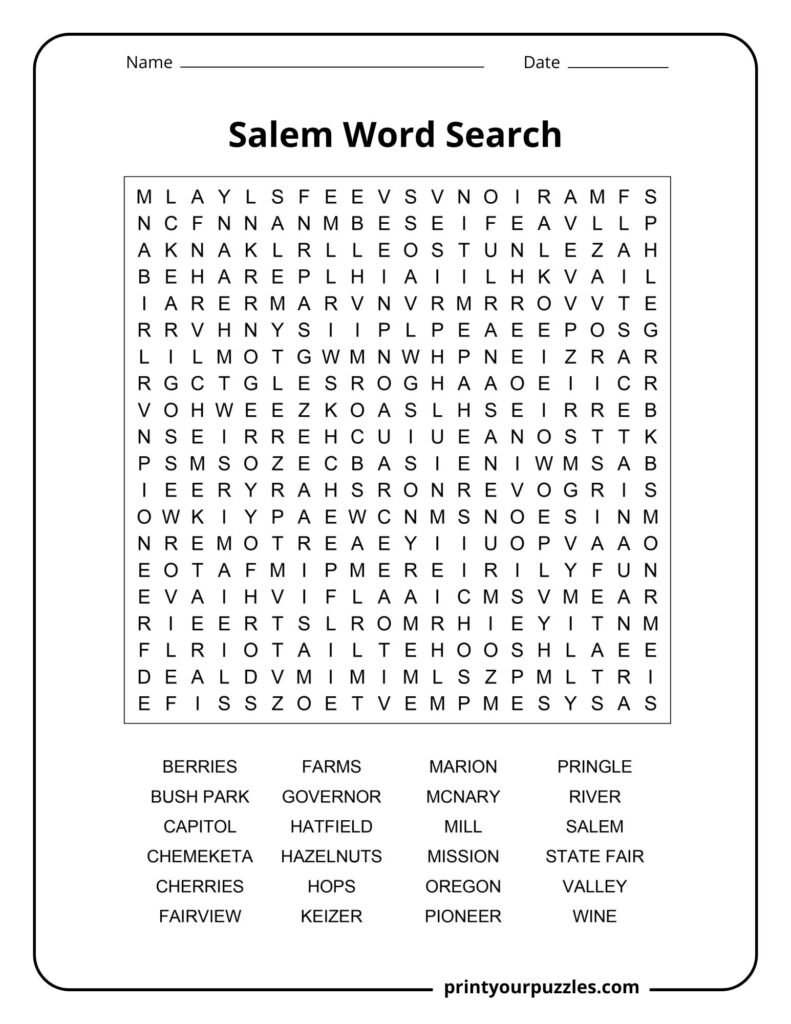
BERRIES, BUSH PARK, CAPITOL, CHEMEKETA, CHERRIES, FAIRVIEW, FARMS, GOVERNOR, HATFIELD, HAZELNUTS, HOPS, KEIZER, MARION, MCNARY, MILL, MISSION, OREGON, PIONEER, PRINGLE, RIVER, SALEM, STATE FAIR, VALLEY, WINE
Salem became Oregon’s capital in 1851 due to its central Willamette Valley location, accessibility, and early settlement by Methodist missionaries. It replaced Oregon City, offering better geographic positioning for statewide governance.
Salem is known as Oregon’s capital, hosting state government operations. It’s also recognized for agriculture including hazelnuts and berries, the annual Oregon State Fair, wine production, and Willamette University.
Salem is Oregon’s third-largest city with approximately 175,000 residents. The metropolitan area, including Keizer and surrounding communities, totals around 400,000 people across Marion and Polk counties’ fertile valleys.
The Kalapuya people, specifically the Santiam and Chelamela bands, inhabited the Salem area for thousands of years before Euro-American settlement. Chemeketa, meaning “meeting place,” derives from their language.
Salem’s economy centers on state government employment, healthcare, education through Chemeketa Community College and Willamette University, agriculture including hazelnuts and wine grapes, and food processing manufacturing operations.
For official city information, government updates, and public services, visit the City of Salem website. If you are planning a trip, check out the official tourism portal, Travel Salem.
Salem sits at the heart of this hazelnut empire in the Willamette Valley. Oregon produces approximately 40,000 tons annually, supplying nearly all domestic hazelnuts and exporting worldwide to chocolate manufacturers.
The first capitol burned in 1855, and the second was destroyed by fire in 1935. The current art deco structure, completed in 1938, features a distinctive tower instead of a traditional dome.
Standing 23 feet tall, this iconic bronze statue holds an axe and faces westward, symbolizing the pioneer spirit. It’s officially named “Oregon Pioneer” and has become Oregon’s most recognizable symbol.
Methodist missionaries Jason Lee and associates chose this Kalapuya word meaning “meeting place” or “resting place” in 1841. They later changed it to Salem, likely meaning “peace” in Hebrew.
This makes it one of America’s longest-running state fairs. Despite brief interruptions for wars and pandemics, the fair has showcased Oregon agriculture and culture for over 160 years annually.
Purus ut praesent facilisi dictumst sollicitudin cubilia ridiculus.