
This engaging Santa Fe word search offers a delightful journey through America’s oldest state capital, where ancient pueblo traditions meet vibrant contemporary culture. Founded in 1610, Santa Fe captivates visitors with its distinctive adobe architecture, world-renowned art scene, and breathtaking mountain setting at 7,000 feet elevation.
Our Santa Fe word search printable features 24 carefully selected words that capture the essence of this enchanting city. From culinary delights like chile and posole to cultural treasures such as Georgia O’Keeffe and the Santa Fe Opera, each term represents something special about the City Different. You’ll discover words related to architecture, food, famous figures, natural landmarks, and beloved traditions that make Santa Fe unforgettable.
What makes this word search printable particularly valuable is that every single word is thoroughly defined with 20-30 word descriptions, providing educational context as you solve the puzzle. Whether you’re planning a visit, teaching about Southwestern culture, or simply enjoy word puzzles, this activity combines entertainment with learning. The large print format ensures comfortable solving for all ages, making it perfect for classrooms, family activities, or leisurely afternoons exploring Santa Fe’s rich heritage through words.
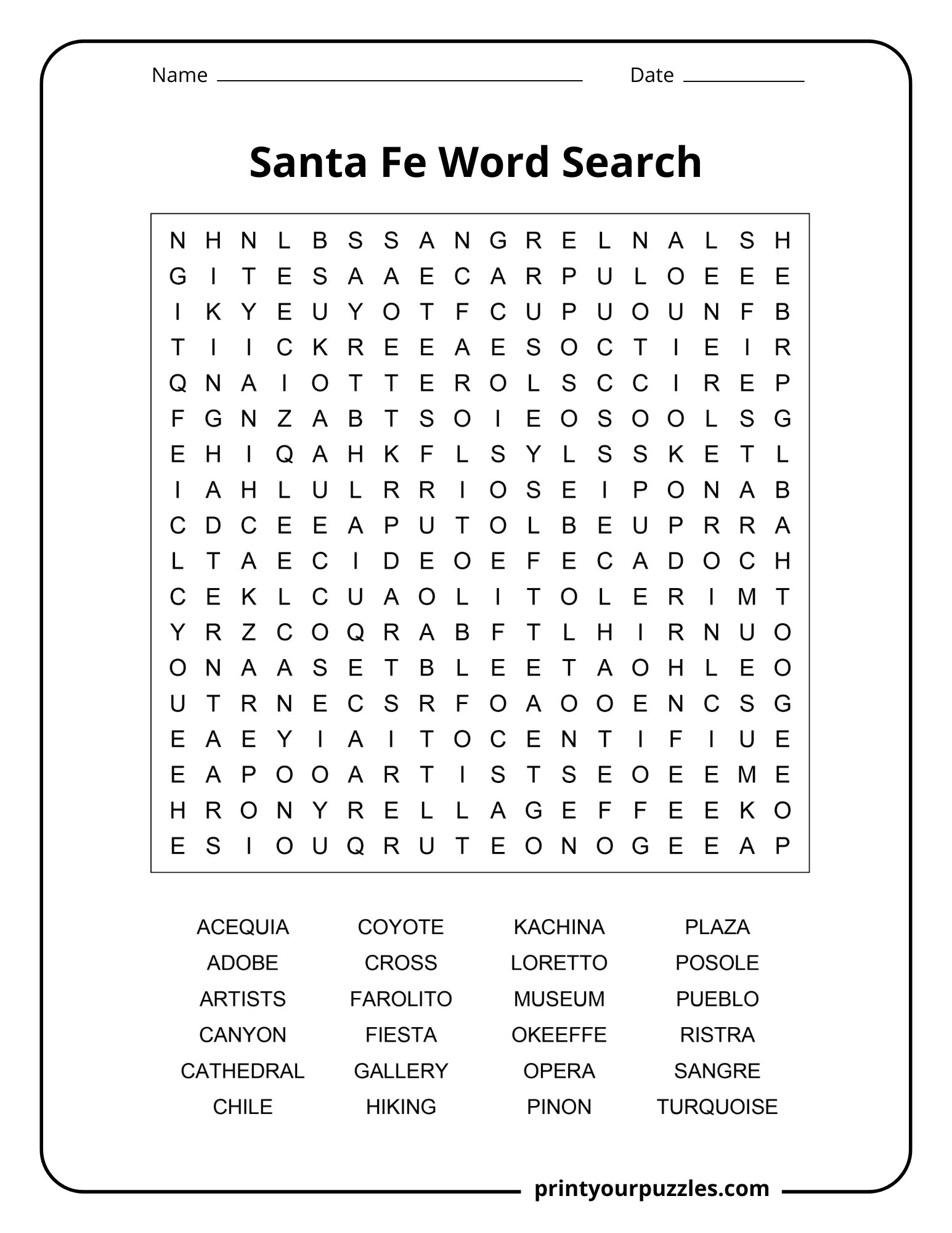
ACEQUIA, ADOBE, ARTISTS, CANYON, CATHEDRAL, CHILE, COYOTE, CROSS, FAROLITO, FIESTA, GALLERY, HIKING, KACHINA, LORETTO, MUSEUM, OKEEFFE, OPERA, PINON, PLAZA, POSOLE, PUEBLO, RISTRA, SANGRE, TURQUOISE
ACEQUIA: Traditional irrigation ditches introduced by Spanish colonists, still used throughout Santa Fe to channel water from mountain streams to farms and gardens for agricultural purposes.
ADOBE: Sun-dried earthen bricks made from clay, sand, and straw, used to construct Santa Fe’s distinctive buildings, creating the city’s iconic tan-colored architectural style.
ARTISTS: Santa Fe hosts one of America’s largest art communities, attracting painters, sculptors, and craftspeople who contribute to the city’s thriving creative economy and cultural identity.
CANYON: Dramatic geological formations surrounding Santa Fe, including nearby Diablo Canyon and Frijoles Canyon, offering spectacular hiking, rock formations, and natural beauty to explore.
CATHEDRAL: The Cathedral Basilica of St. Francis of Assisi, a Romanesque Revival masterpiece completed in 1886, stands as Santa Fe’s most prominent religious landmark downtown.
CHILE: Essential ingredient in New Mexican cuisine, grown locally in red and green varieties, sparking the famous question: “Red or green?” at every restaurant.
COYOTE: Intelligent wild canine commonly seen throughout Santa Fe’s foothills and canyons, featured prominently in Native American folklore as a trickster figure and cultural symbol of the Southwest.
CROSS: The Cross of the Martyrs monument commemorates Franciscan friars killed during the 1680 Pueblo Revolt, overlooking Santa Fe from a hillside near downtown.
FAROLITO: Small paper lanterns lit with candles, placed along walkways, rooftops, and walls during Christmas season, creating magical glowing paths throughout Santa Fe neighborhoods.
FIESTA: Annual September celebration commemorating the peaceful Spanish reconquest of 1692, featuring parades, music, dancing, and the burning of Zozobra, Old Man Gloom.
GALLERY: Santa Fe boasts over 250 art galleries along Canyon Road and downtown, showcasing Native American, contemporary, Western, and international art to collectors worldwide.
HIKING: Popular outdoor activity in Santa Fe’s surrounding mountains and canyons, with trails ranging from easy walks to challenging climbs offering stunning high-desert vistas.
KACHINA: Carved wooden dolls representing spirit beings in Pueblo cultures, sold as art pieces in Santa Fe, depicting dancers, animals, and supernatural entities.
LORETTO: Loretto Chapel features the mysterious “miraculous staircase,” a wooden spiral ascending twenty feet without visible support, attributed by legend to divine carpenter intervention.
MUSEUM: Santa Fe contains numerous museums including the Museum of International Folk Art, Museum of Indian Arts, and Georgia O’Keeffe Museum, showcasing diverse collections.
OKEEFFE: Surname of Georgia O’Keeffe, whose vibrant paintings of New Mexico landscapes, flowers, and bones made her America’s most celebrated female modernist artist.
OPERA: The Santa Fe Opera, founded in 1957, presents world-class performances in a stunning open-air theater with mountain views, attracting international audiences each summer.
PINON: Aromatic pine trees native to New Mexico’s high desert, producing edible nuts and fragrant wood burned in fireplaces, creating Santa Fe’s distinctive winter scent.
PLAZA: Historic central square established in 1610, surrounded by shops, galleries, and the Palace of the Governors, serving as Santa Fe’s social and cultural heart.
POSOLE: Traditional hearty stew made with hominy corn, pork, red or green chile, oregano, and garlic, served throughout Santa Fe, especially during winter celebrations.
PUEBLO: Native American villages with multi-story adobe structures, like nearby Tesuque and Pojoaque pueblos, maintaining ancient traditions and architectural styles for centuries.
RISTRA: Decorative strings of dried red chile peppers hung outside homes and businesses, symbolizing good fortune while preserving peppers for cooking throughout the year.
SANGRE: Sangre de Cristo Mountains, the southernmost range of the Rockies, tower east of Santa Fe, providing skiing, hiking, and the city’s stunning backdrop.
TURQUOISE: Blue-green gemstone mined in New Mexico for centuries, central to Native American jewelry and art, symbolizing Santa Fe’s Southwestern aesthetic and cultural heritage.
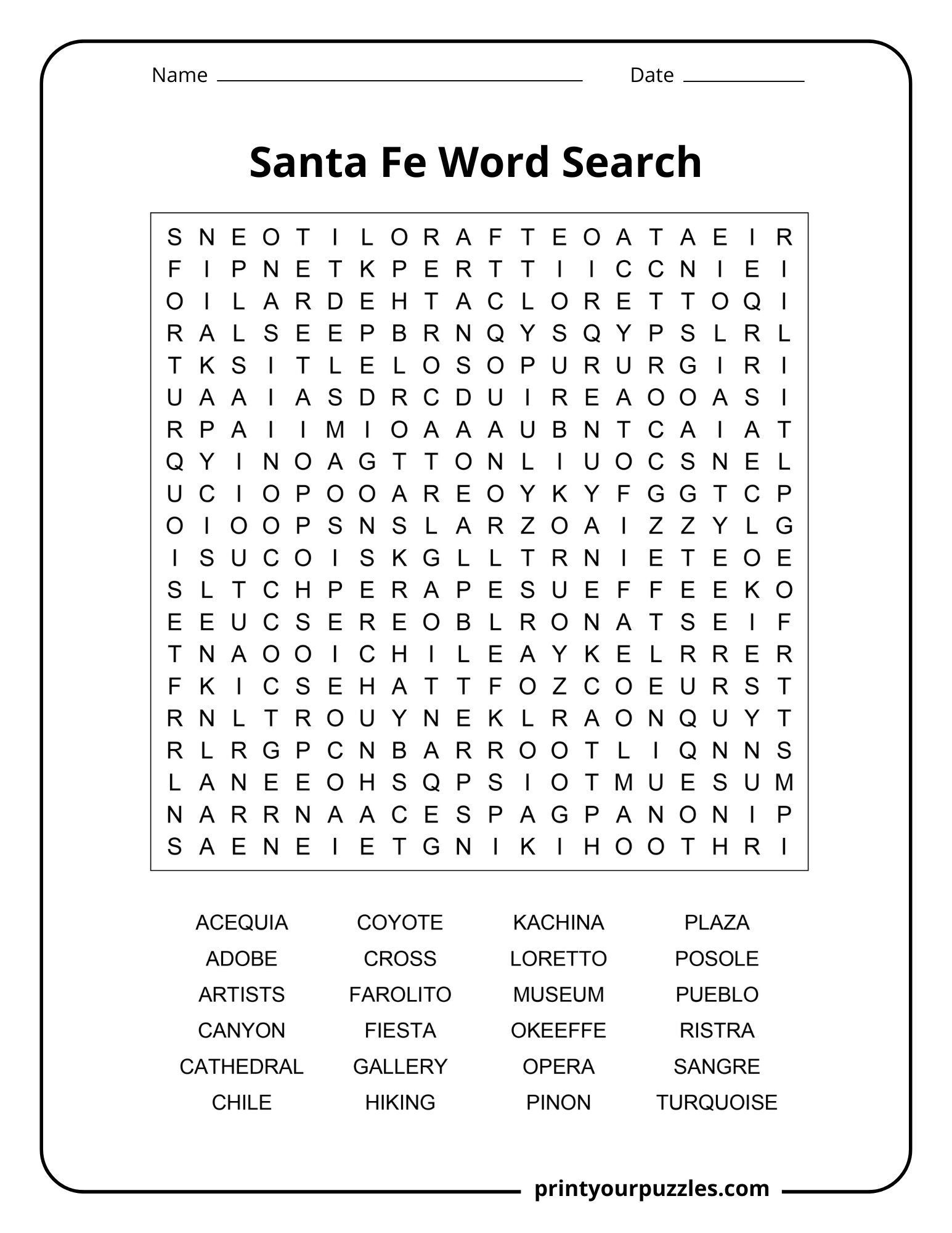
ACEQUIA, ADOBE, ARTISTS, CANYON, CATHEDRAL, CHILE, COYOTE, CROSS, FAROLITO, FIESTA, GALLERY, HIKING, KACHINA, LORETTO, MUSEUM, OKEEFFE, OPERA, PINON, PLAZA, POSOLE, PUEBLO, RISTRA, SANGRE, TURQUOISE
Santa Fe is renowned for its distinctive adobe architecture, thriving art scene with 250+ galleries, world-class museums, Native American and Spanish cultural heritage, and exceptional cuisine featuring red and green Chile.
Santa Fe earned this nickname due to its unique blend of Native American, Spanish, and Anglo cultures, distinctive pueblo-style architecture, vibrant arts community, and its character unlike any other American city.
September through October offers ideal weather with warm days, cool nights, brilliant fall colors, and the famous Fiesta celebration. Spring (April-May) also provides pleasant temperatures and fewer crowds for exploring.
Santa Fe tends to be pricier than average New Mexico destinations due to its upscale art galleries, fine dining restaurants, and boutique hotels. However, free museums, hiking trails, and affordable eateries provide budget-friendly options.
Must-try dishes include red and green chile smothered on everything, posole stew, breakfast burritos, sopapillas with honey, carne adovada, blue corn enchiladas, and biscochitos, New Mexico’s official state cookie.
For official city information, government updates, and public services, visit the City of Santa Fe website. If you are planning a trip, check out the official tourism portal, Visit Santa Fe.
Santa Fe sits at 7,000 feet above sea level, making it the highest state capital in the United States. Visitors often need time to adjust to the thin mountain air.
Since 1957, downtown Santa Fe mandates that buildings follow pueblo or territorial style guidelines, ensuring the city maintains its distinctive earth-toned adobe appearance and preserving its unique character.
Built in 1610, this adobe structure has served Spanish, Mexican, and American governments continuously for over 400 years. Today it operates as a history museum showcasing New Mexico’s past.
Los Alamos National Laboratory, where the Manhattan Project developed the first nuclear weapons during World War II, sits in the mountains northwest of Santa Fe, forever changing world history.
The city maintains strict ordinances against franchises and garish signage in its historic district, preserving local businesses and traditional aesthetics. Even McDonald’s must use turquoise arches instead of golden ones.
Purus ut praesent facilisi dictumst sollicitudin cubilia ridiculus.