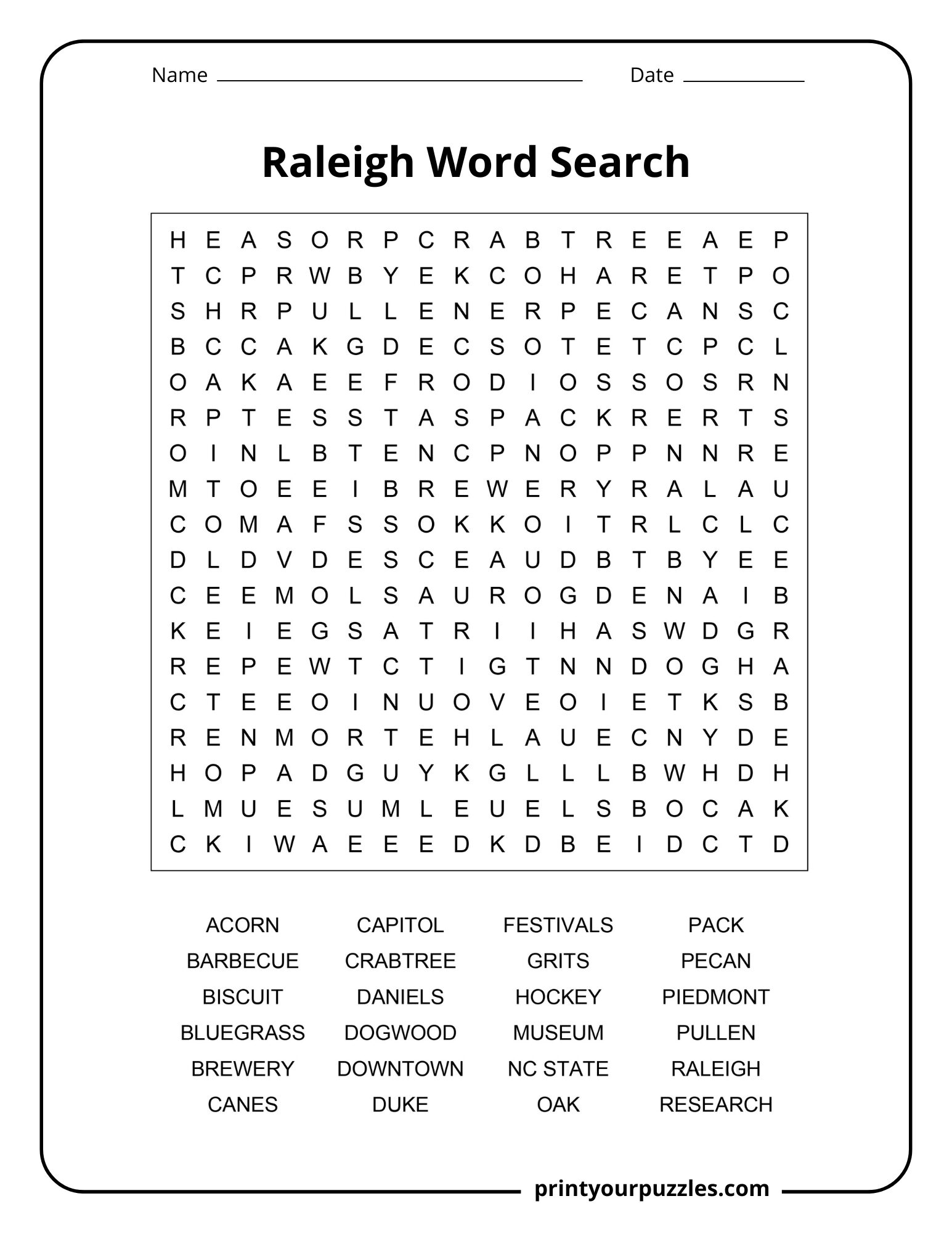

This Skeletal System word search offers an exciting and educational way to explore the fascinating world of human anatomy. Perfect for students, teachers, and science enthusiasts, this puzzle challenges you to locate 24 carefully selected terms related to bones, joints, and skeletal structures hidden within a grid of letters.
What makes this activity particularly valuable is that all the words to search are defined with clear, concise explanations. Each term includes a 20-30 word definition, helping you understand not just the vocabulary but also the meaning and function behind every anatomical component. From major bones like the femur and tibia to important concepts such as cartilage and marrow, you’ll gain comprehensive knowledge while enjoying the puzzle-solving experience.
The Skeletal System word search printable format makes it convenient for classroom distribution, homework assignments, or home learning activities. Teachers can easily reproduce this word search printable for entire classes, while parents can use it as an engaging educational tool at home.
Whether you’re studying for an anatomy exam, supplementing a science lesson, or simply enjoying a brain-teasing challenge, this word search combines entertainment with learning, making skeletal system education both fun and memorable for all ages.
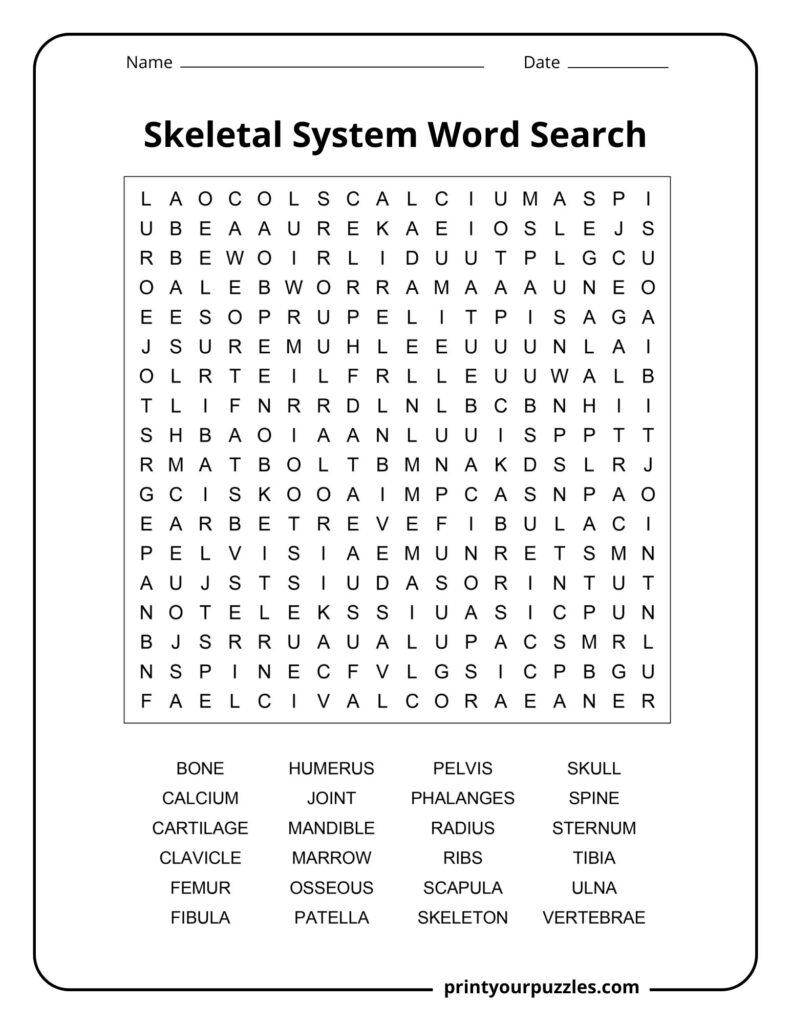
BONE, CALCIUM, CARTILAGE, CLAVICLE, FEMUR, FIBULA, HUMERUS, JOINT, MANDIBLE, MARROW, OSSEOUS, PATELLA, PELVIS, PHALANGES, RADIUS, RIBS, SCAPULA, SKELETON, SKULL, SPINE, STERNUM, TIBIA, ULNA, VERTEBRAE
BONE – The hard, rigid organs that form the skeleton, providing structure, protection, and support while storing minerals and producing blood cells in marrow cavities.
CALCIUM – A mineral essential for bone strength and density, helping maintain skeletal structure and supporting vital functions like muscle contraction and nerve transmission throughout the body.
CARTILAGE – A flexible connective tissue found in joints, ears, nose, and rib cage, providing cushioning between bones and allowing smooth movement while maintaining structural support.
CLAVICLE – The collarbone, a slender S-shaped bone connecting the shoulder blade to the sternum, providing support and mobility for the shoulder and protecting underlying nerves.
FEMUR – The thighbone, which is the longest, strongest, and heaviest bone in the human body, extending from the hip to the knee and supporting body weight.
FIBULA – The smaller, thinner bone located on the outer side of the lower leg, running parallel to the tibia and providing ankle stability and muscle attachment points.
HUMERUS – The long bone of the upper arm, extending from the shoulder to the elbow, allowing arm movement and connecting to both the scapula and forearm bones.
JOINT – The connection point where two or more bones meet, allowing movement and flexibility while being held together by ligaments, tendons, and surrounded by cartilage.
MANDIBLE – The lower jawbone, the largest and strongest facial bone, holding the lower teeth and enabling chewing, speaking, and facial expressions through jaw movement.
MARROW – The soft, spongy tissue inside bones that produces red blood cells, white blood cells, and platelets, while also storing fat in yellow marrow regions.
OSSEOUS – An adjective meaning composed of or resembling bone tissue, describing the hard, mineralized connective tissue that forms the skeletal system’s structural framework throughout the body.
PATELLA – The kneecap, a small, triangular sesamoid bone protecting the knee joint and improving leverage for leg extension by increasing the quadriceps muscle’s mechanical advantage.
PELVIS – The basin-shaped bone structure at the base of the spine, supporting the torso’s weight, protecting abdominal organs, and connecting the legs to the body.
PHALANGES – The small bones forming fingers and toes, with three in each digit except thumbs and big toes which have two, enabling grasping and balance functions.
RADIUS – The shorter forearm bone located on the thumb side,
running from elbow to wrist, enabling forearm rotation and wrist movement alongside the ulna bone.
RIBS – The curved bones forming the rib cage, protecting vital organs like the heart and lungs while providing attachment points for breathing muscles and chest support.
SCAPULA – The shoulder blade, a flat, triangular bone on the upper back connecting the humerus to the clavicle and providing attachment for multiple shoulder muscles.
SKELETON – The internal framework of bones and cartilage supporting the body, protecting organs, enabling movement, storing minerals, and producing blood cells through connected bone structures.
SKULL – The bony structure forming the head, protecting the brain and sense organs while providing shape to the face and anchoring points for jaw and neck muscles.
SPINE – The vertebral column, a flexible series of stacked bones extending from skull to pelvis, protecting the spinal cord, supporting the body, and enabling upright posture.
STERNUM – The breastbone, a flat bone in the chest’s center connecting to ribs via cartilage, protecting the heart and lungs while anchoring the rib cage structure.
TIBIA – The shinbone, the larger and stronger of two lower leg bones, bearing most body weight and connecting the knee to the ankle alongside the fibula.
ULNA – The longer forearm bone on the pinky side, extending from elbow to wrist, forming the elbow joint and working with the radius for arm rotation.
VERTEBRAE – The individual bones stacked to form the spine, separated by cushioning discs, protecting the spinal cord while allowing flexibility and supporting the body’s weight.
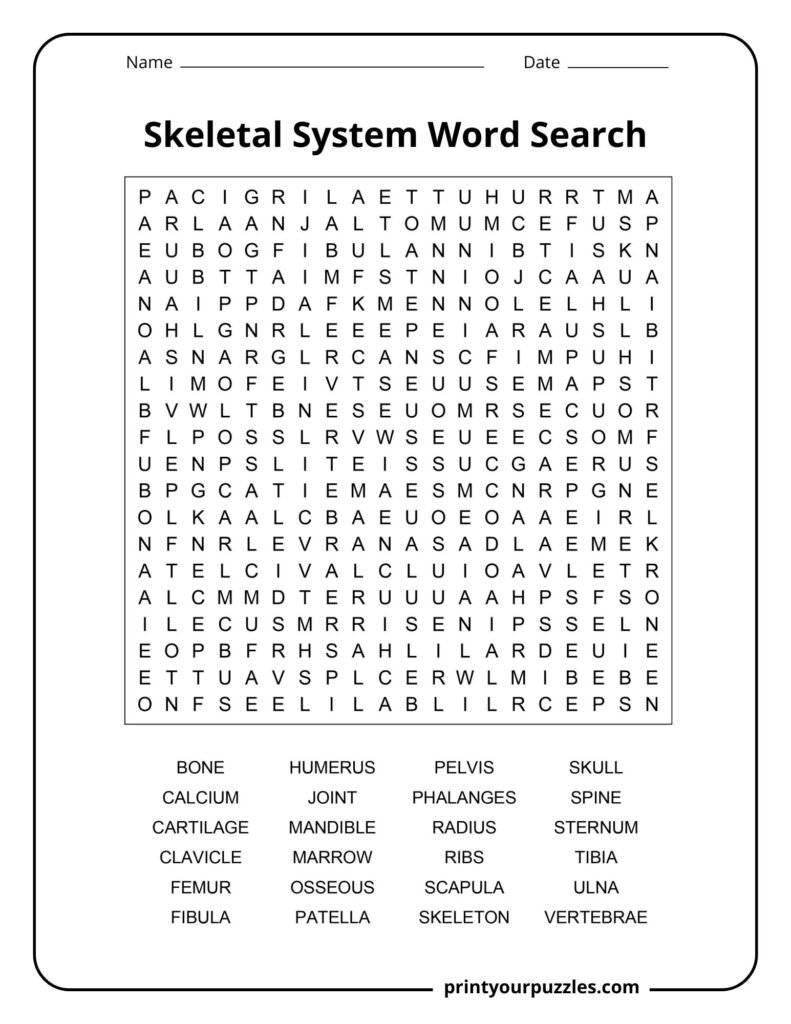
BONE, CALCIUM, CARTILAGE, CLAVICLE, FEMUR, FIBULA, HUMERUS, JOINT, MANDIBLE, MARROW, OSSEOUS, PATELLA, PELVIS, PHALANGES, RADIUS, RIBS, SCAPULA, SKELETON, SKULL, SPINE, STERNUM, TIBIA, ULNA, VERTEBRAE
Adults have 206 bones, while babies are born with approximately 270 bones. Many bones fuse together during childhood and adolescence, gradually reducing to the adult count.
The skeletal system provides structural support, protects vital organs, enables movement through muscle attachment, stores essential minerals like calcium, and produces blood cells within bone marrow.
The femur, or thighbone, is the strongest and longest bone. It can support up to thirty times a person’s body weight and withstands tremendous pressure during movement.
Bone marrow is soft tissue inside bones that produces red blood cells, white blood cells, and platelets. Red marrow creates blood cells while yellow marrow stores fat.
Bones heal through a natural process where blood clots form, new bone cells grow, and calcium deposits harden the area, typically taking six to twelve weeks depending on severity.
Your skeleton completely replaces itself approximately every ten years through a continuous process called remodeling, where old bone tissue breaks down and new tissue forms.
The stapes bone in the middle ear measures only 2.8 millimeters long, roughly the size of a rice grain, yet plays a crucial role in transmitting sound vibrations.
Newborns start with around 270 bones, but many fuse together as they grow. By adulthood, only 206 bones remain, making children’s skeletons more flexible than adults’.
Pound for pound, bone is approximately five times stronger than steel. A bone the size of a matchbox can support nine tons of weight before crushing.
Your hands and feet contain 106 bones combined—that’s over fifty percent of all bones in your body, enabling intricate movements and balance for daily activities.
Purus ut praesent facilisi dictumst sollicitudin cubilia ridiculus.