
Weather word search puzzles offer an engaging and educational way to explore meteorological terminology while having fun. This comprehensive weather word search printable features 24 carefully selected terms related to various weather phenomena, atmospheric conditions, and climate patterns. Whether you’re a student learning about meteorology, a teacher seeking classroom activities, or simply someone who enjoys puzzle challenges, this word search printable provides entertainment for all ages and skill levels.
Each word in the puzzle ranges from three to nine letters, making it accessible yet challenging enough to maintain interest. The collection includes common weather terms like rain, snow, and fog, alongside more complex phenomena such as hurricanes, tornadoes, and blizzards. Two-word phrases like “cold snap” and “heat wave” add variety to your searching experience.
What makes this weather word search particularly valuable is that all words are thoroughly defined with clear, concise explanations of 20-30 words each. These definitions help expand your meteorological vocabulary and deepen your understanding of weather concepts, transforming a simple puzzle into an educational resource that combines learning with leisure.
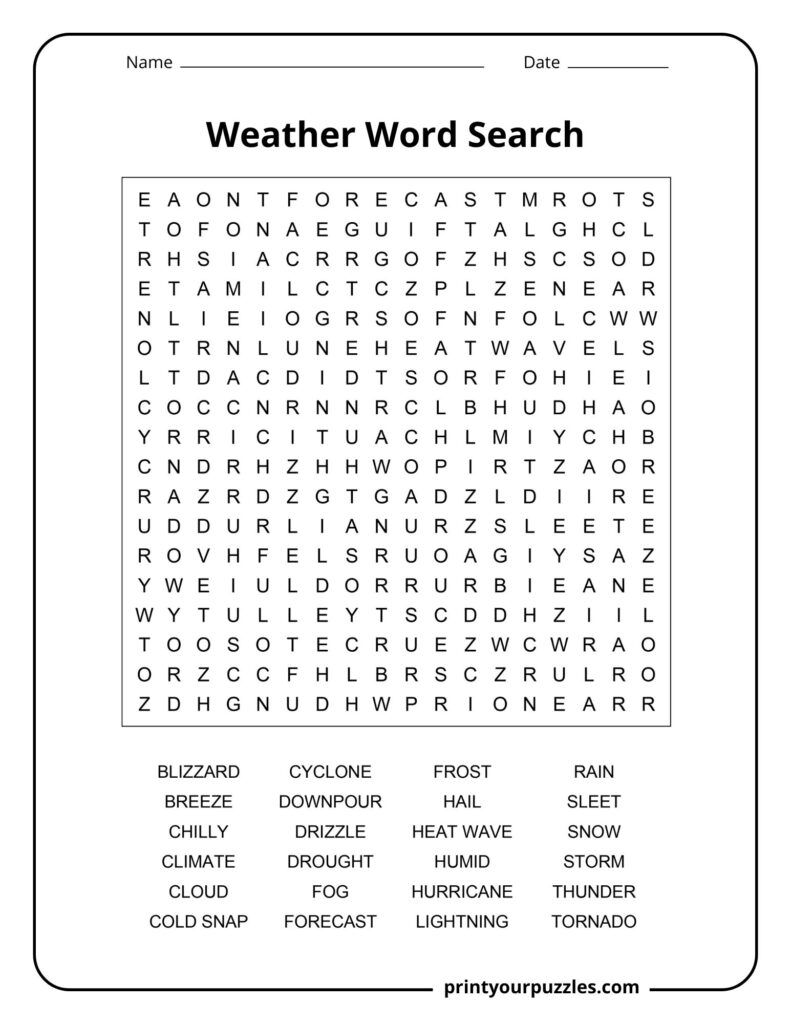
BLIZZARD, BREEZE, CHILLY, CLIMATE, CLOUD, COLD SNAP, CYCLONE, DOWNPOUR, DRIZZLE, DROUGHT, FOG, FORECAST, FROST, HAIL, HEAT WAVE, HUMID, HURRICANE, LIGHTNING, RAIN, SLEET, SNOW, STORM, THUNDER, TORNADO
BLIZZARD – A severe snowstorm characterized by strong winds, low temperatures, and heavy snowfall that reduces visibility significantly, often creating dangerous travel conditions and causing power outages.
BREEZE – A gentle, light wind that flows through the air, typically pleasant and refreshing, varying in strength from calm to moderate, often bringing relief on warm days.
CHILLY – A temperature condition that feels uncomfortably cool or cold, requiring extra layers of clothing for warmth, typically occurring during autumn, winter, or cool evenings.
CLIMATE – The long-term pattern of weather conditions in a specific region, including temperature, precipitation, humidity, and wind patterns, averaged over extended periods of typically thirty years.
CLOUD – A visible mass of water droplets or ice crystals suspended in the atmosphere, formed through condensation, appearing in various shapes and altitudes, indicating different weather conditions.
COLD SNAP – A sudden, brief period of unusually cold weather that arrives abruptly and lasts several days, often bringing frost, freezing temperatures, and requiring extra heating and warm
clothing.
CYCLONE – A large-scale rotating storm system with low atmospheric pressure at its center, characterized by strong winds spiraling inward, bringing heavy rain, potentially causing significant damage and flooding.
DOWNPOUR – An intense, heavy rainfall that falls rapidly and abundantly over a short period, often causing temporary flooding, poor visibility, and making outdoor activities impossible until it subsides.
DRIZZLE – Light, fine rain consisting of tiny water droplets that fall slowly and steadily from low clouds, creating damp conditions without the intensity of heavier rainfall.
DROUGHT – An extended period with significantly below-average precipitation, resulting in water shortages, dried vegetation, crop failures, and potentially severe impacts on ecosystems, agriculture, and water supplies.
FOG – A thick cloud of tiny water droplets suspended at ground level, significantly reducing visibility, commonly occurring in early mornings or near bodies of water, creating hazardous driving conditions.
FORECAST – A prediction of future weather conditions based on scientific analysis of atmospheric data, including temperature, precipitation, wind patterns, and other meteorological factors for upcoming days or weeks.
FROST – A thin layer of ice crystals that forms on surfaces when temperatures drop below freezing, typically occurring overnight, creating a white coating on grass, cars, and windows.
HAIL – Solid ice pellets that form in thunderstorms when water droplets freeze in updrafts, falling from clouds during severe weather, potentially damaging crops, vehicles, and property with impacts.
HEAT WAVE – A prolonged period of excessively hot weather, significantly above normal temperatures for a region, potentially dangerous to health, stressing power grids, and requiring cooling measures and hydration.
HUMID – An atmospheric condition with high moisture content in the air, making temperatures feel warmer and causing discomfort, sweating, and difficulty cooling down through natural evaporation processes.
HURRICANE – A powerful tropical cyclone with sustained winds exceeding seventy-four miles per hour, featuring a defined eye, bringing devastating winds, storm surge, flooding, and widespread destruction to coastal areas.
LIGHTNING – A sudden electrical discharge between clouds or cloud and ground, producing a bright flash of light and thunder, occurring during thunderstorms, potentially dangerous and capable of ignition.
RAIN – Water droplets falling from clouds to the ground as precipitation, essential for replenishing water supplies, nourishing plants, and sustaining ecosystems, varying from light showers to heavy storms.
SLEET – Frozen or partially frozen rain consisting of ice pellets that form when raindrops freeze while falling through cold air layers, creating slippery, hazardous conditions on roads and surfaces.
SNOW – Frozen precipitation in the form of ice crystals that fall from clouds, accumulating on the ground, creating winter landscapes, enabling winter sports, and sometimes disrupting transportation systems.
STORM – A disturbance in the atmosphere characterized by strong winds, heavy precipitation, thunder, lightning, or other severe weather phenomena, potentially causing damage, flooding, and dangerous conditions for people.
THUNDER – The loud rumbling or cracking sound produced when lightning rapidly heats air, causing it to expand explosively, following the visible flash and indicating proximity of thunderstorm activity.
TORNADO – A violently rotating column of air extending from thunderstorm clouds to the ground, featuring extremely high winds capable of catastrophic destruction, characterized by its distinctive funnel shape.
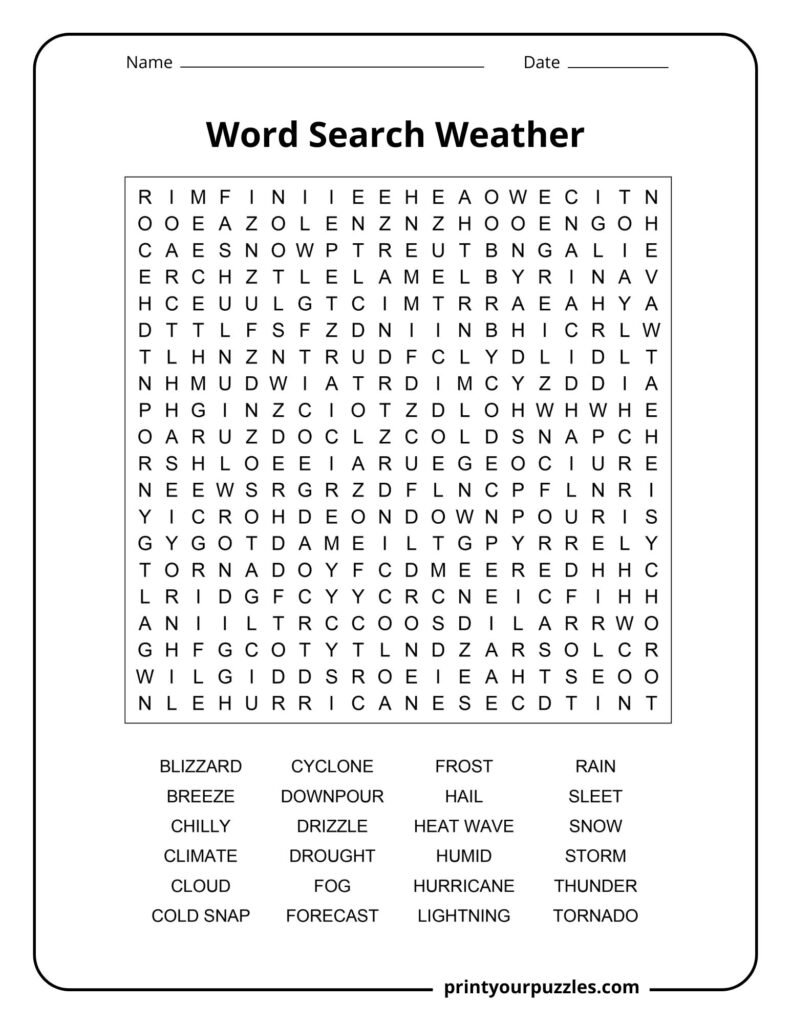
BLIZZARD, BREEZE, CHILLY, CLIMATE, CLOUD, COLD SNAP, CYCLONE, DOWNPOUR, DRIZZLE, DROUGHT, FOG, FORECAST, FROST, HAIL, HEAT WAVE, HUMID, HURRICANE, LIGHTNING, RAIN, SLEET, SNOW, STORM, THUNDER, TORNADO
Weather results from the sun’s energy heating Earth’s atmosphere unevenly, creating temperature differences, air pressure variations, and moisture movement that produce wind, clouds, precipitation, and various atmospheric conditions.
Meteorologists collect data from satellites, weather stations, and radar systems, then use computer models to analyze atmospheric patterns and predict future conditions with increasing accuracy for upcoming days.
Weather describes short-term atmospheric conditions occurring over hours or days, while climate represents long-term average weather patterns in a region measured over decades or centuries.
Rain forms when water vapor in clouds condenses into droplets that grow heavy enough to fall. This occurs when warm, moist air rises, cools, and releases moisture as precipitation.
Lightning occurs when electrical charges build up in storm clouds and discharge suddenly. Thunder is the sound created when lightning instantly heats air, causing rapid expansion and compression.
Each snowflake forms under unique atmospheric conditions as it falls, creating distinct crystalline patterns. The countless possible combinations of temperature, humidity, and path make every snowflake truly one-of-a-kind.
Approximately 8.6 million lightning strikes occur globally each day. The planet experiences roughly 100 lightning bolts per second, with most strikes happening over land rather than oceans.
Contrary to popular depictions, falling raindrops are shaped more like hamburger buns—round on top and flat on bottom—due to air pressure pushing against them as they fall.
These powerful tropical cyclones have different names based on location: hurricanes in the Atlantic and Northeast Pacific, typhoons in the Northwest Pacific, and cyclones in the South Pacific and Indian Ocean.
Fog forms through the same condensation process as clouds but occurs at ground level when air temperature drops to the dew point, creating suspended water droplets that reduce visibility.

Purus ut praesent facilisi dictumst sollicitudin cubilia ridiculus.