Introduction to the Cell Division Word Search
Cell division is the biological process through which one cell produces new cells. It is essential for life because it allows organisms to grow, repair damaged tissues, replace worn-out cells, and reproduce. From the healing of a small cut to the development of a complete human body from a single fertilized egg, cell division is constantly taking place.
Before a cell divides, it must prepare carefully. During a stage called interphase, the cell grows, carries out its normal activities, and copies its DNA. DNA contains the genetic instructions that control how cells function. Copying this material ensures that each new cell receives the information it needs. The duplicated DNA is organized into structures called chromosomes, which become easier to see as division begins.
There are two main types of cell division: mitosis and meiosis. Mitosis produces two daughter cells that are genetically identical to the original cell. It is used for growth, tissue repair, and cell replacement. Mitosis includes several stages: prophase, metaphase, anaphase, and telophase. During these stages, chromosomes condense, line up in the center of the cell, separate, and move toward opposite ends. The cell then completes cytokinesis, the division of its cytoplasm, creating two separate cells.
Meiosis is different because it produces reproductive cells, such as sperm and egg cells. Instead of creating two identical cells, meiosis involves two rounds of division and usually produces four genetically different cells. Each contains half the number of chromosomes found in the original cell. This chromosome reduction is important because it prevents the chromosome number from doubling every time fertilization occurs. Meiosis also increases genetic variation, helping offspring inherit unique combinations of traits.
Cell division must be precisely controlled. Special checkpoints monitor whether DNA has been copied correctly and whether chromosomes are separating properly. When this control system fails, cells may divide too quickly or develop genetic abnormalities. Uncontrolled cell division can contribute to the formation of tumors and diseases such as cancer.
Learning about this process helps explain growth, inheritance, reproduction, healing, and disease. A cell division word search can introduce important vocabulary such as chromosome, nucleus, mitosis, meiosis, spindle, and cytokinesis while reinforcing the key stages and purposes of cellular reproduction. By understanding how cells copy their genetic material and divide it accurately, students gain valuable insight into one of the most fundamental processes in biology.
Related Word Searches:
Cell | DNA | Genetics | Biology | Body Systems | Bacteria
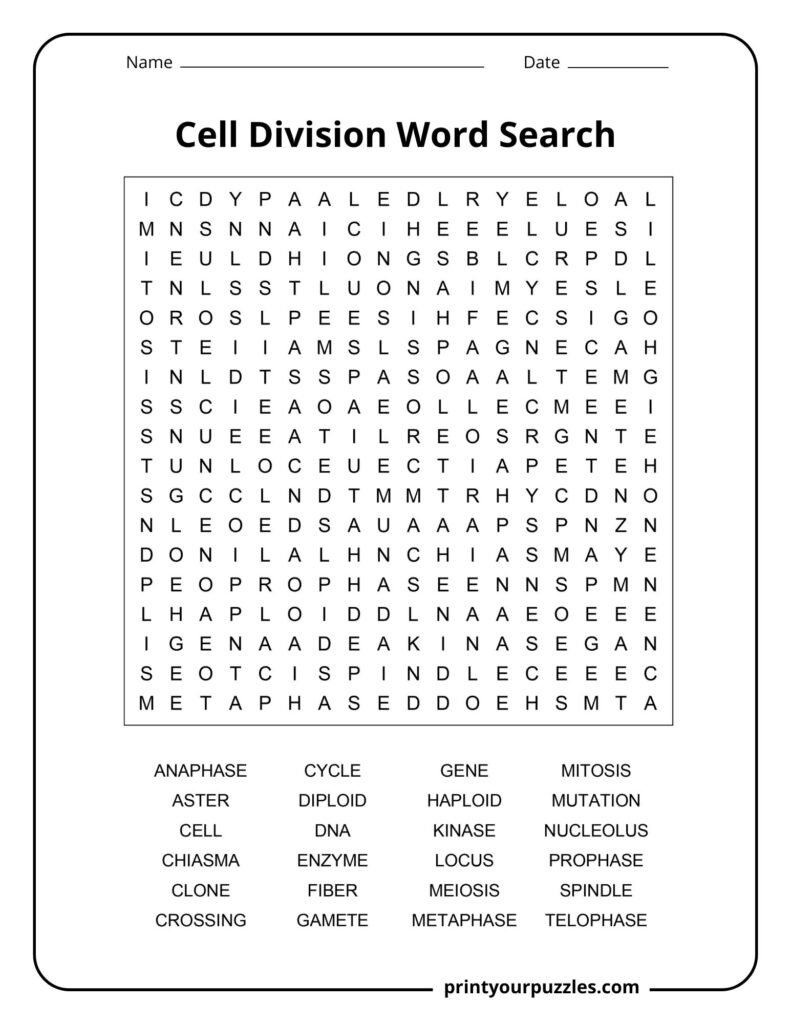
Medium Difficulty Word Search
Words to Find
ANAPHASE, ASTER, CELL, CHIASMA, CLONE, CROSSING, CYCLE, DIPLOID, DNA, ENZYME, FIBER, GAMETE, GENE, HAPLOID, KINASE, LOCUS, MEIOSIS, METAPHASE, MITOSIS, MUTATION, NUCLEOLUS, PROPHASE, SPINDLE, TELOPHASE
All Words Defined
ANAPHASE – Stage of cell division where duplicated chromosomes separate and move to opposite poles of the cell, pulled by spindle fibers attached to their centromeres during mitosis or meiosis.
ASTER – Star-shaped structure formed by microtubules radiating from the centrosome during cell division, helping to position the mitotic spindle and organize chromosome separation properly within the cell.
CELL – The basic structural and functional unit of all living organisms, capable of independent reproduction. Cells contain genetic material and carry out essential life processes like metabolism and growth.
CHIASMA – The physical point of contact between homologous chromosomes during meiosis where crossing over occurs, allowing genetic material exchange. Chiasmata are visible during the prophase one stage.
CLONE – A genetically identical copy of a cell or organism produced through asexual reproduction or artificial techniques. Clones share the exact same DNA sequence as their parent cell.
CROSSING – The exchange of genetic material between homologous chromosomes during meiosis prophase one. This process increases genetic diversity by creating new combinations of alleles in the resulting gametes.
CYCLE – Refers to the cell cycle, the ordered series of events a cell undergoes from its formation to its division into two daughter cells, including interphase and mitotic phases.
DIPLOID – A cell containing two complete sets of chromosomes, one inherited from each parent. In humans, diploid cells have 46 chromosomes arranged in 23 homologous pairs throughout the body.
DNA – Deoxyribonucleic acid, the molecule carrying genetic instructions for development, functioning, and reproduction of all living organisms. Its double helix structure replicates before each cell division event.
ENZYME – A biological protein catalyst that speeds up chemical reactions during cell division, including DNA replication, chromosome condensation, and the breakdown of the nuclear envelope during mitosis.
FIBER – Refers to spindle fibers, protein structures made of microtubules that attach to chromosomes during cell division, guiding their movement and ensuring equal distribution to each daughter cell.
GAMETE – A reproductive sex cell containing a haploid number of chromosomes, produced through meiosis. In animals, gametes are sperm and egg cells that fuse during fertilization to form a zygote.
GENE – A segment of DNA located on a chromosome that encodes instructions for making a specific protein or functional molecule. Genes are faithfully copied and distributed during every cell division.
HAPLOID – A cell possessing only one complete set of chromosomes, half the diploid number. Gametes are haploid cells, and in humans they contain 23 individual chromosomes after meiotic division.
KINASE – A type of enzyme that adds phosphate groups to proteins, regulating key steps of the cell cycle. Cyclin-dependent kinases control progression through different phases of cell division.
LOCUS – The specific fixed position on a chromosome where a particular gene is located. During cell division, each locus is replicated so that daughter cells receive complete genetic information.
MEIOSIS – A specialized type of cell division producing four haploid daughter cells from one diploid parent cell. It involves two successive divisions and is essential for sexual reproduction and genetic variation.
METAPHASE – The stage of cell division in which chromosomes align along the cell’s equatorial plate. Spindle fibers attach to centromeres, ensuring each chromosome is properly positioned before separation begins.
MITOSIS – The process of nuclear division in eukaryotic cells, producing two genetically identical daughter nuclei. It consists of prophase, metaphase, anaphase, and telophase, followed by cytokinesis to complete division.
MUTATION – A permanent change in the DNA sequence of a gene that can occur during replication before cell division. Mutations may be harmful, beneficial, or neutral, and can be inherited by daughter cells.
NUCLEOLUS – A dense structure inside the nucleus responsible for producing ribosomal RNA and assembling ribosome subunits. The nucleolus typically disappears during early stages of mitosis and reforms during telophase.
PROPHASE – The first stage of mitosis where chromatin condenses into visible chromosomes, the nuclear envelope begins to break down, and spindle fibers start forming from the centrosomes at opposite poles.
SPINDLE – A structure composed of microtubule protein fibers that forms during cell division. It attaches to chromosomes at their centromeres and is responsible for separating them equally into daughter cells.
TELOPHASE – The final stage of mitosis where chromosomes arrive at opposite poles, nuclear envelopes reform around each set, chromosomes decondense, and the cell prepares for cytokinesis to produce two cells.
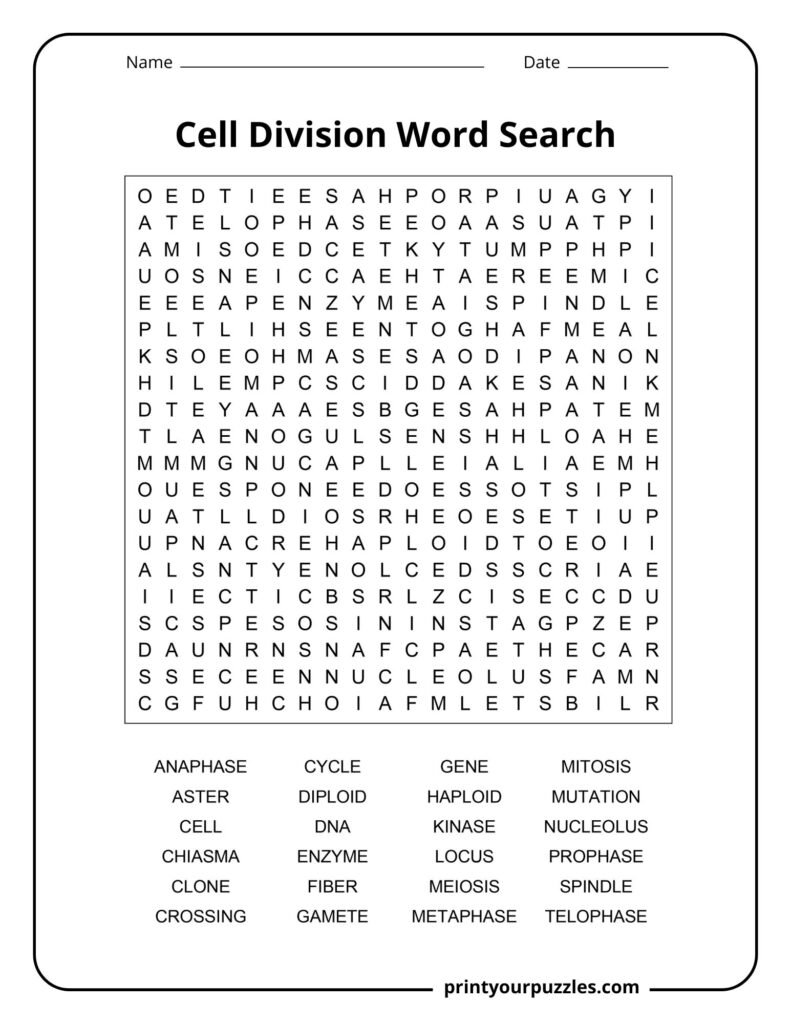
Hard Difficulty Word Search
Words to Find
ANAPHASE, ASTER, CELL, CHIASMA, CLONE, CROSSING, CYCLE, DIPLOID, DNA, ENZYME, FIBER, GAMETE, GENE, HAPLOID, KINASE, LOCUS, MEIOSIS, METAPHASE, MITOSIS, MUTATION, NUCLEOLUS, PROPHASE, SPINDLE, TELOPHASE
5 Key FAQs About the Cell Division
5 Curious "Did You Know?" Facts About the Cell Division