Introduction to the Neuron Word Search
A neuron is a specialized cell that carries information throughout the nervous system. Neurons allow the brain, spinal cord, and nerves to communicate with one another, helping the body think, move, feel, remember, and respond to the environment. Billions of neurons work together every moment, sending signals that control everything from breathing and walking to solving problems and experiencing emotions.
Most neurons have three main parts: the cell body, dendrites, and an axon. The cell body contains the nucleus and manages the basic activities that keep the neuron alive. Dendrites are short, branching structures that receive information from nearby cells. The axon is a long extension that carries electrical signals away from the cell body toward other neurons, muscles, or glands. Some axons are covered by a protective substance called myelin, which helps signals travel more quickly.
Neurons communicate using a combination of electrical and chemical signals. An electrical impulse, known as an action potential, travels along the axon. When it reaches the end of the neuron, chemicals called neurotransmitters are released into a tiny gap called a synapse. These neurotransmitters cross the gap and attach to receptors on another cell, passing the message forward. This process happens extremely quickly and allows the nervous system to coordinate complex actions.
There are several types of neurons, each with a particular role. Sensory neurons carry information from the senses to the brain and spinal cord. Motor neurons send instructions from the nervous system to muscles, allowing the body to move. Interneurons connect other neurons and help process information, especially within the brain and spinal cord.
Although neurons share many basic features, they can vary greatly in shape and size depending on their function. Some have very short axons, while others extend over long distances within the body. Their complex networks make learning, memory, communication, and movement possible.
A neuron word search can introduce useful vocabulary such as axon, dendrite, synapse, impulse, myelin, receptor, and neurotransmitter. Becoming familiar with these terms can help students understand how nerve cells send messages and how the nervous system manages the body’s activities.
Related Word Searches:
Nervous System | Cell | Biology | Muscular System | Electricity | Body Systems
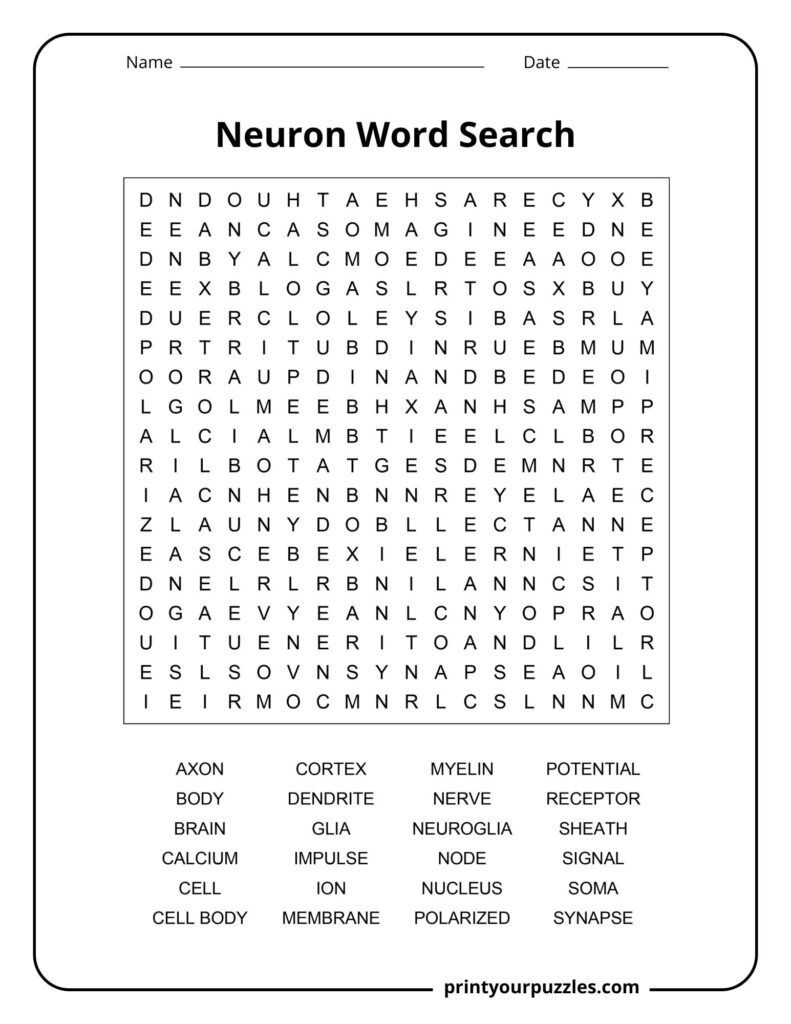
Medium Difficulty Word Search
Words to Find:
AXON, BODY, BRAIN, CALCIUM, CELL, CELL BODY, CORTEX, DENDRITE, GLIA, IMPULSE, ION, MEMBRANE, MYELIN, NERVE, NEUROGLIA, NODE, NUCLEUS, POLARIZED, POTENTIAL, RECEPTOR, SHEATH, SIGNAL, SOMA, SYNAPSE
All Words Defined
AXON – A long, slender projection extending from the neuron’s cell body that conducts electrical impulses away from the soma toward other neurons, muscles, or glands.
BODY – Refers to the cell body or soma of the neuron, containing the nucleus and organelles, serving as the metabolic center of the nerve cell.
BRAIN – The complex organ of the central nervous system composed of billions of neurons and glial cells, responsible for processing information, controlling body functions, and enabling thought.
CALCIUM – A positively charged ion essential for neurotransmitter release at synapses, muscle contraction, and triggering various cellular processes within neurons and
throughout the nervous system.
CELL – The basic structural and functional unit of all living organisms; neurons are specialized cells designed to transmit electrical and chemical signals throughout the nervous system.
CELL BODY – The central part of the neuron containing the nucleus and cytoplasm, where protein synthesis occurs and cellular metabolism is maintained for neuronal function.
CORTEX – The outer layer of the brain composed of gray matter containing neuron cell bodies, responsible for higher-order thinking, sensory processing, and voluntary movement control.
DENDRITE – Branched extensions projecting from the neuron’s
cell body that receive incoming signals from other neurons and conduct them toward the soma for processing.
GLIA – Non-neuronal support cells in the nervous system that provide structural support, insulation, nutrients, and protection to neurons while maintaining proper brain function.
IMPULSE – The electrical signal or action potential that travels along a neuron’s axon, transmitting information rapidly from one part of the nervous system to another.
ION – Electrically charged particles such as sodium, potassium, or calcium that move across neuron membranes to generate electrical signals essential for nerve impulse transmission.
MEMBRANE – The semipermeable lipid bilayer surrounding the neuron that regulates the passage of ions and molecules, maintaining the cell’s internal environment and enabling signal transmission.
MYELIN – A fatty insulating sheath wrapping around axons, produced by glial cells, that increases the speed of electrical impulse transmission and protects the nerve fiber.
NERVE – A bundle of axons grouped together in the peripheral
nervous system that transmits electrical signals between the brain, spinal cord, and other body parts.
NEUROGLIA – Another term for glial cells; supportive cells in the nervous system that outnumber neurons and perform functions including insulation, nutrient delivery, and waste removal.
NODE – Gaps in the myelin sheath along an axon, called nodes of Ranvier, where action potentials are regenerated, enabling faster saltatory conduction of impulses.
NUCLEUS – The membrane-bound organelle within the neuron’s cell body containing genetic material (DNA) that controls cellular functions and protein synthesis essential for neuronal operations.
POLARIZED – The state of a neuron’s membrane having an electrical charge difference between inside and outside, with the interior typically negative relative to the exterior.
POTENTIAL – Refers to the electrical potential difference across the neuron membrane; action potential is the rapid voltage change that constitutes a nerve impulse traveling along axons.
RECEPTOR – Specialized protein molecules on neuron membranes that bind to neurotransmitters or other chemical signals, initiating cellular responses and continuing signal transmission between neurons.
SHEATH – A protective covering around nerve fibers, typically referring to the myelin sheath that insulates axons and increases the speed of electrical signal conduction.
SIGNAL – The electrical or chemical message transmitted between neurons or from neurons to target cells, enabling communication throughout the nervous system and coordinating body functions.
SOMA – The cell body of a neuron containing the nucleus and organelles, integrating incoming signals from dendrites and maintaining the cell’s metabolic and structural integrity.
SYNAPSE – The junction between two neurons or between a neuron and target cell where chemical or electrical signals are transmitted, enabling communication throughout the nervous system.
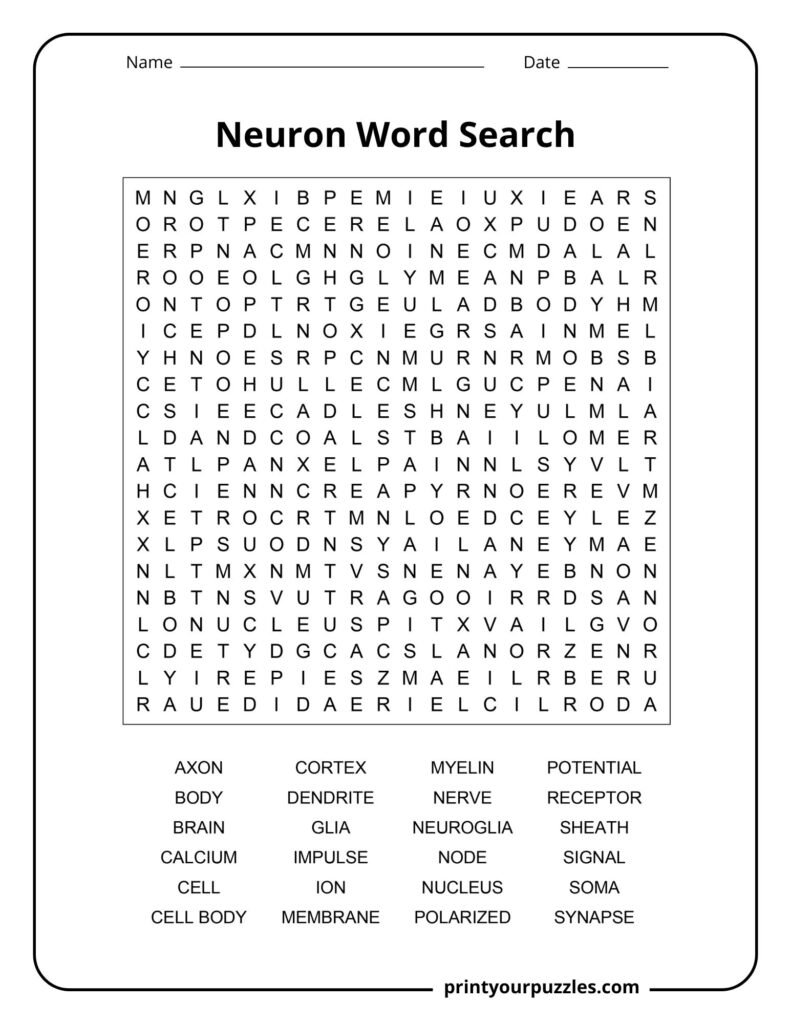
Hard Difficulty Word Search
Words to Find:
AXON, BODY, BRAIN, CALCIUM, CELL, CELL BODY, CORTEX, DENDRITE, GLIA, IMPULSE, ION, MEMBRANE, MYELIN, NERVE, NEUROGLIA, NODE, NUCLEUS, POLARIZED, POTENTIAL, RECEPTOR, SHEATH, SIGNAL, SOMA, SYNAPSE
5 Key FAQs About Neuron
5 Curious "Did You Know?" Facts About Neuron