

The human body is made up of several connected groups of organs called Body Systems. Each system has its own important job, but no system works completely alone. They communicate and cooperate to keep the body supplied with oxygen and nutrients, remove waste, control movement, and respond to changes in the environment.
The Circulatory System includes the heart, blood, and blood vessels. Its main role is to transport oxygen, nutrients, hormones, and other substances throughout the body. It also carries carbon dioxide and waste products away from cells so they can be removed. The Respiratory System, which includes the lungs and airways, works closely with circulation by bringing oxygen into the body and releasing carbon dioxide when we breathe out.
The Digestive System breaks food down into nutrients that the body can absorb and use for energy, growth, and repair. Organs such as the stomach, small intestine, large intestine, liver, and pancreas all take part in digestion. Once nutrients enter the bloodstream, the circulatory system delivers them to cells throughout the body.
Movement and support depend largely on the Muscular System and the Skeletal System. Bones provide structure, protect delicate organs, and store important minerals. Muscles pull on bones to produce movement, while joints allow different parts of the skeleton to bend and turn. Muscles also help with actions that are not always noticeable, including maintaining posture, moving food through the digestive tract, and pumping blood through the heart.
The Nervous System acts as the body’s rapid communication network. The brain, spinal cord, and nerves receive information, process it, and send signals that control movement, senses, thoughts, and automatic activities such as breathing. The Endocrine System also controls body processes, but it uses hormones instead of fast electrical signals. These hormones help regulate growth, metabolism, reproduction, sleep, stress, and blood sugar levels.
Studying a body systems word search can help learners recognize key terms connected with organs, functions, and human anatomy. Understanding how these systems interact makes it easier to see the body as one coordinated structure rather than a collection of separate parts. Every heartbeat, breath, movement, and meal involves several systems working together to keep the body balanced, active, and healthy.
Related Word Searches:
Cell | Biology | Neuron | Cellular Respiration | DNA | Genetics
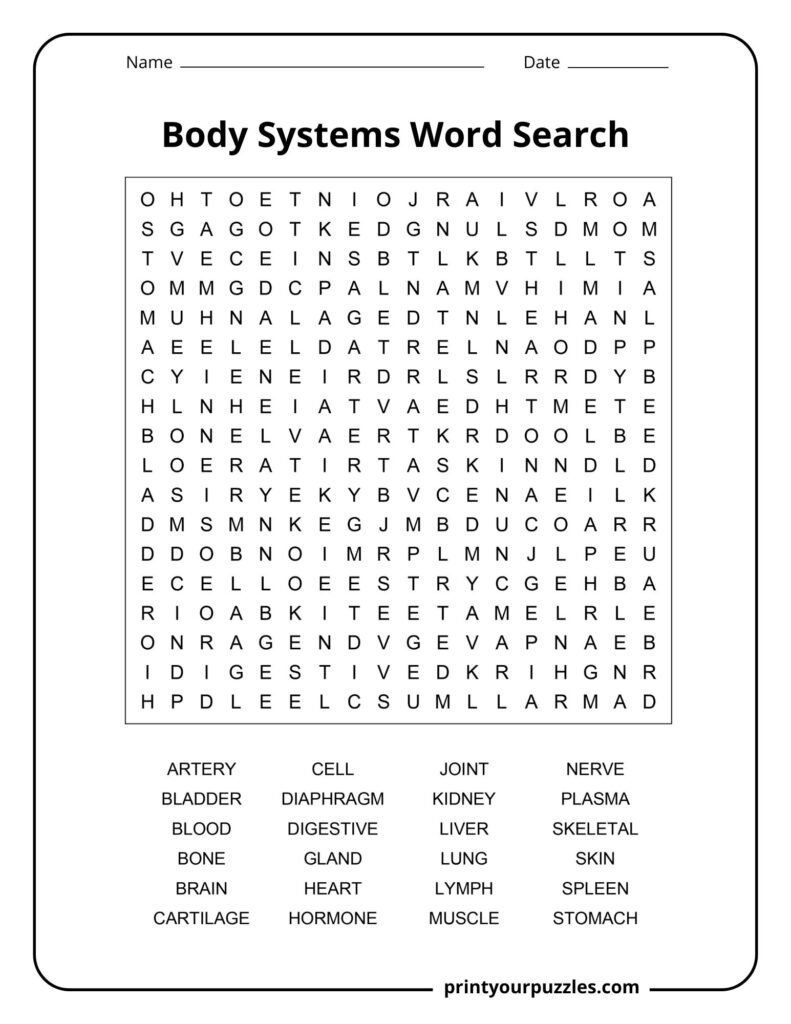
ARTERY, BLADDER, BLOOD, BONE, BRAIN, CARTILAGE, CELL, DIAPHRAGM, DIGESTIVE, GLAND, HEART, HORMONE, JOINT, KIDNEY, LIVER, LUNG, LYMPH, MUSCLE, NERVE, PLASMA, SKELETAL, SKIN, SPLEEN, STOMACH
ARTERY – A blood vessel that carries oxygen-rich blood away from the heart to various tissues and organs throughout the body, featuring thick muscular walls.
BLADDER – A hollow muscular organ in the urinary system that stores urine produced by the kidneys until it is expelled from the body during urination.
BLOOD – The red fluid circulating through the cardiovascular system, transporting oxygen, nutrients, hormones, and waste products while also defending against infections and regulating body temperature.
BONE – Hard, dense connective tissue forming the skeleton, providing structural support, protecting internal organs, producing blood cells, and storing essential minerals like calcium and phosphorus.
BRAIN – The complex control center of the nervous system located in the skull, responsible for thought, memory, emotion, sensory processing, and coordinating all body functions.
CARTILAGE – A flexible, smooth connective tissue found in joints, ears, nose, and between vertebrae, providing cushioning, support, and allowing smooth movement without friction.
CELL – The smallest basic structural and functional unit of all living organisms, containing genetic material and performing specific functions necessary for survival and reproduction.
DIAPHRAGM – A dome-shaped muscular sheet separating the chest from the abdomen, contracting and relaxing to enable breathing by changing pressure within the thoracic cavity.
DIGESTIVE – The body system responsible for breaking down food into nutrients through mechanical and chemical processes, absorbing nutrients, and eliminating waste from the body.
GLAND – An organ that produces and secretes specific substances such as hormones, enzymes, or sweat, either into the bloodstream or through ducts to specific locations.
HEART – A powerful muscular pump in the circulatory system that rhythmically contracts to push blood throughout the body, delivering oxygen and nutrients to all tissues.
HORMONE – A chemical messenger produced by glands and transported through the bloodstream to target organs, regulating growth, metabolism, reproduction, mood, and other bodily functions.
JOINT – The connection point where two or more bones meet, allowing movement and flexibility while providing stability through ligaments, cartilage, and synovial fluid for lubrication.
KIDNEY – A bean-shaped organ that filters waste products and excess water from blood to produce urine, while also regulating electrolytes, blood pressure, and red blood cells.
LIVER – The largest internal organ, performing over five hundred functions including detoxifying harmful substances, producing bile for digestion, storing nutrients, and synthesizing essential proteins.
LUNG – A spongy respiratory organ where oxygen from inhaled air enters the bloodstream and carbon dioxide is removed, enabling gas exchange essential for cellular respiration.
LYMPH – A clear, colorless fluid containing white blood cells that circulates through the lymphatic system, removing toxins, fighting infections, and maintaining fluid balance in tissues.
MUSCLE – Contractile tissue composed of specialized fibers that generate force and movement through contraction and relaxation, enabling mobility, posture, and organ function throughout the body.
NERVE – A bundle of specialized fibers that transmits electrical signals between the brain, spinal cord, and body parts, enabling sensation, movement, and communication throughout the body.
PLASMA – The pale yellow liquid component of blood, comprising about fifty-five percent of total volume, transporting cells, nutrients, hormones, proteins, and waste products throughout circulation.
SKELETAL – Relating to the framework of bones and cartilage that supports the body, protects vital organs, enables movement through muscle attachment, and produces blood cells.
SKIN – The body’s largest organ forming a protective barrier against pathogens, regulating temperature through sweat, providing sensation through nerve endings, and synthesizing vitamin D.
SPLEEN – An organ in the lymphatic system that filters blood, removes old red blood cells, stores white blood cells and platelets, and helps fight infections.
STOMACH – A muscular digestive organ between the esophagus and small intestine that secretes acid and enzymes to break down food into a semi-liquid mixture for absorption.
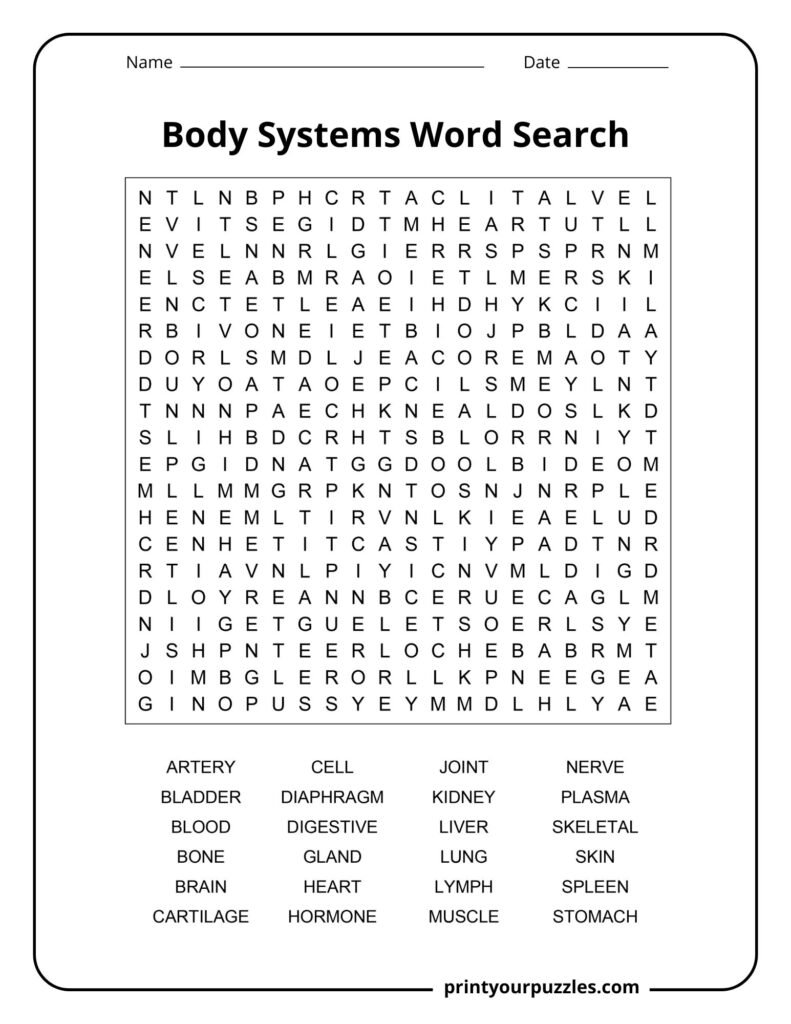
ARTERY, BLADDER, BLOOD, BONE, BRAIN, CARTILAGE, CELL, DIAPHRAGM, DIGESTIVE, GLAND, HEART, HORMONE, JOINT, KIDNEY, LIVER, LUNG, LYMPH, MUSCLE, NERVE, PLASMA, SKELETAL, SKIN, SPLEEN, STOMACH
The eleven major body systems include circulatory, respiratory, digestive, nervous, muscular, skeletal, endocrine, immune/lymphatic, integumentary, urinary, and reproductive systems, each performing specialized functions for survival.
Body systems constantly interact and depend on each other. For example, the respiratory system provides oxygen while the circulatory system delivers it, and the nervous system coordinates all activities.
The integumentary system, primarily consisting of skin, is the largest organ system, covering approximately twenty square feet and protecting internal structures while regulating temperature and sensation.
The nervous system, including the brain, spinal cord, and nerves, serves as the body’s command center, controlling and coordinating all other systems through electrical and chemical signals.
Understanding body systems helps maintain health, recognize disease symptoms, make informed medical decisions, and appreciate how lifestyle choices affect overall well-being and longevity throughout life.
Throughout an average lifetime, the human heart beats over 2.5 billion times, pumping roughly 1.5 million barrels of blood—enough to fill two hundred train tank cars completely.
Pound for pound, human bone is five times stronger than steel. A cubic inch of bone can withstand loads of at least 19,000 pounds, making it remarkably resilient.
The entire digestive tract, stretching from mouth to anus, measures about thirty feet in adults. Food typically takes twenty-four to seventy-two hours to complete this journey.
If laid end-to-end, the arteries, veins, and capillaries in an adult body would circle Earth’s equator more than twice, creating an incredible network for circulation.
The human brain produces approximately twelve to twenty-five watts of electrical power when awake—sufficient energy to illuminate a low-wattage LED bulb through neural activity.