
The Endocrine System is a communication network that uses hormones to control many important activities in the human body. Hormones are chemical messengers produced by special organs called glands. They travel through the bloodstream and deliver instructions to specific cells, tissues, and organs. Although hormones often act more slowly than nerve signals, their effects may continue for hours, days, or even years.
Several glands form the Endocrine System. The pituitary gland, located near the base of the brain, is sometimes called the master gland because it helps control other endocrine glands. The thyroid gland regulates metabolism, which affects how quickly the body uses energy. The adrenal glands help the body respond to stressful or dangerous situations by releasing hormones such as adrenaline.
The pancreas also has an endocrine role. It produces insulin and glucagon, two hormones that help maintain healthy blood sugar levels. The ovaries and testes release hormones involved in reproduction, growth, and physical development. Another important gland is the pineal gland, which produces melatonin and helps regulate the body’s sleep-and-wake cycle.
Like other Body Systems, the Endocrine System does not work alone. It works closely with the Nervous System, which sends rapid electrical messages throughout the body. Together, these systems help regulate temperature, appetite, emotions, growth, and responses to stress. The Circulatory System carries hormones from the glands to the parts of the body where they are needed.
The Endocrine System also interacts with the Digestive System by helping control hunger, digestion, and blood sugar. It supports the Muscular System and Skeletal System by regulating growth, bone development, muscle strength, and calcium levels. Hormones can even influence breathing rate and energy use, connecting endocrine activity with the Respiratory System.
An endocrine system word search printable can introduce students to useful terms such as hormone, gland, thyroid, insulin, pituitary, adrenal, pancreas, and metabolism. Recognizing these words can make the system easier to study and understand. Although endocrine glands are located in different parts of the body, they work together as an organized network. By producing and releasing the right amount of each hormone, the Endocrine System helps the body maintain balance, adapt to change, develop properly, and perform essential everyday functions.
Related Word Searches:
Body Systems | Biology | Cell | Circulatory System | Digestive System | Genetics
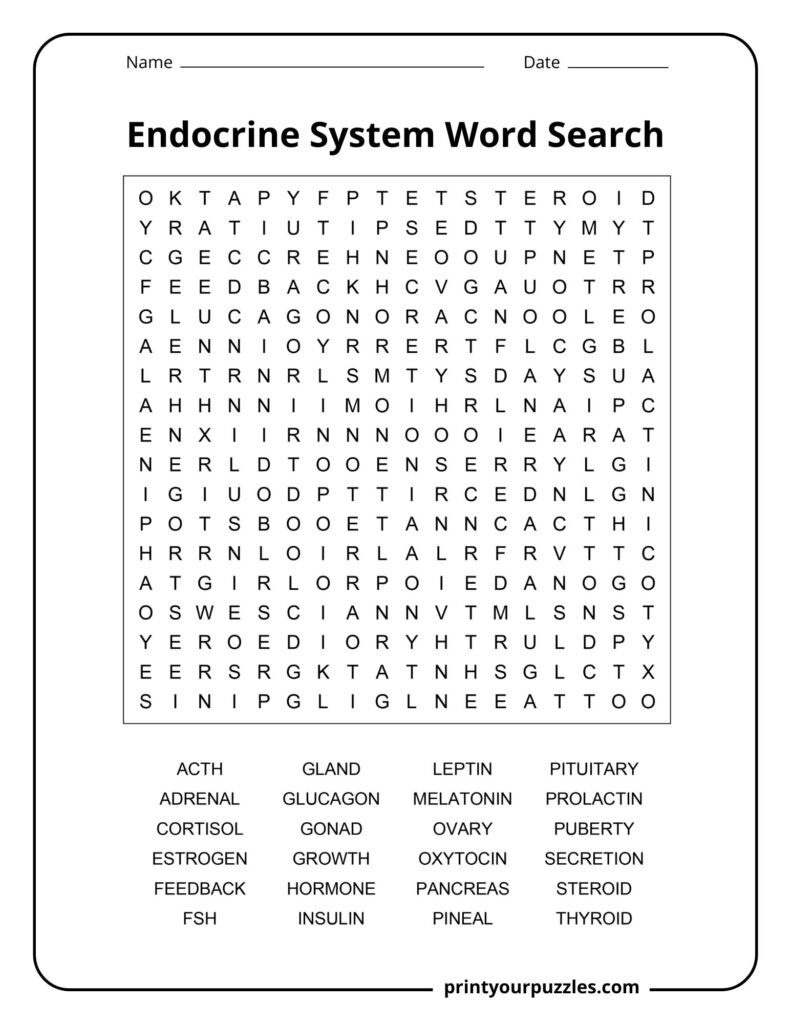
ACTH, ADRENAL, CORTISOL, ESTROGEN, FEEDBACK, FSH, GLAND, GLUCAGON, GONAD, GROWTH, HORMONE, INSULIN, LEPTIN, MELATONIN, OVARY, OXYTOCIN, PANCREAS, PINEAL, PITUITARY, PROLACTIN, PUBERTY, SECRETION, STEROID, THYROID
ACTH – Adrenocorticotropic hormone produced by the pituitary gland that stimulates the adrenal cortex to release cortisol and other steroid hormones essential for stress response and metabolism regulation.
ADRENAL – Triangular-shaped glands located above each kidney that produce vital hormones including cortisol, aldosterone, and adrenaline, regulating stress response, blood pressure, metabolism, and immune function throughout the body.
CORTISOL – Primary stress hormone produced by adrenal glands that regulates metabolism, reduces inflammation, controls blood sugar levels, influences memory formation, and helps maintain blood pressure during stressful situations.
ESTROGEN – Primary female sex hormone produced mainly by ovaries that regulates reproductive system development, menstrual cycle, bone density, skin health, and influences mood, cardiovascular health, and cognitive function.
FEEDBACK – Regulatory mechanism where hormone levels trigger responses that either increase or decrease their production, maintaining homeostasis through negative or positive loops that ensure proper endocrine system balance.
FSH – Follicle-stimulating hormone secreted by pituitary gland that promotes egg maturation in ovaries and sperm production in testes, playing crucial roles in reproductive function and fertility regulation.
GLAND – Specialized organ or tissue that synthesizes and secretes hormones or other substances directly into bloodstream or through ducts, regulating various bodily functions and maintaining physiological balance.
GLUCAGON – Hormone produced by pancreatic alpha cells that raises blood glucose levels by stimulating liver glycogen breakdown and glucose release, working opposite to insulin in blood sugar regulation.
GONAD – Primary reproductive organs, either ovaries in females or testes in males, that produce sex cells and secrete sex hormones controlling reproduction, sexual development, and secondary sex characteristics.
GROWTH – Biological process of physical development and cell multiplication regulated by growth hormone and other factors, involving increased size, maturation of tissues, and development throughout childhood and adolescence.
HORMONE – Chemical messenger produced by endocrine glands
and released into bloodstream to regulate specific cells or organs, controlling metabolism, growth, reproduction, mood, and numerous other physiological processes.
INSULIN – Hormone secreted by pancreatic beta cells that lowers blood glucose levels by facilitating cellular glucose uptake and promoting glycogen storage, essential for preventing diabetes and maintaining energy.
LEPTIN – Hormone produced by fat cells that regulates energy balance by suppressing appetite and signaling satiety to the brain, helping maintain appropriate body weight and energy expenditure levels.
MELATONIN – Hormone produced by pineal gland that regulates sleep-wake cycles and circadian rhythms, with production increasing in darkness to promote sleep and decreasing with light exposure upon waking.
OVARY – Female reproductive gland that produces eggs and secretes estrogen and progesterone hormones, regulating menstrual cycles, pregnancy, and development of female secondary sexual characteristics throughout reproductive years.
OXYTOCIN – Hormone produced by hypothalamus and released by pituitary gland that stimulates uterine contractions during childbirth, promotes milk ejection during breastfeeding, and influences social bonding and trust.
PANCREAS – Dual-function organ serving as both endocrine gland producing insulin and glucagon for blood sugar regulation, and exocrine gland secreting digestive enzymes into small intestine for nutrient breakdown.
PINEAL – Small pine cone-shaped gland located in brain that produces melatonin hormone, regulating circadian rhythms, sleep patterns, and seasonal biological functions based on light-dark cycle detection.
PITUITARY – Master endocrine gland located at brain base that produces multiple hormones controlling other glands, regulating growth, reproduction, metabolism, stress response, lactation, and water balance throughout body.
PROLACTIN – Hormone secreted by pituitary gland primarily responsible for stimulating milk production in mammary glands after childbirth, also influencing reproductive function, metabolism, immune system, and behavioral responses.
PUBERTY – Developmental period when reproductive system matures and secondary sexual characteristics emerge, triggered by increased hormone production, typically occurring during adolescence with significant physical and emotional changes.
SECRETION – Process by which glands produce and release hormones, enzymes, or other substances into bloodstream or onto surfaces, enabling communication between organs and regulation of various physiological functions.
STEROID – Class of lipid-based hormones including cortisol, estrogen, and testosterone that easily cross cell membranes, binding to intracellular receptors to regulate gene expression and control metabolism, immunity, and development.
THYROID – Butterfly-shaped gland in neck producing thyroid hormones that regulate metabolism, energy production, body temperature, heart rate, brain development, and calcium balance essential for overall physiological function.
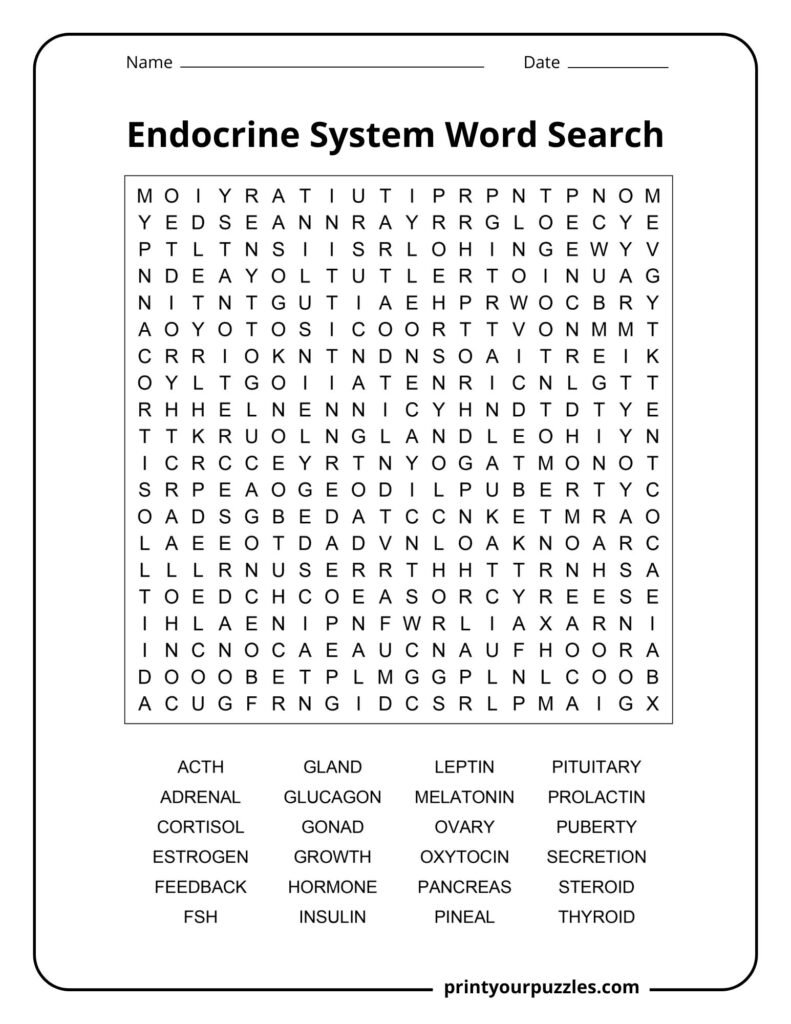
ACTH, ADRENAL, CORTISOL, ESTROGEN, FEEDBACK, FSH, GLAND, GLUCAGON, GONAD, GROWTH, HORMONE, INSULIN, LEPTIN, MELATONIN, OVARY, OXYTOCIN, PANCREAS, PINEAL, PITUITARY, PROLACTIN, PUBERTY, SECRETION, STEROID, THYROID
The endocrine system is a network of glands that produce and secrete hormones directly into the bloodstream, regulating metabolism, growth, reproduction, mood, and maintaining overall body homeostasis.
Major endocrine glands include the pituitary, thyroid, parathyroid, adrenal, pancreas, pineal, and reproductive glands (ovaries and testes), each producing specific hormones controlling different bodily functions.
Hormones act as chemical messengers traveling through bloodstream to target organs and tissues, binding to specific receptors on cells to trigger responses that regulate various physiological processes.
Endocrine disorders occur when glands produce too much or too little hormone, causing conditions like diabetes, thyroid disease, growth disorders, or reproductive issues requiring medical treatment.
The nervous system uses electrical signals for rapid, short-term responses, while the endocrine system uses hormones for slower, longer-lasting effects, though both systems work together coordinating body functions.
Despite being smaller than a pea, the pituitary gland controls multiple other endocrine glands throughout your body, earning its nickname as the “master gland” of the endocrine system.
The heart isn’t just a pump—it’s also an endocrine organ that produces atrial natriuretic peptide (ANP), a hormone regulating blood pressure and fluid balance throughout your body.
During frightening situations, adrenaline release heightens your senses and speeds up brain processing, creating the perception that time is moving in slow motion during dangerous moments.
Thyroid hormones influence virtually every cell in your body, controlling metabolic rate, body temperature, heart function, digestion, brain development, and even hair growth and skin health.
Chronic stress causes prolonged cortisol elevation, which can actually shrink the hippocampus—the brain region responsible for memory and learning—potentially affecting cognitive function and emotional regulation.