Introduction to the French Revolution Word Search
The French Revolution was one of the most dramatic turning points in European history. Beginning in 1789, it transformed France’s political system, weakened the power of the monarchy and nobility, and spread new ideas about liberty, equality, citizenship, and government. What started as a financial and political crisis soon became a revolution that changed not only France but also influenced countries across Europe and beyond.
Before the Revolution, France was ruled by King Louis XVI under a system known as the Ancien Régime. Society was divided into three estates. The clergy formed the First Estate, the nobility made up the Second Estate, and almost everyone else belonged to the Third Estate. Although the Third Estate represented the vast majority of the population, its members carried much of the tax burden while having limited political influence. At the same time, France faced enormous debts, rising food prices, poor harvests, and growing public anger.
In 1789, representatives of the Third Estate declared themselves the National Assembly and demanded political reform. That summer, crowds in Paris stormed the Bastille, a royal fortress and prison that became a powerful symbol of resistance to the monarchy. Revolutionary leaders later issued the Declaration of the Rights of Man and of the Citizen, which promoted principles such as individual freedom and equality before the law.
The Revolution soon became more radical. King Louis XVI and Queen Marie Antoinette were executed, France became a republic, and political conflict led to the Reign of Terror. Thousands of people considered enemies of the Revolution were executed, many by guillotine. Revolutionary France also fought wars against several European monarchies that feared revolutionary ideas would spread.
By the late 1790s, years of instability created an opportunity for the military leader Napoleon Bonaparte to gain power. His rise in 1799 is often considered the end of the French Revolution, although many revolutionary reforms survived.
This French Revolution word search introduces important people, events, ideas, and symbols connected with this extraordinary period. Exploring these terms can help readers understand how France moved from absolute monarchy through revolution, republic, violence, and eventually the rise of Napoleon.
Related Word Searches:
American Revolution | U.S. Constitution | Age of Exploration | Renaissance | Industrial Revolution | Napoleonic Wars
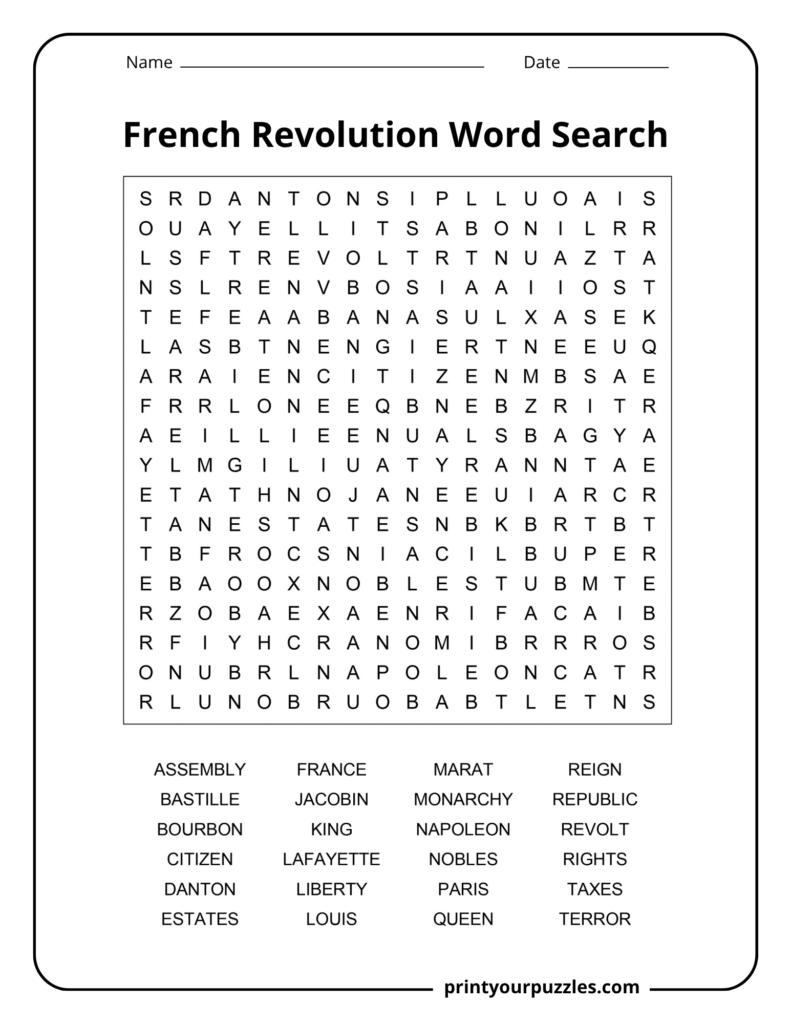
Medium Difficulty Word Search
Words to Find:
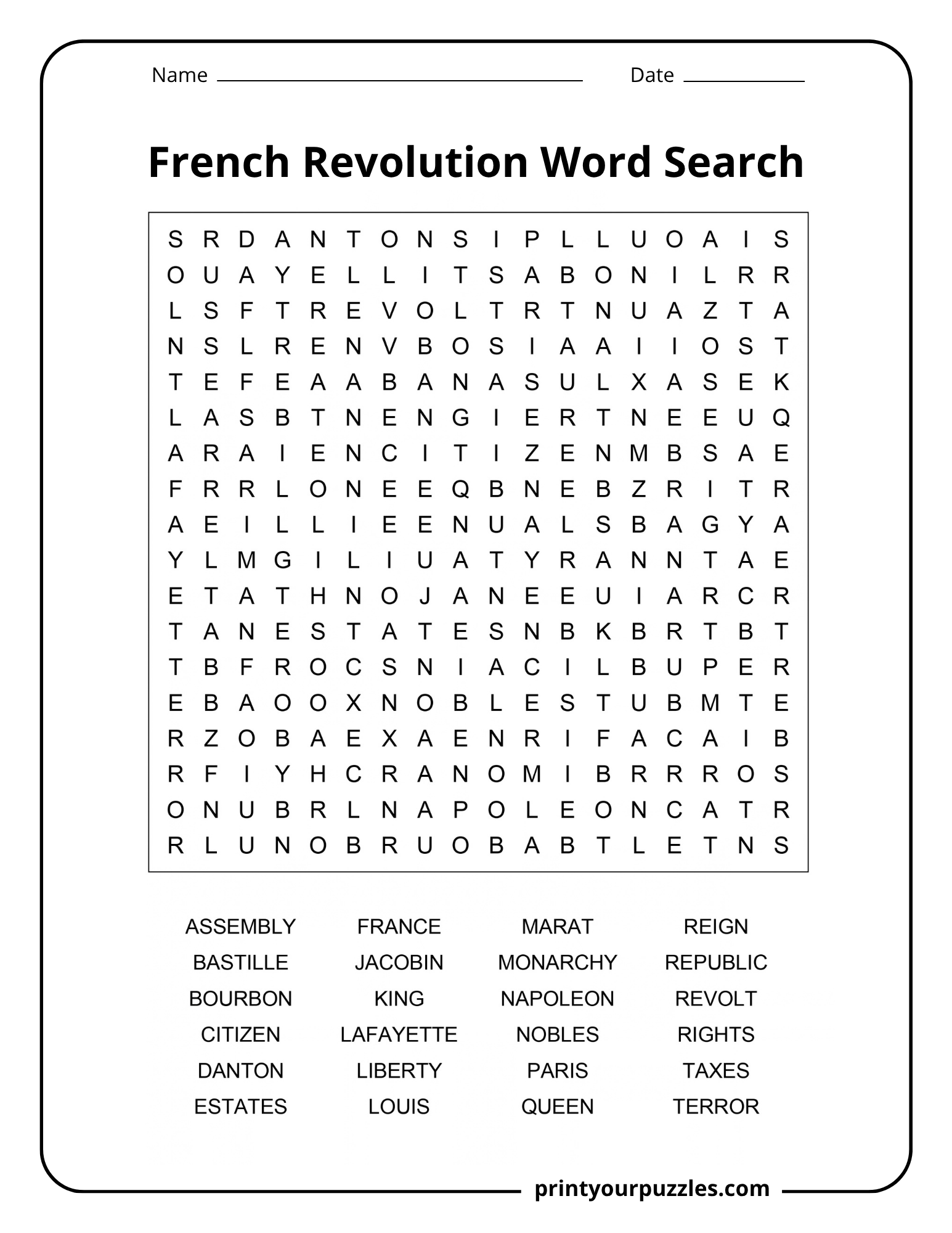
ASSEMBLY, BASTILLE, BOURBON, CITIZEN, DANTON, ESTATES, FRANCE, JACOBIN, KING, LAFAYETTE, LIBERTY, LOUIS, MARAT, MONARCHY, NAPOLEON, NOBLES, PARIS, QUEEN, REIGN, REPUBLIC, REVOLT, RIGHTS, TAXES, TERROR
All Words Defined
ASSEMBLY – Representative political body formed during the Revolution. The National Assembly challenged royal authority, demanded reforms, and began creating a new political system for France.
BASTILLE – Paris fortress and prison stormed by revolutionaries on July 14, 1789. Its fall became a powerful symbol of resistance against royal authority and oppression.
BOURBON – Royal dynasty that ruled France before the Revolution. Louis XVI belonged to the Bourbon family, whose authority collapsed as revolutionary demands grew across the country.
CITIZEN – Term increasingly used during the Revolution to emphasize equality and membership in the nation rather than social rank, noble privilege, or inherited political status.
DANTON – Georges Danton was an influential revolutionary leader and powerful speaker. He helped defend the Revolution but was later accused of moderation and executed in 1794.
ESTATES – Social divisions of pre-revolutionary France: clergy, nobility, and everyone else. The unequal privileges of these three estates contributed greatly to revolutionary anger.
FRANCE – European country where the Revolution began in 1789. Political, social, and economic changes there influenced ideas about rights and government throughout Europe.
JACOBIN – Member of a radical political club during the Revolution. The Jacobins supported republican government and became especially powerful during the Reign of Terror.
KING – Louis XVI was king when the Revolution began. His resistance to political change and attempted escape damaged public trust and contributed to monarchy’s abolition.
LAFAYETTE – French aristocrat and military officer who supported constitutional reform. Lafayette commanded the National Guard and promoted moderate revolutionary ideas inspired partly by the American Revolution.
LIBERTY – Major revolutionary ideal representing freedom from arbitrary government and inherited privilege. Liberty became closely associated with political rights, citizenship, and demands for constitutional government.
LOUIS – Louis XVI was France’s monarch at the Revolution’s beginning. He was removed from power, convicted of treason, and executed by guillotine in 1793.
MARAT – Jean-Paul Marat was a radical journalist and revolutionary politician known for attacking enemies of the Revolution. He was assassinated by Charlotte Corday in 1793.
MONARCHY – System of government led by a king or queen. The French monarchy lost authority during the Revolution and was formally abolished in September 1792.
NAPOLEON – Napoleon Bonaparte was a successful French general who seized political power in 1799. His rise is commonly considered the end of the French Revolution.
NOBLES – Members of France’s privileged upper social class before the Revolution. Many nobles held special rights, owned large estates, and were exempt from certain taxes.
PARIS – Capital of France and major center of revolutionary activity. Crowds, political clubs, newspapers, and popular demonstrations there strongly influenced events throughout the Revolution.
QUEEN – Marie Antoinette, wife of Louis XVI, became a controversial symbol of royal extravagance. She was imprisoned after monarchy’s fall and executed in 1793.
REIGN – Refers especially to the Reign of Terror, a radical revolutionary period from 1793 to 1794 marked by political repression, trials, and thousands of executions.
REPUBLIC – Form of government without a monarch. France officially became a republic in 1792 after revolutionaries abolished the monarchy and removed Louis XVI from power.
REVOLT – Organized resistance against established authority. During the French Revolution, popular revolts challenged royal power, noble privilege, taxation, food shortages, and traditional political institutions.
RIGHTS – Revolutionary leaders promoted legal and political rights through documents such as the Declaration of the Rights of Man and of the Citizen in 1789.
TAXES – Financial charges placed heavily on ordinary people before the Revolution. Anger over unfair taxation increased resentment toward privileged estates and France’s existing political system.
TERROR – Period of intense political violence from 1793 to 1794. Revolutionary authorities executed thousands of suspected enemies while claiming emergency measures were necessary to protect France.
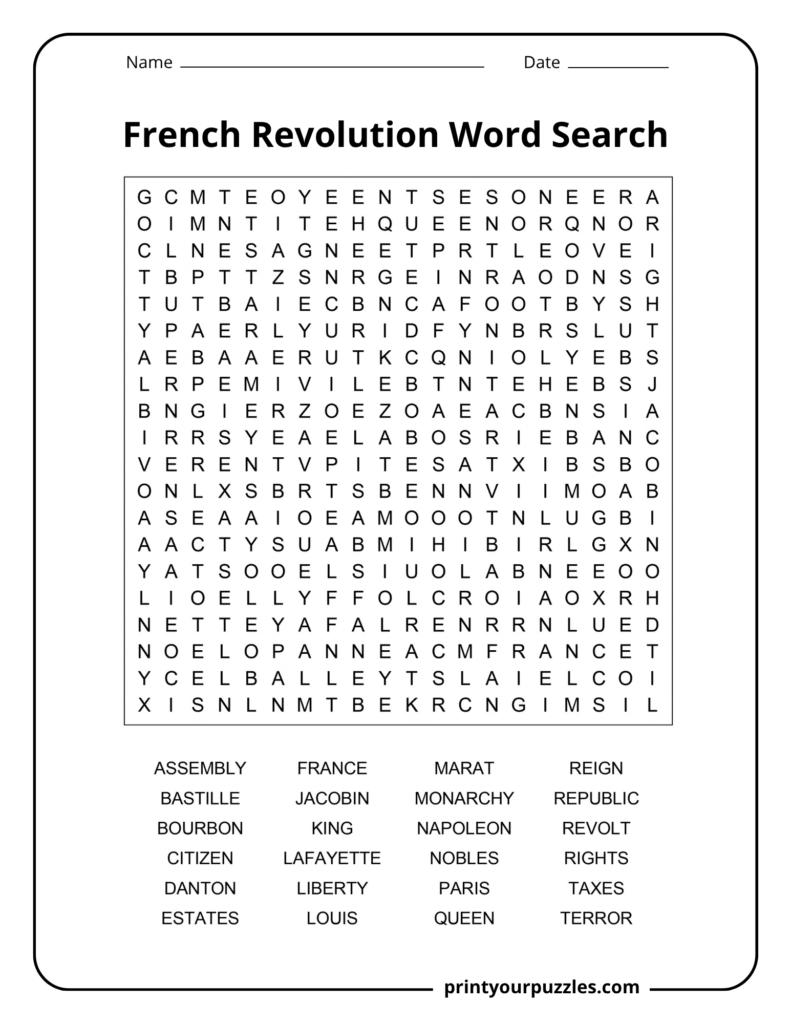
Hard Difficulty Word Search
Words to Find:
ASSEMBLY, BASTILLE, BOURBON, CITIZEN, DANTON, ESTATES, FRANCE, JACOBIN, KING, LAFAYETTE, LIBERTY, LOUIS, MARAT, MONARCHY, NAPOLEON, NOBLES, PARIS, QUEEN, REIGN, REPUBLIC, REVOLT, RIGHTS, TAXES, TERROR
5 Key FAQs About the French Revolution
5 Curious "Did You Know?" Facts About the French Revolution