Introduction to the Industrial Revolution Word Search
The Industrial Revolution transformed the United States from a largely rural and agricultural society into a rapidly growing industrial nation. Beginning in the late 1700s and accelerating throughout the 1800s, new inventions, factories, transportation systems, and methods of production changed how Americans worked, traveled, communicated, and lived. This Industrial Revolution word search introduces important people, inventions, industries, and ideas connected with one of the most influential periods in American history.
Industrialization in the United States was strongly influenced by earlier developments in Great Britain. One important turning point came when Samuel Slater brought knowledge of British textile machinery to America. In 1790, he helped establish a successful water-powered textile mill in Rhode Island. Soon, textile factories expanded across New England, using machines to produce cloth much faster than traditional hand methods.
Other inventions helped reshape the economy. Eli Whitney popularized the cotton gin, which greatly increased the speed of separating cotton fibers from seeds. Later, interchangeable parts and improved manufacturing techniques made it easier to produce goods in large quantities. Steam engines powered factories, steamboats improved river transportation, and railroads connected cities, farms, factories, and markets across increasingly large distances.
Industrial growth also encouraged the rapid expansion of American cities. Many people moved from rural communities to urban areas seeking factory jobs, while immigrants arriving from Europe provided an important source of industrial labor. Cities such as New York, Philadelphia, Pittsburgh, and Chicago became major centers of manufacturing, trade, and transportation.
However, industrialization also created serious problems. Factory employees often worked long hours for low wages in dangerous conditions. Women and children were commonly employed in mills and workshops. Crowded industrial cities struggled with poor housing, pollution, sanitation problems, and inequality. These conditions eventually contributed to the development of labor unions and movements demanding better wages, shorter working hours, and safer workplaces.
By the late nineteenth century, industries such as steel, oil, railroads, machinery, and manufacturing had become central to the American economy. Entrepreneurs including Andrew Carnegie and John D. Rockefeller built enormous business enterprises, while technological innovation continued to transform everyday life.
The Industrial Revolution permanently changed the United States. It created extraordinary economic growth and technological progress, but it also introduced social challenges that shaped debates about workers, business, immigration, cities, and economic opportunity for generations.
Related Word Searches:
Gilded Age | Progressive Era | Pullman Strike | Transcontinental Railroad | Westward Expansion | Roaring Twenties
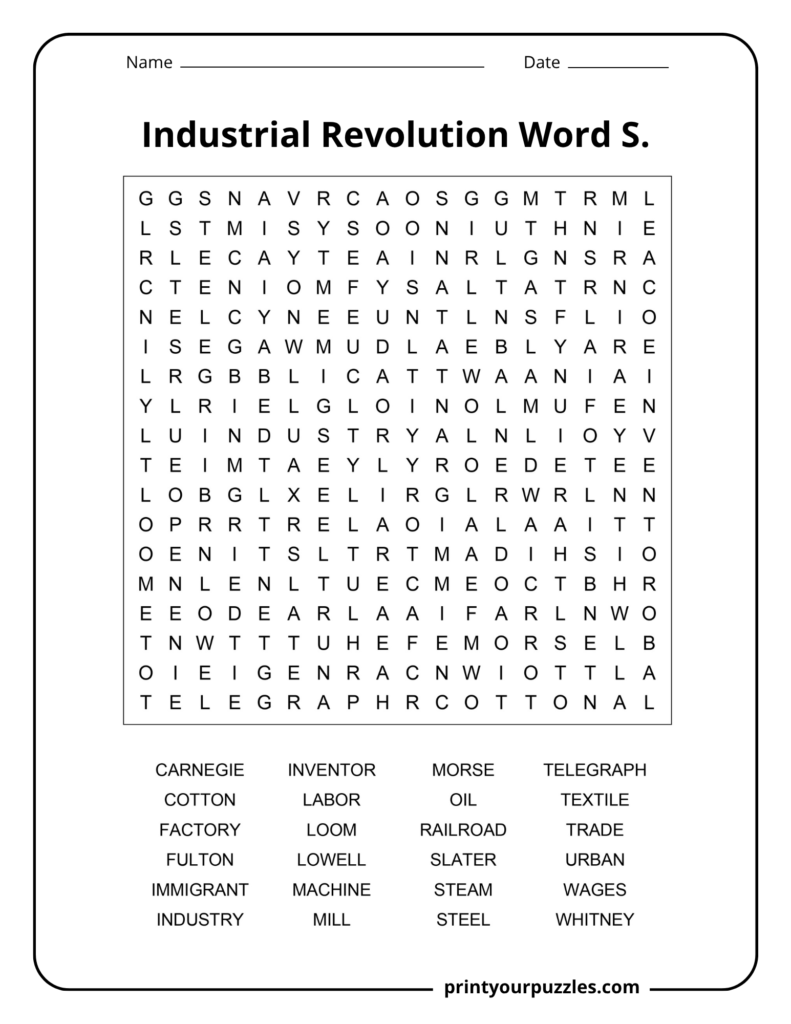
Medium Difficulty Word Search
Words to Find
CARNEGIE, COTTON, FACTORY, FULTON, IMMIGRANT, INDUSTRY, INVENTOR, LABOR, LOOM, LOWELL, MACHINE, MILL, MORSE, OIL, RAILROAD, SLATER, STEAM, STEEL, TELEGRAPH, TEXTILE, TRADE, URBAN, WAGES, WHITNEY
All Words Defined
CARNEGIE – Andrew Carnegie was a Scottish-born American industrialist who built a massive steel empire and became one of the wealthiest businessmen of the Industrial Revolution.
COTTON – Cotton became a major American raw material during industrialization, supplying textile mills while the cotton gin greatly increased production across the southern United States.
FACTORY – A factory is a building where workers and machines manufacture goods, allowing businesses during the Industrial Revolution to produce products faster and in greater quantities.
FULTON – Robert Fulton was an American inventor and engineer who developed a commercially successful steamboat, helping expand river transportation, trade, and economic growth during industrialization.
IMMIGRANT – Immigrants provided an important source of labor for American factories, mines, railroads, and cities, often accepting difficult jobs while building new lives in the United States.
INDUSTRY – Industry refers to the large-scale production of goods and services, which expanded dramatically as factories, machinery, transportation, and new technologies transformed the American economy.
INVENTOR – An inventor creates new devices, machines, or processes, and American inventors played an important role in improving manufacturing, communication, transportation, and everyday life.
LABOR – Labor refers to the workers and physical effort required to produce goods, with factory employees often facing long hours, low wages, and dangerous working conditions.
LOOM – A loom is a machine used to weave thread into cloth, becoming increasingly mechanized in textile factories and helping greatly increase fabric production during industrialization.
LOWELL – Lowell, Massachusetts, became an important textile manufacturing center known for large mills and young female workers who became famous as the Lowell Mill Girls.
MACHINE – Machines replaced or reduced many forms of manual labor, allowing factories to manufacture goods more quickly, consistently, and cheaply during the American Industrial Revolution.
MILL – A mill is a facility where machinery processes materials or manufactures products, with textile mills becoming especially important in early American industrial development.
MORSE – Samuel Morse helped develop the electric telegraph and Morse code, technologies that allowed messages to travel rapidly across long distances and transformed American communication.
OIL – Oil became an increasingly important American industry during the nineteenth century, providing fuel and other products while creating enormous fortunes for businessmen such as Rockefeller.
RAILROAD – Railroads transformed American transportation by moving people, raw materials, and manufactured goods quickly across long distances, connecting farms, cities, factories, and expanding national markets.
SLATER – Samuel Slater helped establish one of America’s first successful textile mills using British manufacturing knowledge, earning him an important place in early American industrialization.
STEAM – Steam power operated engines, factory machinery, locomotives, and steamboats, providing a reliable source of energy that greatly improved manufacturing and transportation during industrialization.
STEEL – Steel became essential for railroads, bridges, buildings, machinery, and other industrial products, while improved production methods helped make the United States a major steel producer.
TELEGRAPH – The telegraph transmitted electrical signals over wires, allowing information to travel much faster than traditional mail and revolutionizing business, journalism, transportation, and personal communication.
TEXTILE – Textile manufacturing was one of the earliest major American industries, using mechanized spinning and weaving equipment to produce cloth rapidly in large factory-based mills.
TRADE – Trade expanded as improved transportation allowed raw materials and manufactured products to move more efficiently between farms, factories, cities, ports, and distant markets.
URBAN – Urban refers to cities and densely populated areas, which grew rapidly as factories attracted workers and industrialization encouraged migration from rural communities and foreign countries.
WAGES – Wages are payments workers receive for their labor, and many industrial employees earned relatively low wages despite working long hours under difficult and sometimes dangerous conditions.
WHITNEY – Eli Whitney was an American inventor best known for the cotton gin and for promoting interchangeable parts, developments that influenced agriculture and manufacturing during industrialization.
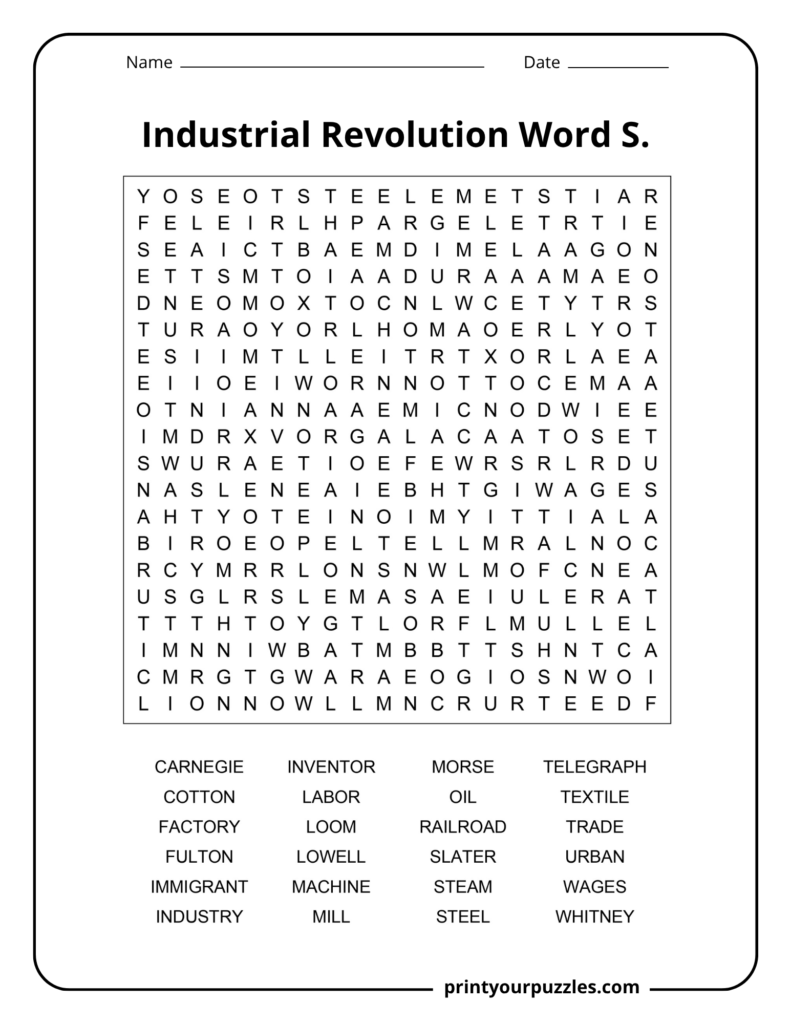
Hard Difficulty Word Search
Words to Find
CARNEGIE, COTTON, FACTORY, FULTON, IMMIGRANT, INDUSTRY, INVENTOR, LABOR, LOOM, LOWELL, MACHINE, MILL, MORSE, OIL, RAILROAD, SLATER, STEAM, STEEL, TELEGRAPH, TEXTILE, TRADE, URBAN, WAGES, WHITNEY
5 Key FAQs About the Industrial Revolution
5 Curious "Did You Know?" Facts About the Industrial Revolution