Black History Month is a time to recognize, study, and celebrate the history, achievements, culture, and experiences of Black Americans. Observed every February in the United States, it encourages people to learn about individuals and events that have played important roles in shaping the nation. From the struggle against slavery and segregation to achievements in science, politics, literature, music, sports, and civil rights, Black history is an essential part of American history.
The origins of Black History Month can be traced to historian Carter G. Woodson. In 1926, Woodson and the organization now known as the Association for the Study of African American Life and History established Negro History Week. Woodson wanted schools and communities to give greater attention to Black history, which was often overlooked in textbooks and classrooms. February was chosen partly because the birthdays of Abraham Lincoln and Frederick Douglass were already commemorated during that month.
Over time, the week-long observance grew into a broader celebration. In 1976, during the United States Bicentennial, President Gerald Ford officially recognized Black History Month and encouraged Americans to honor the contributions of Black citizens throughout the country’s history. Since then, every U.S. president has issued proclamations recognizing February as Black History Month.
The month highlights many influential figures, including Harriet Tubman, Frederick Douglass, Rosa Parks, Martin Luther King Jr., Jackie Robinson, Maya Angelou, Katherine Johnson, and countless others. It also provides an opportunity to explore major events such as the Underground Railroad, Reconstruction, the Harlem Renaissance, the Montgomery Bus Boycott, and the Civil Rights Movement.
Learning about Black history also means examining difficult subjects, including slavery, racial discrimination, segregation, and the long campaign for equal rights. Understanding these experiences helps explain how American society has changed and why the struggle for equality has remained important across generations.
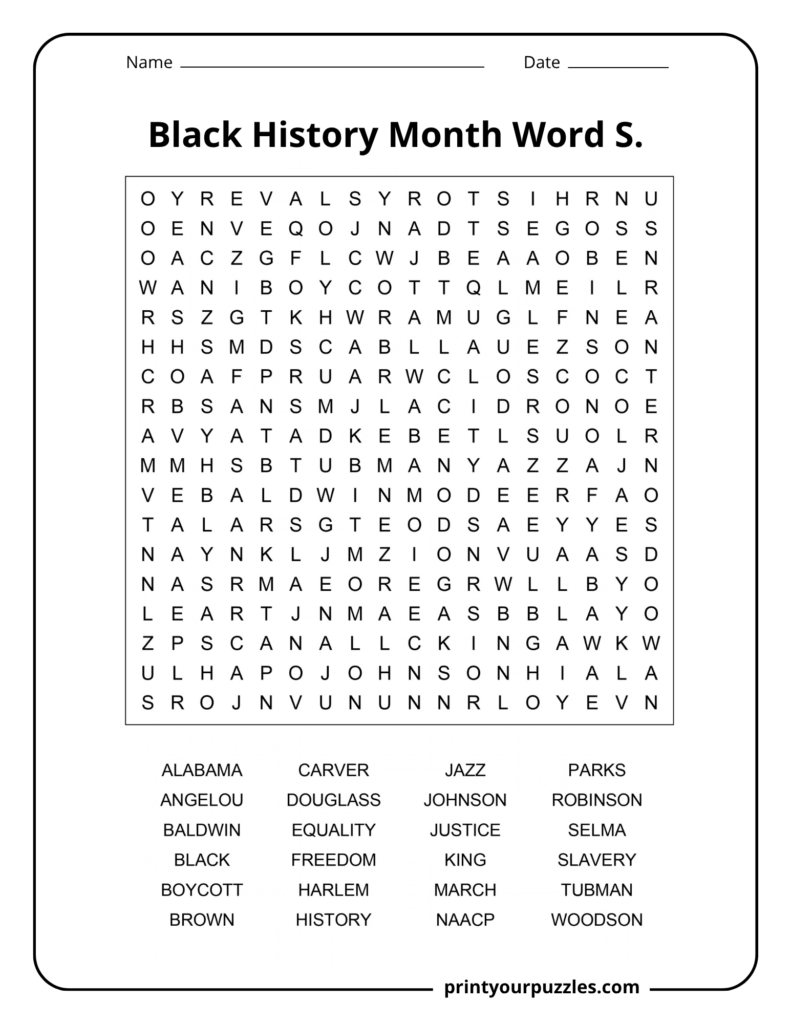
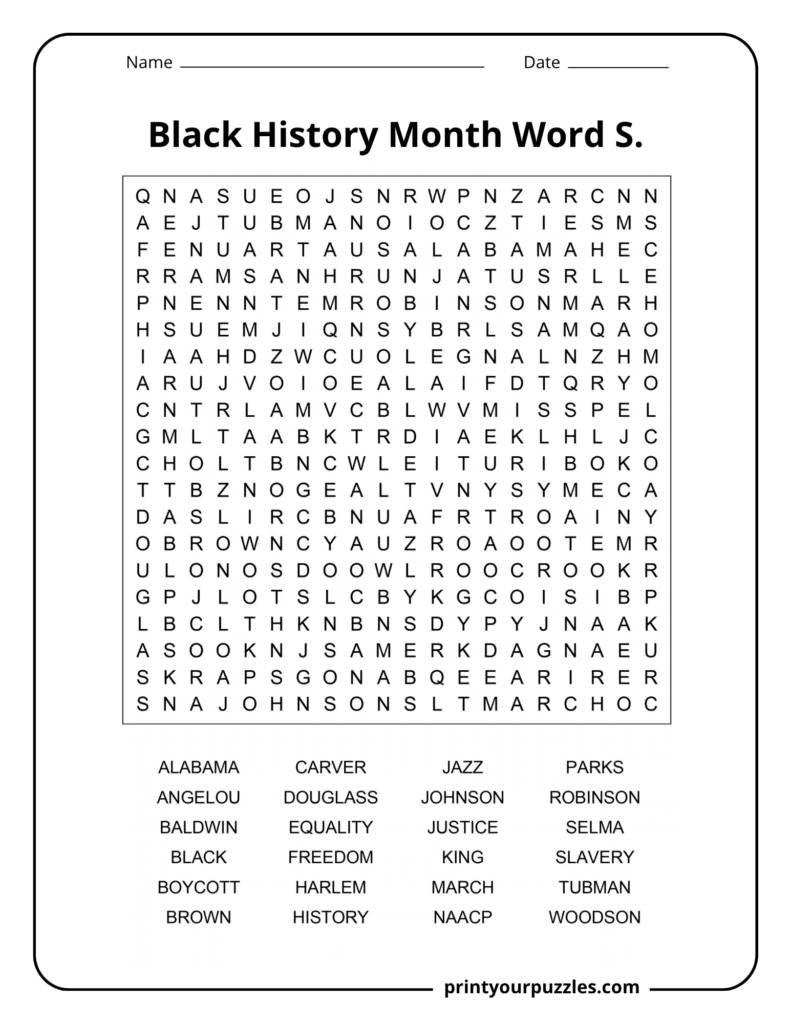
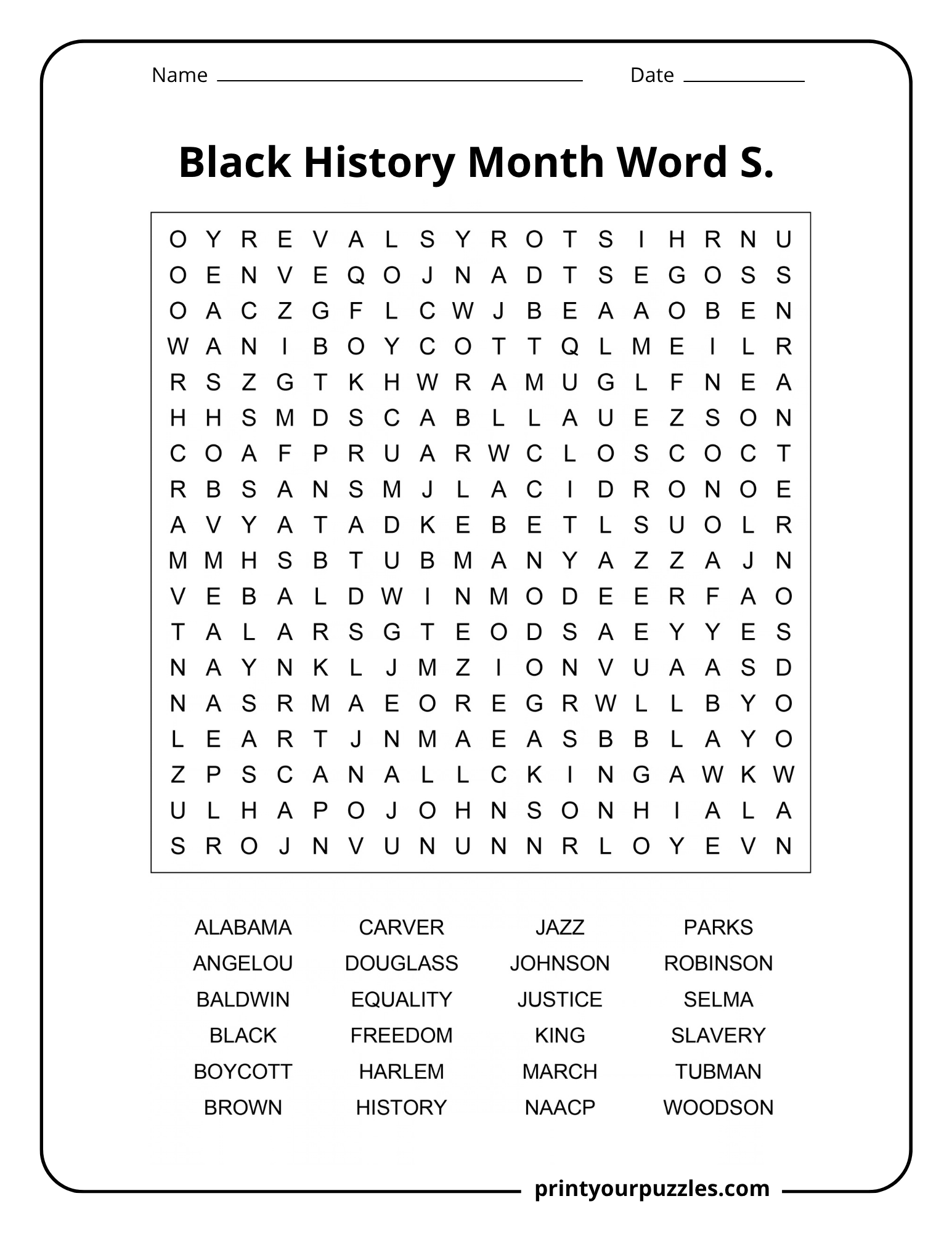
A Black History Month word search can provide an engaging way to introduce important names, places, events, and ideas connected with this history. As you complete the puzzle, you can discover vocabulary that opens the door to deeper learning about people whose courage, creativity, leadership, and achievements have helped shape the United States.
Related Word Searches:
Martin Luther King Jr. Day | Juneteenth | February | Presidents’ Day | Constitution Day
ALABAMA – Southern U.S. state that became a major center of the Civil Rights Movement, including the Montgomery Bus Boycott, Birmingham campaigns, and Selma voting-rights marches.
ANGELOU – Maya Angelou was an influential American poet, author, actress, and civil rights activist whose writing explored identity, racism, resilience, dignity, and the Black experience.
BALDWIN – James Baldwin was an American novelist, essayist, and activist whose powerful works examined race, sexuality, inequality, identity, and the challenges facing American society.
BLACK – Term commonly used to describe people of African descent and a central word in Black History Month, celebrating Black history, culture, achievements, and experiences.
BOYCOTT – Organized refusal to use a service or buy products as a form of protest, famously used during the Montgomery Bus Boycott against racial segregation.
BROWN – Refers to Brown v. Board of Education, the landmark 1954 Supreme Court decision declaring racial segregation in public schools unconstitutional under the Fourteenth Amendment.
CARVER – George Washington Carver was a prominent agricultural scientist and educator who developed innovative farming methods and promoted alternative crops such as peanuts and sweet potatoes.
DOUGLASS – Frederick Douglass was a formerly enslaved man who became a leading abolitionist, writer, speaker, and advocate for equality, voting rights, and freedom in America.
EQUALITY – Principle that all people deserve equal rights, opportunities, and treatment under the law, a central goal of abolitionists and generations of civil rights activists.
FREEDOM – Fundamental idea representing liberty and independence, especially important in Black history because generations struggled against slavery, segregation, discrimination, and other restrictions on basic rights.
HARLEM – New York City neighborhood famous for the Harlem Renaissance, a major cultural movement during the 1920s celebrating Black literature, music, art, creativity, and intellectual life.
HISTORY – Study and record of past events, people, and societies, helping us understand the experiences, struggles, achievements, and contributions remembered during Black History Month.
JAZZ – Musical genre with deep African American roots that developed in the United States, especially New Orleans, and became an influential expression of creativity and cultural identity.
JOHNSON – Katherine Johnson was a pioneering NASA mathematician whose precise calculations helped make early American space missions possible, including John Glenn’s historic orbital flight in 1962.
JUSTICE – Concept of fairness and equal treatment under the law, closely connected with the long struggle against slavery, segregation, discrimination, and unequal civil rights in America.
KING – Martin Luther King Jr. was a Baptist minister and civil rights leader who promoted nonviolent protest and delivered the famous “I Have a Dream” speech.
MARCH – Organized public demonstration used to demand social or political change, including the 1963 March on Washington and the 1965 voting-rights marches from Selma.
NAACP – National Association for the Advancement of Colored People, founded in 1909 to fight racial discrimination and protect the legal, political, educational, and civil rights of Black Americans.
PARKS – Rosa Parks was a civil rights activist whose 1955 refusal to surrender her bus seat helped spark the Montgomery Bus Boycott against segregated public transportation.
ROBINSON – Jackie Robinson became the first Black player in modern Major League Baseball in 1947, breaking the sport’s color barrier while facing intense racism and discrimination.
SELMA – Alabama city closely associated with the 1965 voting-rights campaign, where activists marched toward Montgomery and faced violent resistance while demanding equal access to voting.
SLAVERY – System in which people were legally treated as property and forced to work without freedom, shaping American history and creating lasting social, political, and economic consequences.
TUBMAN – Harriet Tubman escaped slavery and became a famous abolitionist who repeatedly risked her life helping enslaved people reach freedom through the Underground Railroad network.
WOODSON – Carter G. Woodson was a historian and educator who founded Negro History Week in 1926, helping establish the tradition that eventually became Black History Month.