
The Reconstruction Era was the period after the Civil War when the United States tried to rebuild the South, reunite the country, and define the meaning of freedom for millions of formerly enslaved people. It lasted from 1865 to 1877 and became a time of hope, conflict, political change, and unfinished promises.
After the Civil War ended, the South faced enormous challenges. Cities, farms, railroads, and businesses had been damaged or destroyed. The economy was weak, and many families were struggling to survive. At the same time, formerly enslaved people were beginning new lives in freedom, searching for family members, building communities, seeking education, and demanding basic rights.
Reconstruction also created major political disagreements. Abraham Lincoln had wanted a more moderate plan for bringing Southern states back into the Union, but he was assassinated in 1865. President Andrew Johnson then clashed with Congress over how Reconstruction should work. Many members of Congress believed stronger protections were needed for African Americans and for the future of the Union.
The Reconstruction Amendments became central to this period. The 13th Amendment abolished slavery. The 14th Amendment gave citizenship and equal protection under the law. The 15th Amendment protected voting rights for Black men. These amendments changed the Constitution and created new legal foundations for freedom and citizenship.
The Freedmen’s Bureau also played an important role. It helped formerly enslaved people and poor white Southerners with food, schools, labor contracts, and legal support. During Reconstruction, African Americans built churches, opened schools, reunited families, bought land when possible, and participated in politics. Some Black men were elected to local, state, and national offices.
However, Reconstruction faced strong resistance. Black Codes, discrimination, intimidation, and white supremacist violence tried to limit African American freedom and political power. Groups such as the Ku Klux Klan used fear and violence to oppose Reconstruction. In 1877, federal troops were withdrawn from the South, and Reconstruction came to an end.
The Reconstruction Era left a powerful legacy. It expanded constitutional rights, but many of its promises were later weakened by segregation and voter suppression.
This Reconstruction Era word search helps students review vocabulary connected to freedom, amendments, citizenship, Union, South, Freedmen’s Bureau, voting, equality, Black Codes, and Reconstruction. A Reconstruction Era Word Search can make this complex period easier to understand through key terms and historical connections.
This is the sixth and final in our series of 6 word searches about the Civil War. Also explore Civil War, Civil War Causes, Civil War Battles, Civil War Generals, and Civil War Women!
Related Word Searches:
Civil War | Emancipation Proclamation | Abraham Lincoln | Ulysses S. Grant | Harriet Tubman | Civil Rights Movement
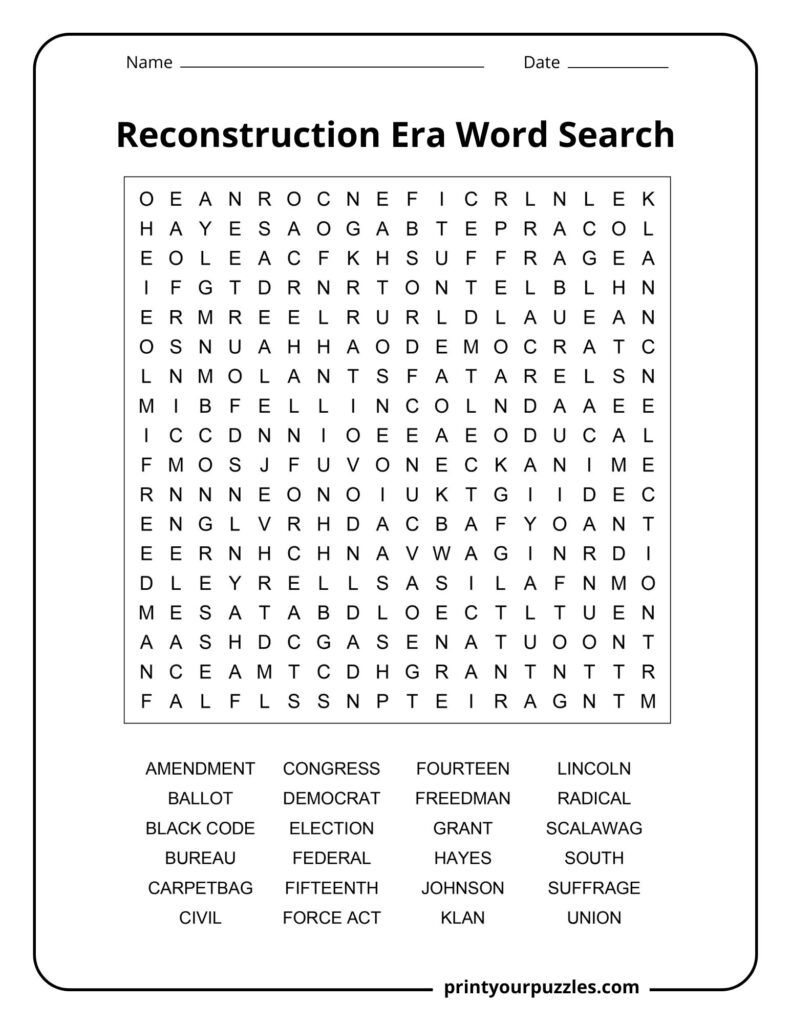
AMENDMENT, BALLOT, BLACK CODE, BUREAU, CARPETBAG, CIVIL, CONGRESS, DEMOCRAT, ELECTION, FEDERAL, FIFTEENTH, FORCE ACT, FOURTEEN, FREEDMAN, GRANT, HAYES, JOHNSON, KLAN, LINCOLN, RADICAL, SCALAWAG, SOUTH, SUFFRAGE, UNION
AMENDMENT – Constitutional changes ratified during Reconstruction, including the Thirteenth abolishing slavery, Fourteenth granting citizenship, and Fifteenth protecting voting rights regardless of race.
BALLOT – The voting process and rights extended to formerly enslaved men through constitutional amendments, representing a fundamental shift in American democracy during Reconstruction.
BLACK CODE – Discriminatory laws passed by Southern states restricting African Americans’ freedom, employment, and movement, attempting to maintain white supremacy after slavery’s abolition.
BUREAU – The Freedmen’s Bureau, a federal agency established to assist formerly enslaved people with education, healthcare, employment, and legal protection during the transition to freedom.
CARPETBAG – Derogatory term for Northern Republicans who moved South after the Civil War, accused of exploiting the region for political and economic gain during Reconstruction.
CIVIL – Relating to civil rights and civil government, central concepts as the nation redefined citizenship, legal equality, and federal authority over states during Reconstruction.
CONGRESS – The legislative body that passed Reconstruction Acts, overrode presidential vetoes, and impeached Andrew Johnson while attempting to reshape the South and protect freedmen’s rights.
DEMOCRAT – Political party that opposed Reconstruction policies, supported states’ rights, and eventually regained control of Southern governments, ending federal protection for African Americans.
ELECTION – Democratic processes that included newly enfranchised Black voters, contested presidential races, and violent intimidation campaigns that ultimately determined Reconstruction’s success and failure.
FEDERAL – Referring to national government authority expanded during Reconstruction to enforce civil rights, oversee Southern states, and protect freedmen against local discrimination and violence.
FIFTEENTH – Constitutional amendment ratified in 1870 prohibiting denial of voting rights based on race, color, or previous condition of servitude, expanding male suffrage significantly.
FORCE ACT – Federal legislation passed to combat Ku Klux Klan violence and protect African Americans’ civil rights through military intervention and prosecution of terrorist organizations.
FOURTEEN – Constitutional amendment ratified in 1868 granting citizenship to all persons born in the United States and guaranteeing equal protection under the law to all citizens.
FREEDMAN – Formerly enslaved person emancipated during or after the Civil War, navigating new rights, economic opportunities, and violent opposition while building communities and families.
GRANT – Ulysses S. Grant, eighteenth president who supported Radical Reconstruction, used federal troops to protect freedmen, and fought the Ku Klux Klan’s terrorist activities.
HAYES – Rutherford B. Hayes, nineteenth president whose contested 1876 election resulted in the Compromise of 1877, effectively ending Reconstruction by withdrawing federal troops from South.
JOHNSON – Andrew Johnson, seventeenth president who opposed Reconstruction, vetoed civil rights legislation, clashed with Congress, and became the first president impeached by House.
KLAN – Ku Klux Klan, white supremacist terrorist organization founded in 1866 that used violence, intimidation, and murder to suppress Black political participation and restore Democratic control.
LINCOLN – Abraham Lincoln, sixteenth president who issued the Emancipation Proclamation and proposed lenient Reconstruction plans before his assassination in 1865 ended his vision.
RADICAL – Radical Republicans in Congress who advocated harsh penalties for Confederates, federal protection for freedmen, and sweeping social transformation of the defeated Southern states.
SCALAWAG – Derogatory term for white Southerners who supported Republican Reconstruction policies, collaborated with Northern Republicans, and advocated for Black civil rights and economic modernization.
SOUTH – Confederate states undergoing military occupation, political reorganization, and social upheaval as they were readmitted to the Union under various conditions and federal supervision.
SUFFRAGE – The right to vote, expanded to Black men through the Fifteenth Amendment but violently suppressed through intimidation, literacy tests, and discriminatory laws.
UNION – The United States federal government that defeated the Confederacy and attempted to reconstruct Southern society while reintegrating rebel states into the constitutional republic.
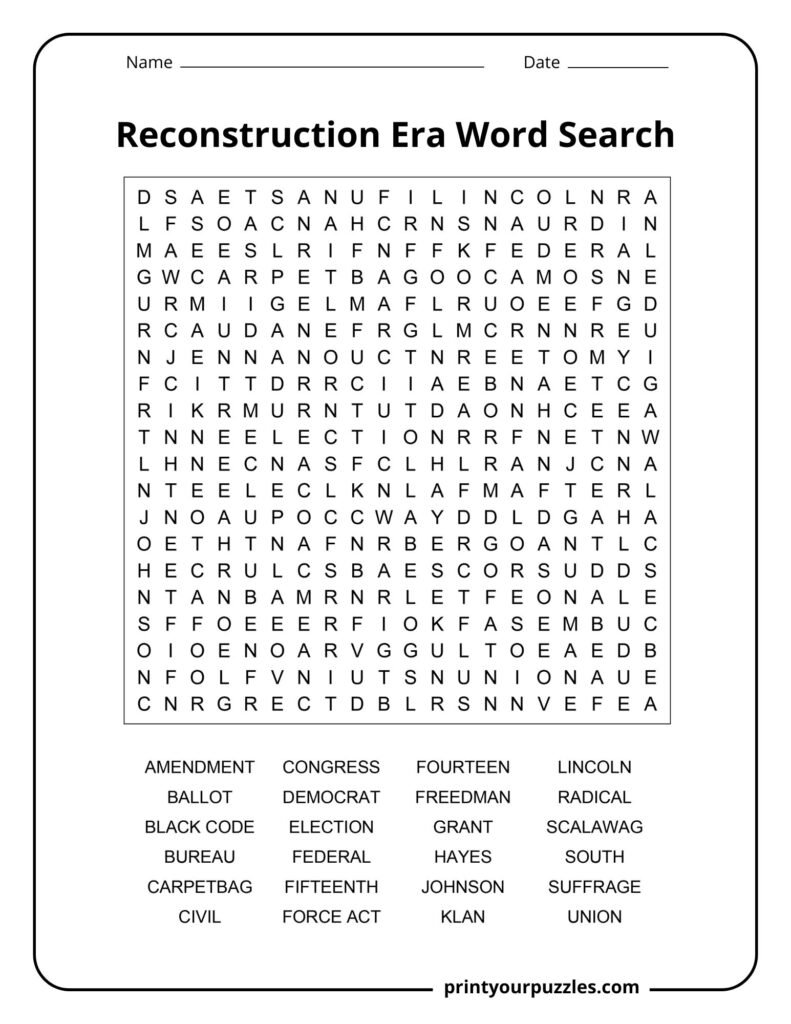
AMENDMENT, BALLOT, BLACK CODE, BUREAU, CARPETBAG, CIVIL, CONGRESS, DEMOCRAT, ELECTION, FEDERAL, FIFTEENTH, FORCE ACT, FOURTEEN, FREEDMAN, GRANT, HAYES, JOHNSON, KLAN, LINCOLN, RADICAL, SCALAWAG, SOUTH, SUFFRAGE, UNION
Reconstruction Era was the period from 1865 to 1877 when the United States worked to reunify after the Civil War, reintegrate Confederate states, and address the status of formerly enslaved people.
Reconstruction Era aimed to restore the Union, rebuild Southern infrastructure, establish civil rights for freedmen, and determine how former Confederate states and leaders would rejoin the nation.
The Thirteenth Amendment abolished slavery, the Fourteenth granted citizenship and equal protection, and the Fifteenth protected voting rights regardless of race, fundamentally transforming American constitutional law.
Reconstruction Era failed due to violent white resistance, weakening Northern political will, economic depression, Supreme Court decisions limiting federal power, and the Compromise of 1877 withdrawing troops.
Despite its end, Reconstruction established constitutional protections for civil rights, demonstrated federal authority over states, and created frameworks later used during the twentieth-century Civil Rights Movement.
Mississippi elected Revels to fill Jefferson Davis’s former Senate seat, symbolically replacing the Confederate president with a formerly enslaved man who advocated for civil rights and education.
Freedmen served as congressmen, state legislators, sheriffs, mayors, and justices of the peace throughout the South, representing an unprecedented political revolution that ended with Reconstruction’s collapse.
The Senate voted 35-19 to convict President Johnson in 1868, falling one vote short of the two-thirds majority needed, making him the first president impeached but not removed.
By 1870, Bureau schools educated approximately 250,000 formerly enslaved people, creating the foundation for Black education in the South and establishing several historically Black colleges still operating today.
The disputed 1876 presidential election was resolved when Republicans agreed to withdraw federal troops from the South in exchange for Rutherford Hayes’s presidency, abandoning freedmen to white supremacist rule.