
Andrew Johnson (1865–1869) became president at one of the most delicate moments in American history. The Civil War had almost ended, Abraham Lincoln had been assassinated, and the country faced a difficult question: how should the United States rebuild after four years of conflict? Johnson inherited the presidency suddenly, but the choices he made during Reconstruction shaped the nation’s future in powerful and controversial ways. The Andrew Johnson word search gives students a clear path into this complicated period after the Civil War.
Johnson’s background was unusual for a president. Born in North Carolina and raised in poverty, he had little formal education and worked as a tailor before entering politics. He later moved to Tennessee, where he became mayor, congressman, governor, senator, and military governor during the Civil War. Although he was a Southern Democrat, he remained loyal to the Union when Tennessee seceded. That loyalty made him a valuable political partner for Lincoln in the election of 1864.
After Lincoln’s death in 1865, Johnson had to guide the country through Reconstruction. His plan allowed many former Confederate states to return quickly to the Union, but it offered limited protection for formerly enslaved people. Many Southern governments passed Black Codes, laws designed to restrict the freedom, labor, and rights of African Americans. These actions alarmed Radical Republicans in Congress, who wanted stronger federal protection for civil rights.
Conflict between Johnson and Congress grew intense. Congress passed major Reconstruction laws and supported the Fourteenth Amendment, which expanded citizenship and equal protection under the law. Johnson opposed many of these efforts and vetoed several bills, but Congress often overrode his vetoes. The struggle became a major battle over who controlled Reconstruction: the president or Congress.
The conflict eventually led to impeachment. In 1868, the House of Representatives impeached Johnson after a dispute over the Tenure of Office Act. The Senate trial ended with Johnson avoiding removal from office by just one vote. His presidency survived, but his political power was badly weakened.
This Andrew Johnson word search examines Reconstruction, impeachment, civil rights, Black Codes, presidential power, and the difficult aftermath of the Civil War. Johnson’s time in office shows that ending a war is not the same as rebuilding justice, trust, and national unity.
Explore more Reconstruction Era Presidents with our Abraham Lincoln word search, Ulysses S. Grant word search, Millard Fillmore word search, and the full US Presidents Word Searches collection.
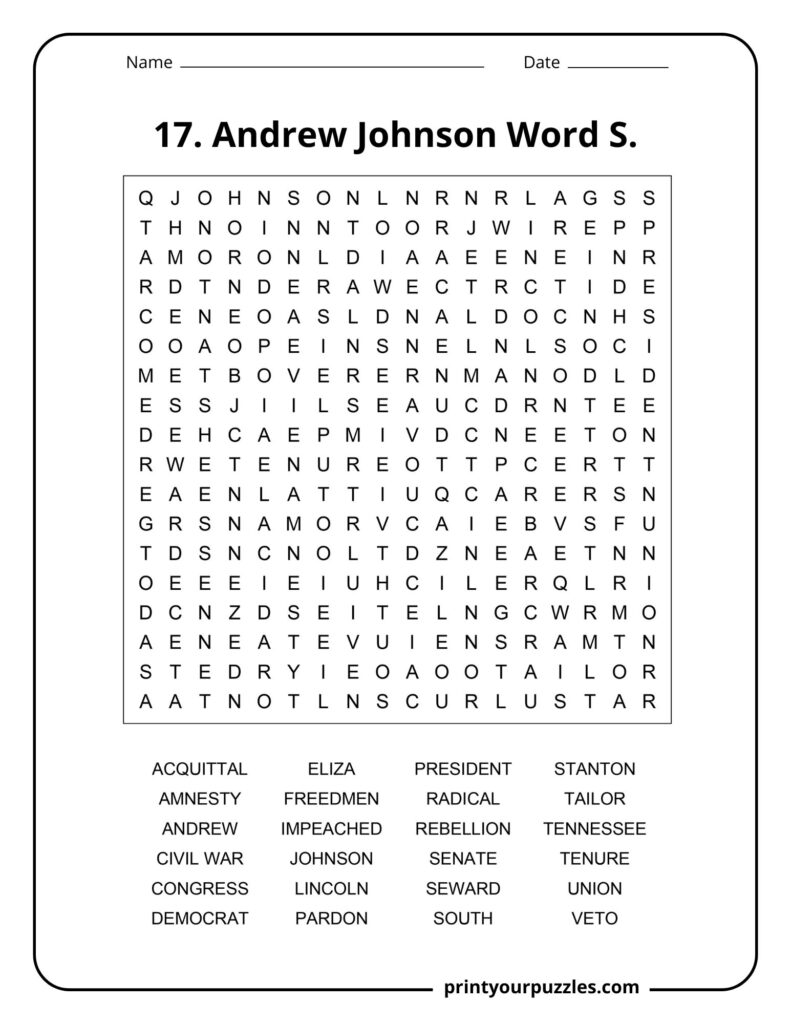
ACQUITTAL, AMNESTY, ANDREW, CIVIL WAR, CONGRESS, DEMOCRAT, ELIZA, FREEDMEN, IMPEACHED, JOHNSON, LINCOLN, PARDON, PRESIDENT, RADICAL, REBELLION, SENATE, SEWARD, SOUTH, STANTON, TAILOR, TENNESSEE, TENURE, UNION, VETO
ACQUITTAL – Johnson’s narrow escape from removal in 1868 when the Senate voted 35-19 to convict, falling one vote short of the two-thirds majority needed for conviction.
AMNESTY – Johnson’s controversial policy granting pardons to former Confederates who pledged loyalty oaths, allowing them to reclaim property and political rights, angering Radical Republicans seeking harsher Reconstruction measures.
ANDREW – His first name, shared with President Andrew Jackson, whose Democratic principles and populist approach Johnson admired and attempted to emulate throughout his political career in Tennessee.
CIVIL WAR – The 1861-1865 conflict between Union and Confederate states during which Johnson remained loyal to the Union despite Tennessee’s secession, leading to his vice presidency under Lincoln.
CONGRESS – The legislative body dominated by Radical Republicans who clashed with Johnson over Reconstruction policies, ultimately impeaching him for violating the Tenure of Office Act in 1868.
DEMOCRAT – Johnson’s lifelong political party affiliation, making him an awkward choice as Lincoln’s running mate on the 1864 National Union ticket designed to attract War Democrats.
ELIZA – Eliza McCardle Johnson, his wife who taught him writing and arithmetic, remained largely secluded due to tuberculosis during his presidency while daughter Martha served as hostess.
FREEDMEN – Formerly enslaved African Americans whose civil rights Johnson opposed protecting, vetoing the Freedmen’s Bureau Bill and Civil Rights Act, both eventually passed over his objections.
IMPEACHED – Johnson became the first U.S. president impeached by the House in 1868 for firing Secretary of War Stanton, violating the Tenure of Office Act protecting Cabinet members.
JOHNSON – The seventeenth president’s surname, succeeding to office after Lincoln’s assassination in April 1865, serving one tumultuous term marked by bitter conflicts over Reconstruction policies and impeachment.
LINCOLN – Abraham Lincoln, the president Johnson served under as vice president for only six weeks before Lincoln’s assassination thrust Johnson into the presidency during Reconstruction’s critical early phase.
PARDON – Johnson’s generous use of presidential clemency toward former Confederates, issuing thousands of individual pardons and broad amnesty proclamations that restored property rights and political participation to rebels.
PRESIDENT – The executive office Johnson assumed unexpectedly after Lincoln’s death, becoming the first vice president to succeed an assassinated president, serving from 1865 to 1869 amid unprecedented turmoil.
RADICAL – The Radical Republicans in Congress who advocated harsh Reconstruction measures, civil rights for freedmen, and punishing former Confederates, constantly battling Johnson’s lenient approach throughout his presidency.
REBELLION – The Confederate insurrection against federal authority that Johnson opposed despite being a Southern Democrat, remaining the only Southern senator to stay loyal to the Union.
SENATE – The upper chamber of Congress where Johnson’s impeachment trial occurred in 1868, ultimately acquitting him by a single vote, and where he later returned as Tennessee senator.
SEWARD – William Seward, Lincoln’s Secretary of State who continued serving under Johnson, negotiating the purchase of Alaska from Russia in 1867, often called “Seward’s Folly” by critics.
SOUTH – Johnson’s regional origin and political base in Tennessee, influencing his lenient Reconstruction policies favoring quick restoration of Southern states without guaranteeing freedmen’s rights or punishing former rebels.
STANTON – Edwin Stanton, Secretary of War whose firing by Johnson violated the Tenure of Office Act, triggering impeachment proceedings after Stanton barricaded himself in his office refusing to leave.
TAILOR – Johnson’s original profession before entering politics, never attending school but learning his trade as an apprentice, remaining proud of his working-class origins throughout his political career.
TENNESSEE – Johnson’s home state where he served as governor, congressman, and senator before becoming vice president, the only Southern state he prevented from seceding while serving as military governor.
TENURE – The Tenure of Office Act passed by Congress in 1867 requiring Senate approval to remove Cabinet members, specifically designed to protect Stanton and limit Johnson’s executive authority.
UNION – The federal government Johnson steadfastly supported during the Civil War despite being a Southern Democrat, earning him Lincoln’s vice presidential nomination to demonstrate bipartisan commitment to preservation.
VETO – Johnson’s frequent rejection of Congressional legislation, vetoing 29 bills including civil rights measures and Reconstruction acts, with Congress overriding 15 vetoes—a record showing their deep conflict.
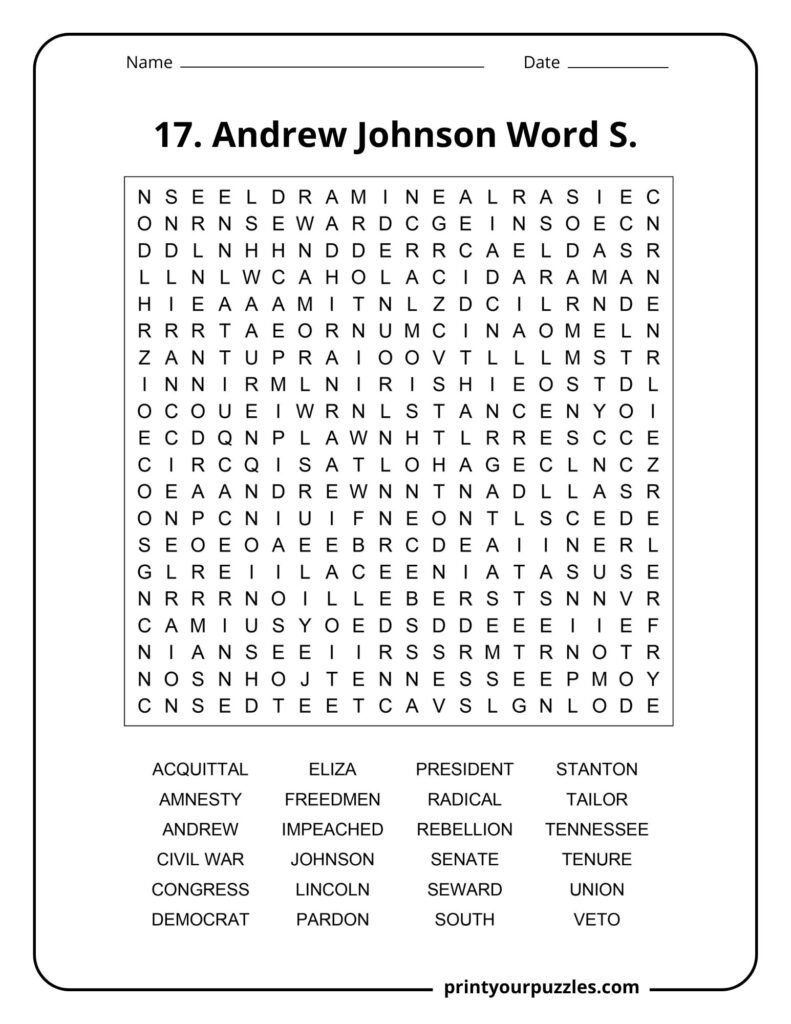
ACQUITTAL, AMNESTY, ANDREW, CIVIL WAR, CONGRESS, DEMOCRAT, ELIZA, FREEDMEN, IMPEACHED, JOHNSON, LINCOLN, PARDON, PRESIDENT, RADICAL, REBELLION, SENATE, SEWARD, SOUTH, STANTON, TAILOR, TENNESSEE, TENURE, UNION, VETO
Johnson was impeached in 1868 for violating the Tenure of Office Act by firing Secretary of War Edwin Stanton without Senate approval, defying Congress’s attempt to limit presidential power.
No. The Senate voted 35-19 to convict Johnson, falling one vote short of the two-thirds majority required for removal. He completed his term, serving until March 1869.
Johnson became president on April 15, 1865, after Abraham Lincoln’s assassination. He had served as Lincoln’s vice president for only six weeks before suddenly assuming the presidency.
Johnson was a self-taught tailor from Tennessee who never attended school. He served as congressman, governor, and senator before becoming Lincoln’s vice president in 1865 on a unity ticket.
Johnson favored lenient treatment of former Confederates, offering generous pardons and opposing civil rights protections for freedmen. This approach clashed dramatically with Radical Republicans seeking harsher measures and equality.
For official administration records and historical biography, visit the Andrew Johnson page in the White House Archives. If you are planning a trip, visit the official Andrew Johnson National Historic Site.
Impeached: The Trial of President Andrew Johnson and the Fight for Lincoln’s Legacy by David O. Stewart. A gripping narrative of the first presidential impeachment, exposing how Johnson’s stubbornness undermined Reconstruction and racial justice.
Completely self-taught, Johnson’s wife Eliza McCardle taught him writing and arithmetic after their marriage. He educated himself by having employees read to him while working in his tailor shop.
On March 4, 1865, Johnson delivered a rambling, incoherent speech after drinking whiskey to combat illness. The embarrassing incident mortified Lincoln and nearly derailed Johnson’s political career immediately.
In 1875, Tennessee elected Johnson back to the U.S. Senate, making him the only former president to serve as senator. He died just months later after suffering a stroke.
Following his wishes, Johnson was buried with his body wrapped in an American flag and his head resting on a copy of the U.S. Constitution, symbols of his unwavering devotion.
Initially accusing Confederate president Davis of conspiring in Lincoln’s assassination, Johnson posted a massive reward for his capture. Davis was eventually caught but never tried for Lincoln’s murder conspiracy.