
The Civil War was a defining conflict in United States history, fought from 1861 to 1865 between the Union in the North and the Confederacy in the South. It divided the country, tested the survival of the United States, and changed the meaning of freedom, citizenship, and national unity.
The main cause of the Civil War was slavery. For decades, Americans had argued over whether slavery should continue and whether it should expand into new western territories. Other issues, such as states’ rights, economic differences, and political power, were also important, but slavery was at the center of the conflict.
Tensions grew stronger after Abraham Lincoln was elected president in 1860. Many Southern leaders feared that his election threatened the future of slavery. Several Southern states seceded from the United States and formed the Confederate States of America, with Jefferson Davis as their president.
The war began in April 1861, when Confederate forces attacked Fort Sumter in Charleston Harbor, South Carolina. After the attack, Lincoln called for troops, and more states chose sides. What many people expected to be a short conflict became a long and devastating war.
Both sides had important leaders and armies. Abraham Lincoln led the Union as president, while Jefferson Davis led the Confederacy. Military figures such as Ulysses S. Grant, Robert E. Lee, William Tecumseh Sherman, and Stonewall Jackson became closely connected with the war’s major campaigns and battles.
The Civil War included many important battles and turning points. Bull Run showed that the war would not be easy for either side. Antietam became the bloodiest single day in American military history. In 1863, Union victories at Gettysburg and Vicksburg helped shift the direction of the war against the Confederacy.
The meaning of the war changed with Lincoln’s Emancipation Proclamation, which took effect on January 1, 1863. It declared freedom for enslaved people in Confederate-controlled areas and allowed African American men to join the Union Army and Navy. The war became not only a fight to preserve the Union, but also a struggle connected to ending slavery.
The Civil War ended in 1865 with Union victory. Its consequences were enormous: hundreds of thousands of people died, slavery was abolished through the 13th Amendment, and the nation entered Reconstruction, a difficult period of rebuilding and redefining rights.
This Civil War word search helps students review vocabulary connected to Union, Confederacy, slavery, Lincoln, battles, soldiers, emancipation, Gettysburg, Reconstruction, and amendment. A Civil War word search can make this complex chapter easier to understand through key terms and historical connections.
This is the first in our series of 6 word searches about the Civil War. After this one, explore Civil War Causes, Civil War Battles, Civil War Generals, Civil War Women, and Reconstruction Era!
Related Word Searches:
Civil War Causes | Civil War Battles | Civil War Generals | Civil War Women | Abraham Lincoln | Emancipation Proclamation
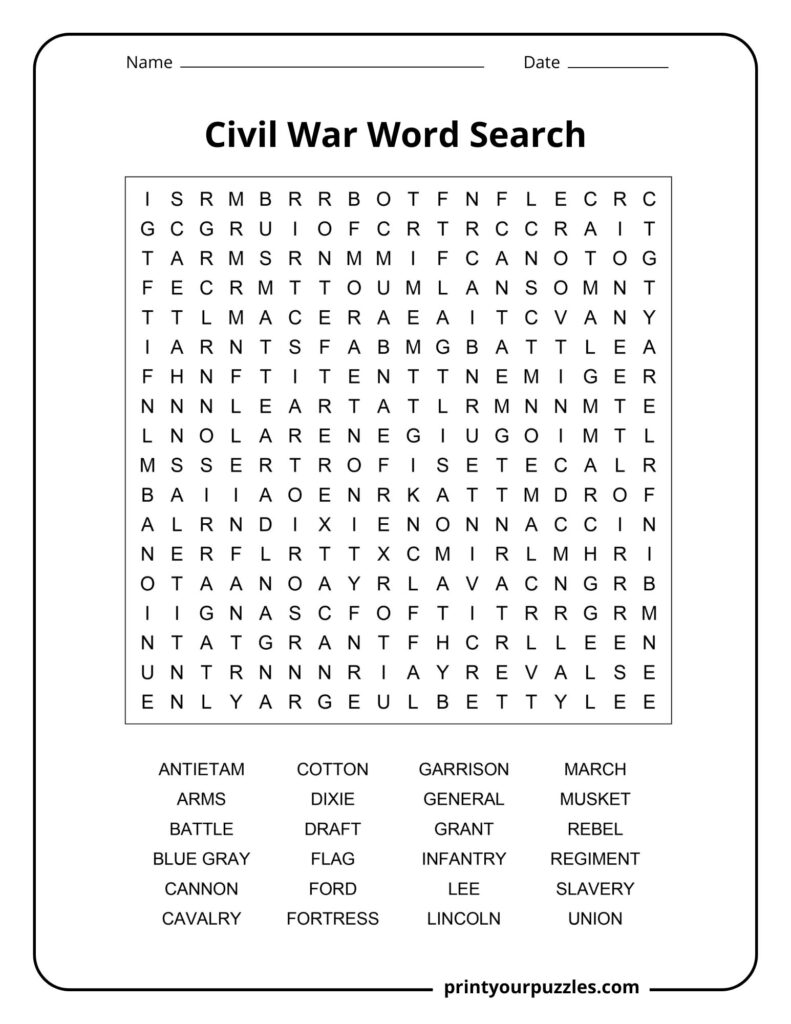
ANTIETAM, ARMS, BATTLE, BLUE GRAY, CANNON, CAVALRY, COTTON, DIXIE, DRAFT, FLAG, FORD, FORTRESS, GARRISON, GENERAL, GRANT, INFANTRY, LEE, LINCOLN, MARCH, MUSKET, REBEL, REGIMENT, SLAVERY, UNION
ANTIETAM – Battle fought on September 17, 1862, in Maryland. It was the bloodiest single day in American history. The Union claimed a strategic victory, which led Lincoln to issue the Emancipation Proclamation.
ARMS – Weapons and military equipment used by both Union and Confederate forces during the war, including rifles, pistols, swords, bayonets, and artillery pieces essential for combat operations throughout the conflict.
BATTLE – An organized military engagement between opposing forces. The Civil War included over 10,000 battles and skirmishes across the nation, from massive confrontations to small guerrilla clashes.
BLUE GRAY – Symbolic colors representing the two sides of the conflict. Blue identified Union soldiers from the North, while gray represented Confederate troops from the South during the war.
CANNON – Heavy artillery weapons widely used during the Civil War. They fired explosive shells, solid shot, and canister rounds, causing devastating casualties on battlefields and during siege operations against fortified positions.
CAVALRY – Mounted soldiers who served as scouts, raiders, and combat troops. Famous cavalry leaders included J.E.B. Stuart for the Confederacy and Philip Sheridan for the Union army.
COTTON – The South’s most important cash crop and economic foundation. Confederate leaders believed European dependence on Southern cotton would bring diplomatic recognition and foreign support during the war.
DIXIE – Popular nickname for the Confederate States and the American South. It was also the title of a famous song that became an unofficial anthem for the Confederacy during the war years.
DRAFT – Mandatory military conscription enacted by both sides during the war. It proved deeply unpopular, sparking violent riots in New York City in 1863 and widespread resistance across the nation.
FLAG – Banners carried into battle representing each side. The Union fought under the Stars and Stripes, while the Confederacy used several designs, including the well-known Southern Cross battle flag.
FORD – Ford’s Theatre in Washington, D.C., where President Abraham Lincoln was assassinated by actor John Wilkes Booth on April 14, 1865, just days after the Confederacy’s surrender at Appomattox.
FORTRESS – Heavily fortified military installations used for defense and control of strategic areas. Fort Sumter, where the war began in April 1861, remains one of the most famous examples.
GARRISON – A body of troops stationed inside a fort or town for defensive purposes. Many garrisons endured long sieges during the war, such as those at Vicksburg and Petersburg.
GENERAL – The highest-ranking military officers commanding armies on both sides. Notable generals included Ulysses S. Grant and William Sherman for the Union, and Robert E. Lee for the Confederacy.
GRANT – Ulysses S. Grant, the Union’s most successful commander. He captured Vicksburg, won at Chattanooga, and accepted Lee’s surrender at Appomattox. He later became the 18th President of the United States.
INFANTRY – Foot soldiers who formed the backbone of both armies. They fought in lines and formations, enduring terrible conditions, long marches, disease, and horrific casualties throughout the four-year conflict.
LEE – Robert E. Lee, commanding general of the Confederate Army of Northern Virginia. A brilliant tactician, he won several major battles but ultimately surrendered to Grant at Appomattox Court House in 1865.
LINCOLN – Abraham Lincoln, the 16th President of the United States. He preserved the Union, issued the Emancipation Proclamation freeing enslaved people, and was assassinated in April 1865, shortly after the war ended.
MARCH – Large-scale troop movements across enemy territory, most famously Sherman’s March to the Sea in 1864, which devastated Georgia and demonstrated the Union’s strategy of total war against the South.
MUSKET – The primary firearm used by infantry soldiers during the Civil War. Rifled muskets like the Springfield Model 1861 greatly increased accuracy and range, transforming battlefield tactics and increasing casualties significantly.
REBEL – Common nickname for Confederate soldiers and supporters who rebelled against the United States government. Union troops often called them “Rebs,” while Confederates called Union soldiers “Yankees” in return.
REGIMENT – A military unit typically consisting of around one thousand soldiers, usually recruited from the same state or region. Regiments were the basic organizational building blocks of both armies during the war.
SLAVERY – The institution of forced labor that was the central cause of the Civil War. Southern states seceded primarily to preserve slavery, while the Union ultimately fought to abolish it permanently.
UNION – The name for the Northern states that remained loyal to the United States government during the Civil War. The Union fought to preserve the nation and eventually to end slavery across all states.
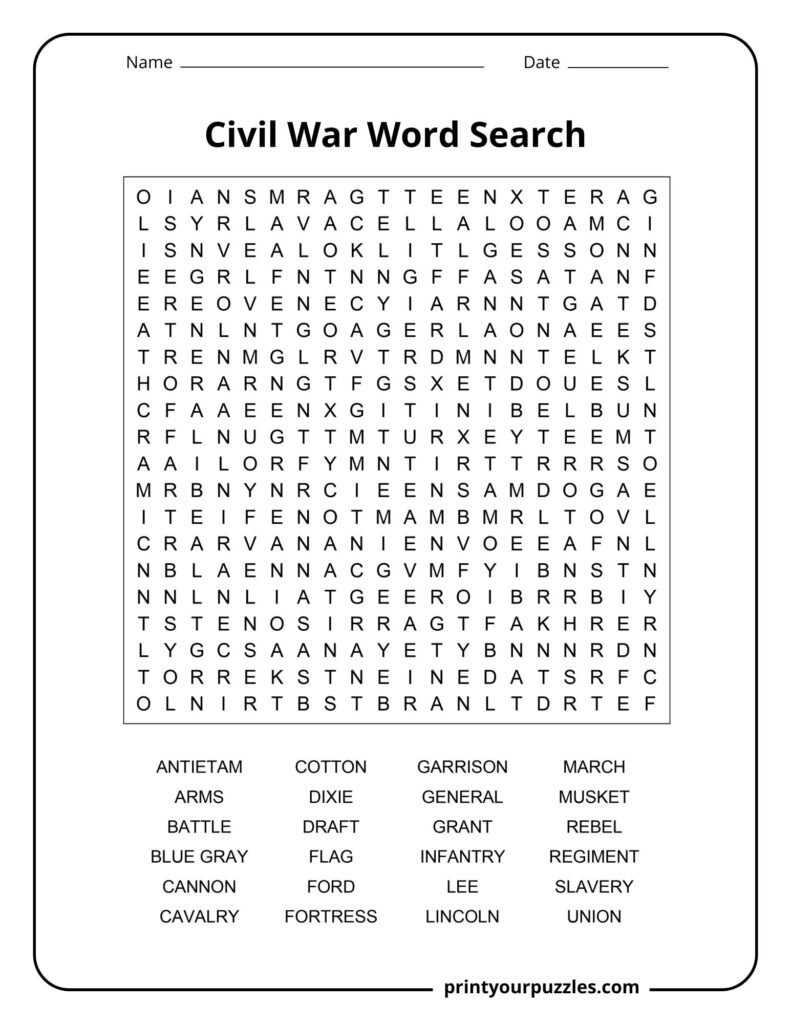
ANTIETAM, ARMS, BATTLE, BLUE GRAY, CANNON, CAVALRY, COTTON, DIXIE, DRAFT, FLAG, FORD, FORTRESS, GARRISON, GENERAL, GRANT, INFANTRY, LEE, LINCOLN, MARCH, MUSKET, REBEL, REGIMENT, SLAVERY, UNION
The primary cause was slavery and its expansion into new territories. Deep economic, social, and political divisions between the industrialized North and the agricultural South made conflict inevitable.
The war began on April 12, 1861, when Confederate forces attacked Fort Sumter in South Carolina. It ended on April 9, 1865, when General Lee surrendered to Grant at Appomattox Court House.
Approximately 620,000 to 750,000 soldiers died from combat, disease, and other causes. It remains the deadliest conflict in American history, surpassing all other wars the nation has fought combined.
Issued by President Lincoln on January 1, 1863, it declared enslaved people in Confederate states to be free. It transformed the war’s purpose and allowed African Americans to serve in Union forces.
The war preserved the Union, abolished slavery through the 13th Amendment, and reshaped American society. However, Reconstruction struggles and racial inequality persisted for generations, with effects still felt today.
Battle Cry of Freedom by James McPherson. Often considered the single best one-volume history of the Civil War, it covers the political, social, and military dimensions from the Mexican-American War through Appomattox. McPherson’s prose is clear and propulsive despite the enormous scope.
The Civil War: A Narrative (3 volumes) by Shelby Foote. A massive, novelistic account of the war’s military history. Foote was a novelist by trade, and it shows: the writing is vivid and cinematic, though some historians note he downplays slavery’s centrality.
Team of Rivals by Doris Kearns Goodwin. Focuses on Lincoln’s political genius in assembling a cabinet of former opponents. It reads almost like a political thriller while drawing on deep archival research.
For every soldier killed in combat, two died from illnesses like dysentery, typhoid, and pneumonia. Poor sanitation, contaminated water, and lack of medical knowledge made army camps extremely deadly.
Edward Black from Indiana joined the Union Army as a drummer boy at age nine. Many children served as drummers, messengers, and even fighters on both sides throughout the war.
An estimated 400 to 750 women secretly enlisted by cutting their hair, binding their chests, and adopting male names. Many were only discovered when wounded or killed in battle.
Photographers like Mathew Brady and Alexander Gardner documented battlefields, soldiers, and camp life. Their striking images brought the harsh reality of war directly into American homes for the first time.
On May 2, 1863, after his brilliant flanking maneuver at Chancellorsville, Confederate soldiers mistakenly shot Jackson in the darkness. He died eight days later from complications following arm amputation.