
The Emancipation Proclamation was one of the most important documents of the American Civil War. It was issued by President Abraham Lincoln as an executive order, with the final version taking effect on January 1, 1863. The proclamation declared that enslaved people in areas still rebelling against the United States “shall be then, thenceforward, and forever free.” It became a major turning point in both the war and the long struggle against slavery.
To understand the Emancipation Proclamation, it is important to remember the situation during the Civil War. The Union was fighting to preserve the United States, while the Confederacy had formed after Southern states seceded. Slavery was at the center of this conflict, even though the war also involved questions about secession, federal power, and the future of the country.
Lincoln issued a preliminary version of the proclamation on September 22, 1862, after the Battle of Antietam. This gave the Confederate states a warning: if they did not return to the Union, enslaved people in those rebellious areas would be declared free. When the Confederacy continued fighting, Lincoln issued the final Emancipation Proclamation on January 1, 1863.
The proclamation did not free every enslaved person immediately. It applied mainly to enslaved people in Confederate-controlled areas, not to border states that remained loyal to the Union or to places already under Union control. However, as Union armies advanced, the proclamation gave freedom a legal and military force in areas they reached.
The Emancipation Proclamation also changed the meaning of the Civil War. The conflict was no longer only about preserving the Union; it was now also a war against slavery. It allowed African American men to join the Union Army and Navy, and their service became an important part of the Union victory. The proclamation also made it harder for European countries to support the Confederacy.
Although it did not abolish slavery everywhere, the Emancipation Proclamation prepared the way for the 13th Amendment, which ended slavery throughout the United States.
This Emancipation Proclamation word search helps students review vocabulary connected to Lincoln, slavery, freedom, Union, Confederacy, Civil War, soldiers, executive order, and amendment. An Emancipation Proclamation word search can make this historic document easier to understand by connecting key terms with its causes, limits, and lasting importance.
Related Word Searches:
Civil War | Abraham Lincoln | Civil War Causes | Civil War Battles | Harriet Tubman | Reconstruction Era
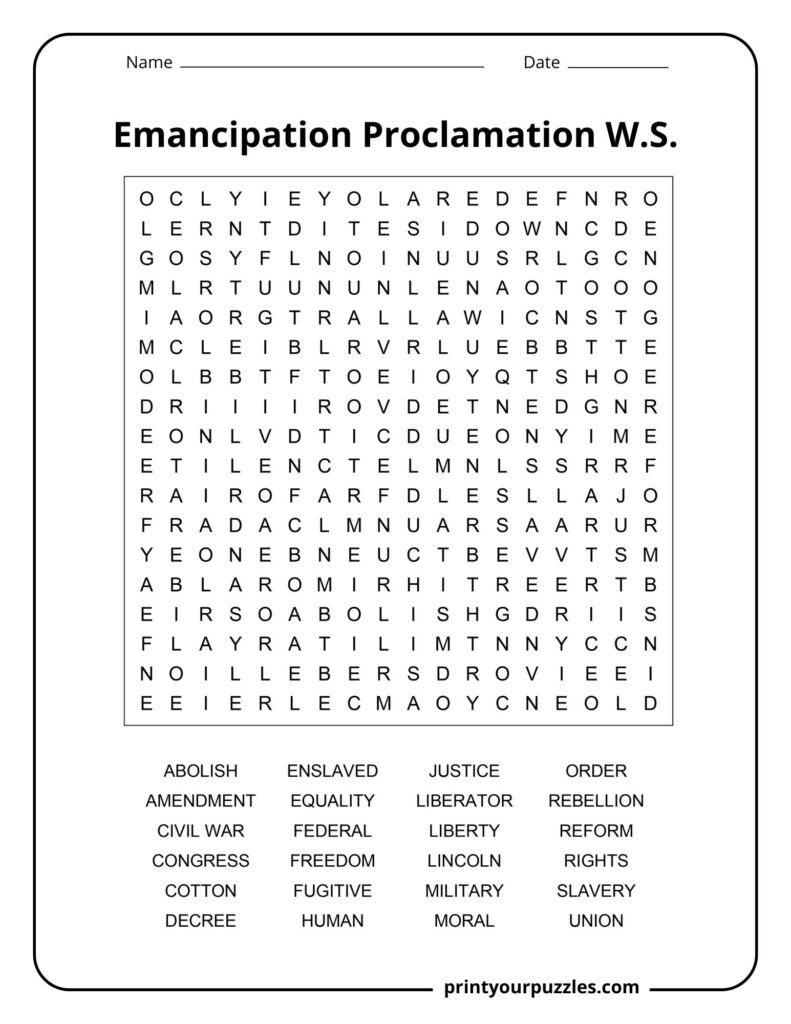
ABOLISH, AMENDMENT, CIVIL WAR, CONGRESS, COTTON, DECREE, ENSLAVED, EQUALITY, FEDERAL, FREEDOM, FUGITIVE, HUMAN, JUSTICE, LIBERATOR, LIBERTY, LINCOLN, MILITARY, MORAL, ORDER, REBELLION, REFORM, RIGHTS, SLAVERY, UNION
ABOLISH – To formally put an end to a system or practice. The Emancipation Proclamation aimed to abolish slavery in the rebellious Confederate states during the Civil War.
AMENDMENT – A formal change or addition to a legal document. The Thirteenth Amendment later completed what the Proclamation started by permanently abolishing slavery throughout the entire United States.
CIVIL WAR – The armed conflict fought between the Union and Confederate states from 1861 to 1865. The Emancipation Proclamation transformed the war into a fight for human freedom.
CONGRESS – The legislative branch of the United States government. Congress played a key role in passing laws related to slavery and eventually approved the Thirteenth Amendment to the Constitution.
COTTON – A crop that dominated the Southern economy and relied heavily on enslaved labor. The plantation system built around cotton made slavery a deeply entrenched institution in Confederate states.
DECREE – An official order issued by a legal authority. President Lincoln’s Emancipation Proclamation served as a presidential decree declaring enslaved people in rebel states to be forever free.
ENSLAVED – Held in bondage and forced to work without freedom or pay. The Proclamation declared that all enslaved people in Confederate territory were to be recognized as free persons.
EQUALITY – The state of being equal in rights and opportunities. The Emancipation Proclamation was a critical step toward equality, though the full realization of equal rights required many more decades of struggle.
FEDERAL – Relating to the central government of the United States. The federal government, under President Lincoln, used its wartime authority to issue the Emancipation Proclamation against the rebel states.
FREEDOM – The condition of being free from oppression or slavery. The Emancipation Proclamation promised freedom to millions of enslaved people held in the Confederate states during the Civil War.
FUGITIVE – A person who has escaped from captivity or is fleeing authority. Before the Proclamation, fugitive enslaved people who escaped to Union lines faced uncertain legal status and possible return.
HUMAN – Relating to people and their fundamental dignity. The Emancipation Proclamation recognized the human rights of enslaved individuals and rejected the idea that people could be treated as property.
JUSTICE – Fairness and moral rightness in the treatment of all people. The Proclamation represented a pursuit of justice by acknowledging that slavery was incompatible with the nation’s founding principles.
LIBERATOR – A person who sets others free from oppression. President Abraham Lincoln became known as the Great Liberator for issuing the Emancipation Proclamation and helping to end slavery in America.
LIBERTY – The state of being free within society from oppressive restrictions. The Emancipation Proclamation advanced the cause of liberty by declaring enslaved people in Confederate states to be free.
LINCOLN – Abraham Lincoln, the sixteenth president of the United States. He issued the Emancipation Proclamation on January first, 1863, changing the course of the Civil War and American history.
MILITARY – Relating to the armed forces of a nation. The Proclamation had a military purpose, allowing formerly enslaved men to enlist in the Union Army and Navy to fight for freedom.
MORAL – Concerned with principles of right and wrong behavior. The Emancipation Proclamation gave the Union cause a strong moral dimension by framing the war as a battle against the injustice of slavery.
ORDER – An authoritative command or directive issued by a leader. The Emancipation Proclamation was an executive order signed by President Lincoln using his constitutional authority as commander in chief.
REBELLION – An organized armed resistance against an established government. Lincoln justified the Proclamation as a wartime measure to weaken the rebellion of the Confederate states against the Union.
REFORM – A movement to improve society by changing laws or institutions. The Emancipation Proclamation was a landmark reform that set the nation on a path toward ending the institution of slavery entirely.
RIGHTS – Legal or moral entitlements belonging to every person. The Proclamation was a decisive step in recognizing the rights of enslaved people, though full civil rights took many more years to achieve.
SLAVERY – The practice of owning people as property and forcing them to labor. The Emancipation Proclamation targeted slavery in Confederate states and marked the beginning of its total abolition in America.
UNION – The northern states that remained loyal to the United States government. The Union fought to preserve the nation, and the Emancipation Proclamation added the goal of ending slavery to its cause.
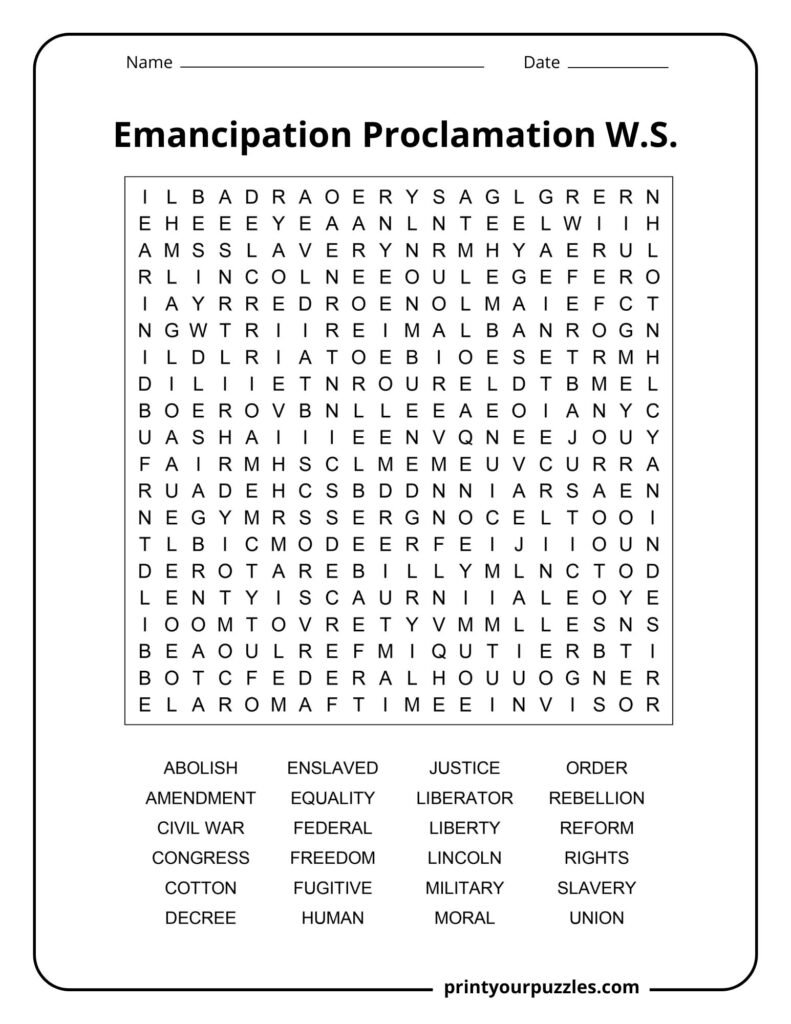
ABOLISH, AMENDMENT, CIVIL WAR, CONGRESS, COTTON, DECREE, ENSLAVED, EQUALITY, FEDERAL, FREEDOM, FUGITIVE, HUMAN, JUSTICE, LIBERATOR, LIBERTY, LINCOLN, MILITARY, MORAL, ORDER, REBELLION, REFORM, RIGHTS, SLAVERY, UNION
It was an executive order issued by President Abraham Lincoln on January 1, 1863, declaring enslaved people in Confederate states to be free during the Civil War.
Lincoln issued it as a wartime strategy to weaken the Confederacy by freeing enslaved people in rebel states and allowing Black men to join the Union military forces.
No, it only applied to enslaved people in Confederate states. Border states loyal to the Union and certain occupied territories were excluded from the order.
The Proclamation transformed the war from a fight to preserve the Union into a battle for human freedom, giving the conflict a powerful moral cause against slavery.
It paved the way for the Thirteenth Amendment, which permanently abolished slavery in 1865. It also symbolized a turning point in the struggle for equality in America.
It only applied to Confederate states in rebellion. Enslaved people in border states loyal to the Union, like Kentucky and Maryland, were not included in the order.
Lincoln had the document ready months earlier but waited until the Union victory at the Battle of Antietam in September 1862 to give it greater political strength.
After its signing, approximately 180,000 Black soldiers enlisted in the Union Army and around 18,000 served in the Navy, significantly strengthening the Northern war effort.
The original signed copy was stored in a building that suffered fire damage. Over time, the document faded significantly and is now carefully preserved in fragile condition.
Some abolitionists felt it did not go far enough because it excluded certain states, while many Southerners and some Northerners opposed it for disrupting the existing social order.