Introduction to the Andrew Jackson Word Search
Andrew Jackson (1829–1837) was one of the most forceful and controversial figures ever to occupy the White House. To many of his supporters, he represented the rise of the common man and a new kind of American democracy. To many critics, he was a dangerous leader who expanded presidential power and ignored important limits. That tension makes his presidency especially important to study. The Andrew Jackson word search gives students a way to explore a president whose legacy is filled with energy, conflict, popularity, and deep controversy.
Long before he became president, Jackson had already built a dramatic public image. He grew up on the frontier, fought in the American Revolution as a boy, became a lawyer and military officer, and gained national fame after defeating the British at the Battle of New Orleans in 1815. His reputation as a tough and determined leader helped him become a symbol for voters who felt ignored by older political elites.
Jackson’s years in office, from 1829 to 1837, belonged to the age often called Jacksonian Democracy. During this period, more white men gained the right to vote, political campaigns became more energetic, and presidents appealed more directly to ordinary voters. Jackson used this popular support to strengthen the presidency and challenge institutions he believed were too powerful.
One of his biggest battles was against the Second Bank of the United States. Jackson argued that the bank favored wealthy interests and gave too much influence to a small financial elite. He vetoed its recharter and worked to weaken it. Supporters praised his defense of ordinary citizens, while opponents warned that his actions damaged the economy and concentrated too much power in the executive branch.
Jackson also faced the Nullification Crisis, when South Carolina claimed it could reject federal tariff laws. Jackson strongly defended the authority of the Union, showing that his belief in states’ rights had limits when national unity was threatened.
His presidency also includes one of the darkest chapters in American history: Indian Removal. His administration supported the forced relocation of Native American nations from their ancestral lands, leading to suffering, death, and the Trail of Tears. This part of his legacy must be understood clearly and honestly.
This Andrew Jackson word search examines democracy, military fame, presidential power, economic conflict, union, removal policy, and the painful consequences of expansion. Jackson changed American politics in lasting ways, but his story also shows that popularity and power can leave deeply divided historical memories.
Explore more presidents from the age of Jacksonian democracy with our John Quincy Adams word search, Martin Van Buren word search, James K. Polk word search, and the full US Presidents Word Searches collection.
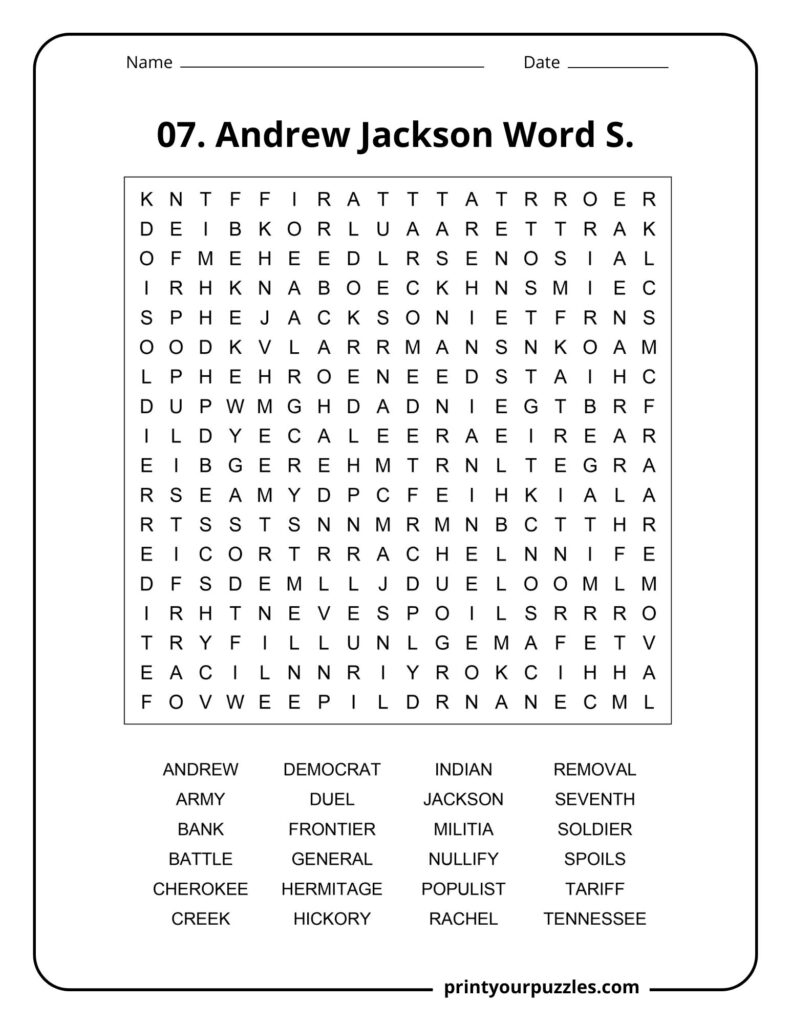
Medium Difficulty Word Search
Words to Find:
ANDREW, ARMY, BANK, BATTLE, CHEROKEE, CREEK, DEMOCRAT, DUEL, FRONTIER, GENERAL, HERMITAGE, HICKORY, INDIAN, JACKSON, MILITIA, NULLIFY, POPULIST, RACHEL, REMOVAL, SEVENTH, SOLDIER, SPOILS, TARIFF, TENNESSEE
All Words Defined
ANDREW – Jackson’s first name, of Scottish origin. He was named after his father Andrew Jackson Sr., who died before his birth in 1767.
ARMY – Jackson served as a major general in the U.S. Army, leading troops in the War of 1812 and various campaigns against Native American tribes.
BANK – The Second Bank of the United States, which Jackson opposed and ultimately destroyed by vetoing its recharter and withdrawing federal deposits during the Bank War.
BATTLE – Jackson fought in numerous battles including Horseshoe Bend, New Orleans, and various conflicts during the Creek War and Seminole Wars, establishing his military reputation.
CHEROKEE – Native American nation forcibly relocated westward under Jackson’s policies, enduring the tragic Trail of Tears in 1838, resulting in thousands of deaths.
CREEK – The Creek War (1813-1814) where Jackson defeated the Red Stick Creeks at Horseshoe Bend, gaining national fame and acquiring millions of acres for American settlement.
DEMOCRAT – Jackson founded the Democratic Party, America’s oldest existing political party, championing common people against elites and establishing new political coalition patterns.
DUEL – Jackson participated in multiple duels defending his and his wife’s honor, most notably killing Charles Dickinson in 1806, carrying a bullet near his heart thereafter.
FRONTIER – Jackson embodied the frontier spirit as the first president from the western frontier, representing rough-hewn settlers rather than eastern aristocratic establishment.
GENERAL – Military rank Jackson achieved, commanding forces in the War of 1812 and leading the decisive victory at the Battle of New Orleans in January 1815.
HERMITAGE – Jackson’s plantation home near Nashville, Tennessee, where he lived with his wife Rachel and enslaved over one hundred people throughout his lifetime.
HICKORY – Nickname “Old Hickory” earned during the War of 1812, referring to his toughness and strength, as hickory wood is notably hard and resilient.
INDIAN – Jackson’s Indian Removal policy forced southeastern tribes westward, resulting in the 1830 Indian Removal Act and devastating displacement of Native American populations.
JACKSON – His surname, becoming synonymous with populist democracy, strong executive power, and the controversial expansion policies of the Jacksonian era in American history.
MILITIA – Jackson commanded Tennessee militia forces during the War of 1812 and Creek War, relying on citizen-soldiers rather than professional troops for many campaigns.
NULLIFY – The Nullification Crisis (1832-1833) when South Carolina claimed the right to nullify federal tariffs; Jackson threatened military force to preserve federal authority.
POPULIST – Jackson’s political style appealed directly to common citizens, expanded voting rights for white men, and challenged established financial and political elites nationwide.
RACHEL – Jackson’s beloved wife Rachel Donelson Robards, whose marriage controversy haunted them both; she died shortly before his presidential inauguration in 1829.
REMOVAL – The Indian Removal Act of 1830 authorized relocating eastern Native American tribes westward, causing immense suffering and death during forced marches.
SEVENTH – Jackson served as the seventh President of the United States from 1829 to 1837, serving two complete terms during a transformative period.
SOLDIER – Jackson’s identity as a military man shaped his presidency; he joined the Continental Army at thirteen and maintained military bearing throughout life.
SPOILS – The “spoils system” where Jackson replaced government officials with political supporters, declaring “to the victor belong the spoils of the enemy.”
TARIFF – Protective tariffs became controversial during Jackson’s presidency, particularly the 1828 “Tariff of Abominations” and subsequent nullification crisis with South
Carolina.
TENNESSEE – Jackson’s adopted home state where he made his fortune, served as senator and judge, and built his Hermitage plantation before becoming president.
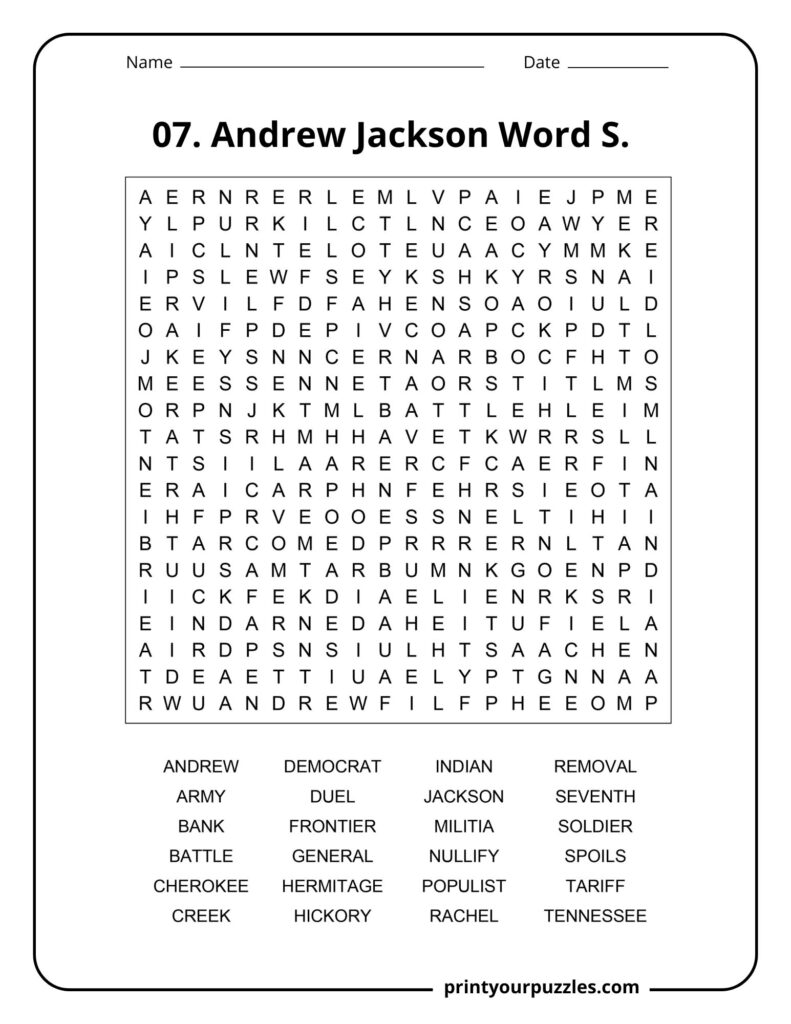
Hard Difficulty Word Search
Words to Find:
ANDREW, ARMY, BANK, BATTLE, CHEROKEE, CREEK, DEMOCRAT, DUEL, FRONTIER, GENERAL, HERMITAGE, HICKORY, INDIAN, JACKSON, MILITIA, NULLIFY, POPULIST, RACHEL, REMOVAL, SEVENTH, SOLDIER, SPOILS, TARIFF, TENNESSEE
7 Key FAQs About Andrew Jackson
5 Curious "Did You Know?" Facts About Andrew Jackson