

The Trail of Tears refers to the forced removal of Native American peoples from their homelands in the southeastern United States to lands west of the Mississippi River. The removals happened mainly during the 1830s and affected thousands of people. Today, the Trail of Tears is remembered as a tragic chapter in United States history, connected to broken treaties, forced migration, and the suffering caused by westward expansion.
Several Native nations were affected by removal policies, including the Cherokee, Choctaw, Chickasaw, Creek, and Seminole peoples. These nations had long histories, governments, communities, farms, and cultural traditions in the Southeast. However, many white settlers wanted their lands for farming, especially for cotton, and state and federal leaders supported expansion into Native territory.
The Indian Removal Act of 1830, signed by President Andrew Jackson, gave the federal government power to negotiate removal agreements with Native nations. In practice, these policies often involved pressure, unfair treaties, and military force. Native peoples were expected to leave their homelands and move to what was called Indian Territory, in present-day Oklahoma.
The Cherokee tried to resist removal through legal and political action. They had their own government, a written constitution, schools, and a newspaper. In the Supreme Court case Worcester v. Georgia, the Court recognized that Georgia did not have authority over Cherokee lands. Even so, removal continued, showing how Native rights were often ignored when they conflicted with expansion.
The forced journey was extremely difficult. Thousands of Cherokee people were removed in 1838 and 1839, traveling long distances under harsh conditions. Many walked through cold weather with limited food, poor shelter, illness, exhaustion, and military supervision. Families were separated from homes, farms, graves, and places that held deep meaning.
The human cost was devastating. Thousands of Native people died during the removals from disease, hunger, exposure, and hardship. The Trail of Tears remains a symbol of loss, injustice, and resilience. It also helps students understand the darker side of westward expansion and the consequences of U.S. policies toward Native American nations.
Students can use this Trail of Tears word search to review vocabulary connected to Cherokee, removal, treaty, homeland, Oklahoma, journey, hardship, Andrew Jackson, Native Americans, and forced migration. These words help connect the causes, experiences, consequences, and lasting meaning of this painful historical event.
Related US History Word Searches:
Andrew Jackson | Native Americans | Indian Removal Act | Westward Expansion | Manifest Destiny | Cherokee Nation
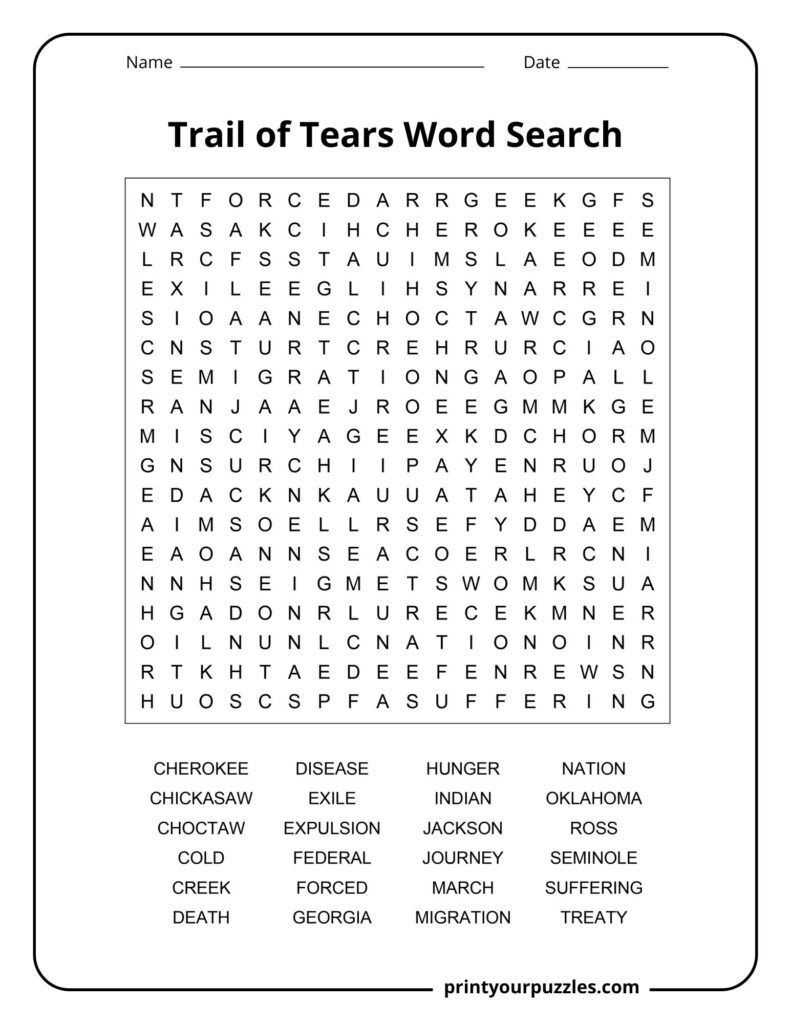
CHEROKEE, CHICKASAW, CHOCTAW, COLD, CREEK, DEATH, DISEASE, EXILE, EXPULSION, FEDERAL, FORCED, GEORGIA, HUNGER, INDIAN, JACKSON, JOURNEY, MARCH, MIGRATION, NATION, OKLAHOMA, ROSS, SEMINOLE, SUFFERING, TREATY
CHEROKEE – Indigenous nation forcibly removed from their southeastern homelands during the 1838-1839 march, suffering thousands of deaths along the brutal journey to Indian Territory.
CHICKASAW – Native American tribe relocated from Mississippi and Alabama to Oklahoma, one of the Five Civilized Tribes affected by federal removal policies during the 1830s.
CHOCTAW – First major tribe removed under the Indian Removal Act in 1831, enduring harsh conditions traveling from Mississippi to Oklahoma with inadequate government support.
COLD – Brutal winter weather conditions during forced marches caused additional suffering, exposure, and death among inadequately clothed and sheltered Cherokee and other displaced peoples.
CREEK – Also called Muscogee, this nation was forcibly removed from Alabama and Georgia between 1834-1837, experiencing violence, starvation, and disease during their relocation westward.
DEATH – Approximately 4,000 Cherokee died during removal, with thousands more from other tribes perishing from disease, exposure, starvation, and exhaustion along the journey.
DISEASE – Cholera, dysentery, measles, and other illnesses spread rapidly among weakened travelers in overcrowded conditions, causing widespread mortality during the forced relocations.
EXILE – The permanent banishment of Native peoples from their ancestral homelands where they had lived for thousands of years to unfamiliar western territories.
EXPULSION – The forcible ejection of entire Native nations from their lands by federal and state governments, stripping them of homes, property, and sacred sites.
FEDERAL – The United States government enacted and enforced removal policies through the Indian Removal Act of 1830, authorizing the forced relocation of tribes.
FORCED – Removal was involuntary and coercive, with military troops compelling Native peoples to leave their homes, often at gunpoint, without adequate preparation time.
GEORGIA – State that aggressively pursued Cherokee removal after gold was discovered on their land, pressuring the federal government to enforce relocation despite treaty protections.
HUNGER – Severe food shortages and starvation plagued the journey as government provisions were inadequate, spoiled, or never arrived, causing malnutrition and death among travelers.
INDIAN – Historical term for indigenous peoples affected by removal policies; thousands were forcibly relocated from southeastern United States to designated territories in the West.
JACKSON – President Andrew Jackson signed the Indian Removal Act in 1830 and vigorously pursued Native American relocation despite Supreme Court rulings protecting tribal sovereignty.
JOURNEY – The devastating forced march covered over 1,000 miles through multiple states in harsh conditions, taking months and claiming thousands of lives along the route.
MARCH – The compulsory movement of entire Native communities, including elderly, children, and sick, forced to walk hundreds of miles with minimal rest or supplies.
MIGRATION – Though termed migration, this was forced relocation rather than voluntary movement, displacing approximately 100,000 Native Americans from their ancestral lands during the 1830s.
NATION – Refers to sovereign indigenous peoples like Cherokee, Choctaw, Creek, Chickasaw, and Seminole who possessed established governments, laws, and territories before forced removal.
OKLAHOMA – Indian Territory destination where removed tribes were relocated, promising land that was often less fertile and unfamiliar compared to their southeastern homelands.
ROSS – John Ross served as Principal Chief of the Cherokee Nation during removal, desperately fighting relocation through legal channels and leading his people through their darkest hour.
SEMINOLE – Florida tribe that resisted removal through warfare from 1835-1842; many were eventually forced to Oklahoma while some remained hidden in the Everglades.
SUFFERING – Immense physical, emotional, and spiritual hardship endured including death, disease, starvation, loss of homeland, destruction of communities, and cultural trauma.
TREATY – Agreements between Native nations and the U.S. government, often coerced or fraudulent, used to justify land seizures despite previous promises of protection.

CHEROKEE, CHICKASAW, CHOCTAW, COLD, CREEK, DEATH, DISEASE, EXILE, EXPULSION, FEDERAL, FORCED, GEORGIA, HUNGER, INDIAN, JACKSON, JOURNEY, MARCH, MIGRATION, NATION, OKLAHOMA, ROSS, SEMINOLE, SUFFERING, TREATY
The Trail of Tears was the forced removal of approximately 100,000 Native Americans from their southeastern homelands to western territories during the 1830s, resulting in thousands of deaths.
White settlers desired Native American lands, especially after gold was discovered in Georgia. The Indian Removal Act of 1830 authorized President Andrew Jackson to relocate tribes westward.
The Five Civilized Tribes—Cherokee, Chickasaw, Choctaw, Creek, and Seminole—were primarily affected, along with other southeastern nations forcibly removed from their ancestral territories to Indian Territory.
Approximately 4,000 Cherokee died during their 1838-1839 removal, with total deaths across all tribes estimated between 15,000-25,000 from disease, starvation, exposure, and exhaustion.
The journey ended in Indian Territory, present-day Oklahoma, where removed tribes were relocated to unfamiliar lands designated by the federal government, far from their southeastern homelands.
The Cherokee Phoenix, first published in 1828, was printed in both English and Cherokee using Sequoyah’s syllabary, advocating against removal until Georgia forcibly shut it down.
Approximately 1,000 Cherokee fled into the Great Smoky Mountains, evading soldiers and eventually forming the Eastern Band of Cherokee Indians, who remain in North Carolina today.
In Worcester v. Georgia (1832), the Supreme Court declared Georgia’s actions unconstitutional, but President Jackson reportedly said, “John Marshall has made his decision; now let him enforce it.”
The government hired private contractors to transport Native peoples, many of whom provided inadequate food, shelter, and supplies while pocketing profits, worsening the humanitarian crisis.
The Cherokee called their journey “Nunna daul Tsuny,” meaning “The Trail Where They Cried,” which was later translated to the now-famous phrase “Trail of Tears.”