
The Monroe Doctrine was a major foreign policy statement announced by President James Monroe in 1823. It warned European powers not to create new colonies or interfere with independent nations in the Americas. At the same time, the United States said it would not interfere in existing European colonies or in the internal affairs of European countries.
The doctrine came at a time when many Latin American nations had recently gained independence from Spain and Portugal. Leaders in the United States worried that European monarchies might try to restore control over these newly independent countries. The Monroe Doctrine was meant to send a clear message that the Western Hemisphere should not become a place for new European colonization.
President Monroe delivered the message, but Secretary of State John Quincy Adams played a major role in shaping the policy. Adams believed the United States should speak clearly against European interference while avoiding a formal alliance with Britain. This helped the young nation define its own position in world affairs.
The main idea of the Monroe Doctrine was simple but powerful: Europe should stay out of the political affairs of the Americas, and the United States would stay out of European conflicts. It was not only a warning to Europe, but also a statement that the United States saw the Americas as a region with a separate political future.
In 1823, however, the United States was still a growing country and did not have enough military power to enforce the doctrine by itself. British naval power also helped discourage European intervention, because Britain wanted open trade with the newly independent nations of Latin America. This made the doctrine more effective than the United States could have made it alone.
Over time, the Monroe Doctrine became an important part of U.S. foreign policy. Later presidents used it to justify a stronger American role in the Western Hemisphere. This history is complex because the doctrine began as a warning against European colonization, but it was later used to support U.S. intervention in Latin America.
This Monroe Doctrine Word Search helps students review vocabulary connected to Monroe, Adams, Europe, colonies, Latin America, independence, foreign policy, hemisphere, intervention, and diplomacy. A Monroe Doctrine Word Search can make this important policy easier to understand by connecting key terms with its background, message, limits, and long-term influence.
Related Word Searches:
James Monroe | War of 1812 | Louisiana Purchase | Thomas Jefferson | Spanish-American War | Truman Doctrine
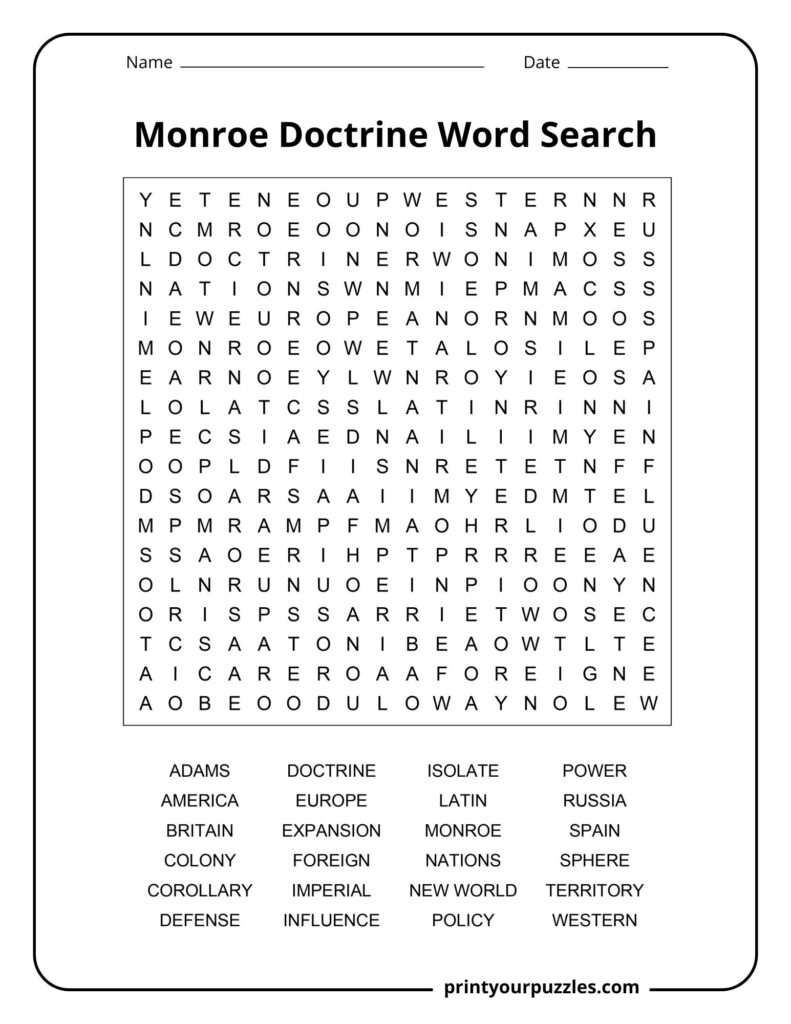
ADAMS, AMERICA, BRITAIN, COLONY, COROLLARY, DEFENSE, DOCTRINE, EUROPE, EXPANSION, FOREIGN, IMPERIAL, INFLUENCE, ISOLATE, LATIN, MONROE, NATIONS, NEW WORLD, POLICY, POWER, RUSSIA, SPAIN, SPHERE, TERRITORY, WESTERN
ADAMS – John Quincy Adams, Secretary of State under President Monroe, who played a crucial role in drafting and shaping the Monroe Doctrine’s key principles and language.
AMERICA – The United States of America, the nation that proclaimed the Monroe Doctrine in 1823 to establish its position on European interference in the Western Hemisphere.
BRITAIN – Great Britain, the powerful European nation whose naval supremacy and shared interests partially enabled the United States to enforce the Monroe Doctrine’s bold proclamations.
COLONY – Territories controlled by European powers that the Monroe Doctrine warned against establishing or expanding in the Americas, protecting newly independent Latin American nations.
COROLLARY – An extension or addition to President Theodore Roosevelt’s 1904 expansion of the Monroe Doctrine, asserting United States authority to intervene in Latin American affairs to maintain stability and order.
DEFENSE – The protection of American sovereignty, security, and interests in the Western Hemisphere, which was a primary justification for establishing the Monroe Doctrine.
DOCTRINE – A formal statement of policy or principle, specifically referring to President Monroe’s 1823 declaration outlining United States opposition to European intervention in the Americas.
EUROPE – The Old World continent whose powerful nations were warned against further colonization, intervention, or interference in the political affairs of the Western Hemisphere.
EXPANSION – The extension of European colonial territories or political influence in the Americas that the Monroe Doctrine explicitly opposed and warned against after 1823.
FOREIGN – Relating to other nations and international relations, particularly European powers’ policies toward the Americas that concerned United States leaders in the early nineteenth century.
IMPERIAL – Related to empire-building and colonial control that European powers practiced, which the Monroe Doctrine sought to prevent from spreading further in the Americas.
INFLUENCE – Political, economic, or military control that European nations might exert over American nations, which the Monroe Doctrine aimed to limit in the Western Hemisphere.
ISOLATE – To remain separate from European political conflicts and entanglements, a key principle underlying the Monroe Doctrine’s call for mutual non-interference between hemispheres.
LATIN – Referring to Latin America, the region of Spanish and Portuguese-speaking nations gaining independence that the Monroe Doctrine aimed to protect from European reconquest.
MONROE – James Monroe, the fifth President of the United States who announced the doctrine in his December 1823 annual message to Congress, establishing American hemispheric policy.
NATIONS – Independent countries of the Americas, particularly newly liberated Latin American republics, whose sovereignty the Monroe Doctrine pledged to support against European threats.
NEW WORLD – Term for the Americas, distinguished from Europe’s Old World, representing a hemisphere where the United States declared European colonization would no longer be tolerated.
POLICY – Official governmental position or diplomatic strategy, specifically the United States’ formal stance on European involvement in Western Hemisphere affairs after 1823.
POWER – Strong nations capable of exerting military, political, or economic influence, particularly European empires that the Monroe Doctrine warned against interfering in American affairs.
RUSSIA – The European empire whose territorial expansion along the Pacific Northwest coast of North America particularly concerned American leaders and influenced the doctrine’s creation.
SPAIN – The former colonial power that controlled much of Latin America until independence movements succeeded, whose potential reconquest attempts the Monroe Doctrine opposed.
SPHERE – A zone of political or economic influence or control, as in “sphere of influence,” which the Monroe Doctrine established for the Americas.
TERRITORY – Land or geographic region under governmental control or territorial claim, which European powers were warned not to expand in the Americas after 1823.
WESTERN – Relating to the Western Hemisphere, the geographic region including the Americas where the Monroe Doctrine declared United States opposition to European colonial expansion.
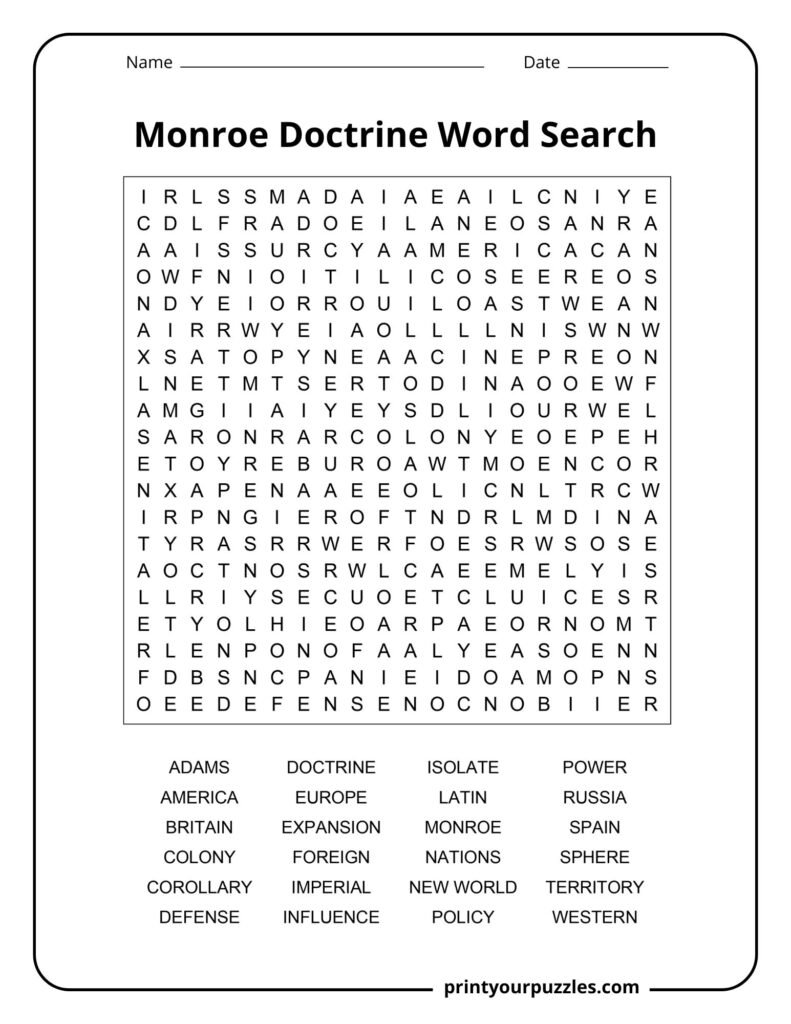
ADAMS, AMERICA, BRITAIN, COLONY, COROLLARY, DEFENSE, DOCTRINE, EUROPE, EXPANSION, FOREIGN, IMPERIAL, INFLUENCE, ISOLATE, LATIN, MONROE, NATIONS, NEW WORLD, POLICY, POWER, RUSSIA, SPAIN, SPHERE, TERRITORY, WESTERN
A United States foreign policy statement from 1823 declaring that European powers should not colonize or interfere with independent nations in the Western Hemisphere or face American opposition.
President James Monroe announced the doctrine on December 2, 1823, during his seventh annual message to Congress, establishing a cornerstone of American foreign policy for decades.
To protect newly independent Latin American nations from European reconquest, prevent further colonization in the Americas, and assert United States influence in the Western Hemisphere.
No new European colonization in the Americas, no European interference in independent American nations’ affairs, and United States non-involvement in European political conflicts or wars.
It discouraged European intervention but also justified later United States interference in Latin American affairs, especially after Theodore Roosevelt’s 1904 Corollary expanded American interventionist authority.
America lacked the naval power to back up its bold proclamation in 1823. British naval supremacy actually prevented European intervention, not American military strength.
Secretary of State Adams wrote most of the doctrine’s principles and convinced President Monroe to issue it, though Monroe received all the credit and naming rights.
European powers and Latin American nations paid little attention to the doctrine until the United States gained enough power to actually enforce its provisions later.
The 1823 declaration had no official name initially. The phrase “Monroe Doctrine” didn’t become popular until the 1850s when politicians began regularly referencing Monroe’s policy statement.
His 1904 Roosevelt Corollary transformed the doctrine from preventing European interference into justifying United States intervention throughout Latin America, becoming the “international police power” policy.