
The Bill of Rights is one of the most important parts of the United States Constitution. It is made up of the first ten amendments, which were added to protect individual freedoms and limit the power of the federal government. These amendments explain many of the basic rights that Americans still study, discuss, and use today.
When the Constitution was written in 1787, not everyone agreed that it gave enough protection to ordinary citizens. Some people feared that the new federal government could become too powerful. Anti-Federalists argued that clear protections for personal liberty should be added. Federalists supported the Constitution, but many eventually accepted that a list of rights would help calm fears and strengthen public support.
The Bill of Rights was ratified in 1791. James Madison played an important role in writing and organizing the amendments, using ideas from earlier state constitutions and public debates. These amendments became a promise that the government could not simply ignore certain freedoms, even when leaders changed or political opinions were divided.
Several of the best-known protections come from the First Amendment. It protects freedom of religion, speech, press, assembly, and petition. These rights allow people to express ideas, practice their faith, publish opinions, gather peacefully, and ask the government to fix problems. Other amendments protect the right to a fair trial, the right to due process, protection from unreasonable searches, and protection from cruel and unusual punishment.
The Bill of Rights matters because it helps define the relationship between citizens and government. It does not mean that every right is unlimited, but it gives courts, lawmakers, and citizens a foundation for deciding how freedom and authority should be balanced. Many major debates in American history have involved the meaning of these amendments.
This Bill of Rights word search gives students a simple way to review key vocabulary connected to rights, freedoms, amendments, justice, courts, and citizenship. Using a Bill of Rights Word Search can help learners remember important terms while building a clearer understanding of American government.
Related Word Searches:
US Constitution | Founding Fathers | Declaration of Independence | James Madison | George Washington | American Revolution
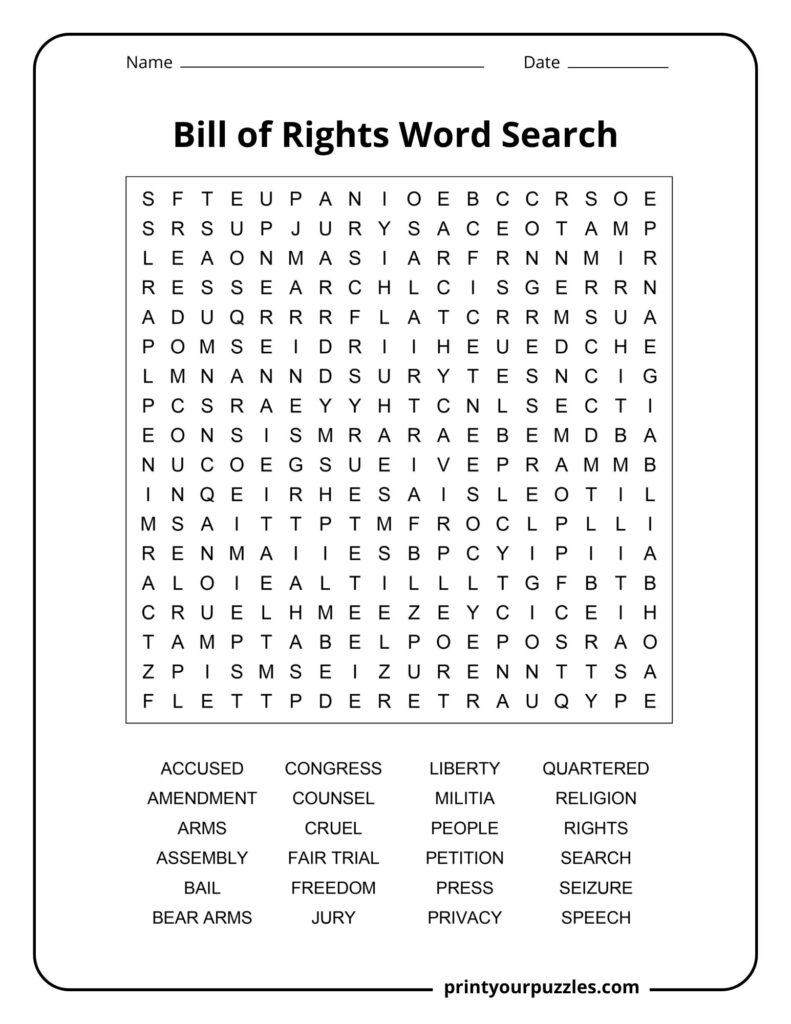
ACCUSED, AMENDMENT, ARMS, ASSEMBLY, BAIL, BEAR ARMS, CONGRESS, COUNSEL, CRUEL, FAIR TRIAL, FREEDOM, JURY, LIBERTY, MILITIA, PEOPLE, PETITION, PRESS, PRIVACY, QUARTERED, RELIGION, RIGHTS, SEARCH, SEIZURE, SPEECH
ACCUSED – A person formally charged with committing a crime who has constitutional rights to due process, fair trial, and legal representation under the Fifth and Sixth Amendments.
AMENDMENT – A formal change or addition to the United States Constitution. The first ten amendments, ratified in 1791, are collectively known as the Bill of Rights.
ARMS – Weapons, particularly firearms, that citizens have the right to keep and bear under the Second Amendment for security, self-defense, and participation in militia service.
ASSEMBLY – The First Amendment right of people to gather peacefully in groups for protests, meetings, demonstrations, or other collective expressions of shared interests and concerns.
BAIL – Money or property given as security to ensure an accused person returns for trial. The Eighth Amendment prohibits excessive bail amounts from being required.
BEAR ARMS – The constitutional right to carry and possess weapons for lawful purposes, protected by the Second Amendment as part of national and personal security measures.
CONGRESS – The legislative branch of the United States government that cannot make laws restricting fundamental freedoms protected by the Bill of Rights, including speech and religion.
COUNSEL – Legal representation and advice provided by an attorney. The Sixth Amendment guarantees accused persons the right to have assistance of counsel for their defense.
CRUEL – Inhumane or excessively harsh treatment. The Eighth Amendment specifically prohibits cruel and unusual punishments from being imposed on convicted criminals or detained individuals.
FAIR TRIAL – A judicial proceeding conducted impartially with proper procedures, evidence rules, and protections ensuring justice, guaranteed by the Fifth, Sixth, and Seventh Amendments.
FREEDOM – The state of liberty and independence from oppression or restriction. The Bill of Rights protects fundamental freedoms including religion, speech, press, and assembly.
JURY – A group of citizens sworn to hear evidence and render a verdict in legal cases. The Bill of Rights guarantees jury trials in criminal and civil cases.
LIBERTY – The state of being free from oppressive restrictions and having the power to act, speak, and think as one chooses within legal boundaries.
MILITIA – A civilian military force of ordinary citizens rather than professional soldiers, referenced in the Second Amendment as justification for bearing arms for collective security.
PEOPLE – The citizens of the United States who possess inherent rights that the government must protect, as emphasized throughout the Bill of Rights amendments.
PETITION – A formal written request to government authorities asking for rights, remedies, or policy changes, protected as a First Amendment right of citizens.
PRESS – News media organizations and journalists who have First Amendment protection to publish information and opinions without government censorship or prior restraint.
PRIVACY – The right to personal autonomy and freedom from unreasonable government intrusion, implied in the Fourth Amendment protection against unreasonable searches and seizures.
QUARTERED – Housing and providing lodging for soldiers in private homes. The Third Amendment prohibits this practice without the homeowner’s consent during peacetime.
RELIGION – Systems of faith, worship, and belief protected by the First Amendment, which prevents government from establishing religion or prohibiting its free exercise.
RIGHTS – Legal and moral entitlements belonging to all people, including those enumerated in the Constitution and others retained by the people per the Ninth Amendment.
SEARCH – Government examination of a person’s body, property, or belongings. The Fourth Amendment requires warrants based on probable cause for searches to be constitutional.
SEIZURE – Government taking or confiscation of property or arresting a person. The Fourth Amendment protects against unreasonable seizures and requires proper legal justification.
SPEECH – Verbal, written, or symbolic expression of ideas and opinions protected by the First Amendment from government censorship or punishment except in limited circumstances.
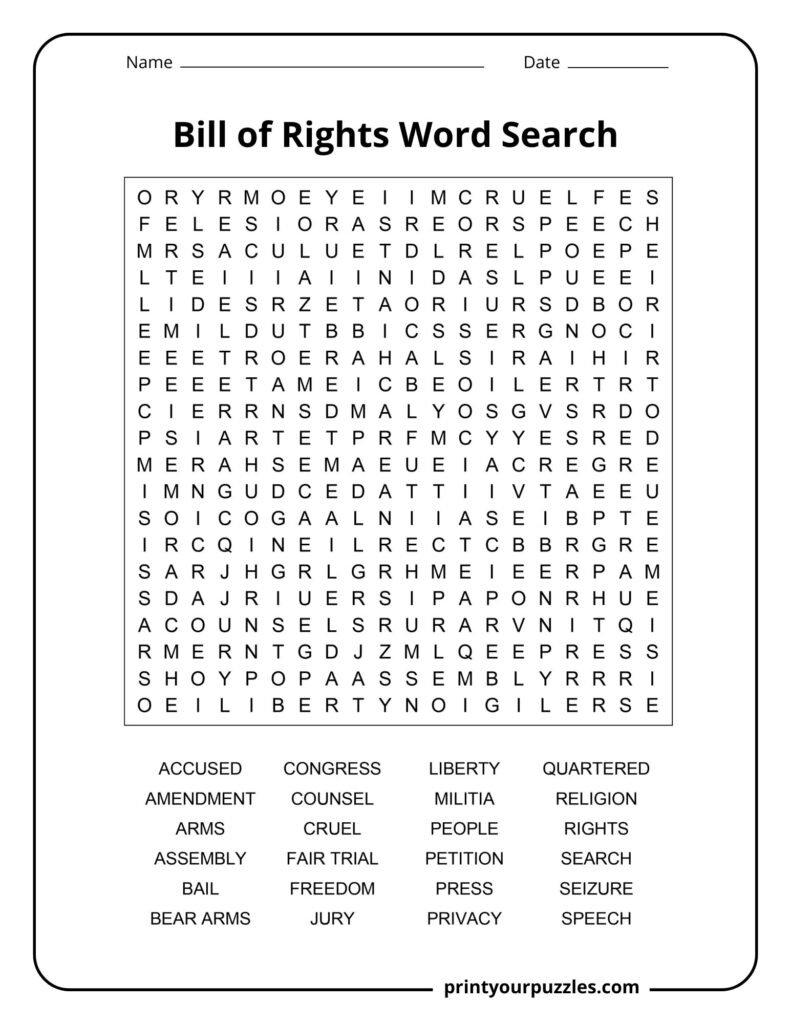
ACCUSED, AMENDMENT, ARMS, ASSEMBLY, BAIL, BEAR ARMS, CONGRESS, COUNSEL, CRUEL, FAIR TRIAL, FREEDOM, JURY, LIBERTY, MILITIA, PEOPLE, PETITION, PRESS, PRIVACY, QUARTERED, RELIGION, RIGHTS, SEARCH, SEIZURE, SPEECH
The Bill of Rights is the first ten amendments to the United States Constitution, guaranteeing fundamental freedoms and protections such as speech, religion, and due process rights.
The Bill of Rights was ratified on December 15, 1791, approximately three years after the Constitution was adopted, following debates about protecting individual liberties from government power.
It was created to protect individual freedoms from government interference and to secure ratification of the Constitution by addressing concerns of Anti-Federalists who feared centralized power.
No single amendment is universally considered most important. The First Amendment protecting speech, religion, and assembly is often cited, though all amendments serve vital protective functions.
Technically yes, through the constitutional amendment process requiring two-thirds congressional approval and three-fourths state ratification, though this has never occurred due to their fundamental importance.
James Madison initially drafted 17 amendments to the Constitution. Congress approved 12, but only 10 were ratified by states, becoming the Bill of Rights we know today.
The Bill of Rights initially only restricted the federal government’s power. It wasn’t until the Fourteenth Amendment and subsequent Supreme Court decisions that protections applied to states.
Massachusetts, along with Georgia and Connecticut, didn’t officially ratify the Bill of Rights until 1939—the 150th anniversary celebration—despite the amendments being law since 1791.
The Third Amendment, prohibiting quartering soldiers in homes, is the only Bill of Rights amendment never central to a Supreme Court ruling, making it historically unique.
One of Madison’s original proposals became the Twenty-Seventh Amendment in 1992, restricting congressional pay raises—ratified 203 years after its initial submission in 1789.