
A president does not always choose the crisis that defines his time in office. For James Madison (1809–1817), that crisis was the War of 1812. Known today as the “Father of the Constitution,” Madison entered the presidency with a reputation as one of the nation’s sharpest political thinkers. Yet his years in the White House tested him not only as a writer and statesman, but as a wartime leader. The James Madison word search introduces students to a president whose story connects ideas, government, conflict, and national identity.
Madison had already helped shape the United States before becoming president. He played a central role at the Constitutional Convention, argued for ratification through the Federalist Papers, and supported the Bill of Rights. His ideas about separation of powers, checks and balances, and limited government became part of the foundation of the American political system. That makes his life important even beyond his presidency.
From 1809 to 1817, Madison led the country during a difficult period in foreign affairs. The United States was still a young nation trying to protect its independence while Britain and France fought for power in Europe. American leaders were frustrated by British interference with trade, the impressment of sailors, and tensions along the western frontier. These problems eventually pushed the United States toward war with Great Britain in 1812.
The War of 1812 was difficult and uneven. American forces had some successes, but the country also faced serious setbacks. In 1814, British troops captured Washington, D.C., and burned important public buildings, including the White House and the Capitol. For a young republic, this was a frightening and humiliating moment.
Still, the war also produced symbols of unity and resilience. The defense of Fort McHenry inspired the poem that later became “The Star-Spangled Banner.” After the war ended, many Americans felt a stronger sense of national pride, even though the conflict had revealed weaknesses in military preparation and political unity.
This James Madison word search highlights a president whose legacy combines constitutional thought with wartime leadership. Madison’s story helps students understand how the United States built its system of government, defended its independence, and developed a stronger national identity during its early decades.
Discover more early American leaders through the Founding and Early Republic era with our Thomas Jefferson word search, James Monroe word search, George Washington word search, and the full US Presidents Word Searches collection.
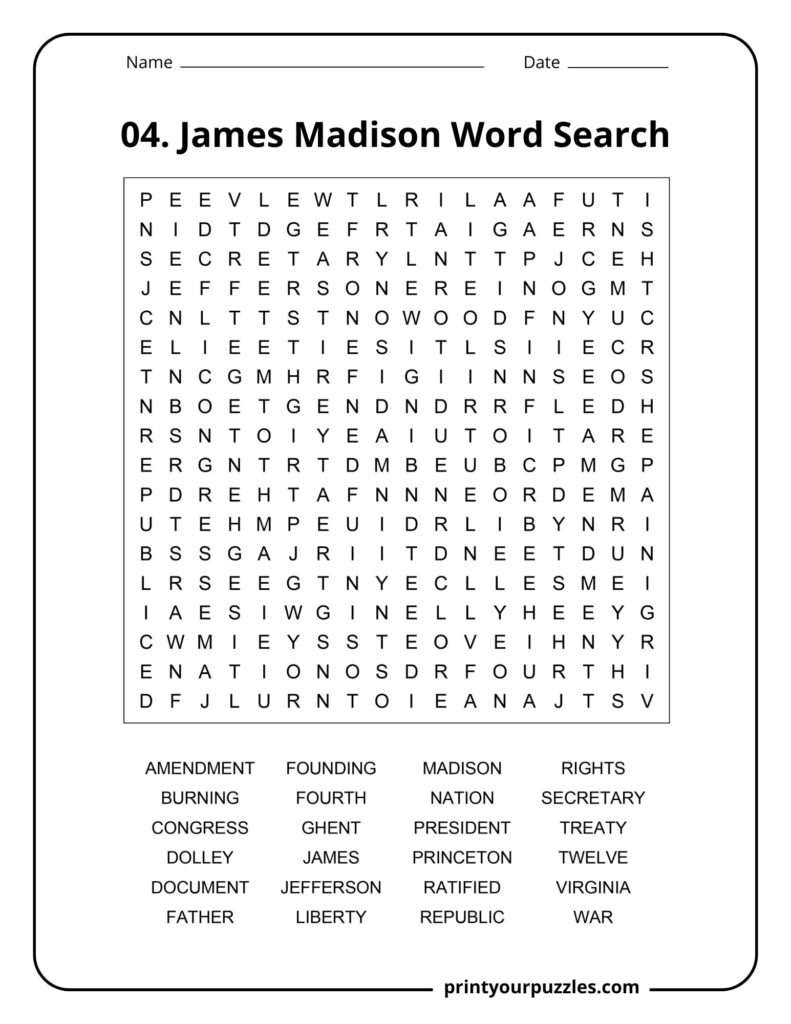
AMENDMENT, BURNING, CONGRESS, DOLLEY, DOCUMENT, FATHER, FOUNDING, FOURTH, GHENT, JAMES, JEFFERSON, LIBERTY, MADISON, NATION, PRESIDENT, PRINCETON, RATIFIED, REPUBLIC, RIGHTS, SECRETARY, TREATY, TWELVE, VIRGINIA, WAR
AMENDMENT – Madison authored the Bill of Rights, the first ten amendments to the Constitution, guaranteeing fundamental freedoms and protections that remain cornerstone principles of American democracy today.
BURNING – During the War of 1812, British forces invaded Washington DC and burned the White House and Capitol in August 1814, forcing Madison to flee the capital.
CONGRESS – Madison served in the Continental Congress and later in the House of Representatives, where he became a leading legislator and advocate for the Constitution’s ratification.
DOLLEY – Dolley Madison, James’s wife, served as First Lady and became famous for her social skills, political influence, and heroically saving Washington’s portrait during the burning.
DOCUMENT – Madison drafted numerous founding documents including the Constitution and Bill of Rights, establishing legal frameworks that defined American government structure and protected individual liberties permanently.
FATHER – Madison earned the title “Father of the Constitution” for his crucial role in drafting the document and developing the framework for America’s federal government system.
FOUNDING – Madison was a Founding Father who helped establish the United States, contributing significantly to constitutional design, federalist philosophy, and early governmental structures and policies.
FOURTH – Madison served as the fourth President of the United States from 1809 to 1817, following Washington, Adams, and his close friend Thomas Jefferson.
GHENT – The Treaty of Ghent, signed in December 1814, ended the War of 1812 between the United States and Great Britain, restoring pre-war boundaries and relations.
JAMES – James was Madison’s first name. Born in 1751, he became one of America’s most influential political philosophers and served two presidential terms until 1817.
JEFFERSON – Thomas Jefferson was Madison’s close friend, political ally, and presidential predecessor. Madison served as Jefferson’s Secretary of State before becoming president himself in 1809.
LIBERTY – Madison championed individual liberty throughout his career, believing that protecting personal freedoms from governmental overreach was essential to maintaining a successful democratic republic.
MADISON – James Madison was America’s fourth president, principal architect of the Constitution, author of the Bill of Rights, and key advocate for federalism and republicanism.
NATION – Madison helped shape the American nation through constitutional design, establishing federal governmental structures that balanced state and national powers for long-term stability.
PRESIDENT – Madison served as President from 1809 to 1817, leading America through the War of 1812 and managing complex foreign policy challenges during turbulent times.
PRINCETON – Madison attended the College of New Jersey, now Princeton University, where he studied history, government, and law, graduating in 1771 before entering public service.
RATIFIED – Madison worked tirelessly to have the Constitution ratified by states, writing Federalist Papers and advocating for adoption despite significant opposition from anti-federalists nationwide.
REPUBLIC – Madison believed strongly in republican government, where power derives from citizens and elected representatives govern according to law rather than through direct democracy.
RIGHTS – Madison drafted the Bill of Rights, the first ten constitutional amendments, protecting essential liberties including speech, religion, press, assembly, and protections against governmental abuse.
SECRETARY – Before becoming president, Madison served as Secretary of State under Thomas Jefferson from 1801 to 1809, managing foreign affairs including the Louisiana Purchase.
TREATY – The Treaty of Ghent concluded the War of 1812, establishing peace between America and Britain and resolving longstanding maritime and territorial disputes peacefully.
TWELVE – Twelve refers to 1812, when Madison declared war against Britain over impressment, trade restrictions, and British support for Native American resistance against expansion.
VIRGINIA – Madison was born and raised in Virginia at Montpelier plantation, representing Virginia interests throughout his political career while championing broader federal constitutional principles.
WAR – The War of 1812 dominated Madison’s presidency, fought against Britain over maritime rights, territorial expansion, and national sovereignty, ending in stalemate but strengthening nationalism.
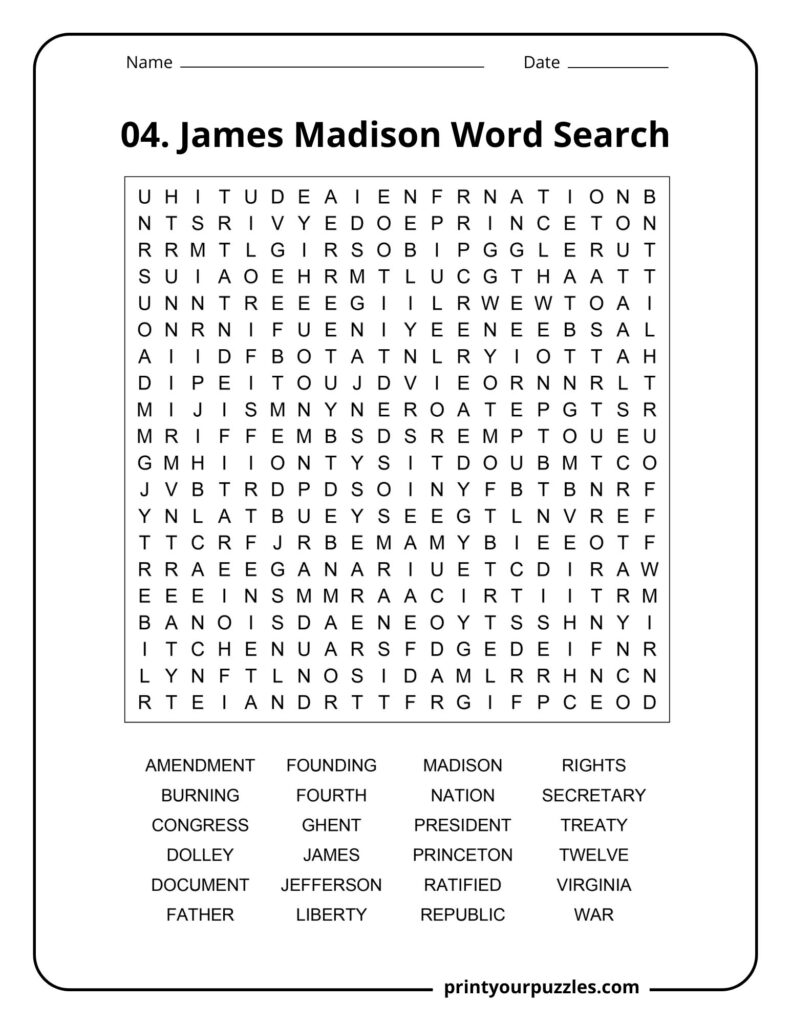
AMENDMENT, BURNING, CONGRESS, DOLLEY, DOCUMENT, FATHER, FOUNDING, FOURTH, GHENT, JAMES, JEFFERSON, LIBERTY, MADISON, NATION, PRESIDENT, PRINCETON, RATIFIED, REPUBLIC, RIGHTS, SECRETARY, TREATY, TWELVE, VIRGINIA, WAR
Madison earned this title by drafting the Constitution’s framework, keeping detailed convention notes, and advocating for its ratification through the influential Federalist Papers he co-authored.
Madison authored and championed the first ten Constitutional amendments, known as the Bill of Rights, which guarantee fundamental freedoms including speech, religion, press, and protection from government overreach.
Madison declared war against Britain in 1812 over maritime rights violations, impressment of American sailors, and trade restrictions. The conflict ended in stalemate but strengthened American national identity.
Dolley Madison was James’s wife and an influential First Lady known for her political savvy, social diplomacy, and heroic rescue of national treasures when British forces burned Washington.
Before his presidency, Madison served in Continental Congress, drafted the Constitution, co-wrote Federalist Papers, authored the Bill of Rights, and served as Jefferson’s Secretary of State managing critical diplomacy.
For official administration records and historical biography, visit the James Madison page in the White House Archives. If you are planning a trip or looking for personal papers, check out the official James Madison’s Montpelier.
James Madison: A Life Reconsidered by Lynne Cheney. Brings the quiet ‘Father of the Constitution’ to life, showing how this shy intellectual became the architect of American democracy.
Standing only 5 feet 4 inches tall and weighing around 100 pounds, Madison was the smallest president in U.S. history, yet his intellectual stature and political influence were enormous.
Dolley’s first husband, John Todd, and their youngest son died during Philadelphia’s 1793 yellow fever epidemic. She married James Madison the following year, becoming a legendary First Lady.
Madison died in 1836 at age 85, outliving all other major Founding Fathers. He was the last surviving signer of the Constitution, witnessing America’s growth for decades.
Despite brilliant ideas, Madison’s voice was so quiet that colleagues often struggled to hear his speeches in large halls. His written words proved far more powerful than spoken ones.
The two friends created an elaborate coded system to communicate confidentially about sensitive political matters, demonstrating their close partnership and concern for secure communications during uncertain times.