
Some presidents are remembered for dramatic wars or sweeping changes, but John Adams (1797–1801) is important for a different reason: he helped guide the United States through the fragile years after George Washington. As the second president, Adams faced the difficult task of proving that the new American government could continue peacefully after its first leader stepped aside. For students, the John Adams word search is a useful way to explore a president who stood at the center of the nation’s earliest political challenges.
John Adams led the country from 1797 to 1801, during the Founding and Early Republic period. Before entering the White House, he had already played a major role in American independence. He supported the Revolution, helped argue for separation from Great Britain, served as a diplomat in Europe, and became the first vice president of the United States. By the time he became president, Adams had spent much of his life defending the idea of American self-government.
One of the biggest challenges Adams faced was tension with France. The United States wanted to avoid being pulled into European wars, but attacks on American ships created pressure for military action. During the undeclared naval conflict known as the Quasi-War, Adams strengthened the navy while also seeking a peaceful solution. His decision to avoid a full war with France became one of the most significant parts of his legacy, even though it angered some members of his own Federalist Party.
Adams also governed during a time of sharp political division. The Federalists and Democratic-Republicans disagreed over the future of the country, the power of the national government, and relations with foreign powers. The Alien and Sedition Acts, passed during his administration, remain controversial because they raised serious questions about civil liberties, immigration, criticism of government, and freedom of speech.
Although Adams served only one term, his presidency marked an important test for the young republic. In 1800, he lost the election to Thomas Jefferson, his political rival and former friend. The peaceful transfer of power from one party to another helped show that the American system could survive disagreement without violence.
This John Adams word search focuses on independence, diplomacy, political parties, the Quasi-War, constitutional debate, and the early challenges of the presidency. Adams may not have been as universally admired as Washington, but his time in office helped prove that the new government could continue after its first great leader.
Continue learning about the Founding and Early Republic Presidents with our George Washington word search, Thomas Jefferson word search, James Monroe word search, and the full US Presidents Word Searches collection.
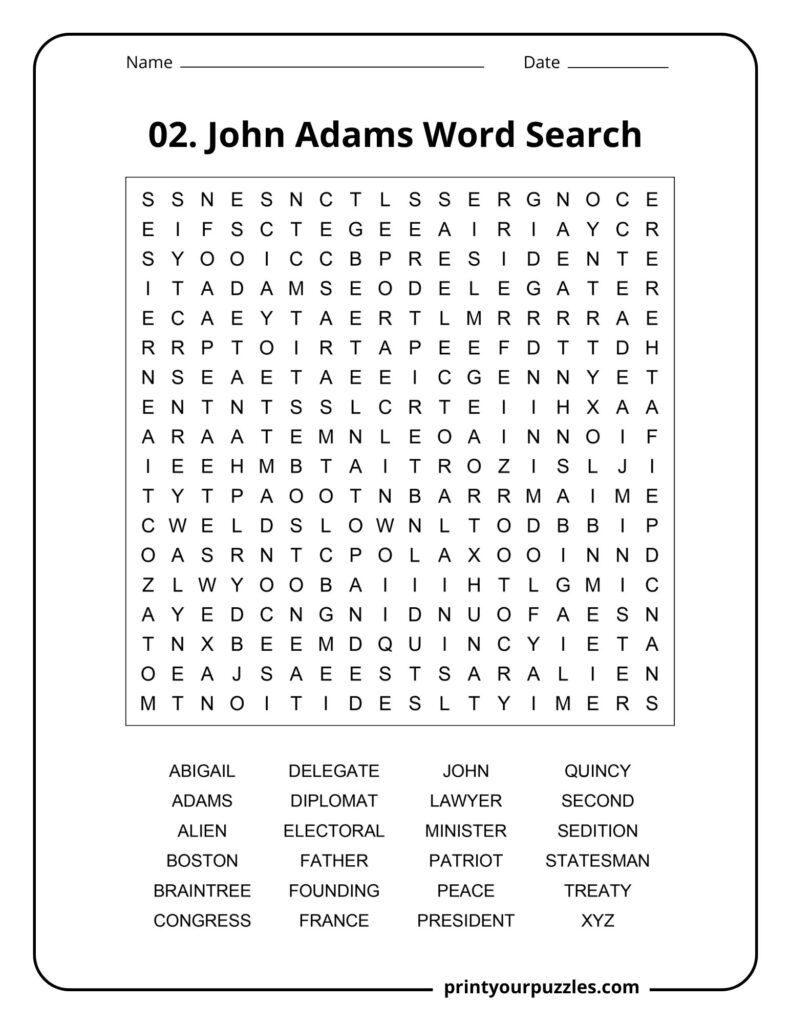
ABIGAIL, ADAMS, ALIEN, BOSTON, BRAINTREE, CONGRESS, DELEGATE, DIPLOMAT, ELECTORAL, FATHER, FOUNDING, FRANCE, JOHN, LAWYER, MINISTER, PATRIOT, PEACE, PRESIDENT, QUINCY, SECOND, SEDITION, STATESMAN, TREATY, XYZ
ABIGAIL – Adams’s wife and trusted advisor, Abigail Smith Adams, who corresponded extensively with him during his political career and championed women’s rights and education.
ADAMS – The family surname of America’s second president, who came from Massachusetts and established a political dynasty including his son, John Quincy Adams.
ALIEN – Refers to the Alien Act of 1798, controversial legislation signed by Adams that allowed deportation of foreigners deemed dangerous during wartime tensions.
BOSTON – Massachusetts city where Adams practiced law, defended British soldiers after the Boston Massacre, and participated in revolutionary activities before independence.
BRAINTREE – Adams’s birthplace in Massachusetts (now Quincy), where he was born in 1735 and later retired after his presidency ended in 1801.
CONGRESS – The Continental Congress where Adams served as a delegate, championed independence, and helped draft the Declaration of Independence alongside Thomas Jefferson.
DELEGATE – Adams’s role as Massachusetts representative to the Continental Congress, where he advocated for colonial rights and pushed for American independence from Britain.
DIPLOMAT – Adams served as American diplomatic minister to France, the Netherlands, and Great Britain, negotiating crucial treaties and securing foreign support.
ELECTORAL – Refers to the Electoral College system through
which Adams won the presidency in 1796, defeating Thomas Jefferson in a contentious election.
FATHER – Adams was a Founding Father who helped establish the United States, contributing to independence, constitutional government, and early American diplomacy.
FOUNDING – Describes Adams’s role as a Founding Father who shaped American independence, government structure, and diplomatic relations during the nation’s formative years.
FRANCE – Country where Adams served as diplomatic minister during the Revolutionary War and later faced tensions during the Quasi-War period.
JOHN – Adams’s first name, distinguishing him from his son John Quincy Adams, who also became president, making them America’s first father-son presidents.
LAWYER – Adams’s profession before politics; he defended British soldiers after the Boston Massacre, demonstrating his commitment to legal justice and fairness.
MINISTER – Adams’s diplomatic title while representing America in France, the Netherlands, and Britain, negotiating treaties and securing international recognition for America.
PATRIOT – Adams was a passionate patriot who advocated for American independence, served in Congress, and dedicated his life to establishing the republic.
PEACE – Adams negotiated the Treaty of Paris in 1783, ending the Revolutionary War and securing American independence from Great Britain through diplomatic efforts.
PRESIDENT – Adams served as America’s second president from 1797 to 1801, succeeding George Washington and navigating difficult foreign policy challenges during tenure.
QUINCY – The Massachusetts town (formerly Braintree) where Adams was born, lived, and is buried, now named partly in honor of his family.
SECOND – Adams was the second president of the United States, serving one term after George Washington and before his rival Thomas Jefferson.
SEDITION – The Sedition Act of 1798, signed by Adams, criminalized criticism of the government and became highly controversial, damaging his political reputation.
STATESMAN – Adams was a distinguished statesman who contributed to American independence, diplomacy, and governance across decades of public service to the nation.
TREATY – Adams negotiated important treaties, including the Treaty of Paris ending the Revolutionary War and later agreements during his diplomatic service abroad.
XYZ – The XYZ Affair was a diplomatic scandal in 1797-1798 when French agents demanded bribes, leading to the undeclared Quasi-War during Adams’s presidency.
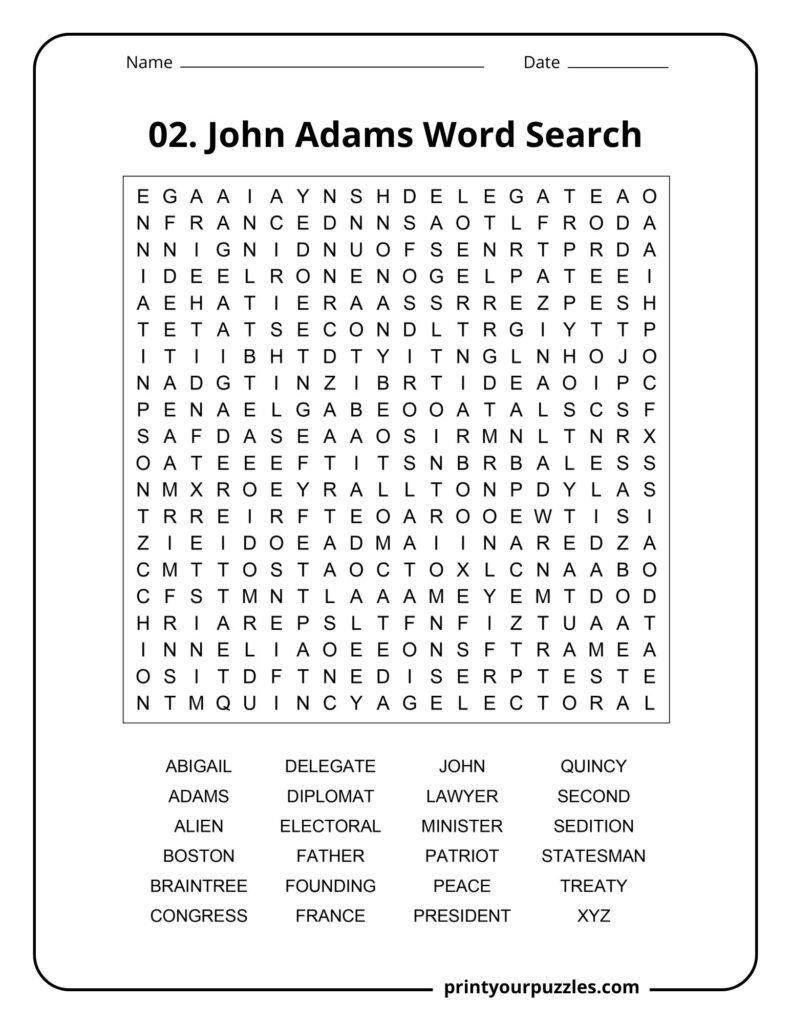
ABIGAIL, ADAMS, ALIEN, BOSTON, BRAINTREE, CONGRESS, DELEGATE, DIPLOMAT, ELECTORAL, FATHER, FOUNDING, FRANCE, JOHN, LAWYER, MINISTER, PATRIOT, PEACE, PRESIDENT, QUINCY, SECOND, SEDITION, STATESMAN, TREATY, XYZ
Adams was a Continental Congress delegate who championed independence, helped draft the Declaration of Independence, and persuaded colonists to support separation from Britain.
Adams believed in justice and rule of law, defending the soldiers to ensure fair trials despite public outrage, demonstrating his commitment to legal principles.
These controversial 1798 laws allowed deportation of foreigners and criminalized government criticism, damaging Adams’s reputation and contributing to his 1800 election defeat.
John Adams was the father of John Quincy Adams, making them the first father-son pair to both serve as U.S. presidents in American history.
Initially close friends and collaborators, they became political rivals during the 1796 and 1800 elections but reconciled later, exchanging letters until dying on the same day in 1826.
For official administration records and historical biography, visit the John Adams page in the White House Archives. If you are planning a trip or looking for personal papers, check out the official Adams National Historical Park.
John Adams by David McCullough. Pulitzer Prize winner and basis for the HBO series. A vivid portrait of a brilliant, stubborn patriot and his extraordinary marriage to Abigail.
Both Founding Fathers died on the 50th anniversary of the Declaration of Independence, with Adams’s last words reportedly being “Thomas Jefferson survives,” unaware Jefferson had died hours earlier.
Adams moved into the unfinished President’s House in Washington, D.C., in November 1800, during the final months of his presidency, before Thomas Jefferson’s inauguration.
Unlike many Founding Fathers, Adams opposed slavery throughout his life and never purchased enslaved people, making him exceptional among Virginia and southern political leaders.
Their extensive correspondence provides invaluable historical insights into revolutionary America, their deep partnership, and Abigail’s progressive views on women’s rights and political matters.
On his final night as president, Adams appointed numerous Federalist judges, including John Marshall as Chief Justice, angering Jefferson and shaping American jurisprudence.