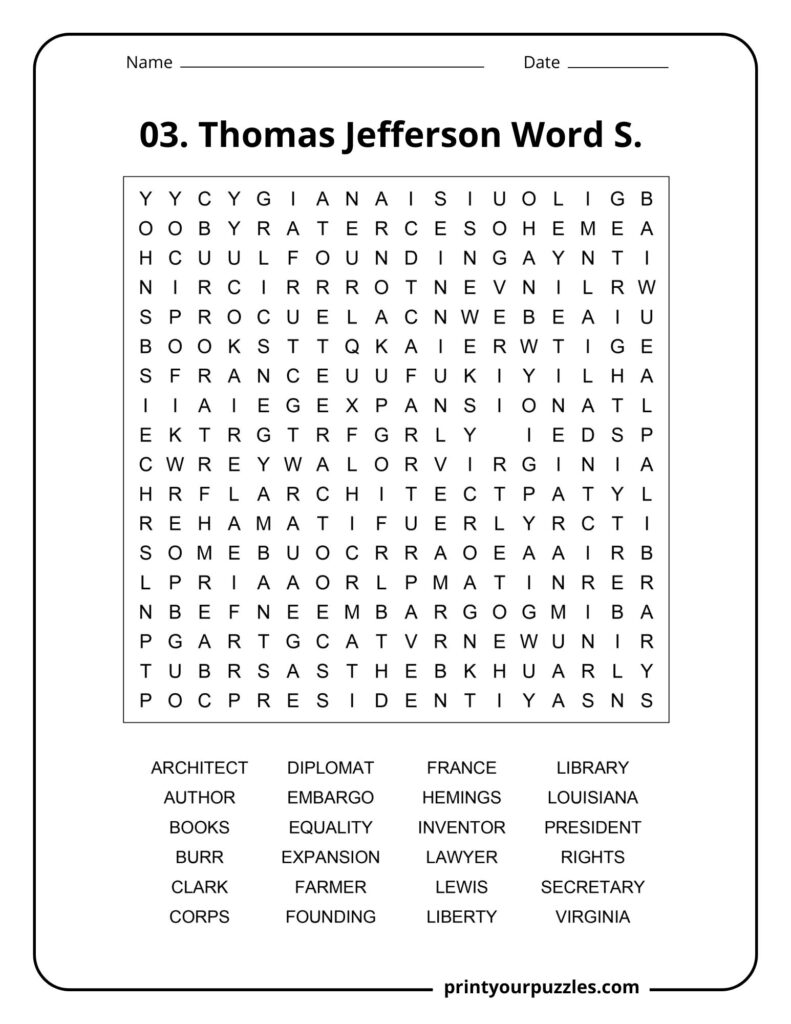
Few presidents are connected to as many big American ideas as Thomas Jefferson (1801–1809). Liberty, expansion, education, democracy, and independence all appear in his story. Before he became the third president of the United States, Jefferson had already written the Declaration of Independence, served as a diplomat, worked as secretary of state, and helped shape the nation’s early political debates. For students, the Thomas Jefferson word search offers a chance to explore a leader whose influence reached far beyond his years in the White House.
Jefferson led the country from 1801 to 1809, during the Founding and Early Republic period. His election was especially important because it marked a peaceful transfer of power between rival political parties. After defeating John Adams, Jefferson became the first Democratic-Republican president, showing that the young nation could change leadership through elections rather than conflict. This moment strengthened confidence in the American political system.
One of Jefferson’s greatest achievements was the Louisiana Purchase in 1803. This enormous land deal with France doubled the size of the United States and opened new possibilities for westward expansion. To learn more about the new territory, Jefferson supported the Lewis and Clark Expedition, which explored lands stretching toward the Pacific. These events made his presidency central to the geographic growth of the country and the future idea of a continental nation.
Jefferson also believed strongly in limited government and individual liberty. He wanted a republic of independent citizens, with less federal power than many Federalists preferred. At the same time, his presidency included difficult contradictions. He defended freedom and democracy, yet he was also a slaveholder. This makes his legacy complex and important to study carefully. His life shows both the ideals of the early United States and the serious injustices that remained part of American society.
Foreign policy brought additional problems. Jefferson tried to keep the United States neutral during conflicts between Britain and France, but trade disputes and attacks on American shipping created pressure. The Embargo Act of 1807, meant to avoid war, hurt American merchants and became deeply unpopular.
This Thomas Jefferson word search highlights a president whose legacy includes bold expansion, political change, democratic ideals, scientific curiosity, and difficult debates that still matter today. Understanding Jefferson means looking at both his achievements and his contradictions.
Travel further through the Founding and Early Republic era with our John Adams word search, James Madison word search, James Monroe word search, and the full US Presidents Word Searches collection.
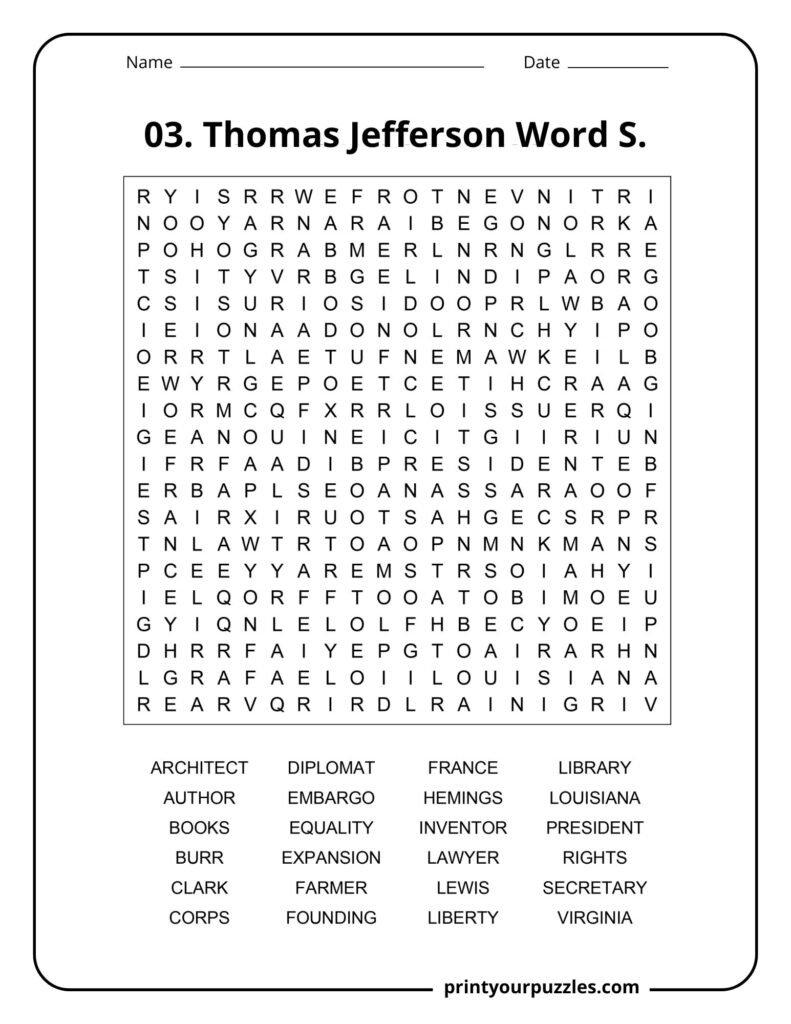
ARCHITECT, AUTHOR, BOOKS, BURR, CLARK, CORPS, DIPLOMAT, EMBARGO, EQUALITY, EXPANSION, FARMER, FOUNDING, FRANCE, HEMINGS, INVENTOR, LAWYER, LEWIS, LIBERTY, LIBRARY, LOUISIANA, PRESIDENT, RIGHTS, SECRETARY, VIRGINIA
ARCHITECT – Jefferson designed his famous estate Monticello, the Virginia State Capitol, and the University of Virginia, showcasing his neoclassical architectural vision and Renaissance man talents.
AUTHOR – Primary author of the Declaration of Independence in 1776, Jefferson crafted the document’s eloquent expression of American ideals, natural rights, and justification for independence from Britain.
BOOKS – Passionate bibliophile who amassed over 6,000 books; his personal library was sold to Congress in 1815, forming the foundation of the Library of Congress.
BURR – Aaron Burr served as Jefferson’s Vice President during his first term (1801-1805) before being replaced by George Clinton in the second term.
CLARK – William Clark co-led the Corps of Discovery expedition with Meriwether Lewis, exploring the Louisiana Territory and reaching the Pacific Ocean between 1804-1806.
CORPS – The Corps of Discovery was the expedition Jefferson commissioned to explore the newly acquired Louisiana Territory, led by Lewis and Clark from 1804-1806.
DIPLOMAT – Served as United States Minister to France from 1785-1789, negotiating trade agreements and representing American interests in Europe during formative post-Revolutionary years.
EMBARGO – The Embargo Act of 1807 prohibited American ships from trading with foreign nations, Jefferson’s controversial attempt to avoid war by using economic pressure.
EQUALITY – Jefferson’s Declaration famously proclaimed “all men are created equal,” establishing equality as a fundamental American principle despite his own contradictory slaveholding.
EXPANSION – Jefferson doubled the nation’s size through the Louisiana Purchase in 1803, acquiring 828,000 square miles and enabling westward expansion across the continent.
FARMER – Lifelong Virginia plantation farmer who experimented with crop rotation, scientific agriculture, and cultivated tobacco, wheat, and vegetables at his Monticello estate.
FOUNDING – One of America’s Founding Fathers who shaped the nation through drafting the Declaration, serving as president, and championing republican principles and limited government.
FRANCE – Served as American minister to France and admired French Enlightenment philosophy, though he later criticized the French Revolution’s violent excesses and radical phases.
HEMINGS – Sally Hemings was an enslaved woman at Monticello; historical evidence confirms Jefferson fathered at least six children with her over their decades-long relationship.
INVENTOR – Created the swivel chair, improved plow design, and the Great Clock at Monticello; constantly tinkered with mechanical devices and architectural innovations throughout life.
LAWYER – Practiced law in Virginia before entering politics, handling cases ranging from property disputes to criminal defense, building reputation through his legal expertise.
LEWIS – Meriwether Lewis, Jefferson’s personal secretary, was
chosen to lead the Corps of Discovery expedition exploring the Louisiana Territory to the Pacific Ocean.
LIBERTY – Central principle Jefferson championed throughout his life, writing extensively about individual freedom, religious liberty, and liberation from tyranny in his political philosophy.
LIBRARY – After the British burned the Capitol in 1814, Jefferson sold his 6,487-volume personal library to Congress, establishing the rebuilt Library of Congress.
LOUISIANA – The Louisiana Purchase of 1803 acquired French territory for $15 million, doubling America’s size and securing control of the Mississippi River and New Orleans.
PRESIDENT – Served as the third President of the United States from 1801-1809, defeating John Adams and establishing Democratic-Republican principles in federal government operations.
RIGHTS – Championed natural rights philosophy, believing governments exist to protect inherent human rights to life, liberty, and pursuit of happiness as stated in Declaration.
SECRETARY – Served as the first Secretary of State under President George Washington from 1790-1793, managing foreign relations and often clashing with Alexander Hamilton.
VIRGINIA – Born, lived, and died in Virginia; represented the state in Continental Congress, served as governor, and built Monticello in the Virginia Piedmont.
ARCHITECT, AUTHOR, BOOKS, BURR, CLARK, CORPS, DIPLOMAT, EMBARGO, EQUALITY, EXPANSION, FARMER, FOUNDING, FRANCE, HEMINGS, INVENTOR, LAWYER, LEWIS, LIBERTY, LIBRARY, LOUISIANA, PRESIDENT, RIGHTS, SECRETARY, VIRGINIA