
Lewis and Clark were explorers who led a major expedition across the western part of North America in the early 1800s. Meriwether Lewis and William Clark were chosen by President Thomas Jefferson to explore lands that were still unfamiliar to many Americans after the Louisiana Purchase. Their journey became an important chapter in the history of exploration, mapping, science, and westward expansion.
The expedition began after the United States bought the Louisiana Territory from France in 1803. This purchase greatly increased the size of the country, but much of the land was not well known to the U.S. government. Jefferson wanted detailed information about rivers, mountains, plants, animals, natural resources, and the Native American nations who lived in the region.
Lewis and Clark were asked to search for a practical route across the continent, especially a water route that might connect the Missouri River to the Pacific Ocean. They were also expected to make maps, record scientific observations, and build diplomatic relationships with Native peoples. Their mission combined exploration, politics, science, and national ambition.
The expedition, officially called the Corps of Discovery, lasted from 1804 to 1806. The group included soldiers, boatmen, interpreters, hunters, and other members who helped the journey succeed. They traveled from the area near St. Louis, followed the Missouri River, crossed difficult mountains, and eventually reached the Pacific Coast before returning east.
Sacagawea, a Shoshone woman, played an important role in the expedition. She helped as an interpreter, guide, and cultural bridge between the explorers and Native American communities. Her knowledge and presence helped the group communicate and survive during parts of the journey.
The expedition faced many challenges, including harsh weather, dangerous rivers, hunger, illness, mountains, and unfamiliar landscapes. Lewis and Clark also depended on Native American knowledge, trade, and assistance. At the same time, their journey became part of the larger story of U.S. westward expansion, which later brought serious consequences for many Native peoples.
The Lewis and Clark expedition produced maps, journals, and descriptions of plants, animals, and geography that helped expand American knowledge of the West.
This Lewis and Clark word search helps students review vocabulary connected to expedition, Louisiana Purchase, Jefferson, Sacagawea, Corps of Discovery, Missouri River, Pacific Ocean, maps, journey, and exploration. A Lewis and Clark word search can make this historic journey easier to understand through key terms and historical connections.
Related Word Searches:
Louisiana Purchase | Westward Expansion | Manifest Destiny | Oregon Trail | Thomas Jefferson | Native Americans
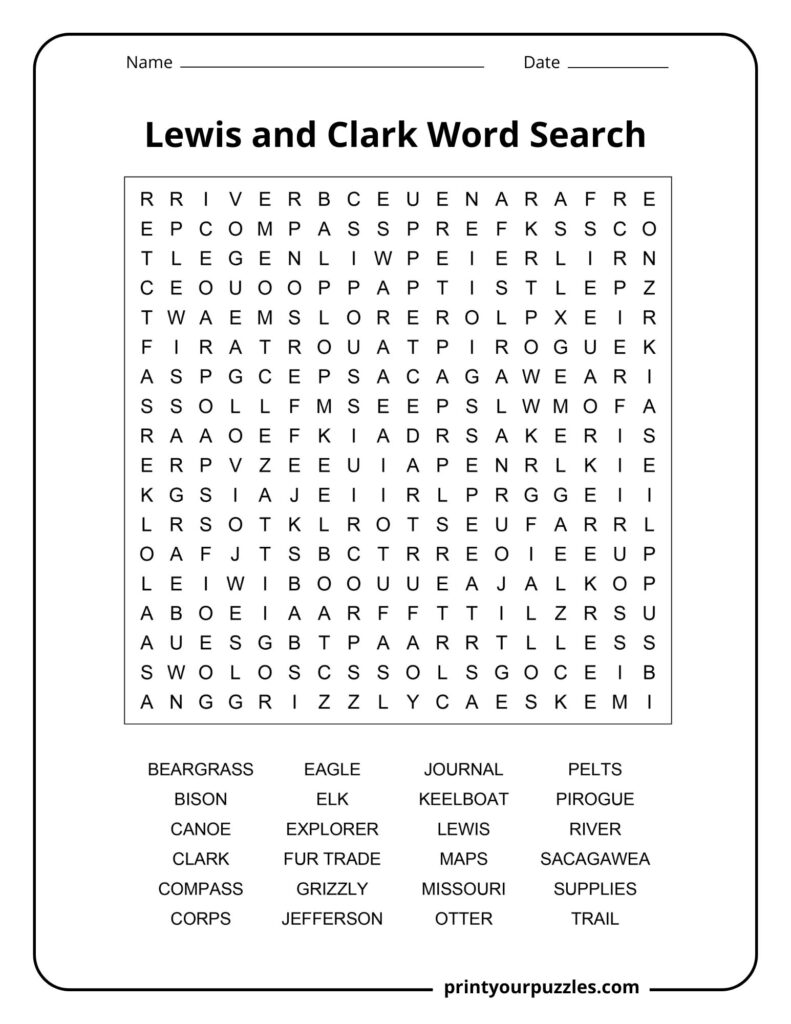
BEARGRASS, BISON, CANOE, CLARK, COMPASS, CORPS, EAGLE, ELK, EXPLORER, FUR TRADE, GRIZZLY, JEFFERSON, JOURNAL, KEELBOAT, LEWIS, MAPS, MISSOURI, OTTER, PELTS, PIROGUE, RIVER, SACAGAWEA, SUPPLIES, TRAIL
BEARGRASS – A hardy plant with long, tough leaves found in the Pacific Northwest. Lewis and Clark documented it during their expedition, noting that Native Americans used it for weaving baskets and other crafts.
BISON – Large, shaggy mammals that roamed the Great Plains in enormous herds. The expedition relied on bison as a vital food source and observed their behavior extensively throughout the journey westward.
CANOE – A lightweight boat essential for river travel. The Corps of Discovery used dugout canoes carved from large trees to navigate western rivers, especially after crossing the Rocky Mountains toward the Pacific.
CLARK – William Clark, co-leader of the expedition alongside Meriwether Lewis. He was an experienced frontiersman and skilled mapmaker whose detailed charts of the western territory proved invaluable for future exploration.
COMPASS – A navigational instrument used to determine direction. Lewis and Clark relied on compasses along with other tools like sextants and chronometers to chart their course across the uncharted American wilderness.
CORPS – Short for the Corps of Discovery, the official name of the expedition group. It consisted of approximately thirty-three members including soldiers, interpreters, and York, Clark’s enslaved servant.
EAGLE – A majestic bird of prey frequently observed and recorded during the expedition. Lewis documented bald eagles and golden eagles in his detailed journals, contributing to early American ornithological knowledge.
ELK – A large species of deer found throughout the western territories. Elk provided the expedition with meat, hides for clothing, and materials for shelter, making them one of the most important game animals.
EXPLORER – A person who travels through unfamiliar regions to learn about them. Lewis and Clark are among America’s most famous explorers, having journeyed from St. Louis to the Pacific Ocean and back.
FUR TRADE – The commercial exchange of animal pelts that drove much of western exploration. One goal of the expedition was to establish trade relationships with Native American tribes and find routes for fur trading.
GRIZZLY – A powerful subspecies of brown bear encountered in the western wilderness. The expedition had several dangerous encounters with grizzly bears, and Lewis provided some of the first detailed scientific descriptions of them.
JEFFERSON – Thomas Jefferson, the third President of the United States who commissioned the expedition. He envisioned exploring the newly acquired Louisiana Purchase and finding a practical water route to the Pacific Ocean.
JOURNAL – Written records kept by members of the expedition documenting their travels. Lewis and Clark’s journals contain detailed observations about geography, wildlife, plants, weather, and encounters with Native American peoples.
KEELBOAT – A large, flat-bottomed riverboat used in the early stages of the journey. The expedition’s keelboat carried supplies up the Missouri River from St. Louis to Fort Mandan before being sent back east.
LEWIS – Meriwether Lewis, co-leader of the expedition and personal secretary to President Jefferson. He was chosen for his scientific knowledge, military experience, and wilderness skills to lead the historic journey.
MAPS – Cartographic representations of territory explored during the expedition. William Clark created remarkably accurate maps of the western landscape that served as essential references for settlers and explorers for decades afterward.
MISSOURI – The longest river in North America, serving as the expedition’s primary route westward. The Corps of Discovery traveled up the Missouri River from its mouth near St. Louis deep into the northern plains.
OTTER – A semi-aquatic mammal prized for its dense, waterproof fur. Lewis and Clark frequently noted otters along rivers and streams, and otter pelts were highly valued in the fur trade economy of the era.
PELTS – Animal skins or hides, especially those with fur still attached. The expedition collected pelts and specimens to send back to President Jefferson as evidence of the rich natural resources found in western territories.
PIROGUE – A flat-bottomed boat similar to a large canoe, often carved from a single tree trunk. The expedition used two pirogues alongside the keelboat during the early portion of their journey up the Missouri.
RIVER – A natural flowing waterway, central to the expedition’s travel strategy. Lewis and Clark navigated numerous rivers including the Missouri, Columbia, Clearwater, and Snake as they sought a water route to the Pacific.
SACAGAWEA – A young Lemhi Shoshone woman who served as interpreter and guide for the expedition. Her knowledge of terrain, languages, and plant life proved essential, and her presence signaled peaceful intentions to Native tribes.
SUPPLIES – The provisions, equipment, and trade goods carried on the expedition. These included weapons, medicines, scientific instruments, food, clothing, and gifts like beads and medals intended for Native American leaders.
TRAIL – A path or route through wilderness territory. The Lewis and Clark Trail stretches over eight thousand miles across the United States and is now preserved as a National Historic Trail for public education.
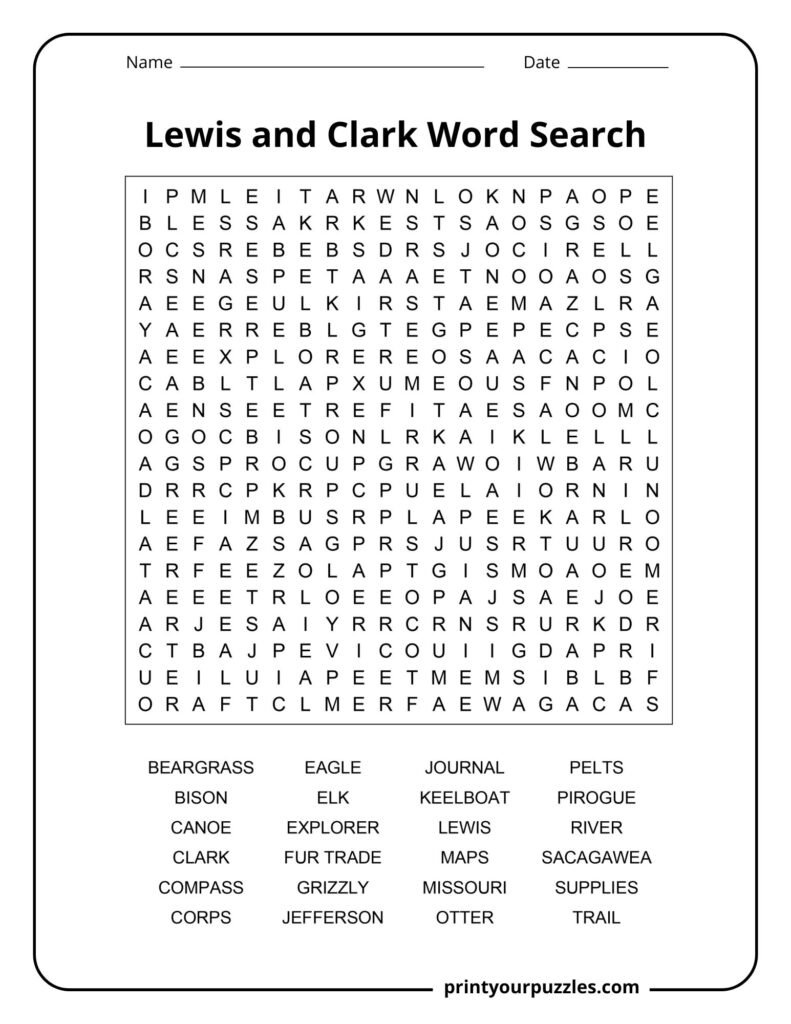
BEARGRASS, BISON, CANOE, CLARK, COMPASS, CORPS, EAGLE, ELK, EXPLORER, FUR TRADE, GRIZZLY, JEFFERSON, JOURNAL, KEELBOAT, LEWIS, MAPS, MISSOURI, OTTER, PELTS, PIROGUE, RIVER, SACAGAWEA, SUPPLIES, TRAIL
President Thomas Jefferson commissioned the expedition to explore the Louisiana Purchase, find a practical water route to the Pacific Ocean, and document the land’s natural resources and inhabitants.
The Corps of Discovery departed from Camp Dubois near St. Louis in May 1804 and returned in September 1806, completing a journey that lasted approximately two years and four months.
Sacagawea was a young Shoshone woman who joined the expedition as an interpreter and guide. Her knowledge of languages, terrain, and survival skills proved essential to the journey’s success.
The expedition mapped vast uncharted territories, documented over 300 new plant and animal species, established relationships with Native American tribes, and strengthened America’s claim to the Oregon territory.
The expedition covered roughly eight thousand miles round trip, traveling from St. Louis through the Great Plains, over the Rocky Mountains, and down to the Pacific Coast at present-day Oregon.
Meriwether Lewis traveled with his Newfoundland dog named Seaman, who accompanied the Corps of Discovery throughout the entire journey, serving as a hunter and guard against wildlife.
While crossing the Bitterroot Mountains, the Corps ran dangerously low on food and resorted to eating candles, portable soup, and even their own horses to survive the harsh conditions.
William Clark carved his name on a sandstone rock at Pompeys Pillar in Montana, spelling it “Wm Clark.” It remains the only verified physical evidence of the expedition along the trail.
Dr. Benjamin Rush provided Lewis with hundreds of powerful laxative pills called “thunderclappers,” which became the primary medical treatment for almost every illness the Corps members suffered during the journey.
Sergeant Charles Floyd died of what historians believe was a ruptured appendix near present-day Sioux City, Iowa. Remarkably, he was the only fatality among over thirty expedition members.