
The Founding Fathers were the leaders who helped create the United States during the American Revolution and the early years of the new nation. They were not all the same kind of people. Some were lawyers, writers, soldiers, diplomats, inventors, planters, merchants, and political thinkers. What connected them was their role in guiding the thirteen colonies from protest against British rule to independence and self-government.
Many Founding Fathers played important parts in the American Revolution. Some helped organize resistance to British taxes and laws, while others wrote speeches, pamphlets, and documents that explained the colonial cause. George Washington became the commander of the Continental Army, leading American forces during the war. Benjamin Franklin used his reputation and diplomatic skill to gain support from France, which became essential to the American victory.
Other Founding Fathers shaped the ideas and documents of the new country. Thomas Jefferson wrote the main draft of the Declaration of Independence, which announced that the colonies were separating from Great Britain. John Adams argued strongly for independence and later helped represent the United States abroad. James Madison became known for his major role in writing and defending the Constitution, while Alexander Hamilton and John Jay helped explain its importance through the Federalist Papers.
The Founding Fathers did not always agree with one another. They debated major questions about federal power, state power, individual rights, taxation, representation, and the best structure for a republic. These disagreements were important because they helped shape the Constitution, the Bill of Rights, and the system of checks and balances that still influence American government today.
At the same time, the history of the Founding Fathers includes contradictions. Many spoke about liberty, equality, and natural rights, but the society they helped build did not protect everyone equally. Some Founding Fathers enslaved people, and women, Native Americans, and many others were excluded from political rights. Understanding this complexity helps students see history more clearly.
The Founding Fathers remain important because their ideas, decisions, and debates shaped the United States government and its understanding of citizenship.
This Founding Fathers word search helps students review vocabulary connected to independence, revolution, liberty, Constitution, Congress, rights, republic, Washington, Jefferson, Franklin, Madison, Hamilton, and Jay. A Founding Fathers word search can make this important topic easier to understand by connecting key terms with the people, documents, and ideas behind the birth of the United States.
Related Word Searches:
Declaration of Independence | US Constitution | Bill of Rights | Benjamin Franklin | George Washington | Thomas Jefferson
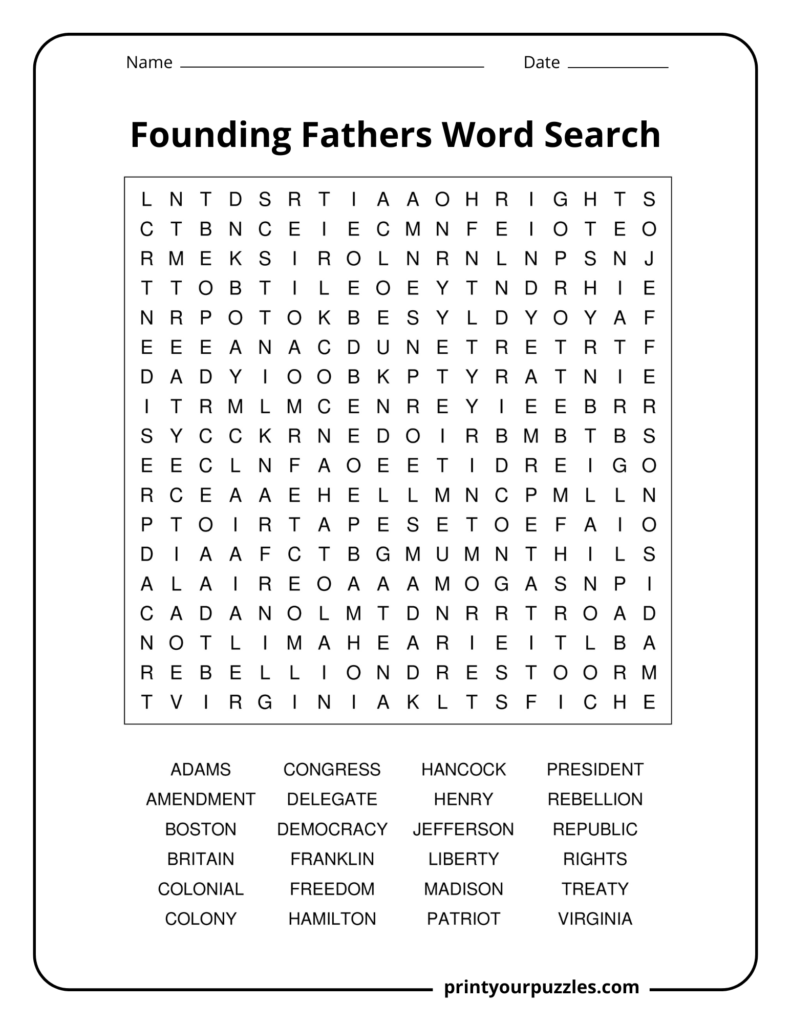
ADAMS, AMENDMENT, BOSTON, BRITAIN, COLONIAL, COLONY, CONGRESS, DELEGATE, DEMOCRACY, FRANKLIN, FREEDOM, HAMILTON, HANCOCK, HENRY, JEFFERSON, LIBERTY, MADISON, PATRIOT, PRESIDENT, REBELLION, REPUBLIC, RIGHTS, TREATY, VIRGINIA
ADAMS – John Adams was America’s second president and key revolutionary leader. He helped draft the Declaration of Independence and served as a diplomat during the Revolutionary War era.
AMENDMENT – A formal change or addition to the Constitution. The first ten amendments, known as the Bill of Rights, were ratified in 1791 to protect individual liberties and freedoms.
BOSTON – Massachusetts city central to American independence. The Boston Tea Party and Boston Massacre were pivotal events that escalated tensions between American colonists and British authorities before the Revolution.
BRITAIN – Great Britain ruled the thirteen American colonies until independence. Conflicts over taxation, representation, and colonial rights led to the Revolutionary War and America’s separation from British control in 1776.
COLONIAL – Relating to the thirteen British colonies established along America’s Atlantic coast. The colonial period lasted from early 1600s until independence, shaping American culture, government, and identity formation.
COLONY – A territory under political control of another nation. Thirteen British colonies existed along the Atlantic seaboard, eventually uniting to declare independence and form the United States of America.
CONGRESS – The legislative body that represents the American people. The Continental Congress coordinated colonial resistance, declared independence, and governed during the Revolution before the Constitution established modern Congress.
DELEGATE – A representative chosen to act on behalf of others. Colonial delegates attended the Continental Congresses, debated independence, drafted founding documents, and made crucial decisions affecting the emerging nation.
DEMOCRACY – A system of government where power resides with the people through voting and representation. America’s founders established democratic principles, including elected representatives, checks and balances, and protected individual rights.
FRANKLIN – Benjamin Franklin was a statesman, scientist, inventor, and diplomat. He helped draft the Declaration of Independence, secured French support during the Revolution, and contributed to the Constitutional Convention.
FREEDOM – The power to act, speak, and think without oppressive restrictions. The Founding Fathers fought for freedom from British rule and established constitutional protections guaranteeing essential liberties for citizens.
HAMILTON – Alexander Hamilton was a Founding Father, first Treasury Secretary, and Constitution advocate. He established America’s financial system, co-wrote the Federalist Papers, and promoted strong federal government authority.
HANCOCK – John Hancock served as Continental Congress president and signed the Declaration of Independence with his famously large signature. He was a wealthy merchant and Massachusetts governor supporting independence.
HENRY – Patrick Henry was a Virginia revolutionary leader famous for declaring “Give me liberty or give me death!” He advocated colonial rights, opposed British tyranny, and championed individual freedoms.
JEFFERSON – Thomas Jefferson authored the Declaration of Independence and served as third president. He promoted individual liberty, religious freedom, education, and expanded America westward through the Louisiana Purchase.
LIBERTY – Freedom from tyranny and oppressive government control. The pursuit of liberty motivated American colonists to revolt against Britain, establishing a nation founded on principles protecting individual rights and freedoms.
MADISON – James Madison is called the “Father of the Constitution” for his pivotal role drafting the document. He co-wrote the Federalist Papers and served as fourth president of America.
PATRIOT – A colonist who supported American independence from Britain. Patriots organized resistance, fought in the Revolutionary War, and sacrificed personal safety to establish a free and independent United States.
PRESIDENT – The chief executive officer of the United States government. George Washington became America’s first president in 1789, establishing precedents and traditions that defined the office for future generations.
REBELLION – Armed resistance against established authority or government. The American Revolution was a colonial rebellion against British rule, resulting in independence and the creation of a new democratic republic.
REPUBLIC – A government system where citizens elect representatives to make decisions. America’s Founding Fathers established a constitutional republic, rejecting monarchy and ensuring power derived from the people’s consent.
RIGHTS – Entitlements and freedoms belonging to all citizens. The Bill of Rights protects essential liberties including speech, religion, assembly, and fair trials, limiting government power over individuals’ lives.
TREATY – A formal agreement between nations establishing terms of peace, trade, or alliance. The Treaty of Paris 1783 ended the Revolutionary War, recognizing American independence from Britain.
VIRGINIA – A colony central to America’s founding. Virginia produced influential Founding Fathers including Washington, Jefferson, Madison, and Henry, playing a crucial leadership role in independence and constitutional development.
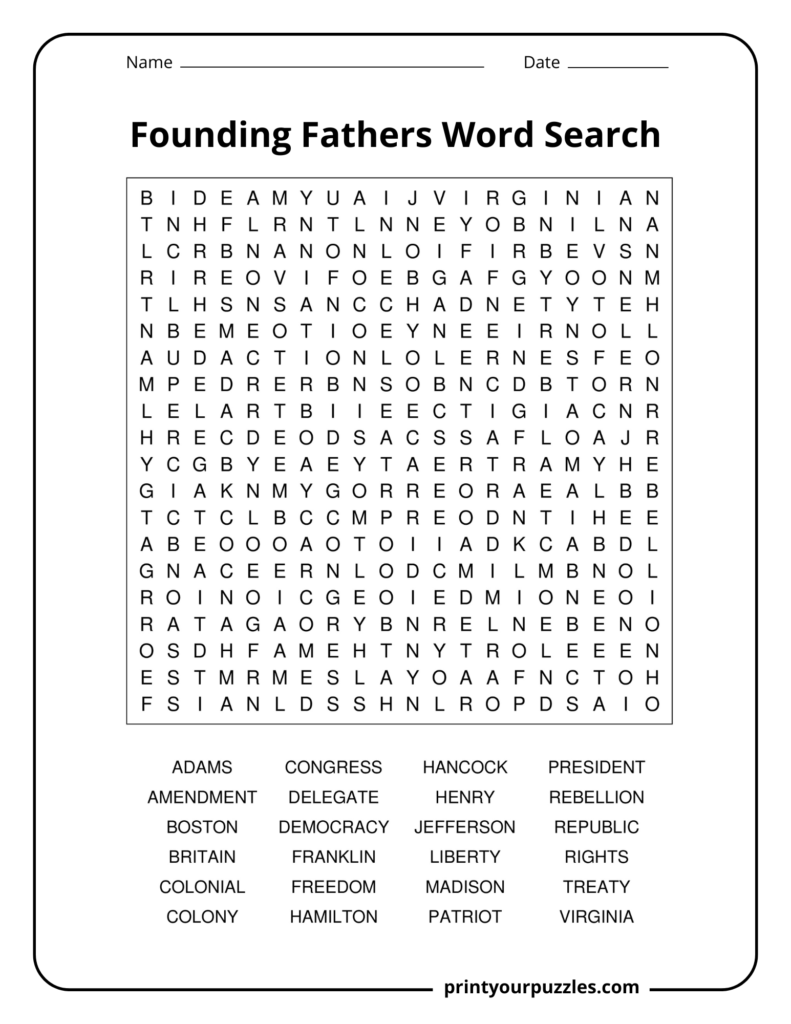
ADAMS, AMENDMENT, BOSTON, BRITAIN, COLONIAL, COLONY, CONGRESS, DELEGATE, DEMOCRACY, FRANKLIN, FREEDOM, HAMILTON, HANCOCK, HENRY, JEFFERSON, LIBERTY, MADISON, PATRIOT, PRESIDENT, REBELLION, REPUBLIC, RIGHTS, TREATY, VIRGINIA
The Founding Fathers include leaders who established American independence and government, notably George Washington, Thomas Jefferson, Benjamin Franklin, John Adams, James Madison, Alexander Hamilton, and John Hancock among others.