The 1929 Stock Market Crash was one of the most important economic events in United States history. It happened in late October 1929, after several years of rapid growth during the Roaring Twenties. Many Americans believed the stock market would continue rising forever, and thousands of people invested their savings in stocks. Some investors also bought shares “on margin,” which meant they used borrowed money to buy more stocks than they could normally afford. This created a dangerous situation because stock prices were rising faster than the real value of many companies.
The crisis became clear on October 24, 1929, known as Black Thursday, when panic spread through Wall Street and investors rushed to sell their shares. Although bankers tried to calm the market, fear continued to grow. A few days later, on October 29, 1929, known as Black Tuesday, the market suffered one of its worst collapses. Millions of shares were traded, prices fell sharply, and many people lost enormous amounts of money in only a few hours.
There was not one single cause of the crash. Several problems came together at the same time. Stock speculation, easy credit, weak banking rules, unequal wealth, overproduction by factories, and falling farm prices all helped create an unstable economy. When the market collapsed, the consequences reached far beyond New York. Banks failed, businesses closed, workers lost jobs, families lost savings, and confidence in the economy disappeared. The crash did not cause the Great Depression by itself, but it helped turn existing economic weaknesses into a deep and lasting crisis.
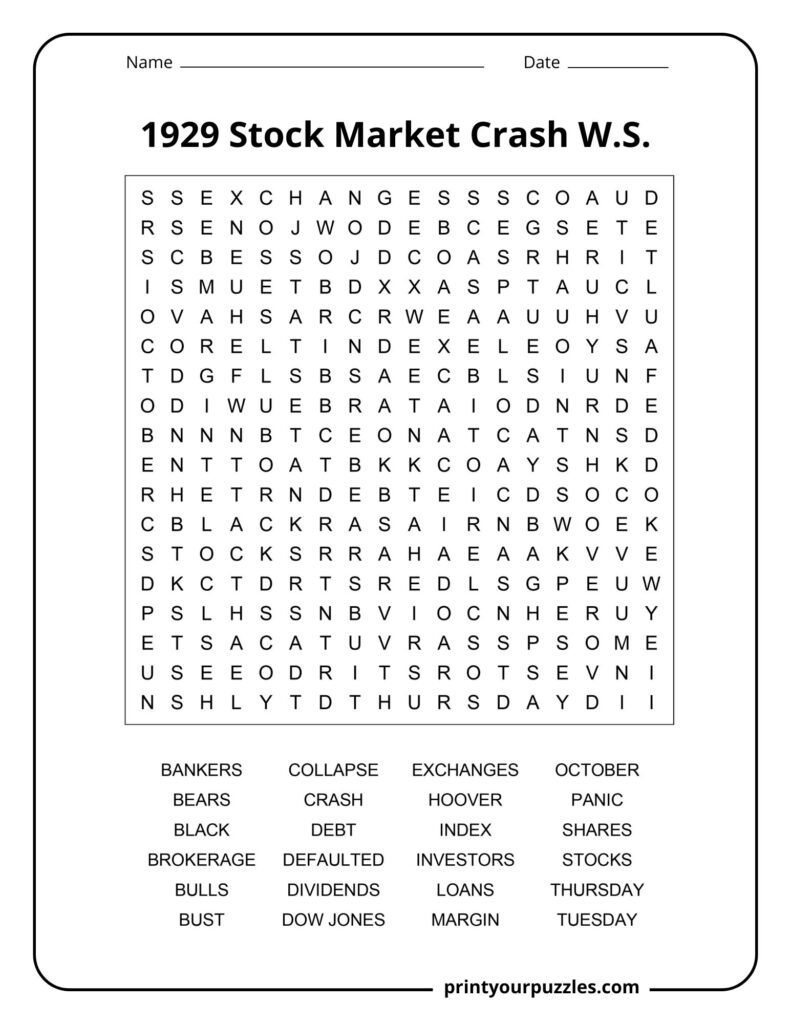
This 1929 Stock Market Crash Word Search gives students a simple and engaging way to explore this serious historical topic. As they search for vocabulary connected to investors, banks, panic, stocks, Wall Street, unemployment, and the Great Depression, they can begin to understand what happened, why it happened, and how it changed American life.
Using a 1929 Stock Market Crash word search also helps learners connect historical facts with important economic terms. It is a useful activity for classrooms, history lessons, or anyone studying how one financial event became a major turning point in the history of the United States.
Related Word Searches:
Great Depression | Roaring Twenties | New Deal | Gilded Age | Progressive Era | Pullman Strike
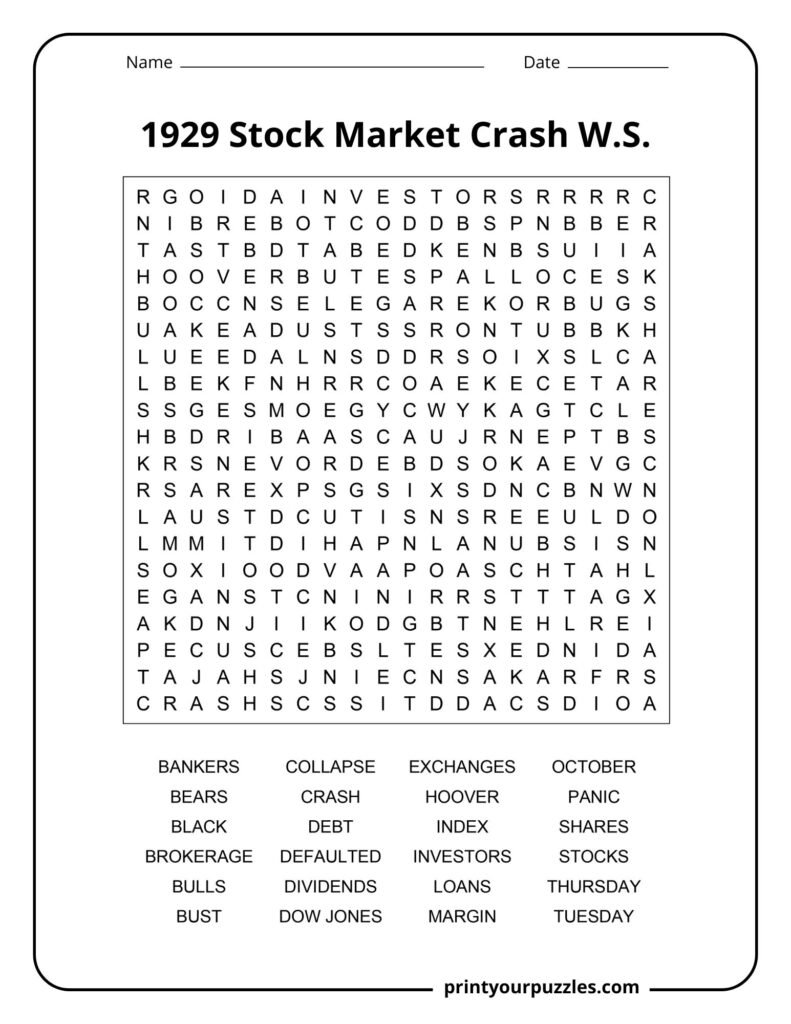
BANKERS, BEARS, BLACK, BROKERAGE, BULLS, BUST, COLLAPSE, CRASH, DEBT, DEFAULTED, DIVIDENDS, DOW JONES, EXCHANGES, HOOVER, INDEX, INVESTORS, LOANS, MARGIN, OCTOBER, PANIC SHARES, STOCKS, THURSDAY, TUESDAY
BANKERS – Financial professionals and institutions that managed investments and credit during the 1920s; some attempted to stabilize markets during the crash but ultimately failed to prevent economic collapse.
BEARS – Investors who anticipate falling stock prices and sell shares or short-sell, profiting from market declines; they dominated sentiment during the 1929 crash as optimism evaporated completely.
BLACK – Descriptor for the darkest days of the crash: Black Thursday (October 24) and Black Tuesday (October 29), when markets experienced devastating losses and widespread investor panic ensued.
BROKERAGE – Firms that facilitated stock purchases and sales for investors; many brokerage houses failed during the crash when clients couldn’t cover margin calls, devastating the entire financial system.
BULLS – Optimistic investors who expect rising stock prices and buy shares anticipating profits; they dominated the 1920s boom but were crushed when the market crashed in October.
BUST – The severe economic downturn following the speculative boom; the market bust in 1929 triggered bank failures, unemployment, and the devastating Great Depression that lasted
throughout the 1930s.
COLLAPSE – The catastrophic failure of stock market values in October 1929, when share prices plummeted rapidly, destroying billions in wealth and triggering a severe, prolonged economic depression worldwide.
CRASH – The sudden, severe drop in stock market prices beginning October 24, 1929, erasing fortunes overnight and marking the end of the prosperous Roaring Twenties economic era.
DEBT – Money borrowed by investors to purchase stocks on margin; excessive debt levels made the market vulnerable and intensified losses when prices fell, triggering widespread financial ruin.
DEFAULTED – Failed to repay loans or meet financial obligations; countless investors and institutions defaulted after the crash, unable to cover margin calls or honor debts, causing cascading failures.
DIVIDENDS – Payments distributed to shareholders from company profits; these dried up during the crash as corporate earnings plummeted, further reducing stock values and investor confidence in markets.
DOW JONES – The leading stock market index measuring thirty major industrial companies; it lost nearly ninety percent of its peak value between 1929 and 1932, reflecting economic devastation.
EXCHANGES – Organized marketplaces where stocks are traded,
primarily the New York Stock Exchange; overwhelmed by panic selling in October 1929, exchanges struggled to process unprecedented transaction volumes.
HOOVER – Herbert Hoover, U.S. President when the crash occurred; widely blamed for inadequate response to the crisis despite efforts to stabilize the economy through limited government intervention.
INDEX – Statistical measure tracking stock market performance; indexes plummeted during the crash, with the Dow Jones losing nearly half its value within weeks, signaling complete market collapse.
INVESTORS – Individuals and institutions purchasing stocks hoping for profits; many lost everything in the crash, particularly those who bought on margin and couldn’t cover their loans.
LOANS – Money borrowed for stock purchases, often through
margin accounts; when markets crashed, lenders demanded immediate repayment, forcing desperate selling that accelerated the catastrophic downward spiral.
MARGIN – Buying stocks with borrowed money, paying only a fraction upfront; widespread margin buying in the 1920s amplified the crash when brokers issued margin calls investors couldn’t meet.
OCTOBER – The fateful month in 1929 when the stock market crashed; October 24 (Black Thursday) and October 29 (Black Tuesday) marked history’s most devastating financial collapse.
PANIC – Mass fear driving frenzied selling as investors desperately tried escaping losses; panic intensified throughout October 1929, overwhelming markets and destroying confidence in the financial system completely.
SHARES – Units of stock ownership in corporations; share values plummeted during the crash, with some becoming worthless as companies failed, wiping out investors’ savings and retirement funds.
STOCKS – Ownership stakes in companies traded on exchanges; stock values soared unrealistically during the 1920s boom, then collapsed spectacularly in 1929, triggering economic depression and widespread hardship.
THURSDAY – Black Thursday, October 24, 1929, when panic selling began; nearly thirteen million shares traded as prices collapsed, though the worst devastation came the following Tuesday.
TUESDAY – Black Tuesday, October 29, 1929, the most catastrophic day; sixteen million shares traded, prices collapsed completely, and the market lost billions, marking the depression’s true beginning.
BANKERS, BEARS, BLACK, BROKERAGE, BULLS, BUST, COLLAPSE, CRASH, DEBT, DEFAULTED, DIVIDENDS, DOW JONES, EXCHANGES, HOOVER, INDEX, INVESTORS, LOANS, MARGIN, OCTOBER, PANIC SHARES, STOCKS, THURSDAY, TUESDAY