
The Great Depression was a severe economic crisis that began in 1929 and affected the United States and many other parts of the world throughout the 1930s. It changed the lives of millions of people, closed banks and businesses, created widespread unemployment, and forced families to struggle with poverty, hunger, and uncertainty.
The crisis did not have only one cause. The 1929 Stock Market Crash damaged confidence in the economy and caused many investors to lose money, but deeper problems already existed. Banks were weak, many people and businesses had too much debt, factories produced more goods than people could buy, farmers faced low prices, and wealth was unevenly distributed.
When these problems came together, the economy began to collapse. Bank failures made the situation even worse. Many people lost their savings when banks closed, and businesses had trouble getting the money they needed to survive. As companies failed or reduced production, millions of workers lost their jobs.
Daily life during the Great Depression was difficult for many Americans. Breadlines and soup kitchens helped feed people who had no income. Some families lost their homes and moved into shantytowns often called Hoovervilles, named after President Herbert Hoover. Children, parents, farmers, and workers all felt the effects of the crisis in different ways.
The Dust Bowl added another layer of hardship. During the 1930s, drought, dust storms, and damaged farmland devastated parts of the Great Plains. Many farm families left their homes and traveled west, especially toward California, looking for jobs and a better life.
President Franklin D. Roosevelt responded with the New Deal, a series of programs designed to provide relief, create jobs, reform banks, and help the economy recover. The Great Depression changed how many Americans thought about government, work, security, and economic responsibility.
This Great Depression word search helps students review vocabulary connected to unemployment, banks, breadlines, Dust Bowl, New Deal, Roosevelt, jobs, poverty, crisis, and recovery. A Great Depression word search can make this difficult period easier to understand through key terms and historical connections.
Related Word Searches:
1929 Stock Market Crash | New Deal | Franklin D. Roosevelt | Roaring Twenties | Dust Bowl | Progressive Era
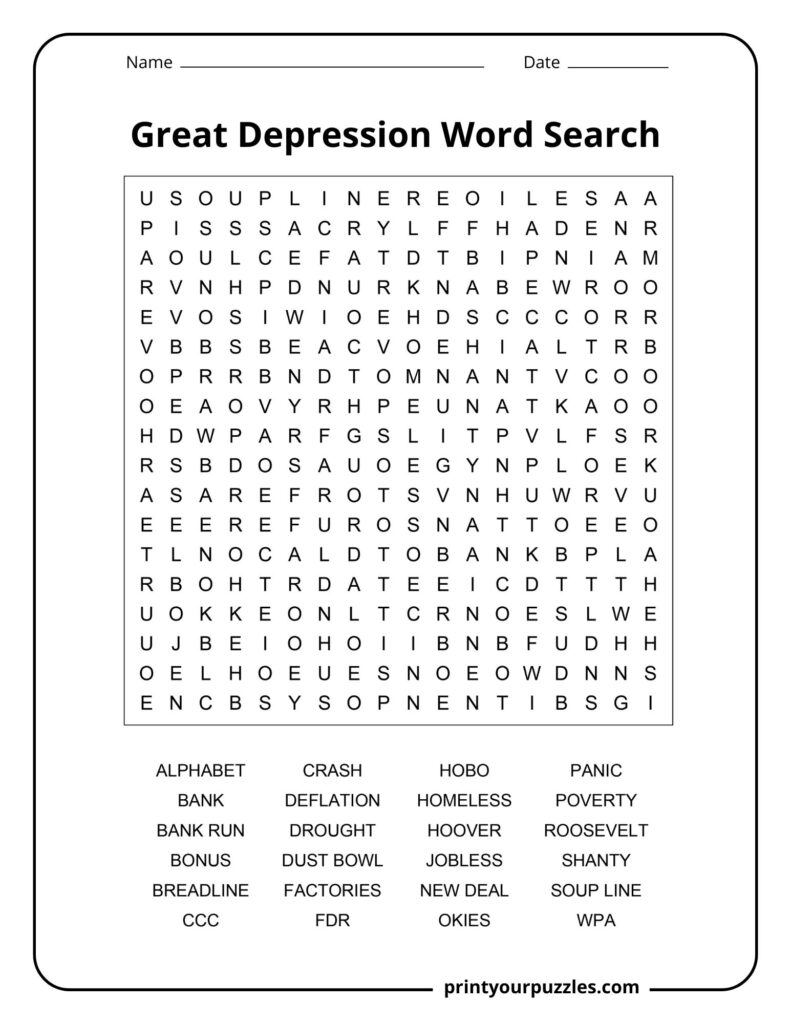
ALPHABET, BANK, BANK RUN, BONUS, BREADLINE, CCC, CRASH, DEFLATION, DROUGHT, DUST BOWL, FACTORIES, FDR, HOBO, HOMELESS, HOOVER, JOBLESS, NEW DEAL, OKIES, PANIC, POVERTY, ROOSEVELT, SHANTY, SOUP LINE, WPA
ALPHABET – Nickname for the numerous New Deal agencies created during the Great Depression, identified by their initials like CCC, WPA, and TVA, designed to provide relief and recovery.
BANK – Financial institutions that held people’s savings and provided loans. Thousands failed during the Depression, causing people to lose their life savings and deepening the economic crisis.
BANK RUN – Mass panic when depositors simultaneously rushed to withdraw their money from banks, fearing institutional failure. This often caused banks to collapse as they couldn’t meet withdrawal demands.
BONUS – Refers to the Bonus Army, World War I veterans who marched on Washington in 1932 demanding early payment of promised military bonuses during their desperate economic circumstances.
BREADLINE – Long queues of unemployed and hungry people waiting to receive free bread and food from charitable organizations, churches, or government agencies during the widespread economic hardship.
CCC – Civilian Conservation Corps, a New Deal program employing young men in environmental projects like planting trees, building parks, and preventing soil erosion while providing wages and meals.
CRASH – The catastrophic stock market collapse of October 1929, when stock prices plummeted dramatically, wiping out investors’ fortunes and triggering the devastating economic depression that followed.
DEFLATION – Economic condition where prices continuously fall due to reduced consumer spending and demand. While seemingly positive, it discouraged business investment and worsened unemployment during the Depression.
DROUGHT – Severe, prolonged dry weather conditions that devastated American farmlands during the 1930s, particularly affecting the Great Plains and contributing to agricultural collapse and migration.
DUST BOWL – Ecological disaster in the Great Plains where drought, poor farming practices, and high winds created massive dust storms, destroying crops and forcing families to abandon farms.
FACTORIES – Manufacturing plants and industrial facilities that closed or drastically reduced operations during the Depression, laying off millions of workers and devastating communities dependent on industrial employment.
FDR – Franklin Delano Roosevelt, the thirty-second president who led America through the Great Depression, implementing the New Deal programs and restoring hope to desperate citizens.
HOBO – Homeless wanderer who traveled illegally on freight trains searching for work and survival opportunities. Thousands became hobos during the Depression, creating a distinct transient culture.
HOMELESS – Millions of Americans who lost their homes due to unemployment, evictions, and foreclosures. Many lived in shantytowns, abandoned buildings, or on the streets during this period.
HOOVER – Herbert Hoover, president when the Depression began. Criticized for inadequate response to the crisis, his name became associated with Depression-era hardships like “Hoovervilles” for shantytowns.
JOBLESS – Unemployed workers who lost their positions when businesses failed. At the Depression’s peak, approximately twenty-five percent of American workers were jobless, creating unprecedented economic suffering.
NEW DEAL – Franklin D. Roosevelt’s comprehensive program of economic reforms, relief efforts, and public works projects designed to rescue America from the Great Depression and prevent future crises.
OKIES – Nickname for displaced farmers and families, particularly from Oklahoma, who migrated westward to California seeking work after the Dust Bowl destroyed their farms and livelihoods.
PANIC – Widespread fear and anxiety about economic collapse that caused people to make desperate financial decisions, like withdrawing savings from banks, which actually worsened the economic crisis.
POVERTY – Extreme economic hardship experienced by millions who lacked money for basic necessities like food, shelter, and clothing. The Depression pushed unprecedented numbers into destitution and desperation.
ROOSEVELT – Franklin Delano Roosevelt, elected president in 1932, who inspired hope through his leadership, radio “fireside chats,” and bold New Deal programs that gradually restored economic stability.
SHANTY – Makeshift dwelling constructed from scrap materials like cardboard, wood, and metal. Thousands of homeless families built shanties in “Hoovervilles” on the outskirts of American cities.
SOUP LINE – Queue where unemployed and destitute people waited to receive free soup and meals from charitable organizations, symbolizing the widespread hunger and desperation of the Depression era.
WPA – Works Progress Administration, a major New Deal agency that employed millions of Americans in public works projects including building roads, bridges, schools, and creating art and cultural programs.
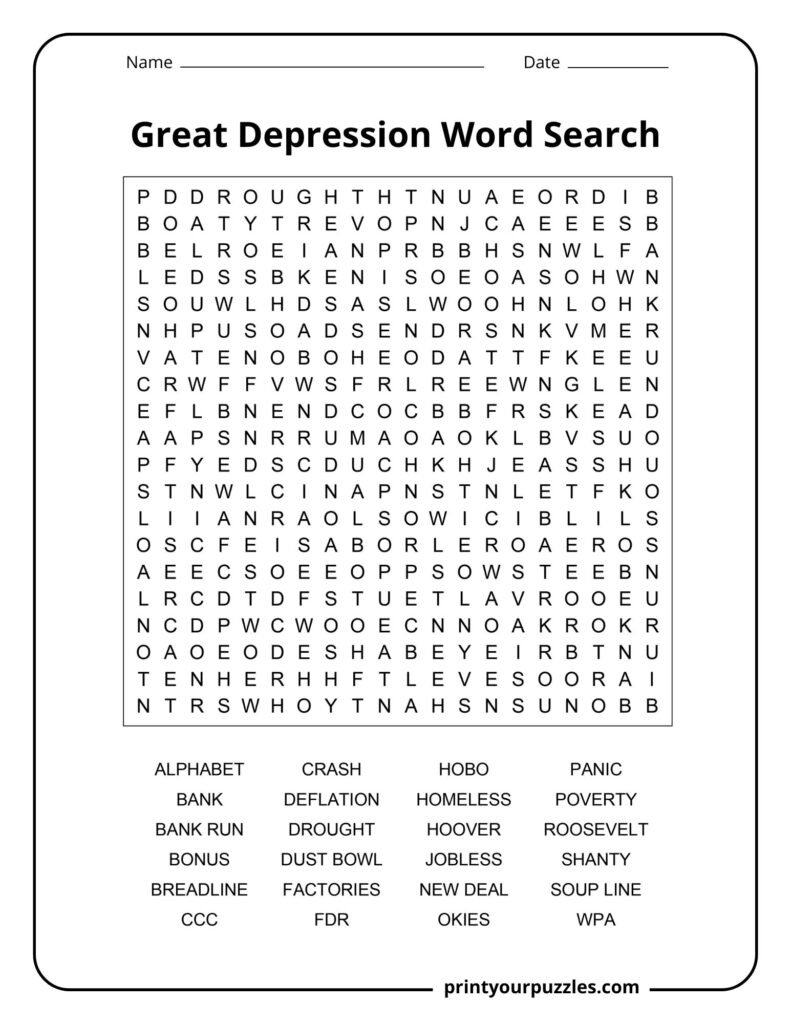
ALPHABET, BANK, BANK RUN, BONUS, BREADLINE, CCC, CRASH, DEFLATION, DROUGHT, DUST, BOWL, FACTORIES, FDR, HOBO, HOMELESS, HOOVER, JOBLESS, NEW DEAL, OKIES, PANIC, POVERTY, ROOSEVELT, SHANTY, SOUP LINE, WPA
The 1929 stock market crash, combined with bank failures, reduced consumer spending, drought conditions, and poor economic policies, triggered the Great Depression. Overproduction and wealth inequality also contributed significantly.
The Great Depression began with the stock market crash in October 1929 and lasted throughout the 1930s. The economy gradually recovered, with World War II finally ending it.
Millions lost jobs, homes, and savings. Unemployment reached twenty-five percent. Families faced hunger, homelessness, and desperation. Breadlines and soup kitchens became common as people struggled to survive daily.
The New Deal was Roosevelt’s comprehensive program of government initiatives, public works projects, financial reforms, and relief programs designed to rescue America from economic collapse and provide jobs.
The Dust Bowl was an ecological disaster affecting the Great Plains, where severe drought and poor farming practices created massive dust storms, destroying crops and forcing farming families westward.
Charles Darrow created Monopoly in 1935, offering escapist fantasy of wealth and property ownership. The game’s success during hard times made it America’s best-selling board game.
Resourceful families recycled flour and feed sacks into clothing. Manufacturers responded by printing colorful patterns on sacks, transforming necessity into fashionable, affordable garments for struggling families.
Over 25,000 miniature golf courses opened nationwide by 1930. The inexpensive entertainment provided affordable recreation when families couldn’t afford expensive leisure activities or vacations during hard times.
Young couples postponed weddings because they couldn’t afford to start families. Birth rates also declined dramatically as people feared bringing children into such uncertain economic circumstances.
Shantytowns built from scrap materials were nicknamed “Hoovervilles” to mock President Hoover. The largest in Seattle housed 1,200 residents with their own mayor and sanitation rules.