
Herbert Hoover (1929–1933) entered the presidency with a reputation for intelligence, organization, and humanitarian service. Before Americans associated his name with the Great Depression, many admired him as a successful engineer, public administrator, and relief leader who had helped feed millions of people during and after World War I. That earlier reputation makes his presidency especially tragic. The Herbert Hoover word search gives students a way to explore a leader whose skills seemed impressive in ordinary times but were severely tested by economic disaster.
At first, Hoover’s future looked bright. He won the election of 1928 during a period of business confidence, consumer excitement, and stock market growth. Many Americans believed prosperity would continue. But in October 1929, only months after he took office, the stock market crashed. The crash did not cause every part of the Great Depression by itself, but it became a powerful symbol of the economic collapse that followed.
Banks failed. Businesses closed. Farms suffered. Unemployment rose to frightening levels. Families lost savings, homes, and hope. Hoover believed deeply in individual effort, voluntary cooperation, and local responsibility. He encouraged businesses, charities, and state governments to respond, but he was reluctant to use massive direct federal relief at first. As the crisis worsened, many Americans felt that his response was too limited for the scale of the emergency.
Hoover did take some federal action. His administration supported public works projects, including the Hoover Dam, and created the Reconstruction Finance Corporation to lend money to banks, railroads, and other institutions. He also signed the Smoot-Hawley Tariff, which was meant to protect American businesses but is often criticized for worsening international trade problems during the depression.
Public anger grew as hardship spread. Shantytowns of unemployed people became known as “Hoovervilles,” a harsh sign of how badly his reputation had fallen. The Bonus Army incident in 1932 damaged him further, when World War I veterans gathered in Washington, D.C., to demand early payment of a promised bonus and the federal response ended in violence and outrage.
This Herbert Hoover word search examines economic collapse, leadership, public works, banking, tariffs, unemployment, Hoovervilles, and the limits of government action before the New Deal. Hoover’s presidency shows how quickly a leader’s reputation can change when a national crisis overwhelms older ideas about how government should respond.
Keep learning about the presidents connected to the Great Depression era with our Calvin Coolidge word search, Franklin D. Roosevelt word search, Harry S. Truman word search, and the full US Presidents Word Searches collection.
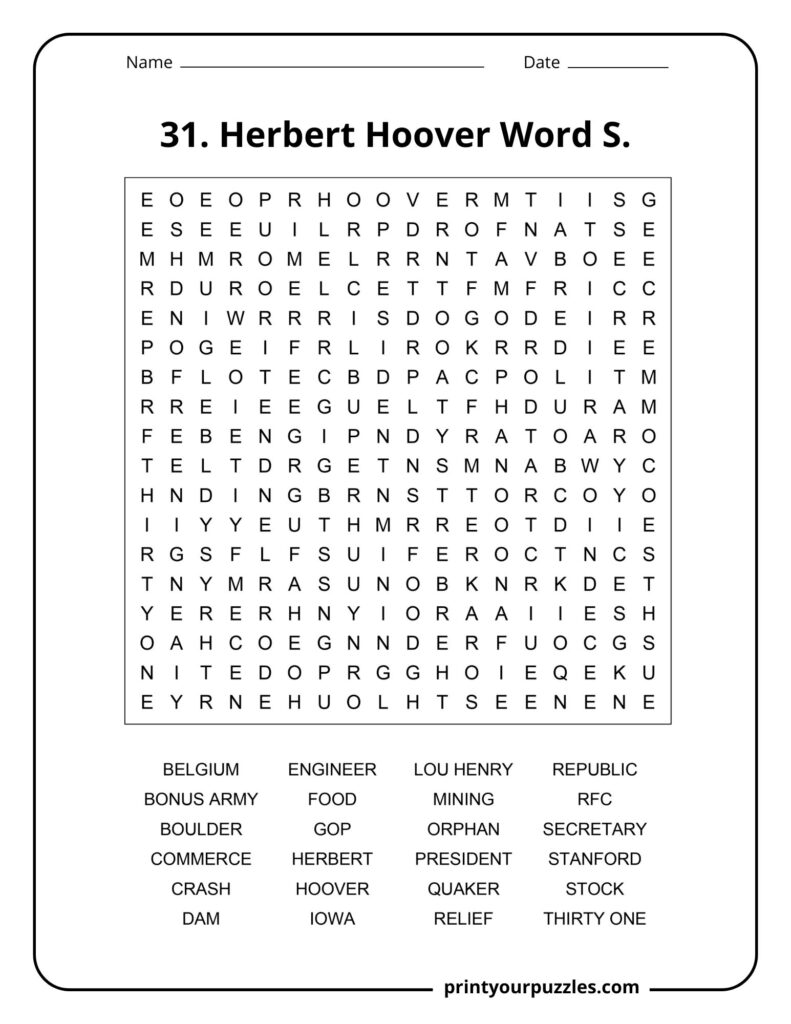
BELGIUM, BONUS ARMY, BOULDER, COMMERCE, CRASH, DAM, ENGINEER, FOOD, GOP, HERBERT, HOOVER, IOWA, LOU HENRY, MINING, ORPHAN, PRESIDENT, QUAKER, RELIEF, REPUBLIC, RFC, SECRETARY, STANFORD, STOCK, THIRTY ONE
BELGIUM – Country where Hoover organized massive humanitarian food relief during World War I, feeding millions of starving civilians and earning international acclaim for his efforts.
BONUS ARMY – The 1932 protest of approximately 43,000 WWI veterans and families who camped in Washington demanding early payment of service certificates, controversially dispersed by troops.
BOULDER – Originally named Boulder Dam, later renamed Hoover Dam, the massive Colorado River project authorized during his presidency to provide power and water resources.
COMMERCE – Cabinet position Hoover held as Secretary of Commerce under Presidents Harding and Coolidge from 1921-1928, modernizing the department before his presidential run.
CRASH – The October 1929 stock market crash that occurred eight months into Hoover’s presidency, triggering the Great Depression and defining his administration’s greatest challenge.
DAM – Refers to Hoover Dam, the monumental engineering project on the Colorado River begun during his presidency, creating Lake Mead and generating hydroelectric power.
ENGINEER – Hoover’s profession before politics; he was a highly successful mining engineer who worked internationally and became wealthy through his technical expertise and business.
FOOD – References Hoover’s role as U.S. Food Administrator during WWI and his extensive international humanitarian food relief operations in Europe saving millions from starvation.
GOP – The Republican Party (Grand Old Party) that Hoover represented as president from 1929-1933, maintaining traditional conservative economic policies during the Depression.
HERBERT – Hoover’s first name; Herbert Clark Hoover was born in 1874 in Iowa and became the 31st President of the United States in 1929.
HOOVER – His surname and presidential legacy name, becoming synonymous with Depression-era hardship through terms like “Hoovervilles” for shantytown settlements of homeless people.
IOWA – Hoover’s birth state; he was born in West Branch, Iowa in 1874, making him the first president born west of the Mississippi River.
LOU HENRY – Lou Henry Hoover, his wife and First Lady, a Stanford graduate, geologist, linguist, and active advocate for women’s athletics and Girl Scouts.
MINING – Hoover’s engineering specialization; he became a wealthy international mining engineer and consultant, working on projects across five continents before entering public service.
ORPHAN – Hoover became an orphan by age nine, losing his father in 1880 and mother in 1884, then raised by Quaker relatives in Iowa and Oregon.
PRESIDENT – The office Hoover held from 1929-1933 as America’s 31st president, serving during the Great Depression and losing reelection to Franklin D. Roosevelt.
QUAKER – The Religious Society of Friends faith Hoover practiced throughout his life, which influenced his humanitarian values, pacifist leanings, and commitment to public service.
RELIEF – Hoover’s specialty in humanitarian aid; he directed massive relief operations feeding millions in Belgium, post-war Europe, and Soviet Russia during his pre-presidential career.
REPUBLIC – Short for Republican, the political party Hoover belonged to, representing traditional conservative values of limited government intervention and business-friendly policies during his presidency.
RFC – The Reconstruction Finance Corporation, established by Hoover in 1932 to provide emergency loans to banks, railroads, and businesses struggling during the Great Depression.
SECRETARY – Refers to Secretary of Commerce, the cabinet position Hoover held for seven years before becoming president, where he expanded the department’s influence significantly.
STANFORD – Stanford University in California, where Hoover studied geology in its inaugural class, graduated in 1895, and maintained lifelong connections with the institution.
STOCK – Refers to the stock market, whose catastrophic crash in October 1929 just months into Hoover’s presidency triggered the economic collapse of the Depression.
THIRTY ONE – Hoover’s numerical presidential position as the 31st President of the United States, serving one term from March 1929 to March 1933 during economic crisis.
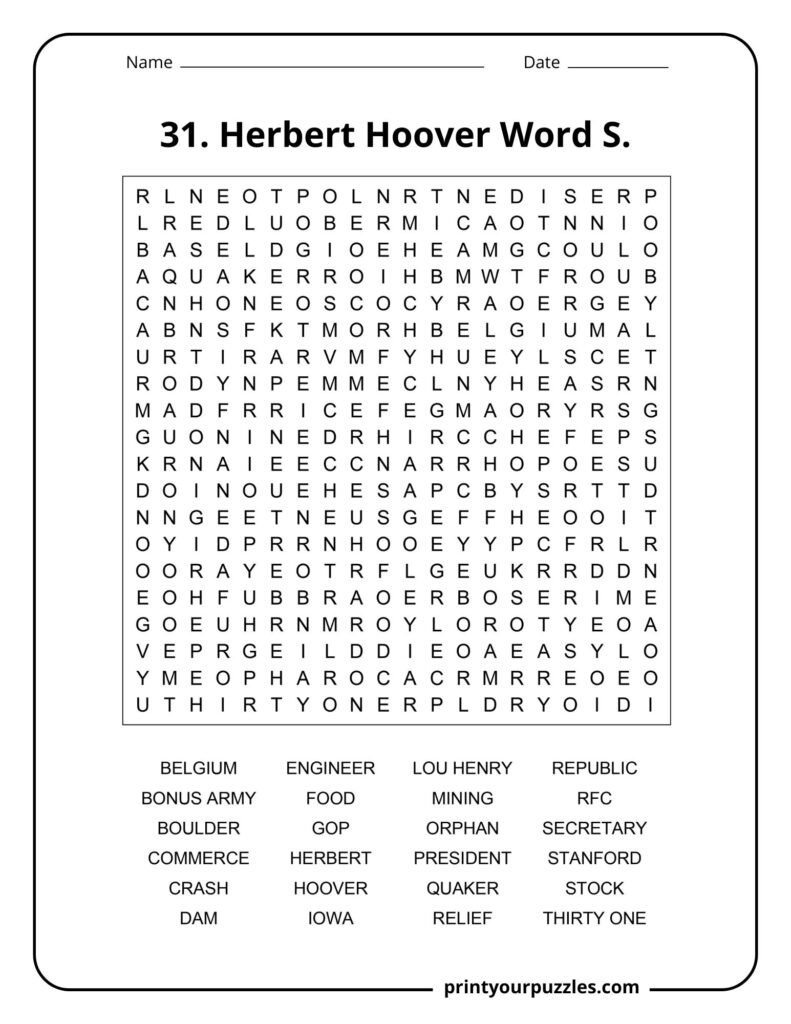
BELGIUM, BONUS ARMY, BOULDER, COMMERCE, CRASH, DAM, ENGINEER, FOOD, GOP, HERBERT, HOOVER, IOWA, LOU HENRY, MINING, ORPHAN, PRESIDENT, QUAKER, RELIEF, REPUBLIC, RFC, SECRETARY, STANFORD, STOCK, THIRTY ONE
Hoover was a successful mining engineer and humanitarian who organized massive food relief operations during World War I, feeding millions in Belgium and post-war Europe, earning international fame.
The stock market crashed eight months into Hoover’s presidency in October 1929. His limited government intervention approach and optimistic public statements seemed inadequate as economic conditions worsened dramatically.
Hoover established the Reconstruction Finance Corporation (RFC) to provide emergency loans to struggling institutions and authorized the Boulder Dam project, demonstrating his commitment to infrastructure and economic recovery.
Orphaned by age nine, Hoover was raised by Quaker relatives in modest circumstances. These experiences instilled strong work ethic, self-reliance, humanitarian values, and commitment to public service.
After Franklin Roosevelt’s landslide victory, Hoover remained active in public service, writing extensively, advising presidents, and continuing humanitarian work until his death in 1964 at age ninety.
For official administration records and historical biography, visit the Herbert Hoover page in the White House Archives. If you are looking for archival records, visit the official Herbert Hoover Presidential Library.
Herbert Hoover in the White House: The Ordeal of the Presidency by Charles Rappleye. Shows how a brilliant humanitarian was paralyzed by the Great Depression, offering a nuanced look at a president crushed by circumstances.
The Hoovers learned Chinese while living in China during the Boxer Rebellion. They often spoke Mandarin in the White House to hold private conversations and prevent eavesdropping.
Already wealthy from his engineering career, Hoover refused his $75,000 annual presidential salary, donating it entirely to charitable causes throughout his four years in office for public service.
Hoover went directly from appointed cabinet positions to the presidency in 1929, making him one of few presidents without prior experience in elected political office or military leadership.
Hoover and his wife Lou translated Georgius Agricola’s “De Re Metallica” from Latin to English, a scholarly achievement demonstrating their expertise in mining engineering and classical education.
During the Depression, homeless encampments across America were mockingly called “Hoovervilles,” reflecting public anger at perceived government inaction. Empty pockets were called “Hoover flags” and newspapers “Hoover blankets.”