Introduction to the Franklin D. Roosevelt Word Search
Franklin D. Roosevelt (1933–1945) became president when millions of Americans were asking whether the country could recover from the Great Depression. Banks were failing, unemployment was widespread, farms and businesses were struggling, and confidence in the future had collapsed. Roosevelt answered that fear with action, communication, and a willingness to expand the role of the federal government. The Franklin D. Roosevelt word search gives students a way to explore a president whose leadership reshaped modern America.
Roosevelt came from a wealthy New York family and had already served as a state senator, assistant secretary of the navy, vice-presidential candidate, and governor of New York. His personal story also included a major challenge: in 1921, he was struck by polio, which left him unable to walk without assistance. Although he carefully managed his public image, his determination became an important part of how many Americans understood his character.
The New Deal became the central domestic achievement of his presidency. Roosevelt’s administration created programs and agencies designed to provide relief, recovery, and reform. Social Security, banking regulation, public works projects, rural electrification, job programs, and protections for workers all changed the relationship between citizens and the federal government. Supporters saw these efforts as necessary responses to emergency conditions. Critics argued that the New Deal gave Washington too much power.
Roosevelt also changed how presidents communicated. Through his radio “fireside chats,” he spoke directly to Americans in a calm and personal style. These broadcasts helped explain government actions, reduce fear, and rebuild public trust during uncertain times. His voice became part of how many families experienced the crises of the 1930s and 1940s.
His presidency later became dominated by World War II. After the Japanese attack on Pearl Harbor in 1941, the United States entered the war against Japan, Germany, and Italy. Roosevelt helped lead the Allied effort, worked closely with Winston Churchill and Joseph Stalin, and supported planning for the United Nations. He did not live to see the war’s end, dying in April 1945 during his fourth term.
This Franklin D. Roosevelt word search examines the Great Depression, the New Deal, Social Security, fireside chats, Pearl Harbor, World War II, and the growth of federal power. Roosevelt’s presidency shows how crisis can transform both a nation and the office of the president itself.
Continue through the Great Depression and World War II years with our Herbert Hoover word search, Harry S. Truman word search, Dwight D. Eisenhower word search, and the full US Presidents Word Searches collection.
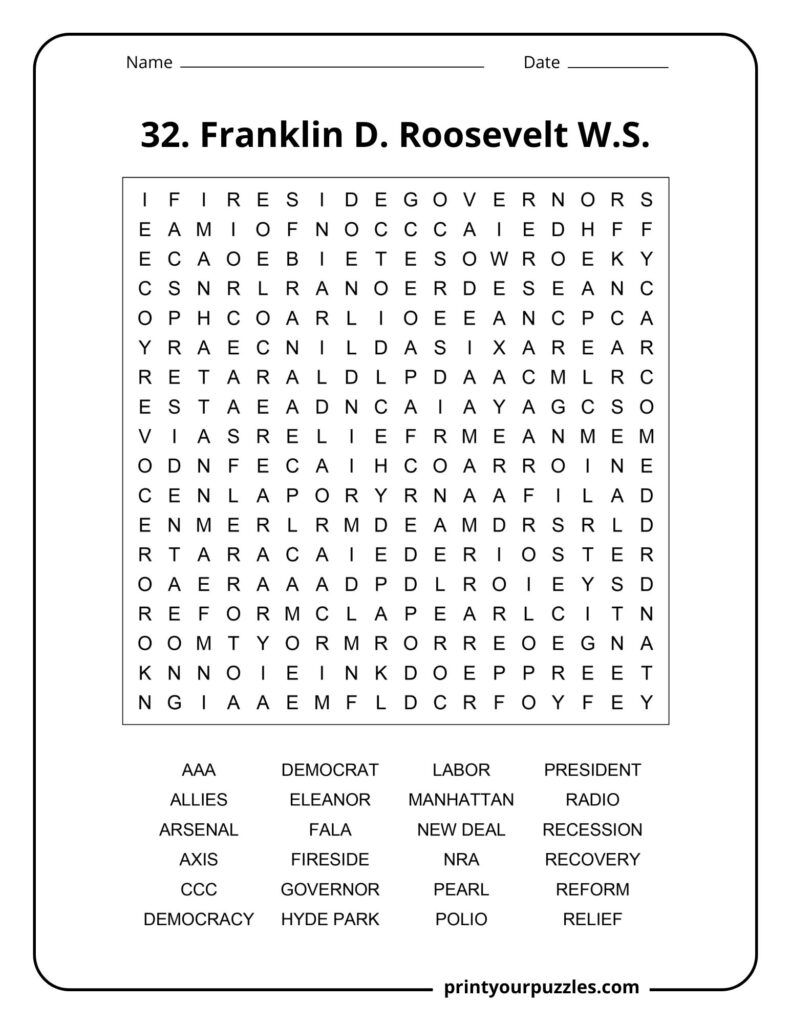
Medium Difficulty Word Search
Words to Find:
AAA, ALLIES, ARSENAL, AXIS, CCC, DEMOCRACY, DEMOCRAT, ELEANOR, FALA, FIRESIDE, GOVERNOR, HYDE PARK, LABOR, MANHATTAN, NEW DEAL, NRA, PEARL, POLIO, PRESIDENT, RADIO, RECESSION, RECOVERY, REFORM, RELIEF
All Words Defined
AAA – Agricultural Adjustment Act, a New Deal program designed to boost agricultural prices by reducing crop surpluses through paying farmers to decrease production and acreage.
ALLIES – The Allied powers including Britain, Soviet Union, and China that fought alongside the United States against Axis powers during World War Two under Roosevelt’s leadership.
ARSENAL – Reference to “Arsenal of Democracy,” Roosevelt’s term describing America’s role supplying military equipment and materials to Allied nations fighting fascism before entering World War Two.
AXIS – The Axis powers, primarily Germany, Italy, and Japan, that formed the opposing alliance against the United States and Allies during World War Two under Roosevelt.
CCC – Civilian Conservation Corps, a New Deal program employing young men in environmental conservation projects, planting trees, building parks, and fighting soil erosion across America.
DEMOCRACY – The system of representative government that Roosevelt defended against fascism and totalitarianism during the Great Depression and throughout World War Two’s global conflict.
DEMOCRAT – Roosevelt’s political party affiliation; he served as the Democratic Party’s standard-bearer, winning four consecutive presidential elections from nineteen thirty-two through nineteen forty-four.
ELEANOR – Eleanor Roosevelt, Franklin’s wife and First Lady, who became a prominent activist, diplomat, and advocate for civil rights, human rights, and social justice.
FALA – Roosevelt’s beloved Scottish Terrier, a famous presidential pet who accompanied him frequently and became subject of the humorous “Fala speech” defending against Republican attacks.
FIRESIDE – Roosevelt’s fireside chats were informal radio broadcasts where he spoke directly to Americans, explaining policies and providing reassurance during the Depression and World War Two.
GOVERNOR – Roosevelt served as New York’s Governor from nineteen twenty-nine to nineteen thirty-three, implementing progressive reforms before becoming president during the Great Depression.
HYDE PARK – Roosevelt’s family estate and home in New York’s Hudson Valley, where he was born, lived, and is buried alongside Eleanor Roosevelt.
LABOR – Roosevelt supported labor unions and workers’ rights, signing legislation protecting collective bargaining and establishing minimum wage, maximum hours, and workplace safety standards.
MANHATTAN – The Manhattan Project was the secret wartime program Roosevelt authorized to develop atomic weapons, ultimately producing the bombs used against Japan in August nineteen forty-five.
NEW DEAL – Roosevelt’s comprehensive domestic program of relief, recovery, and reform legislation designed to combat the Great Depression through government intervention and economic stimulus.
NRA – National Recovery Administration, a New Deal agency promoting fair competition codes, minimum wages, and maximum hours to stimulate economic recovery during the Depression years.
PEARL – Pearl Harbor, the Hawaiian naval base attacked by Japan on December seventh, nineteen forty-one, prompting Roosevelt’s “date which will live in infamy” speech.
POLIO – Poliomyelitis, the paralyzing disease Roosevelt contracted in nineteen twenty-one at age thirty-nine, which left him unable to walk without assistance for life.
PRESIDENT – Roosevelt served as America’s thirty-second president for unprecedented four terms from nineteen thirty-three until his death in April nineteen forty-five during wartime.
RADIO – The medium Roosevelt mastered for communication,
delivering fireside chats and speeches that reached millions of Americans directly in their homes nationwide.
RECESSION – The economic downturn of nineteen thirty-seven to nineteen thirty-eight occurred during Roosevelt’s presidency when he reduced government spending, temporarily reversing New Deal recovery gains.
RECOVERY – The economic recovery component of Roosevelt’s New Deal focused on reviving businesses, creating jobs, and restoring financial stability after the Great Depression’s devastating collapse.
REFORM – The reform element of Roosevelt’s New Deal aimed at preventing future economic crises through financial regulation, social insurance programs, and government oversight reforms.
RELIEF – The relief aspect of Roosevelt’s New Deal provided immediate assistance to unemployed and suffering Americans through direct aid, public works jobs, and emergency programs.
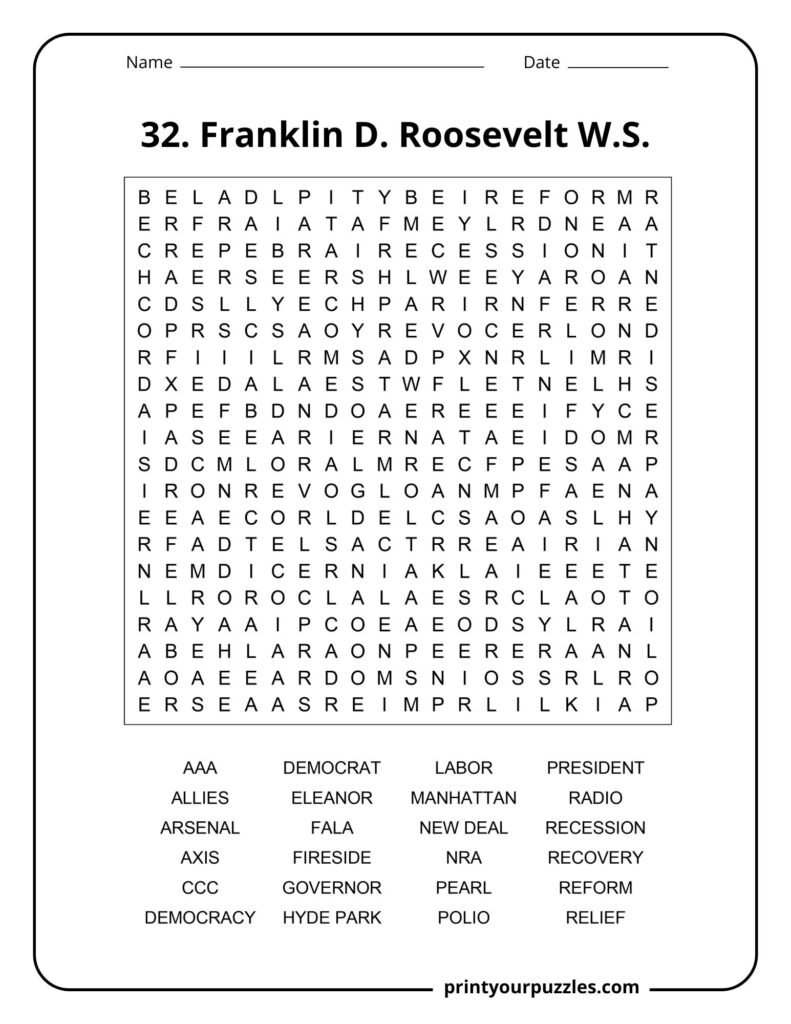
Hard Difficulty Word Search
Words to Find:
AAA, ALLIES, ARSENAL, AXIS, CCC, DEMOCRACY, DEMOCRAT, ELEANOR, FALA, FIRESIDE, GOVERNOR, HYDE PARK, LABOR, MANHATTAN, NEW DEAL, NRA, PEARL, POLIO, PRESIDENT, RADIO, RECESSION, RECOVERY, REFORM, RELIEF
7 Key FAQs About Franklin D. Roosevelt
5 Curious "Did You Know?" Facts About Franklin D. Roosevelt