
Calvin Coolidge (1923–1929) became president without noise or drama. After Warren G. Harding died in 1923, Coolidge took the oath of office in a small Vermont farmhouse, with his father, a local official, administering it by lamplight. That simple scene matched much of Coolidge’s public image: modest, restrained, serious, and cautious about the power of government. The Calvin Coolidge word search gives students a way to explore a president closely connected with the business confidence and cultural changes of the 1920s.
Coolidge built his career through steady political service rather than personal showmanship. He worked as a lawyer in Massachusetts, served in local and state offices, became governor, and later became vice president. His reputation grew after the Boston Police Strike of 1919, when he supported law and order during a tense labor conflict. Many Americans saw him as calm, firm, and dependable.
His presidency took place during a period often remembered for economic growth, consumer culture, jazz, automobiles, radios, movies, advertising, and a booming stock market. Coolidge believed that the federal government should generally keep taxes low, reduce spending, and allow business to expand with limited interference. His approach fit the pro-business mood of the decade. Supporters credited him with encouraging prosperity and stability.
Yet the prosperity of the 1920s was not shared equally. Farmers struggled with low prices and debt, many workers faced insecurity, and wealth became increasingly concentrated. Coolidge’s limited-government philosophy meant that he did not support large federal programs to solve these problems. This makes his presidency important for understanding both the excitement and the weaknesses of the decade before the Great Depression.
Coolidge also supported immigration restrictions that reflected the prejudice and fear of newcomers common in the period. At the same time, his administration dealt with foreign debts, arms agreements, and efforts to maintain peace after World War I. He chose not to run again in 1928, leaving office before the stock market crash changed the nation’s direction.
This Calvin Coolidge word search looks at restraint, tax cuts, business growth, consumer culture, immigration, farmers, and the Roaring Twenties. Coolidge’s presidency shows how a quiet leader could represent an entire era of confidence, caution, and hidden economic risk.
Explore more presidents from the years before the Great Depression with our Warren G. Harding word search, Herbert Hoover word search, Harry S. Truman word search, and the full US Presidents Word Searches collection.
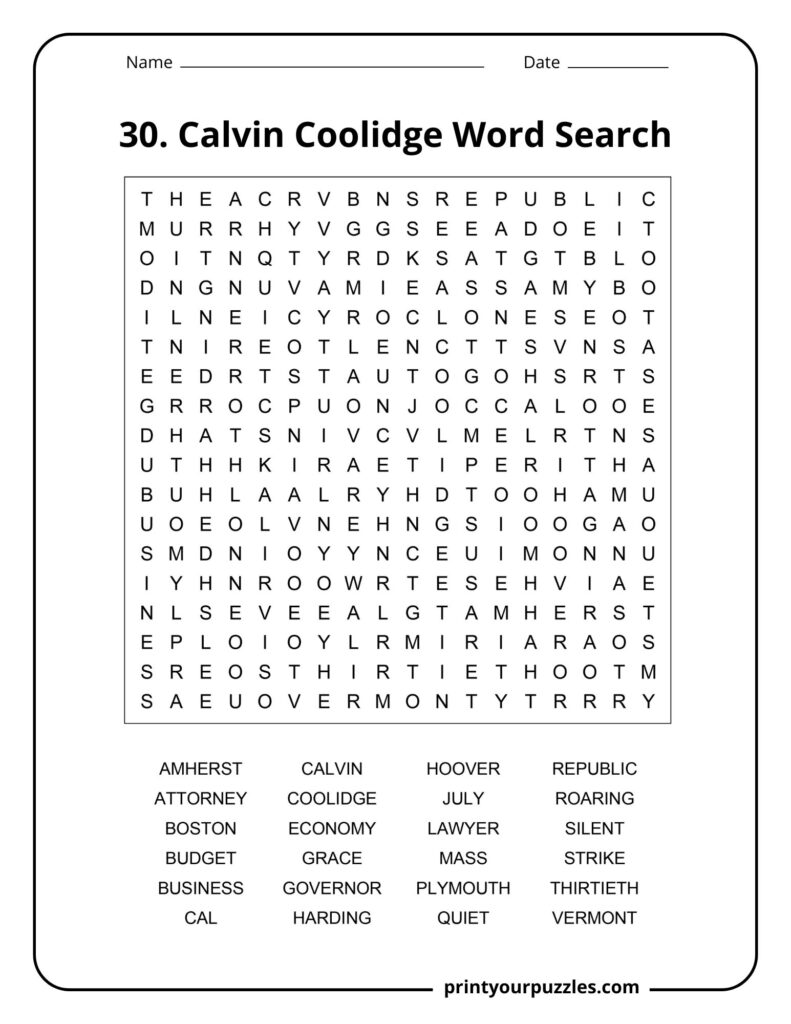
AMHERST, ATTORNEY, BOSTON, BUDGET, BUSINESS, CAL, CALVIN, COOLIDGE, ECONOMY, GRACE, GOVERNOR, HARDING, HOOVER, JULY, LAWYER, MASS, PLYMOUTH, QUIET, REPUBLIC, ROARING, SILENT, STRIKE, THIRTIETH, VERMONT
AMHERST – Massachusetts college where Coolidge earned his undergraduate degree, graduating cum laude in 1895, which prepared him for his legal and political career in the state.
ATTORNEY – Coolidge’s profession before entering politics; he practiced law in Northampton, Massachusetts, establishing a solid reputation that launched his public service career in local government.
BOSTON – Massachusetts capital where Coolidge gained national attention during the 1919 police strike, declaring “there is no right to strike against the public safety by anybody, anywhere, anytime.”
BUDGET – Coolidge’s commitment to balanced federal budgets and reducing national debt, reflecting his conservative fiscal philosophy that government spending should be minimized and controlled carefully.
BUSINESS – Referenced in Coolidge’s famous declaration that “the chief business of the American people is business,” emphasizing his pro-commerce philosophy and belief in minimal government interference.
CAL – Common nickname for Calvin Coolidge, used by friends, family, and the public, reflecting a more informal and personable side despite his reserved public demeanor.
CALVIN – His first name, given at birth on July 4, 1872, in Plymouth Notch, Vermont, sharing a birthday with American independence, which he celebrated annually.
COOLIDGE – The thirtieth president’s surname, synonymous with 1920s prosperity, conservative values, and the philosophy of limited government intervention in American economic and social life.
ECONOMY – Coolidge presided over strong economic growth and prosperity during the Roaring Twenties, favoring low taxes, reduced government spending, and minimal regulation of business activities.
GRACE – Grace Anna Goodhue Coolidge, his wife, was a vivacious and charming First Lady who provided warmth and social grace, contrasting with her husband’s reserved personality.
GOVERNOR – Position Coolidge held in Massachusetts from 1919-1921, where his handling of the Boston Police Strike brought him national recognition and led to his vice presidency.
HARDING – Warren G. Harding, the president under whom Coolidge served as vice president from 1921 until Harding’s sudden death in August 1923 elevated Coolidge.
HOOVER – Herbert Hoover, Coolidge’s Secretary of Commerce and successor as president in 1929, who inherited the economic bubble that would burst into the Great Depression.
JULY – Month of Coolidge’s birth on Independence Day, July 4, 1872, making him the only U.S. president born on the Fourth of July celebration date.
LAWYER – Coolidge’s legal profession, practiced in Northampton, Massachusetts, after reading law and passing the bar, providing foundation for his methodical approach to governance and policy.
MASS – Abbreviation for Massachusetts, the state where Coolidge built his entire political career, serving in various local and state offices before reaching the presidency.
PLYMOUTH – Plymouth Notch, Vermont, Coolidge’s birthplace and childhood home, where his father administered the presidential oath of office by lamplight after Harding’s death in 1923.
QUIET – Describes Coolidge’s reserved, taciturn personality and leadership style, preferring action through restraint and believing that sometimes doing nothing was the best governmental approach available.
REPUBLIC – Short for Republican Party, Coolidge’s political affiliation throughout his career, representing conservative values of limited government, fiscal responsibility, and support for business interests.
ROARING – Refers to the Roaring Twenties, the prosperous, culturally vibrant decade over which Coolidge presided, characterized by economic growth, jazz, and social transformation.
SILENT – Coolidge’s most famous nickname, “Silent Cal,” earned for his quiet demeanor, brief speeches, and legendary reluctance to engage in unnecessary conversation or governmental action.
STRIKE – The 1919 Boston Police Strike that Coolidge, as Massachusetts governor, decisively ended, declaring no right to strike against public safety, catapulting him to prominence.
THIRTIETH – Coolidge’s numerical position as the 30th President of the United States, serving from 1923 to 1929, bridging the post-World War I era and pre-Depression America.
VERMONT – Coolidge’s birth state and ancestral home, representing his New England values of thrift, honesty, and independence that shaped his character and presidential philosophy throughout life.
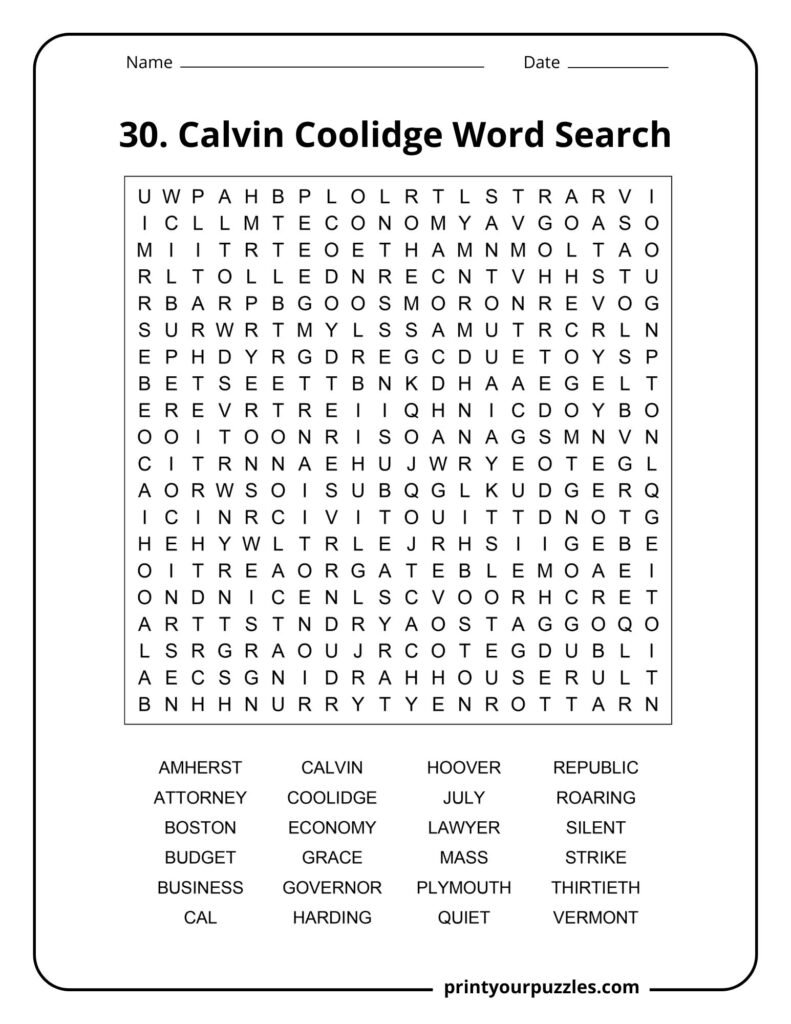
AMHERST, ATTORNEY, BOSTON, BUDGET, BUSINESS, CAL, CALVIN, COOLIDGE, ECONOMY, GRACE, GOVERNOR, HARDING, HOOVER, JULY, LAWYER, MASS, PLYMOUTH, QUIET, REPUBLIC, ROARING, SILENT, STRIKE, THIRTIETH, VERMONT
Coolidge earned the nickname “Silent Cal” due to his famously taciturn personality and reluctance to speak unnecessarily. He believed in brevity and often responded with minimal words or silence.
Coolidge became president on August 3, 1923, when President Warren G. Harding died suddenly. His father administered the presidential oath of office by lamplight at their Vermont home.
Coolidge believed in limited government, reduced taxes, balanced budgets, and minimal business regulation. His famous quote “the chief business of the American people is business” reflected his pro-commerce philosophy.
In 1919, Boston police officers struck for better conditions. Governor Coolidge decisively ended it, declaring “there is no right to strike against the public safety,” gaining national recognition.
Calvin Coolidge was born on July 4, 1872, in Plymouth Notch, Vermont. He remains the only U.S. president born on Independence Day, making his birthday particularly symbolic.
For official administration records and historical biography, visit the Calvin Coolidge page in the White House Archives. For research materials, visit the official Calvin Coolidge Presidential Foundation.
Coolidge by Amity Shlaes. A detailed rehabilitation of ‘Silent Cal,’ arguing his restrained governance and fiscal discipline deserve more respect than history has given them.
Coolidge and his wife Grace kept a raccoon named Rebecca as a pet. She walked on a leash, attended Easter egg rolls, and was originally intended for Thanksgiving dinner.
When Harding died, Coolidge was vacationing in Vermont. His father, a notary public, swore him in as president at 2:47 AM by kerosene lamp in their family homestead.
Coolidge typically slept 10-11 hours daily, including afternoon naps. He believed adequate rest was essential for clear thinking and effective decision-making as president and maintained this routine religiously.
In 1924, sixteen-year-old Calvin Jr. died from blood poisoning after developing a blister while playing tennis. Coolidge later wrote that “the power and glory of the Presidency went with him.”
Despite being eligible and popular, Coolidge announced “I do not choose to run” in 1928. He felt ten years in office was enough and wanted to return to private life.