The Boston Police Strike of 1919 was one of the most important labor disputes in early twentieth-century America. It took place in Boston, Massachusetts, at a time when workers across the United States were demanding better wages, shorter hours, and improved working conditions. The strike became especially controversial because it involved police officers, raising an important question: should public safety employees have the same right to strike as other workers?
Boston police officers had several complaints about their jobs. Many worked long hours for relatively low pay, and some were required to sleep at police stations in poor conditions. Their wages had also failed to keep pace with the rising cost of living during and after World War I. Hoping to improve their situation, officers attempted to organize a union connected with the American Federation of Labor. Police Commissioner Edwin U. Curtis strongly opposed the effort, arguing that police officers had a special responsibility to the public and should not belong to an outside labor organization.
The conflict reached a crisis on September 9, 1919, when more than 1,000 Boston police officers went on strike. With much of the regular police force absent, Boston experienced disorder, including looting, vandalism, and street violence. State authorities responded by sending members of the Massachusetts State Guard into the city to restore order and protect property.
Massachusetts Governor Calvin Coolidge became nationally known for his response to the strike. He supported Police Commissioner Curtis and refused to reinstate the striking officers. Coolidge famously argued that public employees responsible for maintaining safety could not abandon their duties. His handling of the crisis strengthened his political reputation and helped him gain national attention before he later became vice president and eventually president of the United States.
The Boston Police Strike also reflected the wider labor tensions of 1919, a year marked by major strikes involving steelworkers, coal miners, and other workers. Studying terms, people, and events through a Boston police strike word search can help students recognize the main issues surrounding the dispute. The strike remains an important example of the continuing debate over workers’ rights, public responsibility, unions, government authority, and the special role of police officers in American society.
Related Word Searches:
Progressive Era | Roaring Twenties | Pullman Strike | Great Depression | Woodrow Wilson | Calvin Coolidge
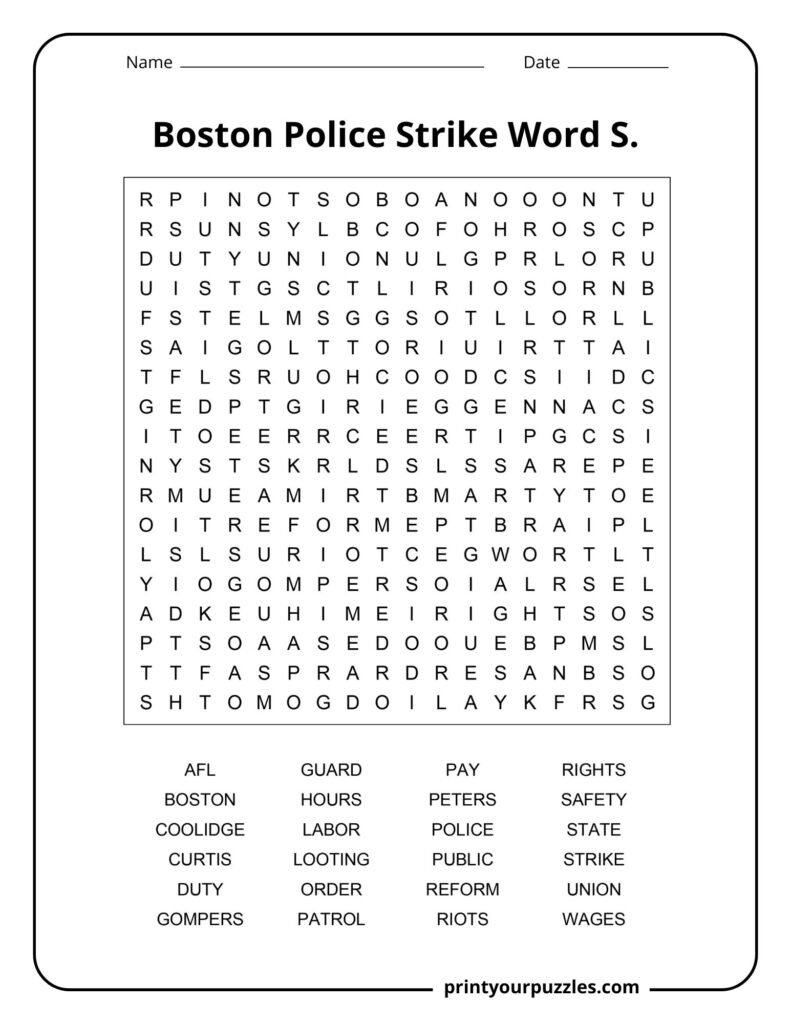
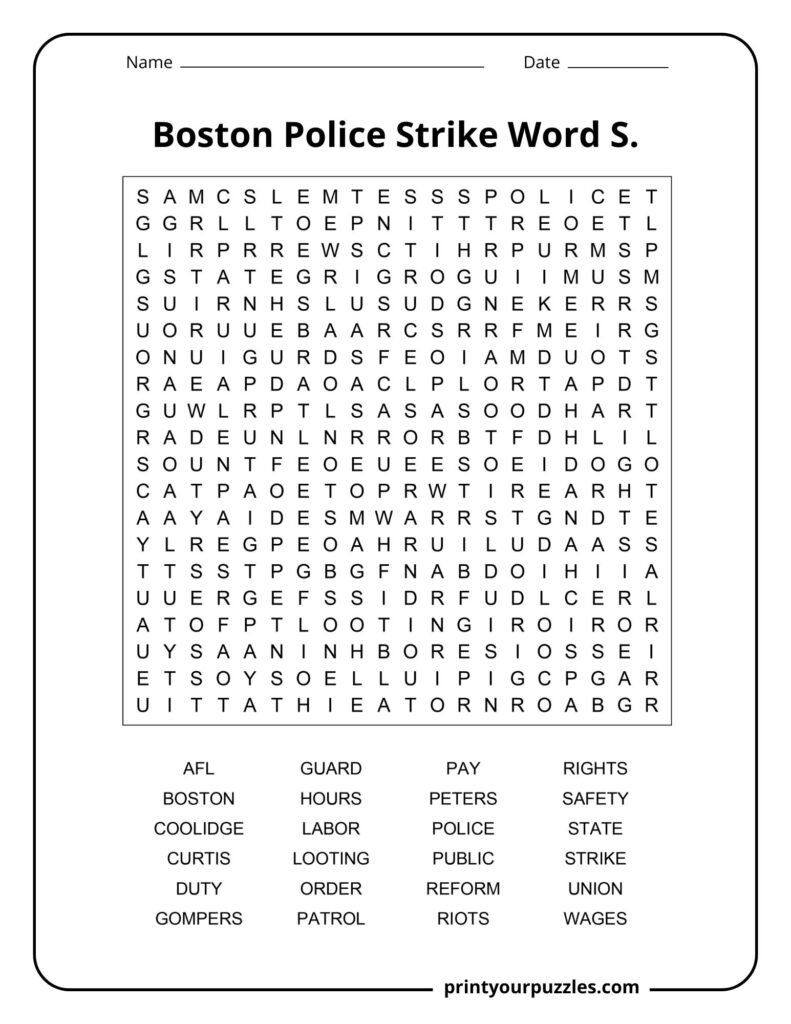
AFL, BOSTON, COOLIDGE, CURTIS, DUTY, GOMPERS, GUARD, HOURS, LABOR, LOOTING, ORDER, PATROL, PAY, PETERS, POLICE, PUBLIC, REFORM, RIOTS, RIGHTS, SAFETY, STATE, STRIKE, UNION, WAGES
AFL – American Federation of Labor, a major national labor organization that supported workers’ unions and accepted the Boston police union’s affiliation shortly before the 1919 strike.
BOSTON – Massachusetts city where more than one thousand police officers went on strike in September 1919, creating a major national debate about unions and public safety.
COOLIDGE – Massachusetts governor who supported Police Commissioner Edwin Curtis during the strike, called in the State Guard, and opposed restoring the striking police officers to duty.
CURTIS – Edwin U. Curtis, Boston’s police commissioner, opposed police unionization and suspended union leaders, helping trigger the dispute that eventually resulted in the September 1919 strike.
DUTY – Responsibility police officers had to protect Boston residents, maintain public order, and enforce laws, making their decision to strike especially controversial among government officials.
GOMPERS – Samuel Gompers, president of the American Federation of Labor, advised the striking Boston police officers and attempted to resolve the conflict by urging arbitration and reinstatement.
GUARD – Massachusetts State Guard troops were deployed to Boston during the strike to restore public order, patrol streets, and replace some functions of the absent police officers.
HOURS – Working hours were an important complaint among Boston police officers, who often faced demanding schedules and difficult working conditions while receiving comparatively low wages.
LABOR – Organized workers and their efforts to improve wages, hours, and working conditions formed the broader background of the Boston Police Strike and other major 1919 disputes.
LOOTING – Theft from stores and businesses occurred during the disruption following the police walkout, strengthening arguments that the strike had placed public safety and property at risk.
ORDER – Maintaining peace and preventing crime became especially difficult after striking officers left their posts, leading authorities to deploy replacement forces throughout Boston’s streets.
PATROL – A basic police responsibility involving officers moving through assigned areas to prevent crime, enforce laws, and protect residents, duties disrupted during the 1919 walkout.
PAY – Boston police officers complained that their salaries had not kept pace with the rising cost of living, making improved compensation an important part of their grievances.
PETERS – Andrew Peters was Boston’s mayor during the 1919 police strike and became involved in responding to the disorder and public safety problems caused by the walkout.
POLICE – Boston officers whose dissatisfaction with wages, hours, working conditions, and restrictions on union membership led more than one thousand of them to strike in September 1919.
PUBLIC – Boston residents depended upon police protection, making the strike different from many private-sector labor disputes because the walkout directly affected community security and public order.
REFORM – Changes sought by Boston police officers included improvements to wages, working hours, conditions, and workplace representation during a period of growing American labor activism.
RIOTS – Violent disturbances and street disorder occurred during the strike, increasing public concern and encouraging officials to bring additional forces into Boston to restore peace.
RIGHTS – The strike raised lasting questions about whether police officers and other public employees should possess the same union and strike rights as workers in private industries.
SAFETY – Protection of Boston residents and property became a central concern when many police officers stopped working, contributing to strong government opposition to the strike.
STATE – Massachusetts state authorities played an important role in the crisis, particularly when Governor Coolidge used the State Guard to help restore stability throughout Boston.
STRIKE – Work stoppage beginning September 9, 1919, when more than one thousand Boston police officers left their posts after disputes over unionization, wages, and working conditions.
UNION – Organization formed to represent workers and defend their interests; Boston police officers sought affiliation with the American Federation of Labor despite strong opposition from Commissioner Curtis.
WAGES – Police salaries were a major source of dissatisfaction because inflation and the rising cost of living had reduced officers’ purchasing power following World War I.
AFL, BOSTON, COOLIDGE, CURTIS, DUTY, GOMPERS, GUARD, HOURS, LABOR, LOOTING, ORDER, PATROL, PAY, PETERS, POLICE, PUBLIC, REFORM, RIOTS, RIGHTS, SAFETY, STATE, STRIKE, UNION, WAGES