Introduction to the Vietnam War Word Search
The Vietnam War was a long conflict in Southeast Asia involving North Vietnam, South Vietnam, the United States, and other allies. It grew out of the Cold War and became one of the most difficult and divisive wars in modern American history. U.S. involvement increased during the 1950s and 1960s, ended with the withdrawal of American troops in 1973, and was followed by the fall of Saigon in 1975.
After French colonial rule ended in Indochina, Vietnam was divided into North Vietnam and South Vietnam. North Vietnam was led by communist forces, while South Vietnam was supported by the United States and other anti-communist allies. The division was supposed to be temporary, but political conflict and military struggle soon turned Vietnam into a major Cold War battlefield.
American leaders viewed the war through the policy of containment, which aimed to stop the spread of communism. They also believed in the domino theory, the idea that if one country became communist, nearby countries might follow. For this reason, the United States gave money, advice, equipment, and eventually large numbers of troops to support South Vietnam.
The war escalated during the presidency of Lyndon B. Johnson, especially after the Gulf of Tonkin incident in 1964. Earlier presidents, including Dwight D. Eisenhower and John F. Kennedy, had also increased support for South Vietnam. Later, President Richard Nixon pursued a policy called Vietnamization, which aimed to reduce U.S. troop involvement while strengthening South Vietnamese forces.
Fighting in Vietnam was extremely difficult. Soldiers faced jungles, heat, monsoon rains, guerrilla warfare, land mines, ambushes, and an enemy that often blended into local communities. The war also caused enormous suffering for Vietnamese civilians, including bombing, displacement, destroyed villages, and loss of life. More than 58,000 U.S. service members died, and millions of Vietnamese soldiers and civilians were killed during the conflict.
In the United States, the Vietnam War created deep debate and protest. Many Americans questioned the draft, the growing number of casualties, the cost of the war, and whether government leaders were telling the truth. The conflict affected politics, families, veterans, students, and public trust in government.
The Paris Peace Accords were signed in 1973, and U.S. troops withdrew. In 1975, North Vietnam captured Saigon, ending the war and reunifying Vietnam under communist control. Students can use this Vietnam War Word Search to review vocabulary connected to Vietnam, Cold War, communism, containment, soldiers, draft, protest, Saigon, jungle, and peace. These words help connect the causes, fighting, debates, and consequences of this complex conflict.
Related Word Searches:
Cold War | Lyndon B. Johnson | Richard Nixon | John F. Kennedy | Truman Doctrine | Watergate
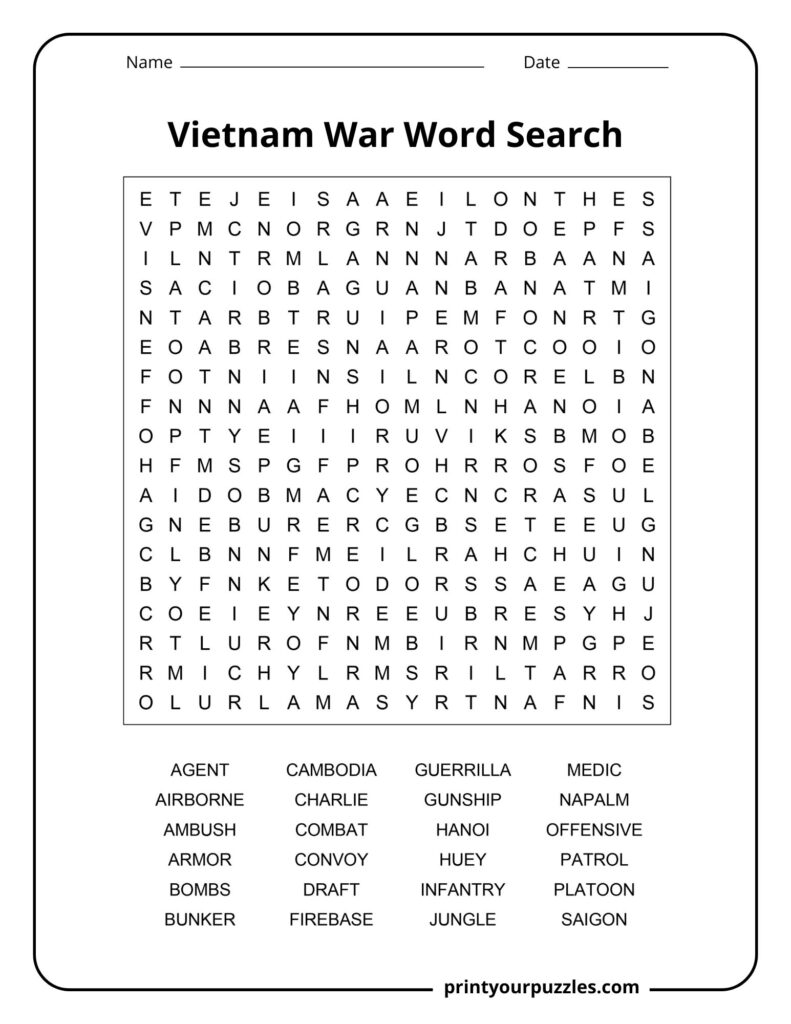
Medium Difficulty Word Search
Words to Find
AGENT, AIRBORNE, AMBUSH, ARMOR, BOMBS, BUNKER, CAMBODIA, CHARLIE, COMBAT, CONVOY, DRAFT, FIREBASE, GUERRILLA, GUNSHIP, HANOI, HUEY, INFANTRY, JUNGLE, MEDIC, NAPALM, OFFENSIVE, PATROL, PLATOON, SAIGON
All Words Defined
AGENT – Chemical defoliants like Agent Orange used to destroy jungle cover and crops, causing long-term health problems for exposed soldiers and Vietnamese civilians.
AIRBORNE – Elite paratroopers who jumped from aircraft into combat zones, including the 101st and 82nd Airborne Divisions that conducted rapid deployment operations throughout Vietnam.
AMBUSH – Surprise attacks by Viet Cong forces hiding in jungle terrain, targeting American patrols and convoys using knowledge of local geography and guerrilla tactics.
ARMOR – Tanks and armored personnel carriers used for ground operations, providing mobile firepower and protection despite challenges navigating Vietnam’s difficult jungle and rice paddy terrain.
BOMBS – Massive aerial bombardment campaigns dropped millions of tons of explosives on North Vietnam, Cambodia, and Laos in operations like Rolling Thunder and Linebacker.
BUNKER – Underground fortified shelters built by both sides for protection from artillery and air strikes, connected by extensive tunnel networks especially by Viet Cong.
CAMBODIA – Neutral neighboring country secretly bombed by US forces to destroy North Vietnamese supply routes and sanctuaries along the Ho Chi Minh Trail network.
CHARLIE – American military slang nickname for Viet Cong guerrilla fighters, derived from the military phonetic alphabet designation “Victor Charlie” meaning VC or Viet Cong.
COMBAT – Close-quarters fighting in dense jungle environments involving small unit actions, search and destroy missions, and intense firefights with guerrilla forces throughout South Vietnam.
CONVOY – Military vehicle columns transporting troops, supplies, and equipment along roads, frequently targeted by Viet Cong ambushes using mines, rockets, and small arms fire.
DRAFT – Mandatory military conscription system requiring young American men to serve in armed forces, causing widespread protests and social division throughout the United States.
FIREBASE – Temporary fortified artillery positions established in remote areas to provide fire support for ground operations and serve as defended outposts in hostile territory.
GUERRILLA – Unconventional warfare tactics used by Viet Cong, including hit-and-run attacks, sabotage, booby traps, and blending with civilian populations to avoid conventional battles.
GUNSHIP – Armed helicopters like Cobra attack helicopters providing close air support with rockets and machine guns, escorting troop transports and attacking enemy positions.
HANOI – Capital city of North Vietnam and headquarters of communist government led by Ho Chi Minh, primary target of American bombing campaigns throughout the war.
HUEY – Iconic UH-1 helicopter used extensively for troop transport, medical evacuation, and supply missions, becoming the symbolic aircraft of the Vietnam War era.
INFANTRY – Ground combat soldiers conducting patrols, search and destroy missions, and fighting in difficult jungle conditions against elusive Viet Cong and North Vietnamese forces.
JUNGLE – Dense tropical forest terrain of Vietnam providing cover for enemy forces, presenting extreme challenges including heat, disease, limited visibility, and difficult navigation.
MEDIC – Combat medical personnel providing emergency first aid and life-saving treatment to wounded soldiers under fire, often risking their lives to evacuate casualties.
NAPALM – Jellied gasoline incendiary weapon dropped from aircraft, creating devastating firestorms that burned jungle cover and destroyed enemy positions with extreme heat.
OFFENSIVE – Major military campaigns like the Tet Offensive in 1968, when North Vietnamese forces launched coordinated surprise attacks throughout South Vietnam during holiday ceasefire.
PATROL – Small unit reconnaissance missions through hostile territory searching for enemy forces, gathering intelligence, and securing villages while vulnerable to ambushes and booby traps.
PLATOON – Basic infantry unit of approximately forty soldiers led by a lieutenant, conducting ground operations and bearing the brunt of close combat throughout the conflict.
SAIGON – Capital of South Vietnam and headquarters of American military operations, falling to North Vietnamese forces in 1975, ending the war with dramatic evacuations.
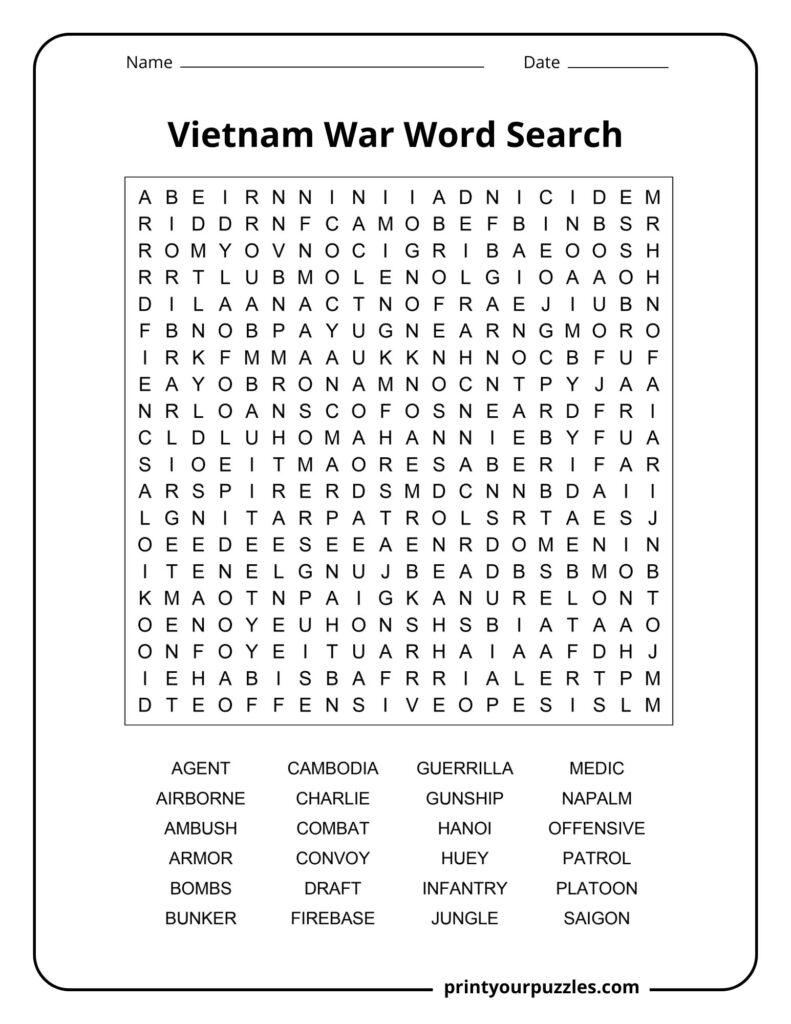
Hard Difficulty Word Search
Words to Find
AGENT, AIRBORNE, AMBUSH, ARMOR, BOMBS, BUNKER, CAMBODIA, CHARLIE, COMBAT, CONVOY, DRAFT, FIREBASE, GUERRILLA, GUNSHIP, HANOI, HUEY, INFANTRY, JUNGLE, MEDIC, NAPALM, OFFENSIVE, PATROL, PLATOON, SAIGON
5 Key FAQs About the Vietnam War
5 Curious "Did You Know?" Facts About the Vietnam War