Introduction to the Watergate Scandal Word Search
The Watergate Scandal was a major political scandal in the United States during the presidency of Richard Nixon. It began with a break-in in 1972 and grew into a much larger crisis involving a cover-up, government investigations, secret recordings, and questions about the limits of presidential power. The scandal became a turning point in how many Americans viewed trust, honesty, and accountability in government.
The first major event happened on June 17, 1972, when several men were arrested inside the Democratic National Committee headquarters at the Watergate complex in Washington, D.C. The men had broken into the offices during Nixon’s reelection campaign. At first, the incident seemed like a strange burglary, but investigators soon found connections to people linked to the president’s campaign.
The break-in was serious, but the cover-up became the center of the scandal. Members of Nixon’s administration tried to hide information, block investigations, and protect people involved. As more facts became public, questions grew about how much the president and his closest advisers knew and whether they had tried to obstruct justice.
Investigative journalism played an important role in the story. Reporters Bob Woodward and Carl Bernstein of The Washington Post followed leads, interviewed sources, and helped keep public attention on Watergate. Their reporting showed how a free press could help uncover government wrongdoing.
Congress, the courts, and special prosecutors also investigated the scandal. Senate hearings brought dramatic testimony to the public, and legal battles reached the Supreme Court. A key discovery was that Nixon had secretly recorded conversations in the White House. These tapes became important evidence in understanding the cover-up.
In 1974, the Supreme Court ruled in United States v. Nixon that the president had to turn over the tapes. As impeachment became almost certain, Nixon resigned on August 9, 1974, becoming the first U.S. president to leave office in that way. Watergate damaged public trust in government and became a lasting symbol of political corruption, abuse of power, and the importance of checks and balances.
This Watergate Scandal word search gives students a helpful way to review key terms such as Nixon, break-in, cover-up, tapes, Congress, impeachment, resignation, journalism, investigation, and accountability. Through these words, learners can better understand how a burglary became a national political crisis and why Watergate remains such an important lesson about power, honesty, and government responsibility.
Related Word Searches:
Richard Nixon | Vietnam War | Cold War | Gerald Ford | Iran-Contra Affair | Lyndon B. Johnson
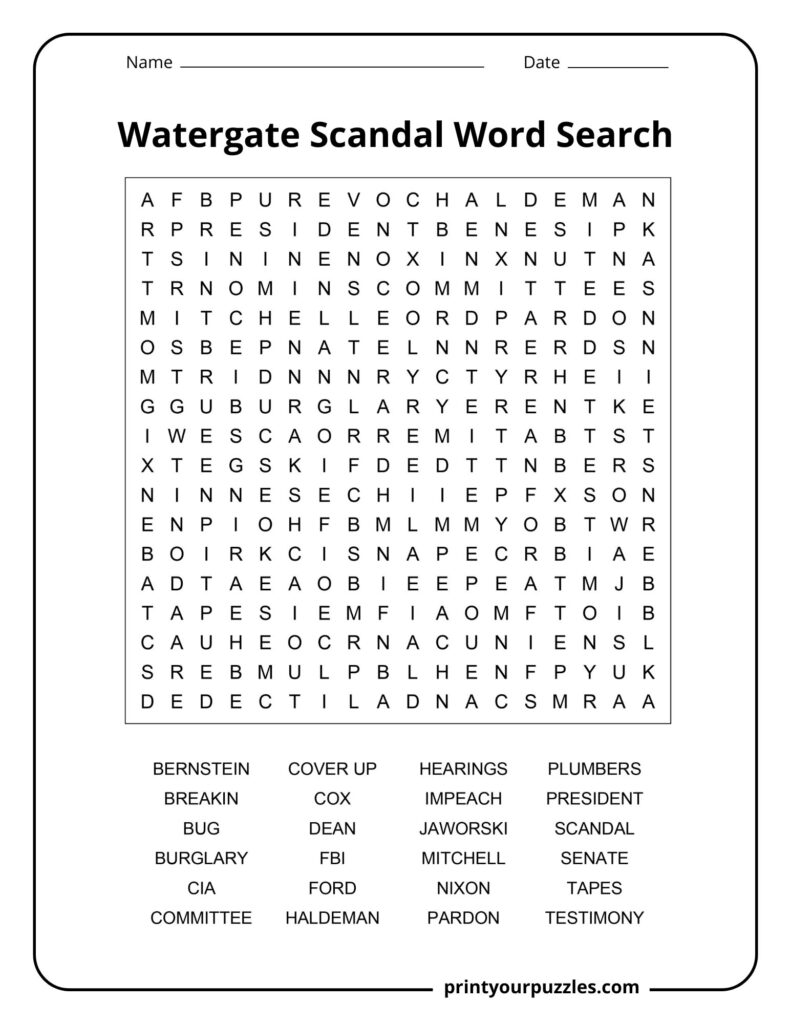
Medium Difficulty Word Search
Words to Find
BERNSTEIN, BREAKIN, BUG, BURGLARY, CIA, COMMITTEE, COVER-UP, COX, DEAN, FBI, FORD, HALDEMAN, HEARINGS, IMPEACH, JAWORSKI, MITCHELL, NIXON, PARDON, PLUMBERS, PRESIDENT, SCANDAL, SENATE, TAPES, TESTIMONY
All Words Defined
BERNSTEIN – Carl Bernstein, Washington Post investigative reporter who, alongside Bob Woodward, broke the Watergate story and uncovered the Nixon administration’s involvement in the scandal.
BREAKIN – The illegal entry into Democratic National Committee headquarters at the Watergate complex on June 17, 1972, which initiated the scandal that toppled Nixon’s presidency.
BUG – Electronic listening devices and wiretaps illegally installed by Nixon operatives to surveil political opponents and gather intelligence during the 1972 presidential campaign.
BURGLARY – The criminal act of breaking into the Watergate offices to photograph documents and install surveillance equipment, leading to the arrest of five men.
CIA – Central Intelligence Agency, whose former operatives participated in the break-in and whose potential involvement raised concerns about intelligence agency abuses of power.
COMMITTEE – The Senate Select Committee on Presidential Campaign Activities, chaired by Sam Ervin, which investigated Watergate through televised hearings in 1973, revealing widespread corruption.
COVER-UP – The systematic attempt by Nixon and his aides to obstruct justice by concealing White House involvement, paying hush money, and destroying evidence.
COX – Archibald Cox, the first special prosecutor appointed to investigate Watergate, fired by Nixon during the Saturday Night Massacre in October 1973.
DEAN – John Dean, White House counsel who testified against Nixon, revealing the cover-up and famously stating there was “a cancer on the presidency.”
FBI – Federal Bureau of Investigation, which conducted the initial criminal investigation into the break-in and faced pressure from the White House to limit inquiries.
FORD – Gerald Ford, Nixon’s vice president who became president after Nixon’s resignation and controversially granted Nixon a full pardon in September 1974.
HALDEMAN – H.R. “Bob” Haldeman, Nixon’s powerful chief of staff who orchestrated cover-up efforts and was convicted of conspiracy, obstruction, and perjury charges.
HEARINGS – The televised Senate Watergate hearings in 1973 that captivated the nation and exposed the extent of White House corruption and abuse of power.
IMPEACH – The constitutional process begun by the House Judiciary Committee to remove Nixon from office for obstruction, abuse of power, and contempt of Congress.
JAWORSKI – Leon Jaworski, the second special prosecutor who succeeded Cox and successfully fought to obtain Nixon’s secret White House tape recordings through Supreme Court.
MITCHELL – John Mitchell, Nixon’s former attorney general and campaign director, convicted for his role in the break-in conspiracy and cover-up, served prison time.
NIXON – Richard Nixon, 37th U.S. president who resigned on August 9, 1974, becoming the only American president to resign from office amid impeachment.
PARDON – President Ford’s controversial decision to grant Nixon a full pardon for any crimes committed while in office, preventing criminal prosecution but sparking public outrage.
PLUMBERS – The White House Special Investigations Unit, nicknamed “Plumbers,” created to stop information leaks and conduct covert operations against Nixon’s perceived enemies.
PRESIDENT – The office held by Richard Nixon, whose abuse of presidential power and obstruction of justice led to constitutional crisis and redefined executive accountability.
SCANDAL – The political crisis involving illegal activities, abuse of power, and cover-up that destroyed Nixon’s presidency and shook American faith in government institutions.
SENATE – The U.S. Senate’s role in investigating Watergate through the Ervin Committee hearings, which brought crucial evidence and testimony to public attention nationwide.
TAPES – Secret White House audio recordings that proved Nixon’s involvement in the cover-up, including the “smoking gun” tape that forced his resignation.
TESTIMONY – Sworn statements given by witnesses during Senate hearings and trials, including Dean’s revelations and Alexander Butterfield’s disclosure of the taping system.
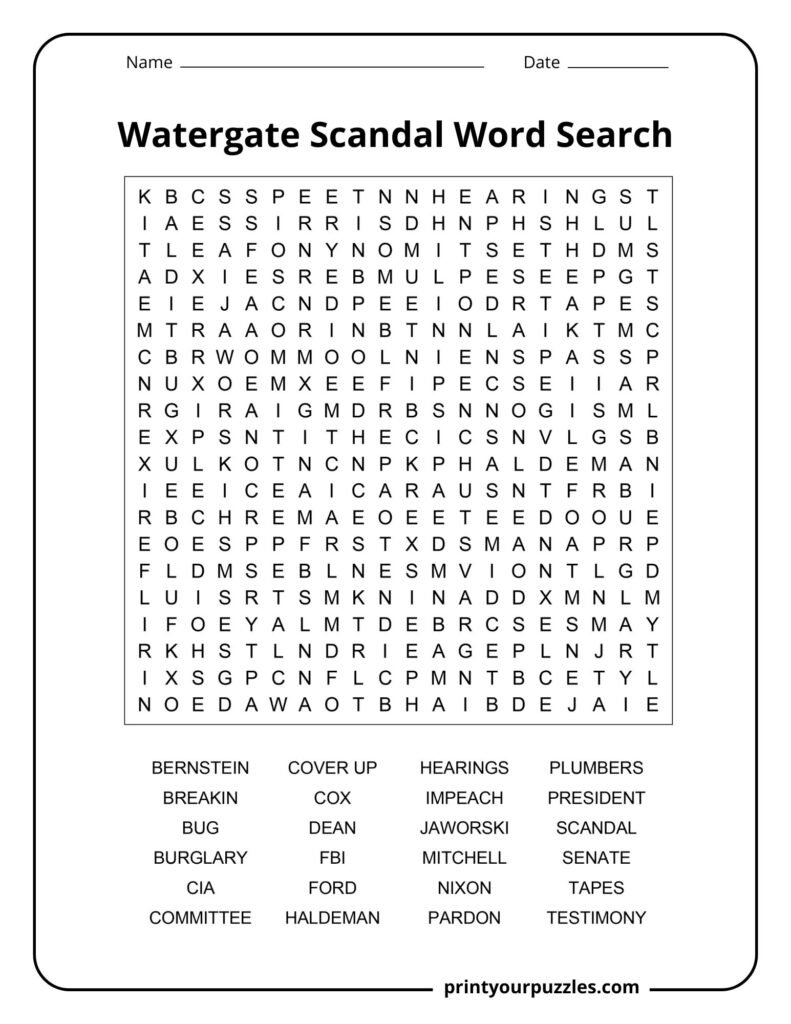
Hard Difficulty Word Search
Words to Find
BERNSTEIN, BREAKIN, BUG, BURGLARY, CIA, COMMITTEE, COVER-UP, COX, DEAN, FBI, FORD, HALDEMAN, HEARINGS, IMPEACH, JAWORSKI, MITCHELL, NIXON, PARDON, PLUMBERS, PRESIDENT, SCANDAL, SENATE, TAPES, TESTIMONY
5 Key FAQs About the Watergate Scandal
5 Curious "Did You Know?" Facts About the Watergate Scandal