The Iran-Contra affair was a major political scandal that affected the administration of President Ronald Reagan during the 1980s. It involved secret arms sales, hidden financial transactions, and attempts by government officials to avoid restrictions established by the United States Congress. The affair became public in 1986 and raised serious questions about presidential authority, government accountability, and the limits of foreign policy.
The scandal connected two separate international issues. The first involved Iran, which was fighting Iraq in the Iran-Iraq War. Although the United States had officially restricted arms sales to Iran, American officials secretly arranged for weapons to be sold to the Iranian government. Some officials hoped the sales would improve relations with Iranian leaders and help secure the release of American hostages held by groups linked to Iran in Lebanon.
The second issue concerned the Contras, rebel groups fighting the left-wing Sandinista government in Nicaragua. President Reagan strongly supported the Contras because he viewed the Sandinistas as a communist threat in Central America. However, Congress passed restrictions known as the Boland Amendments, which limited or prohibited American government assistance to the rebels.
Officials within the National Security Council secretly redirected part of the money received from the Iranian arms sales to support the Contras. This transfer of funds created the central connection behind the name “Iran-Contra.” Lieutenant Colonel Oliver North became one of the most recognizable figures in the scandal because of his involvement in organizing the operation and his televised testimony before Congress.
Investigations revealed that documents had been destroyed and that important information had been hidden from Congress. Several officials were charged with crimes, although some convictions were later overturned or pardoned. President Reagan stated that he had not known the full details of the diversion of money, but the scandal damaged public trust in his administration.
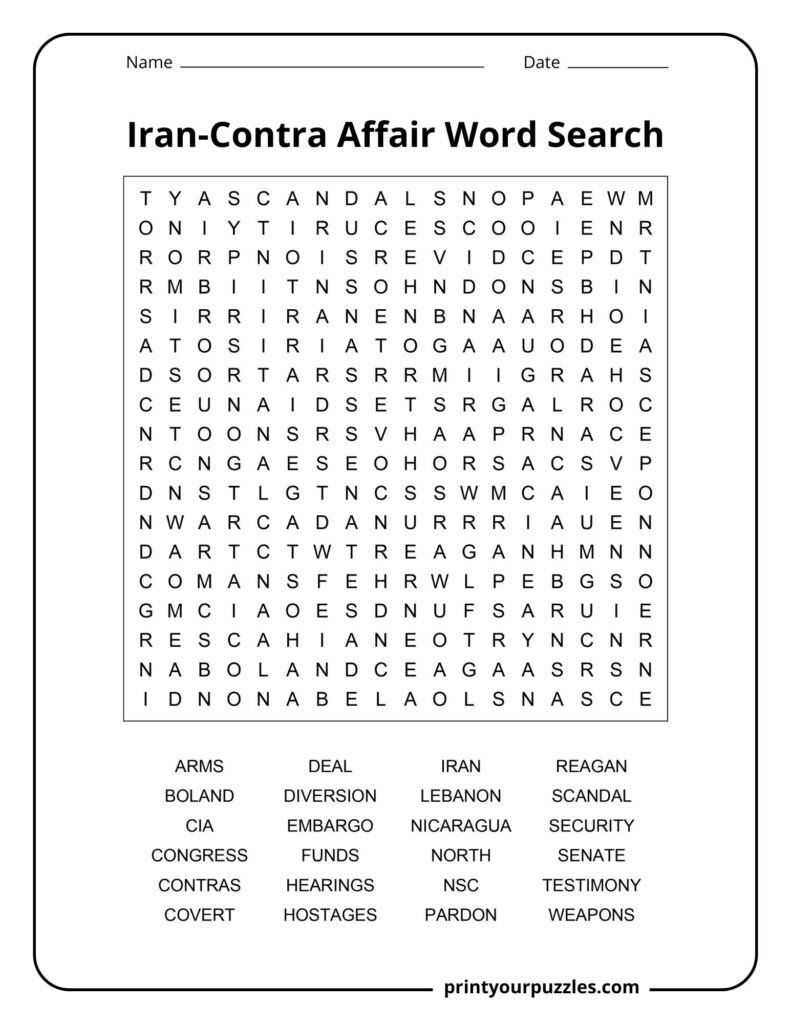
An Iran-Contra affair word search can introduce important terms such as Reagan, Contras, Iran, hostages, weapons, Congress, Nicaragua, and Oliver North. Understanding this vocabulary helps readers follow how the secret operation developed and why it became so controversial.
The Iran-Contra affair remains an important example of the conflict that can arise between executive power and congressional oversight. It also demonstrates how secret foreign-policy decisions can produce lasting political and legal consequences.
Related Word Searches:
Ronald Reagan | Cold War | Watergate Scandal | Jimmy Carter | Vietnam War | Richard Nixon
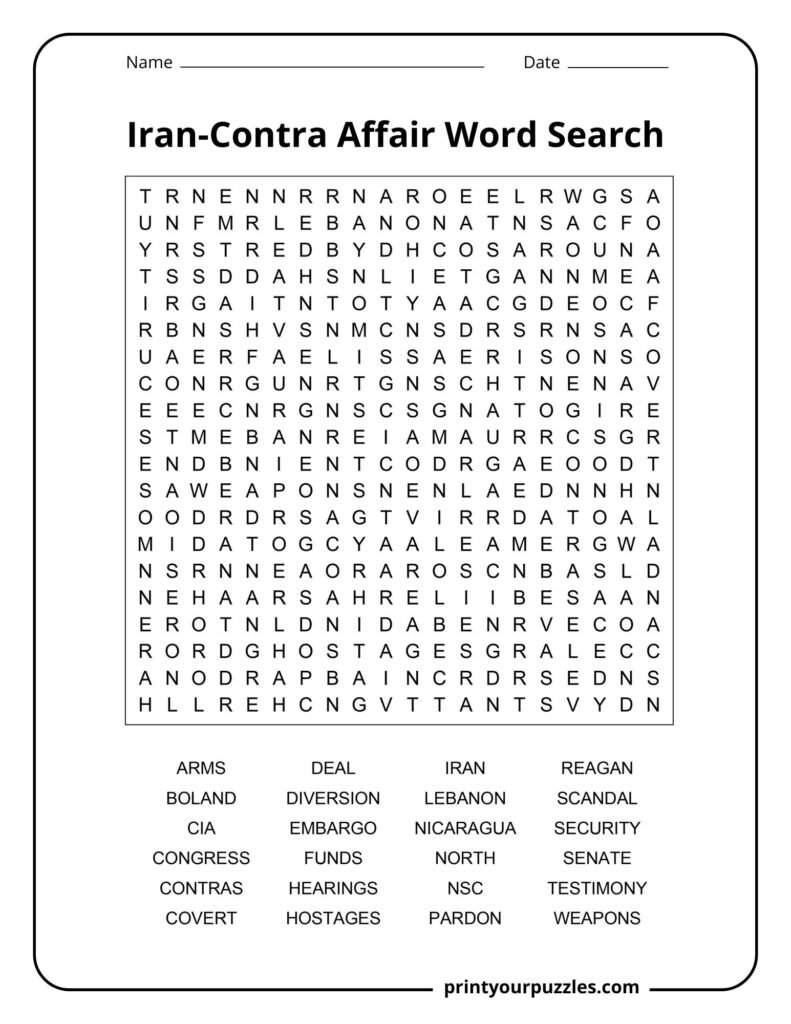
ARMS, BOLAND, CIA, CONGRESS, CONTRAS, COVERT, DEAL, DIVERSION, EMBARGO, FUNDS, HEARINGS, HOSTAGES, IRAN, LEBANON, NICARAGUA, NORTH, NSC, PARDON, REAGAN, SCANDAL, SECURITY, SENATE, TESTIMONY, WEAPONS
ARMS – Weapons secretly sold to Iran through intermediaries despite official restrictions. Proceeds from these transactions became connected to efforts supporting Contra rebels in Nicaragua financially.
BOLAND – Name associated with congressional amendments restricting United States government assistance to the Contras and limiting how the Reagan administration could support Nicaragua’s rebel movement.
CIA – United States intelligence agency involved in earlier assistance to the Contras and broader covert operations, although later activities were increasingly managed through National Security Council officials.
CONGRESS – Legislative branch that restricted Contra funding, investigated the secret operations, held televised hearings, and examined whether executive officials had violated laws or withheld important information.
CONTRAS – Nicaraguan rebel groups supported by the Reagan administration in their armed struggle against the Sandinista government, which American leaders viewed as a communist regional threat.
COVERT – Describes activities intentionally kept secret from the public or Congress, including weapons transfers, financial arrangements, and unauthorized efforts to continue supporting Nicaragua’s Contra forces abroad.
DEAL – Secret arrangement involving weapons sales to Iran, partly intended to improve relations and encourage the release of American hostages held by Iran-linked groups in Lebanon.
DIVERSION – Secret redirection of money from Iranian arms sales toward supporting the Contras, creating the central connection between the two operations involved in the political scandal.
EMBARGO – Official restriction prohibiting trade with a country; the United States maintained limits on arms sales to Iran, making the secret weapons transactions highly controversial.
FUNDS – Money generated through arms transactions and transferred through hidden channels, with part of the proceeds used to provide unauthorized support for the Contra movement overseas.
HEARINGS – Public congressional sessions held in 1987 where officials, including Oliver North, testified about secret operations, destroyed documents, concealed information, and responsibilities within the Reagan administration.
HOSTAGES – Americans held captive in Lebanon by militant groups connected to Iran, whose possible release helped motivate officials to pursue secret weapons negotiations with Iranian representatives.
IRAN – Middle Eastern country secretly supplied with American weapons during the Iran-Iraq War, despite restrictions and official policies discouraging arms transactions with its revolutionary government at the time.
LEBANON – Country where American hostages were held by militant groups linked to Iran, making their captivity an important factor behind the administration’s secret diplomatic and arms efforts.
NICARAGUA – Central American country where the Contra rebels fought the Sandinista government, becoming a major Cold War concern for President Reagan and his foreign-policy advisers.
NORTH – Lieutenant Colonel Oliver North, National Security Council staff member who helped organize the secret operations, managed communications, and became a prominent witness during televised congressional hearings.
NSC – National Security Council, a White House body whose staff members helped direct secret Iran and Contra activities outside the usual congressional oversight and approval processes.
PARDON – Presidential act forgiving criminal offenses; President George H. W. Bush pardoned several Iran-Contra defendants in 1992, ending or preventing further legal proceedings against those officials.
REAGAN – President Ronald Reagan strongly supported the Contras and approved efforts involving Iran, although he denied knowing that arms-sale proceeds had been secretly redirected to Nicaragua.
SCANDAL – Public controversy involving secret arms sales, unauthorized Contra funding, misleading statements, and questions about whether executive officials ignored congressional restrictions and proper standards of government accountability.
SECURITY – Central concern used to justify covert foreign-policy actions, especially efforts to counter communism, influence Iran, free hostages, and protect American interests during the Cold War.
SENATE – One chamber of Congress that participated in investigations and hearings, examining the roles of administration officials and whether laws governing foreign policy and funding were bypassed.
TESTIMONY – Statements given under oath during investigations, especially Oliver North’s widely watched appearance, which revealed operational details while also raising disputes over responsibility and presidential knowledge.
WEAPONS – Military equipment, including missiles and spare parts, secretly transferred to Iran through intermediaries despite an arms embargo and official American opposition to such controversial sales.
ARMS, BOLAND, CIA, CONGRESS, CONTRAS, COVERT, DEAL, DIVERSION, EMBARGO, FUNDS, HEARINGS, HOSTAGES, IRAN, LEBANON, NICARAGUA, NORTH, NSC, PARDON, REAGAN, SCANDAL, SECURITY, SENATE, TESTIMONY, WEAPONS